
artificial intelligence (AI) | Competivation - Part 2
KI als Werkzeug für das strategische Management

KI als Werkzeug für das strategische Management

Die Künstliche Intelligenz (KI) entwickelt sich gegenwärtig zu einem mächtigen Werkzeug für das strategisches Management, das Lernprozesse beschleunigt, verstärkt und verändert. Dies gilt sowohl für die Unternehmensebene als auch für die Ebene der Funktionsbereiche und Geschäftsprozesse. Vorreiter-Unternehmen setzen eine wissensspezifische KI in den verschiedenen Phasen von Strategieprozessen ein und erzielen Wettbewerbsvorteile mit innovativen, KI-basierten Geschäftsmodellen. Dabei hat die generative KI den Charakter eines Weckrufs.


In unserer Blogpost-Reihe zur Künstlichen Intelligenz beschäftigt sich dieser Beitrag mit der Rolle von KI im strategischen Management. Darin erläutere ich die zunehmende Bedeutung von KI in Strategieprozessen.


Generative KI als Weckruf

Die Anwendung von Künstlicher Intelligenz im strategischen Management ist nicht neu. Bereits seit der Jahrtausendwende haben US-amerikanische Digital-Unternehmen wie Amazon die KI-basierte Personalisierung im Rahmen ihrer innovativen Geschäftsmodelle eingesetzt.1 Erstaunlicherweise ist der Beitrag der KI vielen Nutzern dieser Geschäftsmodelle nicht bewusst.

In unserem 2020 erschienenen Buch Das Internet der Dinge und Künstliche Intelligenz als Game Changer haben wir den Strategieprozess für neue IoT- und KI-basierte Geschäftsmodelle beschrieben2 und relevante Geschäftsmodellmuster behandelt.3 Zu dieser Zeit hielt sich das Interesse an dem Thema in Deutschland allerdings noch in Grenzen.

Der eigentliche Weckruf, der dann eine breite Öffentlichkeit wachgerüttelt hat, ist im November 2022 erfolgt, als OpenAI sein Dialogprogramm ChatGPT veröffentlichte. Diese Aktion löste einen Hype um die generative KI und große Sprachmodelle aus, dem eine gewisse Ernüchterung gefolgt ist.4

Viele Unternehmen fragen sich nun, welche Rolle die Künstliche Intelligenz in ihren Strategieprozessen spielen kann.


KI-unterstützte Strategieprozesse auf der Unternehmensebene

Eine Studie des Massachusetts Institute of Technology (MIT) kommt zu dem Ergebnis, dass Künstliche Intelligenz Lernprozesse beschleunigt und verstärkt.5 Ein solches erweitertes (augmented) Lernen setzt an den vorhandenen Lernfähigkeiten an. Ein wichtiges Anwendungsfeld sind die verschiedenen Phasen von innovativen Strategieprozessen, die Unternehmen zu einer neuen Form von Wettbewerbsvorteilen verhelfen.

Lernprozess Innovationsstrategie

Am Anfang steht ein KI-Audit zur Analyse der strategischen Ausgangssituationen des Unternehmens und seiner Anwendung von KI. Hieran schließt sich eine KI-unterstützte strategische Vorausschau (Foresight) an, die eine schnellere und leistungsfähigere Früherkennung ermöglicht. Die wissensspezifische KI ist auch ein Mittel bei der Neuausrichtung von Geschäftsmodellen. Eine weitere Phase ist die Gestaltung eines KI-orientierten Stakeholder-Ökosystems. Bei der Auswahl von Partnern gilt es, die richtige Balance zwischen Kooperation und Wettbewerb zu finden.

Eine Basis für relevante Anwendungen bilden innovative KI-Plattform-Architekturen, zu deren Realisierung Unternehmen in der Regel Partner benötigen. Die Umsetzung von Strategien erfolgt mit Hilfe eines agilen, KI-unterstützten Performance Managements. Dabei findet eine enge Abstimmung zwischen der Unternehmensebene und der Ebene verbundener Geschäftsprozesse statt.

Eine entscheidende Rolle bei agilen Strategieprozessen spielen strategische Lernschleifen, die in Form von schnellen Iterationen ablaufen. So wird die Analyse der strategischen Ausgangssituation zu einem dynamischen Prozess.


KI-Audit zur Analyse der strategischen Ausgangssituation

Eine Studie des Instituts der deutschen Wirtschaft (IW) kommt zu dem Ergebnis, KI könne bundesweit 330 Milliarden Euro zur Bruttowertschöpfung beitragen. Jedes fünfte Unternehmen setzt bereits KI ein. Die meisten Anwendungen sind aber eher punktuell, z.B. in Form von Chatbots für Kundenanfragen. Erstaunlicherweise sagen 66 Prozent der Unternehmen, KI sei für ihr Geschäftsmodell nicht relevant. 36 Prozent halten die Integration in bestehende Systeme für schwierig. Über das fehlende Know-how der Beschäftigten klagen 47 Prozent. Der NRW-Ministerpräsident Hendrik Wüst glaubt aber dennoch, KI könne der Motor für einen wirtschaftlichen Aufschwung sein.6

Um dieses Ziel zu erreichen, sollten Unternehmen ein KI-Audit durchführen und sich z.B. mit der SWOT-Analyse einen Überblick zu ihrer strategischen Ausgangssituation verschaffen.7 Interessanterweise ähneln sich die Ergebnisse einer solchen Analyse der Stärken, Schwächen, Möglichkeiten und Bedrohungen. Eine Stärke vieler Unternehmen ist, dass sie über viel spezifisches Wissen verfügen, welches das Potenzial zu einer Erweiterung durch KI hat. Dem stehen häufig Schwächen bei einer systematischen Verankerung von KI in Strategien und Prozessen gegenüber. Die Möglichkeiten von KI liegen sowohl in der Produktivitätssteigerung als auch in Innovationsvorteilen durch neue Produkte, Dienstleistungen und Geschäftsmodelle. Andererseits gibt es vielfältige Bedrohungen durch Konkurrenten, nicht-europäische Stakeholder-Ökosysteme und einen Missbrauch der in Künstlicher Intelligenz steckenden Macht.8

Lernprozess Innovationsstrategie

Auf dieser Grundlage geht es dann in einem nächsten Schritt darum, sich mit Hilfe einer KI-unterstützten strategischen Vorausschau noch besser auf zukünftige Entwicklungen vorzubereiten.


KI-unterstützte strategische Vorausschau

Die in den 1970er und 80er Jahren geprägten Begriffe strategische Früherkennung und Vorausschau (Foresight) haben eine längere Vorgeschichte, in der noch heute verbreitete Methoden wie die Szenarioanalyse entstanden sind. Der von uns entwickelte Gamechanger-Radar ermöglicht eine Vorbereitung auf tiefgreifende Veränderungen.9 Mit einer KI-unterstützten strategischen Vorausschau schreiben Vorreiter-Unternehmen nun ein neues Foresight-Kapitel. Dieses Kapitel geht von einem Wandel der Art und Weise aus, wie Menschen im Internet nach Informationen suchen.

So hat Google die neue Suchfunktion „Übersicht mit KI“ entwickelt, die zusammenfassende Texte zu Themen liefert. Ein Beispiel ist in der folgenden Abbildung dargestellt. Das Thema, das ich eingegeben habe, lautet: „Applying Complexity Theory in Management“. Die Antwort, die Google liefert, ist überraschend gut. Sie beschreibt den Paradigmenwechsel im strategischen Management, der sich in den vergangenen Jahrzehnten vollzogen hat, umfassender und besser als viele einzelne Publikationen zu diesem Thema.

Lernprozess Innovationsstrategie

Foresight-Anwender werden relativ schnell lernen, ihre Prompting-Fähigkeiten zu verbessern. Daneben entstehen gegenwärtig KI-unterstützte Foresight-Plattformen, die das frühzeitige Erkennen neuer Trends, die sich meist in Form von schwachen Signalen ankündigen, vereinfachen und beschleunigen.

Natürlich stellt diese Entwicklung auch eine Bedrohung für das traditionelle, mit Werbung verknüpfte Suchmaschinengeschäft von Google dar. Das Start-up Perplexity versucht z.B. mit seiner benutzerfreundlichen „Antwortmaschine“, Google Nutzer abzujagen. Es bleibt abzuwarten, wie sich dies auf den Gewinnbringer des Marktführers auswirken wird.10

Für komplexe Aufgabenstellungen wie die strategische Vorausschau bietet die Reasoning AI („argumentierende KI“) Vorteile. Sie wird inzwischen von einigen KI-Entwicklern angeboten. Beim Reasoning zerlegt die KI mögliche Anfragen in Teilprobleme und bearbeitet diese schrittweise. Ein solches langsameres Denken kostet mehr Computerleistung und Strom. Das „Nachdenken“ von KI nennen Entwickler Chain of Thought (CoT) im Sinne einer Argumentationskette. Reasoning-Modelle erreichen dies durch einen zusätzlichen Trainingsschritt, der mit Hilfe des Reinforcement Learning ausführliche Begründungen schult. Ähnlich wie ein erfahrener Mitarbeiter analysieren Reasoning-Modelle schrittweise komplexe Informationen. Dazu benötigen sie einen einzigen präzisen Prompt und viel Kontext. Die Anwendung von „argumentierender KI“ bei der strategischen Vorausschau befindet sich allerdings noch im Experimentierstadium.11


KI-basierte Neuausrichtung von Geschäftsmodellen

Gegenwärtig entstehen innovative Geschäftsmodelle für eine KI-basierte Robotik. Hierin liegt eine Chance für Europa. Die Stanford-Professorin und große „Patin der KI“ Fei-Fei Li hat das Start-up World Labs gegründet, das KI-Modelle für eine räumliche Intelligenz von Robotern entwickelt, die Maschinen unterstützen. Auch die Google-Tochter DeepMind und der Digital-Gigant Nvidia arbeiten an Partnernetzwerken für KI-basierte menschenähnliche Roboter. Viele der Partner kommen aus Europa. Neben bekannten Robotik-Unternehmen entstehen hier Start-ups wie Anybotics (Schweiz) sowie Agile Robots, Neura Robotics und Quantum Systems aus Deutschland, die aber nicht über so große finanzielle Mittel verfügen, wie ihre Wettbewerber aus den USA (z.B. Figure AI und Covariant). Für Europa kommt es darauf an, möglichst schnell die Chancen zu nutzen, die sich aus der Verbindung von tiefem branchenspezifischem Wissen und innovativen KI-Modellen ergeben.12

Bei einer KI-basierten Neuausrichtung von Geschäftsmodellen sind zwei Dimensionen relevant. Diese Dimensionen sind die Produktivitätsorientierung und die Innovationsorientierung. Die meisten Unternehmen beginnen mit einer KI-basierten Produktivitätssteigerung und setzen KI bei Routineprozessen ein, um Personalkosten zu senken. Daneben sind inzwischen viele Anwendungsfelder für KI-basierte Innovationen entstanden. Wenn beide Dimensionen zusammenkommen, sprechen wir von einer KI-basierten Ambidextrie. Der Begriff Ambidextrie kennzeichnet ursprünglich im Sport die Fähigkeit zum Einsatz beider Hände. Übertragen auf das Management beschreibt Ambidextrous Leadership eine Führung, die eine gute Balance zwischen Innovation und Produktivität findet.13

Lernprozess Innovationsstrategie

Aufgrund der spezifischen Anwendungen dieser beiden Dimensionen in Branchen und Unternehmen ergibt sich eine große Vielfalt an KI-basierter Ambidextrie. Dabei sind die neuen Geschäftsmodelle in KI-orientierte Stakeholder-Ökosysteme eingebettet.


KI-orientierte Stakeholder-Ökosysteme

Die deutsche und die europäische Politik planen eine Leistungssteigerung ihres KI-Ökosystems. Angesichts einer sich wandelnden geopolitischen Lage sieht der Koalitionsvertrag der neuen Bundesregierung eine Stärkung der digitalen Souveränität vor. Die Digitalpolitik der Europäischen Union (EU) zielt in die gleiche Richtung. Geplant sind fünf riesige Rechenzentren, um den Rückstand bei der Künstlichen Intelligenz aufzuholen. Kandidaten für eine solche Gigafactory in Deutschland sind die Standorte Jülich und Stuttgart. Bei der KI-Regulierung möchte die EU die Wettbewerbsfähigkeit stärker in den Mittelpunkt stellen und Bürokratie abbauen. Hierzu liegt der Entwurf eines EU-Aktionsplans vor. Ob diese Maßnahmen ausreichen, um die Abhängigkeit von den großen Cloud-Anbietern (Hyperscaler) aus den USA zu verringern, bleibt abzuwarten.14

Auch bei einer Gestaltung des KI-orientierten Stakeholder-Ökosystems eines Unternehmens15 sind zwei Dimensionen zu beachten. Die eine Dimension ist die Abhängigkeit von mächtigen, nicht-europäischen KI-Anbietern. Um diese Abhängigkeit zu verringern, gewinnt als zweite Dimension für Unternehmen eine Verbesserung der eigenen Kompetenzen zur Entwicklung und Anwendung von Künstlicher Intelligenz an Bedeutung. In der Hype-Phase von KI-Grundlagenmodellen hat die Abhängigkeit von US-amerikanischen Anbietern zugenommen. Die Chance für Europa liegt nun vor allem bei wissensspezifischen KI-Modellen für verschiedene Anwendungen. Durch eine Verbindung dieser beiden Dimensionen entstehen hybride KI-Ökosysteme. Eine solche Konnektivität erfordert spezifische Fähigkeiten.

Lernprozess Innovationsstrategie

Angesichts der geopolitischen Unsicherheiten stehen Unternehmen bei der Gestaltung ihres KI-Ökosystems vor der schweren Aufgabe, die richtigen Partnern zu finden. Dabei sind die Übergänge zwischen Kooperation und Wettbewerb fließend. Eine solche Situation beschreibt der Begriff Coopetition.16 Für eine Kombination von Cooperation und Competition fehlen bei KI-Ökosystemen bislang aber noch die theoretischen Grundlagen. Ein wichtiges Anwendungsfeld ist die Auswahl und eigene Entwicklung von innovativen KI-Plattform-Architekturen.


Innovative KI-Plattform-Architekturen

Der Chiphersteller AMD und das zu AMD gehörende finnische Start-up Silo AI arbeiten mit den Unternehmen der schwedischen Wallenberg-Gruppe zusammen. Der Nvidia-Wettbewerber AMD hat eine Partnerschaft mit 38 Unternehmen bekannt gegeben. Hierzu gehören u.a. AstraZeneca, Scania, Saab, Ericsson und IKEA. Die Zusammenarbeit koordiniert das Wallenberg-Innovationsnetzwerk Combient. Das Ziel ist eine Skalierung unternehmensspezifischer KI-Modelle. Während OpenAI seine KI-Modelle auf Nvidia-Chips trainiert, verwendet Silo AI Chips von AMD. Die Rolle von Silo AI ist, den Einsatz von KI-Modellen bei Unternehmen, die AMD-Plattformen nutzen, zu beschleunigen. Eine wichtige Rolle spielt dabei, auf welcher Infrastruktur die Arbeiten begonnen haben, da ein Umzug aufwändig ist. Silo AI setzt multimodale KI-Agenten ein, also Modelle, die neben Sprache auch Bilder und Audiodateien verarbeiten.17

Etablierte Digital-Unternehmen praktizieren seit geraumer Zeit eine Organisationsform, in deren Zentrum sich eine IT-Plattform befindet.18 Mit der zunehmenden Bedeutung von Künstlicher Intelligenz wird dieses Konzept für etablierte Unternehmen immer relevanter. Dabei verbinden innovative KI-Plattform-Architekturen sowohl die strategische und die operative Ebene als auch zentrale und dezentrale Organisationseinheiten. Dies ermöglicht, dass alle Geschäftsprozesse und Projekte Zugang zu einer gemeinsamen Datenbasis haben. Aufgrund ihrer verbindenden Rolle werden KI-Plattformen somit nicht nur zu einem Strategiebaustein, sondern auch zu einem wichtigen organisatorischen Gestaltungselement. Eine nicht einfach zu beantwortende Frage ist, wie groß der Anteil von Partnern und der eigene Anteil bei einer solchen KI-Plattform sein soll.

Lernprozess Innovationsstrategie

Innovative Plattform-Architekturen liefern auch die Infrastruktur für ein KI-unterstütztes Performance Management.


KI-unterstütztes Performance Management

Bei der Beantwortung der Frage, wie Künstliche Intelligenz das Performance Management verbessern kann, hilft ein Blick in die Geschichte der Leistungsmessung. Wichtige konzeptionelle Grundlagen liefern das von Peter Drucker entwickelte Management bei Objectives (MbO) und die von dem Organisationspsychologen Edwin Locke stammende Zielsetzungstheorie. Bereits in den 1980er Jahren entstand bei Intel die agile Objectives and Key Results (OKR-) Methode, die der Wagniskapitalgeber Kleiner Perkins z.B. bei Google einsetzte.19 In Deutschland wesentlich bekannter ist die aus einer Best-Practice-Studie von Robert Kaplan und David Norton hervorgegangene Balanced-Scorecard-Methode.20 Ein von Kleiner Perkins und dem Start-up Betterworks gestaltetes, KI-unterstütztes Performance Management zielt nun auf eine bessere Verbindung von Strategie und Motivation ab.

Lernprozess Innovationsstrategie

Für das Jahr 2025 gehört die Künstliche Intelligenz zwar zu den Topthemen des Managements, viele Unternehmen formulieren aber weder konkrete KI-Ziele noch messen sie die Ergebnisse. Eine weltweite BCG-Studie, in der 1800 Manager befragt wurden, kommt zu dem Ergebnis, dass nur 24 Prozent der Unternehmen ihre operativen und finanziellen KI-Ziele nachverfolgen. Ein KI-unterstütztes Performance Management steht vor drei Herausforderungen. Diese Herausforderungen sind:21

  1. Frühe Erprobungsversuche nicht abwürgen
  2. geeignete Schlüsselergebnisse für den Erfolg einer einzelnen Maßnahme festlegen und darüber hinaus
  3. die längerfristigen Effekte erfassen, die aus dem Zusammenwirken verschiedener Maßnahmen resultieren.

Die agile OKR-Methode liefert hierfür eine konzeptionelle Basis, bedarf aber einer Anpassung. Der OKR-Pionier Kleiner Perkins ist einer der Kapitalgeber des Anbieters von Performance-Management-Software Betterworks. Die Vision des 2013 gegründeten Unternehmens mit Sitz in Palo Alto ist, das traditionelle Performance Management weiterzuentwickeln. Eine wichtige Rolle spielt dabei KI als Co-Pilot. Zeitgewinne bei Routineaufgaben können Manager so in eine bessere Harmonisierung strategischer und operativer Projekte investieren. Wichtige Anwendungsfälle (Use Cases) sind:22

  • Eine Abstimmung von anspruchsvollen Unternehmenszielen und persönlichen Zielen
  • datenbasierte, motivierende Feedbacks sowie
  • die Unterstützung von Kommunikations- und Lernprozessen.

Der angestrebte Nutzen, der zum Gesamterfolg beiträgt, ist:

  • Eine Verringerung von Voreingenommenheit (bias), mehr Fairness und Objektivität
  • eine erhöhte Produktivität sowie
  • bessere persönliche Beziehungen.

Damit kommt das Performance Management dem schon von der Zielsetzungstheorie verfolgten Motivationsgedanken einen Schritt näher.

Mit der zunehmenden Bedeutung von Künstlicher Intelligenz im strategischen Management wird neben praktischen Fähigkeiten beim Umgang mit KI als Werkzeug die geopolitische Kompetenz bei der Zusammenarbeit mit Stakeholdern immer wichtiger. Eine Grundlage hierfür ist ein starkes Zukunftsnarrativ.


Ein starkes Zukunftsnarrativ als Grundlage

In unserem 2020 erschienenen Buch zum Gamechanger-Potenzial der Künstlichen Intelligenz haben wir uns kritisch mit der europäischen und der deutschen Digitalpolitik auseinandergesetzt.23 Die neue Bundesregierung steht nun vor der Aufgabe, ein starkes Zukunftsnarrativ zu entwickeln, das verschiedene Politikfelder verbindet.24 Ein Ansatz zu einer solchen dringend benötigten, großen Erzählung ist die Anwendung von vertrauenswürdiger KI sowohl zur Steigerung der Produktivität als auch zur Lösung der Innovations- und Umweltprobleme von Organisationen. Im Mittelpunkt steht dabei die bereits skizzierte neue Form der Ambidextrie.

Lernprozess Innovationsstrategie

Die traditionelle Ambidextrie strebt eine Balance zwischen der Erschließung von Innovationspotenzialen (Exploration) und der Ausschöpfung von Produktivität (Exploitation) an. Mit Hilfe einer KI, die vertrauenswürdig sein sollte, bietet sich nun die Möglichkeit, gleichzeitig

  • durch Produktivitätssteigerungen die Arbeitskosten zu senken, dem Fachkräftemangel zu begegnen25 und
  • qualifiziertes Personal stärker zur digitalen und ökologischen Neuausrichtung von Organisationen einzusetzen.26

Angesichts der veränderten geopolitischen Lage ergibt sich für eine AI made in Europe ein Zeitfenster, das der „alte Kontinent“ nutzen sollte, um die Weltmarktführerschaft bei notwendigen Nachhaltigkeitsinnovationen anzustreben.27 Aufgrund der Vielzahl der zu bewältigenden Krisen erfordert dies zunächst ein resilienzorientiertes strategisches Management.28


Fazit

  • Strategieprozesse werden durch die Anwendung von Künstlicher Intelligenz leistungsfähiger
  • Eine wissensspezifische KI unterstützt die strategische Vorausschau, eine Neuausrichtung von Geschäftsmodellen, die Gestaltung von Stakeholder-Ökosystemen, innovative Plattform-Architekturen und das Performance Management
  • Vorreiter-Unternehmen arbeiten an einer KI-basierten Ambidextrie
  • Angesichts der geopolitischen Herausforderungen kommt es entscheidend auf die Wahl der richtigen Partner an.


Literatur

[1] Servatius, H.G., Wettbewerbsvorteile mit wissensspezifischer KI. In: Competivation Blog, 11.02.2025

[2] Kaufmann, T., Servatius, H.G., Das Internet der Dinge und Künstliche Intelligenz als Game Changer – Wege zu einem Management 4.0 und einer digitalen Architektur, SpringerVieweg 2020, S. 56ff.

[3] Kaufmann, Servatius, a.a.O., S. 34ff.

[4] Servatius, H.G., Entwicklung der KI-Technologien. In: Competivation Blog, 19.02.2025

[5] Alavi, M., Westerman, G., How GenAI Will Transform Knowledge Work. In: Harvard Business Review, 7. November 2023

[6] Höning, A., Kowalewski, R., Jeder fünfte Betrieb in NRW nutzt KI. In: Rheinische Post, 13. November 2025, S. 1

[7] Servatius, H.G., Auditierung des Innovationssystems eines Unternehmens. In: Competivation Blog, 19.03.2015

[8] Suleyman, M., Bhaskar, M., The Coming Wave – Technology, Power and the Twenty-First Century‘s Greatest Dilemma, Crown 2023

[9] Servatius, H.G., Strategische Vorausschau mit einem Game-Changer-Radar. In: Competivation Blog, 27.01.2021

[10] Alvares de Souza Soares, P., Geldmaschine Google – Wie lange noch? In: Handelsblatt, 25./26./27. April 2025, S. 26-27

[11] Knees, L., Warum Nutzer mehr für langsame KI zahlen. In: Handelsblatt, 31. März 2025, S. 24-25

[12] Holtermann, F., Schimroszik, N., Die Roboter kommen! In: Handelsblatt, 3./4./5. Januar 2025, S. 44-48

[13] O’Reilley, C., Tushman, M., Lead and Disrupt – How to Solve the Innovator‘s Dilemma, Stanford Business Books 2016

[14] Bomke, L., et al., Europa will eigene KI-Factories bauen. In: Handelsblatt, 9. April 2025, S. 6-7

[15] Servatius, H.G., Gestaltung von innovativen Stakeholder-Ökosystemen. In: Competivation Blog, 10.01.2023

[16] Brandenburger, A.M., Nalebuff, B.J., Co-Opetition – A Revolutionary Mindset That Combines Competition and Co-Operation, Bantam 1996

[17] Holzki, L., AMD schließt Partnerschaft mit der Industrie. In: Handelsblatt, 30. Januar 2025, S. 24

[18] Servatius, H.G., Die Ressourcen-Plattform mit agilen Teams als neue Organisationsform. In: Competivation Blog, 12.01.2021

[19] Doerr, J., Measure What Matters – How Google, Bono and the Gates Foundation Rock the World with OKRs, Portfolio/Penguin 2018

[20] Kaplan, R.S., Norton, D.P., Balanced Scorecard – Translating Strategy into Action, Harvard Business School Press 1996

[21] Bomke, L., Höppner, A., Nur wenige Unternehmen messen ihre KI-Initiativen. In: Handelsblatt, 16. Januar 2025, S. 21

[22] Gouldsberry, M., The Pivotal Role of AI in Performance Management, 11. Januar 2025

[23] Kaufmann, Servatius, a.a.O, S. 203ff.

[24] Servatius, H.G., Auf dem Weg zu einem neuen wirtschaftspolitischen Narrativ. In: Competivation Blog, 16.05.2022

[25] Servatius, H.G., Prozessorientierte KI zur Produktivitätssteigerung. In: Competivation Blog, 12.03.2025

[26] Servatius, H.G., KI und die Zukunft der Management Education. In: Competivation Blog, 09.04.2025

[27] Servatius, H.G., Nachhaltigkeitsorientiertes strategisches Management. In: Competivation Blog, 15.08.2024

[28] Servatius, H.G., Resilienzorientiertes strategisches Management. In: Competivation Blog, 15.03.2024

AI and the future of management education

AI and the future of management education

The education and training of managers has gone through various phases in the past. At present, the negative consequences of too narrow a focus on theory are becoming increasingly clear and the idea of management as a dynamic profession that combines theory and practice is emerging. At the same time, artificial intelligence (AI) is changing learning and management education. Key drivers of this evolutionary change are disruptive learning ecosystems that are challenging the traditional players. The journey into this near future begins with an outline of the current patterns of success for a career in management.


In this new article in our series of blog posts on AI, I look at the present and future development of management education, in which artificial intelligence plays an important role.


Success patterns for a management career

In past decades, the proven success pattern for a turbo career in management consisted of the following steps:

  • Bachelor’s degree in engineering or information technology
  • short orientation phase in a reputable company
  • MBA at a renowned business school
  • further years of training in consulting, investment banking or private equity
  • change to a staff unit for corporate development and
  • rapid promotions on the way to management level.

However, this pattern of success is associated with two obvious disadvantages:

  1. The limited work-life balance in professional services companies, which are considered to be labor-intensive, and
  2. the cost barrier of MBA programs at well-known business schools.

For example, the cost of a one-year MBA course at one of Europe’s elite universities is between 80,000 and 100,000 euros. Added to this is the high cost of living at locations in metropolitan regions. In the USA, where most MBA programs last two years, the costs, including accommodation and health insurance, can add up to 250,000 euros.1 Applicants must therefore carefully consider whether such an investment and the associated loss of income is worthwhile.

In addition, starting in the USA and with a considerable delay, a second pattern of success has also emerged in Germany, albeit one that is associated with even greater risks. This path leads from an idea to the founding and scaling of a start-up. The players are usually creative, interdisciplinary teams that work on new business models with great commitment. A characteristic of successful founders is that they are also deeply involved in details and are familiar with important processes. There has long been no shortage of such talent in Germany, but there are deficits in the innovation policy framework. The situation has improved in recent years. But there is still a lot to be done.

One reason for the success patterns outlined above is that management science has become increasingly open to the technical sciences. Training in traditional engineering and the newer information technology qualifies students for a specialist career. However, a management career also requires skills in strategy, innovation, marketing, production, finance, organization and personnel management. An interdisciplinary management course teaches all of this. In addition, management education trains the skills that link to the technical sciences. An important field of application is the design of new business models.2

The pioneer of this development in Germany is the University of Stuttgart, where I have been teaching as an honorary professor since 1994 following my external habilitation. In Stuttgart, the technical-oriented business administration course was introduced as early as 1974, thus focusing on the connectivity of business and technology. The following diagram illustrates the segmentation of disciplines.

Lernprozess Innovationsstrategie

Less obvious than these patterns of success is a shift in focus in the content of management education and training. This development affects both business schools and traditional technology and business-oriented courses. One important point of criticism is their excessive focus on theory.


Too strong a focus on theory and its consequences

In an article published in the Harvard Business Review in 2005, the renowned US professors Warren Bennis and James O’Toole criticize a misguided development at American business schools. Triggered by funding from foundations, a stronger emphasis on scientific rigor in the form empirical treatment of relatively limited issues began there at the end of the 1950s. Publication in scientific journals became decisive for a career as a professor. Practical experience and the relevance of research fell by the wayside, playing an increasingly minor role in appointments(3.

Unfortunately, the same development has been taking place at German universities for a long time. The result is a series of negative consequences:

  • Teaching has become less important than research
  • the professors bring less practical experience to their teaching and research
  • there are hardly any up-to-date textbooks, especially in dynamic subjects such as innovation management
  • research is dealing less and less with complex topics of practical relevance that are difficult to access using empirical methods
  • the target audience for the results of this research is primarily other researchers, while practitioners rarely read articles from scientific journals
  • many graduates are not immediately employable as project managers in demanding practical projects, even after completing a doctorate.

The major beneficiaries of this development have long been management consultancies and the consultants working there, who fill the gap left by business schools and universities. These winners distinguish themselves with their ability to tackle new, complex problems in a practice-oriented manner. As a result, consulting has become an important next step in professional development and a career accelerator. For clients, this causal chain has unfortunately increased their dependence on consultants.

It is astonishing that this development has not yet been analyzed and evaluated more critically by corporate practice. We therefore want to explore the question of what an approach to improvement could look like. To do this, management would have to transform itself into a dynamic profession.


Management as a dynamic profession

The education and training of managers is characterized by the three dimensions of theory, practice and the dynamics of change. Particular challenges lie in the combination of theory and practice as well as the increasing dynamics of the corporate environment. The idea of management as a dynamic profession is based on the development of management education and training.

Lernprozess Innovationsstrategie

This development has taken place in various phases. The emergence of management as an interdisciplinary field has a long history. The success of many German hidden champions in recent decades and also the phenomenal rise of digital companies from the USA is primarily based on managers with the ability to combine technical and business expertise.

The early degree programs made an important contribution to this connectivity in the first phase. With their pronounced focus on practice, prospective managers were very well prepared for the challenges of working in organizations. This phase could be placed under the motto of the great social psychologist Kurt Lewin: „Nothing is as practical as a good theory“. This implies that an excellent professor can be expected to have extensive practical experience in addition to academic achievements.

Lernprozess Innovationsstrategie

In a second phase of management education, the academization already outlined took place in the sense of restricting research to empirical approaches for dealing with limited issues. The majority of dissertations and habilitations now follow this path, which rarely leads to far-reaching management innovations.

Today, new impetus usually comes from professors who are also active in executive education and consulting or even as company founders. The results are often published in practice-oriented journals such as the Harvard Business Review and books by international publishers. Although this type of professor is in the minority in terms of numbers, they make a significant contribution to innovations in management theory.

A reorientation of management education is emerging in a third phase. This phase takes account of the highly dynamic nature of change and creates a stronger link between theory and practice. The result is a management that sees itself as a dynamic profession. The aim is to create innovative content for research and teaching in order to meet the many new challenges.

The following are important criteria for management activities to become a profession:

  • Qualified training with a degree
  • practical experience with demanding tasks
  • ethical standards and possibly also
  • a form of regulation, e.g. of AI.

In this respect, management’s claim to be a profession is currently only partially fulfilled. However, management can learn from other application-oriented sciences such as medicine.


Learning from medical training

No sensible person would allow themselves to be treated by a doctor with little practical experience who has never worked in a hospital. In order to ensure that medical training is not just theoretical, chief physicians at renowned clinics often work as professors at universities alongside their practical work. Part of the training takes place in teaching hospitals and overall the system of universities and clinics is much more permeable than the training and further education of managers.

The more practice-oriented universities and the dual study programs offered by private business schools do offer an alternative to studying at universities. However, most providers only have a limited right to award doctorates. This means that the contribution made by doctoral students to research is largely missing.

In view of the universities‘ strong desire to maintain their position, the best that can be expected from them in management education and training is change in small steps. A first step could be to integrate theoretically qualified managers and their companies much more closely into teaching and research. A long-established approach to this is action research.4 This involves interdisciplinary teams designing innovative practical projects, publishing the results and making them accessible for teaching purposes. This has long been a common approach in management consulting. Both theoretically oriented professors and practitioners would benefit from such cooperation between universities and companies.

One exciting question now is what new impetus for management education will come from artificial intelligence (AI).


AI is changing management education

According to a study by the British „Times Higher“ magazine, thirteen of the world’s best AI universities are in the USA, three in the UK, two in China, one in Switzerland and one in Singapore. So there is still „room for improvement“ for the countries of the European Union. Chinese companies see 2025 as a key year for AI applications. This is why China is increasingly focusing on specific industry models in addition to large language models.5 This is a strategy that Germany could learn from.

In addition to industry-specific models, AI is also becoming increasingly important for training and development. Almost all companies are faced with the challenge of upskilling and reskilling their employees successfully and cost-effectively.

This also applies to management training and development. AI has a profound impact on four aspects of management. It changes:

  • Research and teaching as well as learning technologies
  • all functions and business processes of organizations
  • all economic sectors and the public sector as well as
  • management as a developing profession.

The practical skills of managers and employees who use AI as a tool are of great importance here.

Lernprozess Innovationsstrategie

Engineering and management courses are now facing the challenge of integrating the fundamentals and applications of artificial intelligence into their curriculum. The learning content is developing very dynamically and individual professors therefore often feel overwhelmed by this integration task. According to the European Union’s AI Act, companies are obliged to train employees who use AI systems in how to use them. Many companies are not yet aware of this. In July 2024, the German association Bitcom asked German managers about their attitude towards AI. According to the survey6

– 29% of respondents are cautious and 16% skeptical, but still
– 46% are keen to experiment and 9% are even enthusiastic.

Artificial intelligence is therefore both a learning content and a learning tool that is changing university teaching and practice.

In this context, it is remarkable how dynamically learning technologies have developed over the past two decades. We therefore want to take a look at the possible future of corporate learning.


Development towards AI-based corporate learning

Since the turn of the millennium, the development of learning technologies used by organizations has gone through the following four phases:

  1. E-learning with Learning Management Systems (LMS) as a platform
  2. further development of the LMS into a more competence-oriented learning in the sense of a personnel development system
  3. digital microlearning with Learning Experience Platforms (LXP) and the increasing importance of videos, as well as
  4. AI-based learning platforms that generate individualized content relatively independently.

In each of these phases, LearnTech providers have disappeared from the market and new ones have emerged. Providers that rely on AI include Absorb, Arist, Docebo, Growthspace, LearnUpon, Sana Labs, Uplimit and Work Ramp7

Planning the use of learning technologies in organizations is often not done top-down, but bottom-up by HR management and information technology. Cooperation with start-ups plays an important role here

The young Berlin-based company Doinstruct uses AI to train „desk-less“ employees. Gartner estimates this target group at 2.7 billion people worldwide. It is twice as large as the number of people who work at a desk. The company uses AI to generate short educational videos for „frontline workers“, who often have neither a laptop nor an email address. So far, Doinstruct has produced more than 250 training videos. Companies can personalize this offer. The basis for the generated videos is provided by well-known AI providers. Doinstruct’s experts select the content and scriptwriters prepare it. The company has developed software that sends the log-in via SMS. WhatsApp chats are also being considered. The content is translated into 25 languages.8


Procedure for AI-supported learning in management

The Doinstruct example shows what AI-supported learning in management can look like. It consists of seven steps that are adapted to the respective situation.

Lernprozess Innovationsstrategie

The first step is an AI-supported summary of existing learning content. This step requires prompting supported by reasoning models and a critical analysis of the AI-generated content. It is not intended to replace teachers, but above all to increase their productivity.

In step two, project-oriented action learning by universities and companies creates innovative, practice-oriented learning content. In this way, new knowledge and skills are incorporated into teaching.

The third step is about combining the basics with new content and structuring it into microlearning. These short sequences enable the modularization of learning programs.

A multimodal, didactic preparation is then the task of step four. In this way, a professional combination of text, sound and image is achieved, which is combined with practical exercises. These first four steps can be used for specific management disciplines and industries.

In the fifth step, there is the option of AI-supported individualization of the learning content. This allows it to be adapted to the specific situation of a company and individuals.

In the sixth step, innovative learning technologies are used to further develop learning platforms that enable scaling. Most companies will master this step together with LearnTech partners.

This lays the foundation for step seven, which focuses on AI-supported continuous improvement. Disruptive learning ecosystems play an important role in the implementation of such an approach.


Change through disruptive learning ecosystems

A disruptive learning ecosystem is a network of partners from politics, science, business and the learning community whose disruptive effect comes from innovative approaches and barriers that are difficult to overcome by traditional players.9 One advantage of the emerging AI-based stakeholder ecosystems is better cooperation between the partners.

Lernprozess Innovationsstrategie

Such a learning ecosystem consists of the following players:

  • Politics that create a framework that promotes innovation
  • universities, consultants, trainers and authors who conduct research and offer learning content
  • traditional and innovative education providers that market learning content
  • AI and LearnTech providers who design learning platforms and
  • organizations and individuals in the dual role of customer and provider of learning content and data.

The opportunity for a more resilient Europe lies in taking a pioneering role in such new educational systems with trustworthy AI solutions. The goal is connective management education for the changing world of work in the AI age.


Connective management education for the AI age

An important characteristic of the fifth development stage of connective strategic management 10  is personnel development that takes into account the specific requirements of the changing world of work in the AI age. This connective management education combines elements in the following fields:

  • Theory and practice (A)
  • training and further education (B)
  • specialization and interdisciplinarity (C) and
  • human strengths and artificial intelligence (D).

The harmonization of these elements is an important design approach within the framework of Strategy 5.0, which enables new competitive advantages. The basis for this is a changed attitude that is characterized by a future-oriented spirit. Such an attitude combines optimism with openness and curiosity with the joy of experimentation to create a mental agility that helps to recognize and exploit opportunities.11

Lernprozess Innovationsstrategie

The first of these four fields is a better combination of theoretical principles and their practical application. This involves both training for a changed world of work and the further training of many people in a world of work that is changing as a result of AI. AI is giving rise to new professional specializations. At the same time, the importance of a more interdisciplinary approach to management education is increasing. Overall, it is important to combine human strengths in teaching and research, such as a forward-looking approach, with the use of AI as a tool.

This fourfold connectivity has now become one of our focal points in research, teaching and consulting.


Conclusion

  • Universities should strive for a stronger link between theory and practice in the education and training of managers. Medical training provides inspiration on the path to management as a dynamic profession
  • Artificial intelligence (AI) is not only changing the world of work, but also management education. AI is both a learning content and a tool
  • LearnTech providers and user companies are working on AI-based learning platforms, which are the focus of a new development phase in corporate learning
  • Disruptive learning ecosystems challenge traditional players, but also represent an opportunity to realign the European education system
  • Connective management education for the AI age combines elements in various fields.


Literature

[1] von Elm, K., Beware of lofty expectations. In: Handelsblatt, March 07/08/09, 2025, p. 36-37

[2] Servatius, H.G., Evolution of strategic management. In: Competivation Blog, 28.06.2024

[3] Bennis, W.G., O´ Toole, J., How Business Schools Lost Their Way. In: Harvard Business Review, May 2005, pp. 96-104

[4] Servatius, H.G., Generative AI and Mass Customized Action Learning. In: Competivation Blog, 28.08.2023

[5] Bomke, L., Gusbeth, S., Who will win the AI race? In: Handelsblatt, March 10, 2025, p.18

[6] Burkhardt, K., Anyone working with AI systems must be trained beforehand. In: Handelsblatt, March 18, 2025, p. 26-27

[7] Bersin, J., The $ 340 Billion Corporate Learning Industry is Poised for Disruption, March 23, 2024

[8] Schimroszik, N., Doinstruct trains employees with AI. In. Handelsblatt, March 19, 2025, p. 27

[9] Servatius, H.G., Designing innovative stakeholder ecosystems. In: Competivation Blog, 10.01.2023

[10] Servatius, H.G., Strategy 5.0 for mastering the new challenges. In: Competivation Blog, 28.06.2022

[11] Pferdt, F.G., Radikal besser – Entfache den Zukunftsgeist, der in dir steckt, Hamburg 2025

Development of AI technologies

Development of AI technologies

There is a large discrepancy between the current importance of the topic of artificial intelligence and the AI expertise of most people. This widespread know-how gap ranges from students and teachers to managers and politicians. It therefore seems important to look at the development and current status of AI technologies, which were created almost 70 years ago, something that many people are unaware of.

This new blog post is the continuation of our series on competitive advantage with knowledge-based artificial intelligence. In it, I outline the roots of AI technologies and explain the hype and disillusionment with large language models.


Training offensive based on the AI Act

The European Union’s AI Act requires companies to provide their employees with practical know-how on how AI works and how it can be used, as well as the opportunities and limitations of the technology. This EU Regulation 2024/1689 came into force in Germany on February 2, 2025.1 Specific training modules may be necessary for individual user groups, such as IT, legal, HR and operational units, which must be tailored to the existing level of knowledge. Furthermore, it seems sensible to adapt the teaching of AI know-how to the respective situation of the company. One place to start is with knowledge of the development of artificial intelligence (AI) and its various technologies


From symbolic AI and neural networks to „AI winters“

Artificial intelligence has experienced a series of ups and downs in its long development history. In the computer sciences of the 1950s, two approaches emerged in the attempt to develop machines that mimic human intelligence:2

  • Symbolic AI is based on programmable rules and a systematic logic with the aim of representing knowledge and deriving conclusions. The aim is to represent a real-world problem programming symbols and their relationships.
  • Inspired by the networking of the brain, neural networks aim to simulate learning processes by using connections between artificial neurons. This method relies on data-driven machine learning to find patterns and correlations.

The Dartmouth summer research project initiated by scientists such as John McCarthy and Marvin Minsky in 1956, which focused on symbolic AI, is regarded as the birth of artificial intelligence. This forms the basis for expert systems that attempt to translate rules and decision-making chains into computer code . However, its advocates underestimated the complexity of the brain, which led to the first „AI winter“ in the 1970s.

The first neural network was designed by psychologist Frank Rosenblatt, who was not present at Dartmouth, in 1956. Inspired by Rosenblatt’s work, physiologist, cognitive psychologist and computer scientist Geoffrey Hinton developed a multilayer neural network and an algorithm at the University of Toronto in 1986 that enabled the system to learn from its calculation errors. This method of backpropagation led to a refinement of the answers. It was the breakthrough for neural networks. However, the computing power was not sufficient for large amounts of data and a second „AI winter“ occurred before the turn of the millennium.


Deep learning

An improvement in hardware was achieved with the super-fast chips of the graphics processing units (GPU), which the US semiconductor manufacturer Nvidia initially developed for video games and later used to train multi-layer neural networks. Improved methods of image recognition that used small errors to recognize patterns (Convolutional Neural Network CNN) were then decisive. In 2015, Hinton and his colleagues coined the term deep learning for deeper models with more neuron layers.


Transformer architecture

In 2013, important impulses for Natural Language Processing (NLP) came from a Google team that trained a neural network in such a way that the proximity of words within a space reflects their semantic relationship. The team taught its word embedding system (word2vec) to predict the missing word in a sentence. A further development published in 2017 was called the Google Transformer architecture. The basic principle is to find out which words are most important in a sentence (self-attention) and thus „transform“ a text into a summary.

In 2019, OpenAI published its GPT-2 model, which had been trained on 40 gigabytes (eight million websites) with 1.5 billion parameters and should therefore be able to predict the most likely next word in a sequence. GPT stands for Generative Pre-Trained Transformer. On November 30, 2022, OpenAI launched its chatbot ChatGPT to the public. Following a prompt, the chatbot produces longer texts from different fields of knowledge, but is prone to errors (hallucinates). Foundation models that form a training foundation for specific applications and are based on Internet content are known as large language models (LLMs).

This development of artificial intelligence is summarized in the following figure. AI is a generic term for various technologies that describes an extension of aspects of learning and intelligence by a machine.

Lernprozess Innovationsstrategie

With an AI that combines neural networks with the Monte Carlo Tree Research (MCTR) method, DeepMind, a company acquired by Google, has not only managed to defeat one of the world’s best players in the Asian board game Go since 2015, but also to predict the folding of 200 million proteins. This shows that an AI that works according to the principle of reinforcement learning both increases productivity and expands specific knowledge and the resulting skills. When generative AI (GenAI) is applied, this results in new perspectives for knowledge work in companies. With the help of knowledge-specific (domain-specific) GenAI, the European economy, with its high proportion of highly specialized companies, has new opportunities to differentiate itself from the competition.


Nobel Prizes for AI researchers

The 2024 Nobel Prizes in Physics went to John Hopfield and Geoffrey Hinton, who conduct research into machine learning and artificial neural networks. One half of the 2024 Nobel Prize in Chemistry went to Demis Hassabis and John Jumper, who work at Google subsidiary DeepMind, for their AI-based prediction of complex protein structures. This makes it clear that there are serious changes in technology and innovation management in the creation of new knowledge.


Hype and disillusionment with large language models

Large language models (LLMs) are currently going through a hype cycle. The technological trigger was the chatbot ChatGPT developed by Open AI in November 2022. Large language models based on the Transformer technology presented by Google researchers in 2017 had been around for some time. But ChatGPT reached the masses and had 100 million users after two months.

The peak of exaggerated expectations was demonstrated by a gigantic investment bubble in the race for AI supremacy by large digital companies and start-ups.

The valley of disappointment manifested itself in the unfulfilled management illusion that the high investments would also lead to profitable applications and the resulting stock market illusion.3

Lernprozess Innovationsstrategie

One possible path to enlightenment could come from cost-effective small language models with industry-, company- and process-specific applications.

Whether, when and how exactly a plateau in productivity will be reached with knowledge-based AI is not yet entirely clear. However, we assume that this will result in opportunities for the European economy. AI providers should exploit these opportunities together with users.


Advantages of small and specific AI models

Large language models strive to cover as many areas as possible and are primarily trained with data from the internet. This is not only time-, cost- and energy-intensive, but the marginal benefit of additional data decreases. For specialized tasks, the performance of large language models can even deteriorate over time.(4)

Small language models do not have these disadvantages. Their training is based on industry-, company- and process-specific data. The Berlin start-up Xayn, for example, specializes in law firms and legal departments. There are several approaches to training, e.g.

– a Retrieval Augmented Generation (RAG): This involves the coupling of a large language model to internal databases
– Continuous pre-training in the form of domain-specific models and
– training of own models with complete control over the data used.

Start-ups from the USA, such as Databricks, offer their customers the joint development of company-specific AI models. The costs for training these customized models are significantly lower than those for training GPT-4, for example, which amount to almost 80 million dollars. The training is based on individual company data.5 One potential risk is becoming dependent on service providers. The alternative is therefore to empower your own employees. The basis for this is an AI human reource strategy for the company.

When it comes to industry-specific AI solutions, cooperation between established companies and start-ups can be successful.6 The Berlin start-up Linetweet, for example, focuses on AI tools for store management in the retail sector. Linetweet already won the optician chain Fielmann in 2019 with a tool for digital appointment scheduling. This tool was developed further together. Today, Store AI automatically adjusts the schedules in Fielmann stores based on company-specific data, thereby increasing store productivity. So far, Linetweet is wholly owned by the two founders. This example shows the potential of combining the industry-specific knowledge of established companies with the AI expertise of start-ups.

At present, many companies are still focusing on individual processes in their AI applications. The really big breakthrough of AI will probably only come with an integrated view of strategies and business processes.7 These are the topics of our next blog posts.


Conclusion

  • The basis for generative AI with large language models is formed by neural networks, the development of which began many decades ago
  • Nobel Prize-winning AI researchers have changed technology and innovation management
  • After the hype phase triggered by ChatGPT, a certain disillusionment is emerging in large language models
  • Knowledge-based AI has a number of advantages that European companies should explore.


Literature

[1] Obmann, C., What bosses and employees need to know about AI now. In: Handelsblatt, February 17, 2025, p. 32-33

[2] Meckel, M., Steinacker, L., Alles überall auf einmal – Wie Künstliche Intelligenz unsere Welt verändert und was wir dabei gewinnen können, Rowohlt 2024

[3] Holtermann, F., Holzki, L., de Souza Soares, A.P., The great crisis of meaning. In: Handelsblatt, August 9/10/11, 2024, pp. 46-51

[4] Bomke, L., Holzki, L., Which AI counts for the economy. In: Handelsblatt, September 23, 2024, p. 20-23

[5] Bomke, L., Kerkmann, C., Scheuer, S., Corporate AI becomes affordable. In: Handelsblatt, May 3 / 4 / 5, 2024, p. 30

[6] Bomke, L., Retailers reorganize their stores with AI. In: Handelsblatt, January 2, 2025, p. 32

[7] Servatius, H.G., Competitive advantages with a knowledge-specific AI. In: Competivation Blog, February 11, 2025

Learning from successful digital companies

Learning from successful digital companies

Six of the seven most valuable companies in the world are leaders in artificial intelligence (AI) technologies. Start-ups are also providing important impetus for the current topic of generative AI. This raises the question of what established companies can learn from these digital champions. The search for answers to this question leads us to a paradigm shift in strategic management that has not been understood by established companies for a long time. Closely linked to this is a change in personnel management and culture.


In this blog post, I explain an approach that has contributed to the success of digital companies. In the USA, this approach is known as the „geeky leadership style“.


Increasing the enterprise value of the „big six“

The seven most valuable companies in the world (as of 27.06.2024) include Microsoft, Apple, Nvidia, Alphabet, Amazon and Meta. These „big six“ from the USA are benefiting to varying degrees from the current boom in generative artificial intelligence.1 Microsoft alone is currently worth 77% more than all 40 DAX companies combined.

However, the success of US companies is not only based on their digital expertise, but also on management innovations. This combination has led to an advantage over established companies. While the expertise in the different waves of digitalization is obvious, the new management approaches in the success phases of digital companies are far less transparent.


Causes of the success phases of digital companies

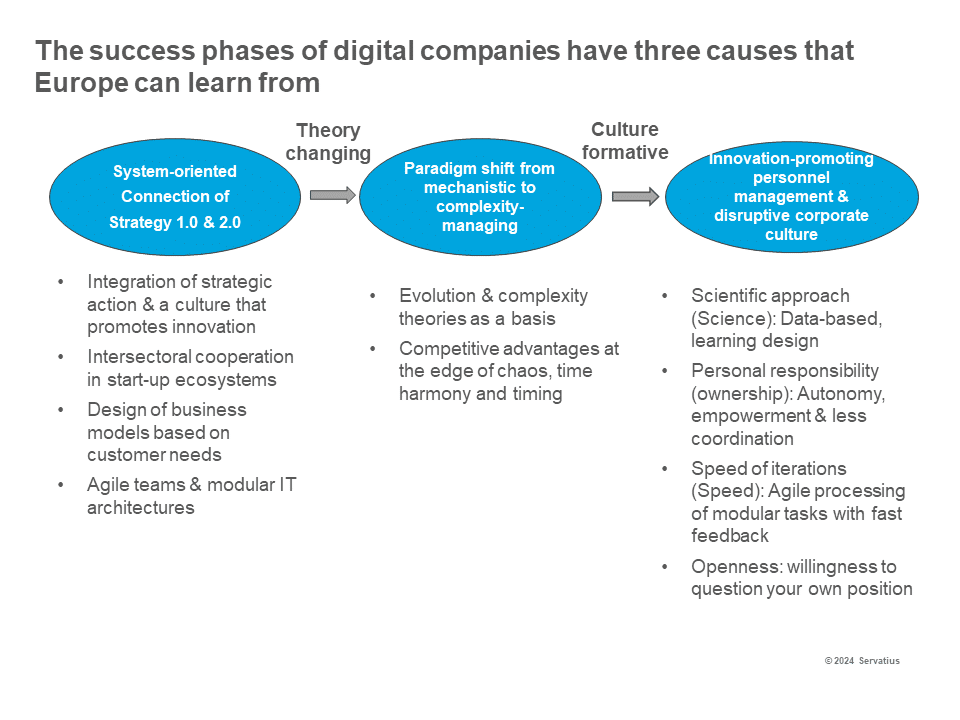
We therefore investigated the question of what the European economy can learn from successful digital companies. The result is a causal chain that begins with the connection between the first development stage of market- and finance-oriented strategic management and the second stage, which is determined by technology and innovation. This connection has had a theory-changing effect and led to a paradigm shift from a more mechanistic to a complexity-managing strategic management. This paradigm shift has shaped the culture in the success phases of digital companies. During these phases, an innovation-promoting personnel management and disruptive corporate culture has emerged, which represents a difficult barrier for established companies to overcome.

Lernprozess Innovationsstrategie

I would like to explain these three causes in the following sections. A better understanding of the causes can help established companies to better manage the digital transformation. However, a basic prerequisite for this is a willingness to learn and to question traditional cultural norms. The starting point is a system-oriented combination of Strategy 1.0 and Strategy 2.0.


System-oriented combination of Strategy 1.0 and 2.0

Since the early 1980s, the traditional market- and finance-oriented strategic management (Strategy 1.0) has been expanded to include a technology- and innovation-oriented second stage of development (Strategy 2.0).2 Successful digital companies have used this expansion to their advantage. On the one hand, their success is based on their lead in digital technologies. At least as important is the system-oriented integration of analysis-oriented strategic action and a culture that promotes innovation. In this way, they have succeeded in implementing a new integrated approach to designing innovation systems.3 This approach is not limited to their own company, but also includes start-up ecosystems.

In successful start-up ecosystems, four sectors work together in partnership. Politicians actively promote education, new technologies and innovations. Science successfully spins off start-ups. Venture capitalists and corporate venture management finance not only the founding but also the scaling of start-ups. Society also plays an important role by creating a positive climate for innovation and attractive framework conditions.

Lernprozess Innovationsstrategie

This interplay has led to the success story of Silicon Valley, which is several decades ahead of Europe.4 However, the example also shows the tension between the current AI boom and the exploding cost of living on the US West Coast.

The development of start-up ecosystems was stimulated by the design science5 and methods such as design thinking, which emerged in the 1960s.6 Design thinking supports the interdisciplinary learning process for designing digital business models. Innovative technologies act as enablers of new forms of problem solving and satisfying customer needs. The action research7 developed by psychology professor Kurt Lewin in the USA back in the 1940s provides the theoretical basis for learning loops that start from hypotheses, design something that can be tested with customers and whose results lead to possible changes in direction. In the early 1990s, agile software development methods such as Scrum were developed on this basis.8 Start-ups that use these concepts have become the most valuable companies in the world.

The example of Amazon shows that these companies also had to overcome critical phases. After the failure of a project to improve collaboration between functional areas, Jeff Bezos recognized the need for a change of direction. He introduced the „two-pizza principle“ for agile teams and implemented the concentration of project managers on a single project (single-threaded leaders). To enable agile teams to work as independently as possible, it was necessary to develop a modular IT architecture. This internal initiative formed the starting point for the founding of Amazon Web Services (AWS), today’s global market leader in the cloud business. 9

The theoretical basis for such activities was provided by a paradigm shift in strategic management that took place in the 1990s. I would like to briefly describe how I experienced this period.


Paradigm shift from mechanistic to complexity management

After about a decade in strategy consulting, I had the impression that the existing, relatively mechanistic strategy concepts were not sufficient to cope with the complexity of innovation and sustainability issues. In my search for better solutions, I came across evolutionary and complexity theories and completed an external habilitation at the University of Stuttgart in 1991 on the seemingly necessary paradigm shift in strategic management.10

Lernprozess Innovationsstrategie

Complexity-based strategic management is based on three theoretical foundations that have influenced each other. Firstly, evolutionary theories have emerged in various disciplines. They view the dynamic sequence of imbalances as a balance between chaos and order, the outcome of which depends on the initial conditions.11 Important impetus then came from the Santa Fe Institute, founded in the USA in 1984, and the theory of complex adaptive systems developed there. This deals with the creation of suitable framework conditions for a more self-organized interaction of competent actors at the „edge of chaos“ based on simple rules.12 The theory of complex interactive relationship processes makes a contribution to the application in organizations. The focus here is on local, non-linear interactions between actors, from the course of which patterns emerge that are difficult to predict. 13

These relatively abstract-sounding ideas were difficult to convey to established companies in the 1990s. As a result, even the large consulting firms did not jump on the bandwagon. Nevertheless, the theories have found their way into practice. This path led from Stanford University to Google. As digitalization progressed, the importance of evolutionary and complexity theories increased significantly.

In 1995, the book Competing on the Edge was published by future Google manager Shona Brown and Stanford professor Kathleen Eisenhardt, who attempt to apply complexity theories to strategic management.14 They divide their recommendations for action into the fields of chaos edge, time harmony and timing. The focus here is on overcoming complexity by finding the right balance. In the field of chaos edge, the recommendations for action are as follows:

  • Using professional improvisation to find the middle ground between too much structure and too much confusion and
  • utilize synergies between businesses through joint adaptation in order to find the balance between too much cooperation and too much selfishness.

The recommendations in the Time Harmony field are:

  •  Deriving benefits from the future and the past through targeted renewal and
  •  Carry out experiments to shape tomorrow with experience today.

The last recommendation concerns the timing. It reads:

  •  Set the tempo to synchronize transitions and find your own rhythm.

These recommendations for action have shaped the HR management and culture of Google and other digital companies.


Innovation-promoting personnel management and disruptive corporate culture

A specific leadership style has developed in digital companies, which is referred to as the „geeky leadership style“ in the USA. The term geek is undergoing a positive change in meaning. This form of personnel management is culturally influential. It is characterized by the following four cultural norms: 15

  •  A specific scientific approach (Science)
  •  Personal responsibility (ownership)
  •  a high speed of iterations (Speed) and
  •  Openness.

The disruptive nature of such a culture lies in the fact that it is difficult for established companies to develop due to behavioral barriers. I would like to explain this briefly.

Lernprozess Innovationsstrategie

The scientific approach based on action learning and design theory is geared towards data-based, adaptive design. Digital companies such as Google used these findings early on and developed infrastructures for testing hypotheses. The test results then form the starting point for intensive, fact-based argumentation by the stakeholders. In contrast, decisions in established companies are based more on the convictions and power of managers and the opinions of experts. The cultural change to a more scientifically oriented approach can therefore trigger resistance in established companies because those responsible fear a loss of importance. Personnel development at universities and in practice should create a conscious counterbalance here.

Digital start-ups are characterized by the personal responsibility of managers with a higher degree of autonomy, empowerment of agile teams and less coordination effort. Established companies, on the other hand, often struggle with increasing bureaucratization, where many are allowed to have a say and demonstrate their power by exercising a veto. Microsoft was also faced with the challenge of regaining a culture of ownership, which it has succeeded in doing under the leadership of Satya Nadella. Bayer’s attempt to reduce bureaucracy with the help of the humanocracy concept developed by management guru Gary Hamel is the subject of much public debate.16 It remains to be seen how successful this attempt will be.

One root of the „geeky leadership style“ is the agile manifesto written in 2001, which emphasizes the speed of rapid iterations. Established hardware-oriented companies often find it difficult to link this approach, which originated in software development, with their existing product innovation process. In view of the increasing importance of software in the automotive industry, for example, hybrid approaches that combine existing skills with digital expertise are becoming increasingly important. One indicator of success here is that companies achieve their set time targets and do not fall victim to the 90 percent syndrome, in which the players realize too late that they are missing their targets.

Characteristics of the cultural norm of openness are the sharing of information, receptiveness to other arguments, the willingness to re-evaluate situations and change one’s own direction. The opposite of openness is widespread defensive behavior patterns, which Harvard professor Chris Argyris has described as a characteristic of established companies since the 1980s.17 The negative consequence is often that the community punishes those who violate prevailing norms. An extreme form of defensive behavior is the tacit toleration of unethical or punishable activities. On the other hand, a culture characterized by openness can be recognized, for example, by the fact that young employees are allowed to openly contradict their boss in an internal meeting without having to expect sanctions.

This example leads us to an approach on how established companies can reduce the cultural distance to the digital world.


Adapting and exemplifying cultural norms

Managers of established companies have the task of finding an individual approach to the cultural norms of successful digital companies. Knowledge of the theoretical principles outlined above can be helpful in this regard. However, success in the digital world does not mean that these norms can be transferred 1:1 to an established company. They need to be adapted to the specific situation and framework conditions of the respective company. Once there is a consensus regarding this situational adaptation, it is important for managers to exemplify changed cultural norms. Appropriate personnel development and promotion policies then play an important role. The idea of a rapid, comprehensive digital transformation is therefore unrealistic. A successful digital realignment in established companies is more likely to be a specific, longer-term process.18


Collaboration with start-ups as an underutilized opportunity

One way for established organizations to learn from successful digital companies is to work more closely with start-ups. Unfortunately, too little use is made of this opportunity. A study by the German Start-up Monitor concluded that cooperation between corporations and SMEs and young companies fell by ten percent between 2020 and 2023. Verena Pausder, head of the start-up association, sees this backward trend as an alarm signal and is promoting a revival of the partner culture.19 The current topic of generative artificial intelligence in particular offers a variety of approaches to this. There are a number of initiatives, such as the „Hinterland of Things“ conference, which has been taking place in East Westphalia since 2018 and brings together various players. But overall, there is still considerable potential for expansion in the design of start-up ecosystems.


Conclusion

  • Many of the world’s most valuable companies have evolved from start-ups to digital champions in a relatively short space of time
  • To answer the question of what established companies can learn from this, we have analyzed the development of strategic management
  • In contrast to established companies, digital companies have actively driven a paradigm shift in strategic management from mechanistic to complexity management during their success phases
  • A change in personnel management and culture has played an important role here
  • Managers in established companies are faced with the task of exemplifying cultural norms that are adapted to the situation
  • They should make greater use of the opportunity to work together with start-ups


Literature

[1] Sommer, U., AI sparks price fireworks. In: Handelsblatt, December 27, 2023, p.1, 4, 6

[2] Servatius, H.G., Evolution of strategic management. In: Competivation Blog, 28.06.2024

[3] Servatius, H.G., Gestaltung des Innovationssystems von Unternehmen. In: Servatius, H.G., Piller, F.T. (eds.), Der Innovationsmanager – Wertsteigerung durch ein ganzheitliches Innovationsmanagement, Symposion 2014, pp. 21-64

[4] Keese, C., Silicon Valley – What is coming to us from the most powerful valley in the world, Knauer 2014

[5] Simon, H.A., The Sciences of the Artificial, 2nd ed., MIT Press 1981 (1st ed.1969)

[6] Kelly T., Kelly, D., Creative Confidence – Unleashing the Creative Potential within us all, William Collins 2013

[7] Marrow, A.J., Kurt Lewin – Life and Work, Ernst Klett 1977

[8] Sutherland, J.J., The Scrum Fieldbook – A Master Class on Accelerating Perfomance, Getting Results, and Defining the Future, Currency 2019

[9] Bryar, C., Carr, B., Working Backwards – Insights, Stories, and Secrets from Inside Amazon, Macmillan 2021

[10] Servatius, H.G., Vom strategischen Management zur evolutionären Führung – Auf dem Weg zu einem ganzheitlichen Denken und Handeln, Poeschel 1991

[11] Beinhocker, E.D., Die Entstehung des Wohlstands – Wie Evolution die Wirtschaft antreibt, mi-Fachverlag 2007

[12] Lewin, R., Die Komplexitätstheorie – Wissenschaft nach der Chaos-Forschung, Hoffmann und Campe 1993

[13] Stacey R., Tools and Techniques of Leadership and Management – Meeting the Challenge of Complexity, Routledge 2012

[14] Brown, S.L., Eisenhardt, K.M., Competing on the Edge – Strategy as Structured Chaos, Harvard Business Review Press 1998

[15] McAfee, A., The Geek Way – The Radical Mindset That Drives Extraordinary Results, Macmillan 2023

[16] Hamel, G., Zanini, M., Humanocracy – Creating Organizations as Amazing as the People Inside Them, Harvard Business Review Press 2020

[17] Argyris, C., Overcoming Organizational Defences – Facilitating Organizational Learning, Allyn and Bacon 1990

[18] Servatius, HG, Triple strategic realignment. In: Competivation Blog, 07.06.2024

[19] Müller, A., Schimroszik, N., Mittelstand moves away from start-ups. In: Handelsblatt, June 13, 2024, p.22


Interessiert?

CONNECTIVE MANAGEMENT

Vereinbaren Sie einen unverbindlichen Gesprächstermin:


    +49 (0)211 454 3731