

In the field of artificial intelligence (AI), a paradigm shift is currently underway from purely statistical correlations to dynamic cause-and-effect models. The theory of complex, evolutionary systems—which our expert network Competivation has been applying to real-world management problems for several years—offers a promising foundation for this causal AI. The goal is to integrate these two lines of development. Investor interest in the Heidelberg-based startup Kausable AI demonstrates just how great the potential of this paradigm shift is.
In our new blog post, I explain how the management theory of complex, evolutionary systems can help causal AI achieve a breakthrough.
Early-stage investment in Kausable AI
AI models trained on historical data reach their limits when something unexpected occurs. They then have to be adjusted through a time-consuming process. The Heidelberg-based company Kausable AI started with the idea that a new generation of models must learn to cope better with constant change. To this end, Kausable has received an early-stage investment of 12 million euros from venture capitalists and renowned AI researchers. The model, trained using synthetic data, is designed to understand causes and effects, derive hypotheses from them, and learn from results to master new challenges. Whether this approach will work remains to be seen, but the need is great, as tackling complex problems is becoming increasingly demanding. For example, with their project TipPFN, the founders are attempting to identify tipping points at which systems suddenly change.1
In this context, innovative AI models require a practical theoretical foundation.
Applying the theory of complex, evolutionary systems to real-world management problems
I recently described the development of the theory of complex evolutionary systems and its application to real-world management problems in an article.2 For this connection with an AI that understands causes and effects, certain characteristics of these systems are significant, which I would like to briefly explain. This is particularly true with regard to the complex interactions between different levels, such as geopolitics, the environment, states, regions, companies, and administrations, as well as individuals and society.
The implications for designing multilevel strategies are profound. AI support can help mitigate the shortcomings of traditional management practices.
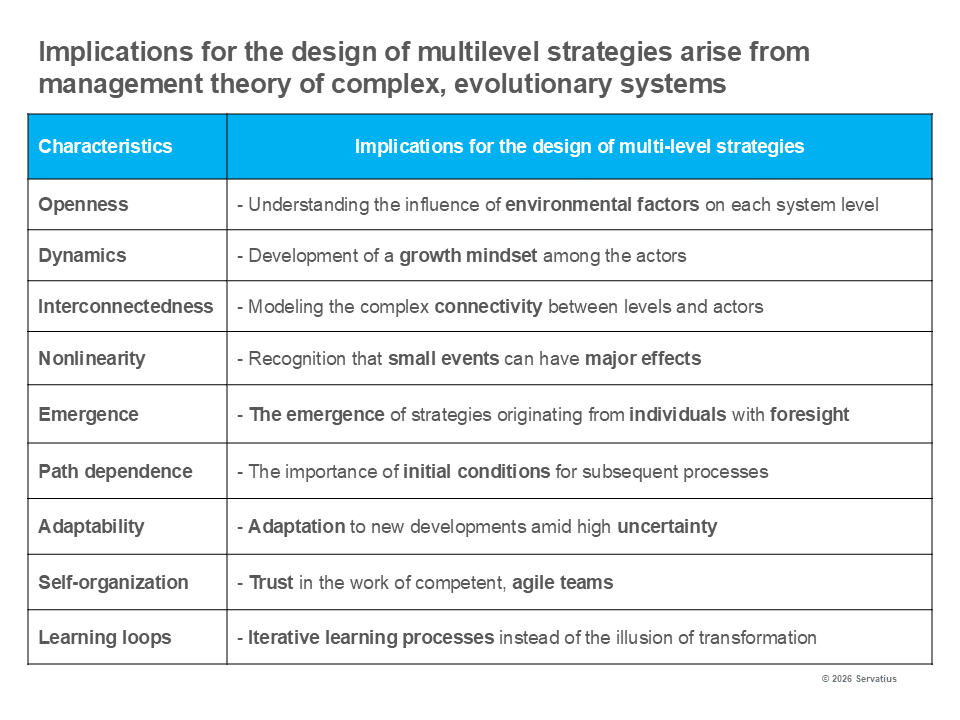
A defining characteristic of complex, evolutionary systems is openness. It is therefore important to understand the influence of environmental factors at every level of the system. Currently, the interplay of various risks poses a new type of threat to the German economy.
This environment is characterized by high dynamism. Consequently, all relevant stakeholders face the challenge of developing a growth mindset. Leadership and human resources development provide important impetus for such a self-image.
Another key characteristic is interconnectedness. AI can help model the complex connectivity between levels and stakeholders. For example, problems related to the energy transition in the past have arisen from barriers between the sectors of politics, science, business, and society.
The nonlinearity of these processes is often underestimated. This refers to the realization that small events can have major effects. However, these effects are usually only recognized after tipping points have been reached.
A hallmark of many strategies is emergence. Contrary to the widespread belief that top management develops strategies, these often originate with individuals possessing exceptional foresight and spread from the outside or from the bottom up through the hierarchy.
Path dependence is also underestimated. This refers to the importance of initial conditions for subsequent processes. A typical example is strategies that are logically sound but fail due to a toxic organizational culture.
Complex, evolutionary systems are characterized by adaptivity. This adaptation to new developments amid high uncertainty has reached an extreme level due to the current geopolitical situation.
As a result, the framework conditions for self-organization are becoming increasingly important. Successful digital companies rely on the work of competent, agile teams. On the other hand, in “old-school” personnel management, agility is still a foreign concept.
Closely linked to this is the importance of learning loops. One indicator that these iterative learning processes are working is when leaders do not fall victim to a “transformation illusion” and believe that a new, stable state of equilibrium is achievable.
Understanding complex, evolutionary systems plays a key role in helping causal AI achieve a breakthrough. To this end, it is important to examine the significance of the three levels of a causality ladder for dynamic cause-and-effect models.
Significance of the three levels of the causality ladder
The significance of the three levels of causality developed by Turing Award winner Judea Pearl lies in overcoming the limitations of pure pattern recognition to create systems that understand cause-and-effect relationships, run through hypothetical scenarios, and act in a comprehensible manner. Pearl distinguishes between the levels of observation, action, and reflection.3
The first level of observation (association) involves capturing data and patterns. This is the foundation of classical deep learning. The problem here is that while these systems recognize correlations, they do not recognize causalities—in other words, they do not understand the “why.” When the framework conditions change (dataset shift), traditional AI models often fail.
The focus of the second level of action lies on actively intervening in a system and altering variables. At this stage, causal AI moves beyond its passive role. It can predict, to a limited extent, what might happen.
The third level of reflection (counterfactual thinking) explores alternative scenarios as part of a retrospective analysis. This stage bridges the gap to human cognition. It enables AI to truly learn from mistakes through hypothetical simulations.
For a definitive breakthrough in causal AI, progress is currently still lacking in the following four key areas:
- Automatic structure discovery. To identify cause and effect from observational data (causal discovery), the involvement of human experts with methodological and subject-matter expertise is required.
- The development of standardized software frameworks. There is a lack of both universal, easily understandable software libraries for specific applications and benchmarks for measuring the performance of causal models.
- A lack of real-world data regarding causality levels two and three. To simulate complex application domains, better methods for generating synthetic data are needed.
- The connection to deep learning. The strength of causal AI lies in logical thinking. Deep learning excels at processing unstructured data. Research institutes and tech giants are working to merge these two worlds (causal deep learning).
An AI-supported application of the theory of complex evolutionary systems in management practice focuses on these key areas.
Cooperation among different stakeholder groups
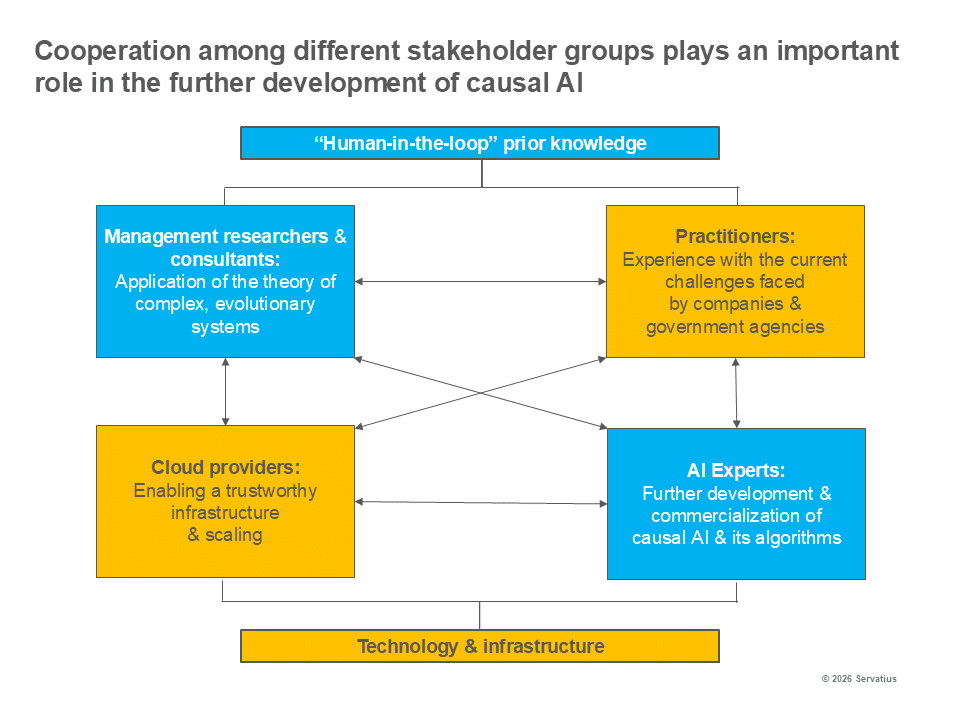
When combining causal AI with complex, evolutionary systems, cooperation among various stakeholder groups plays a crucial role. These groups include:
- Management researchers and consultants who apply the theory of complex evolutionary systems, as well as
- practitioners who have experience with the current challenges facing companies and government agencies.
These two groups provide the “human-in-the-loop” prior knowledge and should safeguard this valuable resource. In addition to this experiential level, there is the level of technology and infrastructure. Here, the following groups are active:
- AI experts who work on the further development and commercialization of causal AI and its algorithms, as well as
- cloud providers who enable the use of a trustworthy infrastructure and its scalability.
In the past, our network of experts has found that the connectivity among these stakeholders is a key success factor. In this respect, the topic is another building block of the fifth stage of development in connective strategic management, a concept we have coined.4
It is important to recognize that, even for digital giants, causal AI is something like the “Holy Grail” of the next generation of AI. Such “Next AI” relies more heavily on the Socratic method of critical, step-by-step questioning to reduce the hallucinations typical of language models.5 An interesting application of causal AI is the development of positive visions of the future through strategic foresight.
Development of positive visions of the future
Strategic foresight has a long history of development. Although the term “foresight” was not coined until the 1980s, key methods—such as scenario analysis—emerged as early as the 1960s, when research institutes in the U.S. shifted their focus from the military to the private sector following World War II.
The Game-Changer Radar, which we developed several years ago, aims to identify profound changes at an early stage in order to capitalize on emerging opportunities before competitors do.6 We used this method in our book on AI as a game changer, published in 2020.7
Strategic foresight should focus more on designing positive visions of the future that view the future as a space of possibilities that can be shaped.8 Causal AI can help systematically think through possible developments and interactions. Such visions of the future serve as the starting point for compelling narratives that foster a stronger emotional connection. Germany urgently needs such a narrative at this time.
Conclusion
- Causal AI has the potential to prepare organizations for unexpected changes more effectively and cost-efficiently than traditional AI models
- The application of the theory of complex, evolutionary systems in management and the characteristics of this theory provide an important foundation for causal AI
- This theoretical base can contribute to a breakthrough in causal AI. This requires cooperation among different stakeholder groups
- In practice, there is a great need for positive visions of the future, which we develop with the help of AI-supported strategic foresight.
References
[1] Bomke, L., Renowned AI Researchers Are Backing These German Founders. In: Handelsblatt, July 24, 25, and 26, 2026, p. 31
[2] Servatius, H.G., Learning to Design Solutions for Complex Management Problems. In: Competivation Blog, July 15, 2025
[3] Pearl, J., Mackenzie, D., The Book of Why – The New Science of Cause and Effect, New Edition, Basic Books 2026
[4] Servatius, H.G., Connective Strategic Management in the AI Era. In: Competivation Blog, May 22, 2026
[5] Bomke, L., Dehari, L., Fokuhl, J., Training AI with Socrates. In: Handelsblatt, August 12, 2026, pp. 26-27
[6] Servatius, H.G., Strategic Foresight with a Game-Changer Radar. In: Competivation Blog, January 27, 2021
[7] Kaufmann, T., Servatius, H.G., The Internet of Things and Artificial Intelligence as Game Changers – Paths to Management 4.0 and a Digital Architecture, SpringerVieweg 2020
[8] Schön, N., Peters, N., Europe Urgently Needs More Future Competence. In: Handelsblatt, August 5, 2026, p. 14