
Designing trustworthy high-performance systems
In recent years, the importance of connective strategic management has continued to grow. In light of the dynamic development of artificial intelligence (AI) and new geopolitical challenges, the design of trustworthy high-performance systems has become a focal point of interest. In this context, the term „high performance“ is being reinterpreted in business and politics. An important field of action here is design-oriented management research.
In our first blog post of 2026, I address the question of what important areas of action for Europe in terms of trustworthy high-performance systems are.
High performance in business and politics reinterpreted
For Jeanette zu Fürstenberg, who is responsible for Europe at the US fund General Catalyst, there is an opportunity for the old continent in connecting startups with the world of established industrial companies. Her successful investments include Mistral in France and the defense company Helsing in Germany. These companies focus on artificial intelligence (AI) that uses highly specialized application knowledge. Her publication „Wie gut wir sind, zeigt sich in Krisenzeiten“ (How good we are is revealed in times of crisis) was named Management Book of the Year in 2025. For her, the basis for a European high-performance system that can achieve reindustrialization is resilience, which enables recovery as quickly as possible after external shocks.1 In 2025, the number of startups founded in Germany reached a record high.
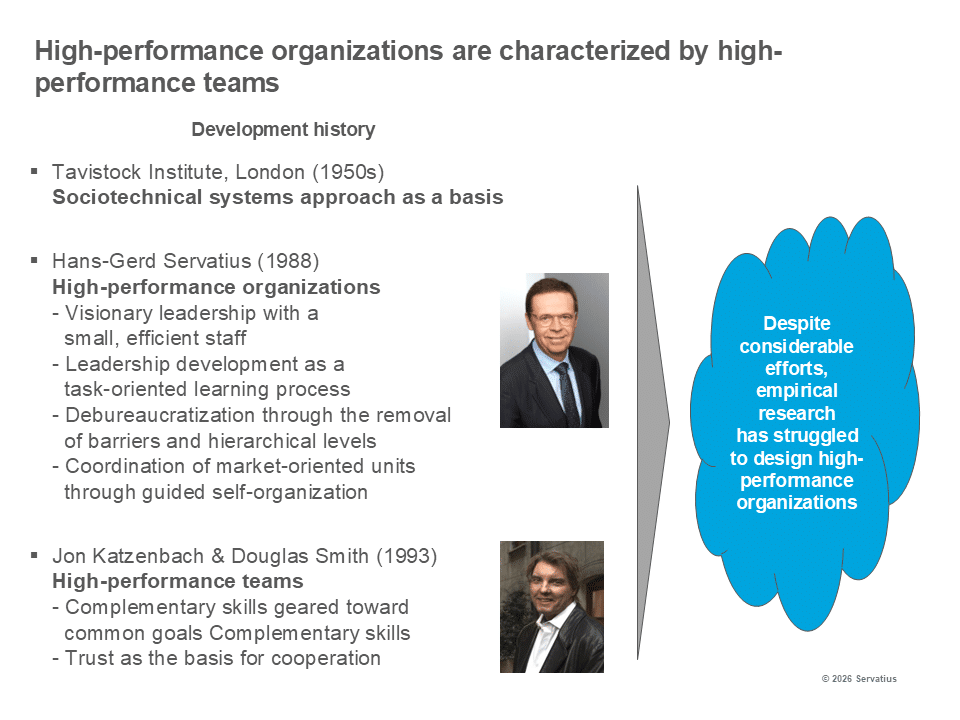
The topic of high-performance organizations is not new. High-performance organizations are characterized by high-performance teams. As early as the 1950s, the British Tavistock Institute developed an initial foundation with its socio-technical systems approach. I described the results of consulting projects on the characteristics of high-performance organizations in an article in Harvard Manager magazine in 1988. One important finding is that visionary leadership creates the framework for teams that work in a more self-organized manner.2
McKinsey consultants Jon Katzenbach and Douglas Smith examined the question of what characterizes high-performance teams.3 However, further developments have shown that, despite considerable efforts, empirical research is struggling with the design of high-performance organizations.4 AI is now giving performance management new impetus to improve the connection between strategy implementation and motivation.5
US tech companies with artificial intelligence (AI) now dominate the global economy. By the end of 2025, 61 of the world’s 100 most valuable companies will be from the US. The dominance of the US results from the unique strength of seven tech giants, which together have a market value of €18.3 trillion. An important driver of this development is the hype surrounding artificial intelligence (AI). Germany is represented in the top 100 ranking with the companies SAP (rank 40), Siemens (72), the European joint venture Airbus (91), and Allianz (100). In view of geopolitical changes, this concentration of power raises the question of how great the danger of dependence on the US is. 6 In the AI chip market, competitive pressure is increasing for market leader Nvidia.
AI chips are becoming increasingly powerful, but at the same time, AI increases the risk of disinformation. With a global market share of 85.2%, AI chip manufacturer Nvidia has a dominant position ahead of Broadcom (10.3%), Marvell (2.1%), and AMD (1.8%). Challengers AMD and Meta have announced a new AI system for data centers (Helios platform) that is expected to deliver a significant performance boost. Nvidia is countering with its new Rubin chip generation.7
However, there is a risk of a loss of trust in AI due to the risk of disinformation from fake accounts. AI bots falsify content, imitate people, and post automatically on social media. Such deepfakes can cause great economic damage and, for example, ruin a brand’s reputation.8
Large language models and free AI tools often lead to a loss of quality and trust because they are not trained for high performance, but rather for the production of average knowledge. When AI users are under time pressure and there are no quality standards in place, „AI slop“ can result. Although this produces faster results, the quality declines. Possible consequences include a loss of reputation and trust. When using AI, it is therefore important to supplement content with expert knowledge after quality control.9
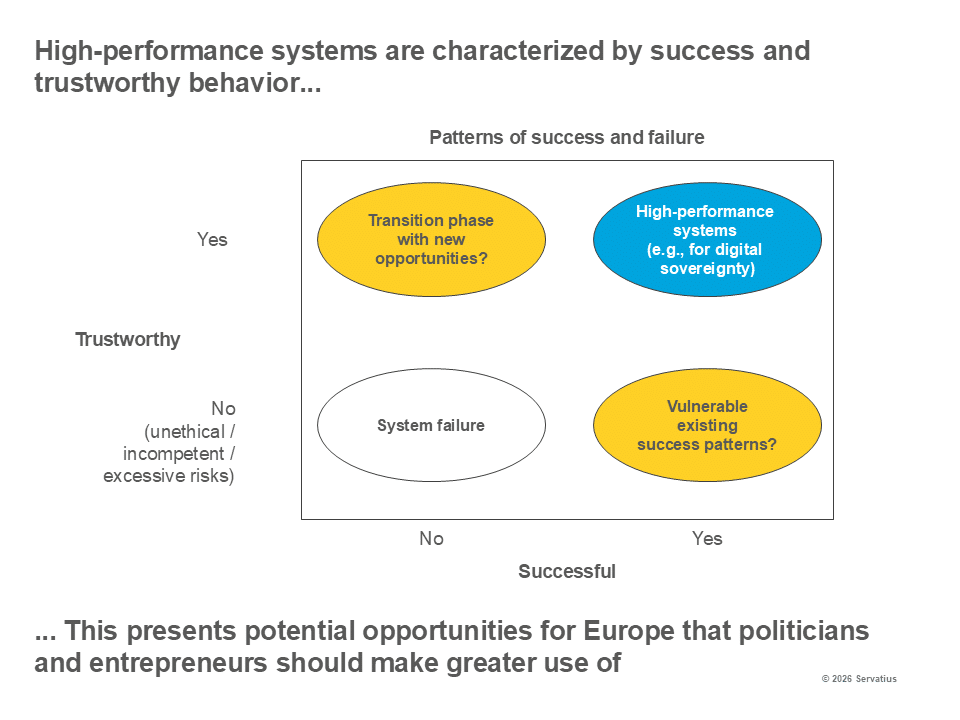
AI and geopolitical challenges are reinterpreting the concept of high performance. Not all AI is trustworthy. We understand a trustworthy high-performance system to be a system (e.g., a company, a region, or a state) that performs very well compared to the competition and is trusted by the recipients of its services. In addition, these service recipients are willing and able to pay for the services. High-performance systems must therefore justify their higher prices (e.g., through „German quality,“ technical superiority, or a luxury brand).
Reinterpreting high performance means that high-performance systems are characterized by both success and trustworthy behavior. If neither of these is the case, we speak of system failure. Most socio-technical systems fall somewhere in between. Cases where only one of the two criteria is met are interesting. An existing pattern of success is at risk when a previously successful system, such as that of the AI champions, loses trust. This could result in a transitional phase with new opportunities, for example, if Europe, which has been less successful in digitalization to date, scores points with trust.
Peter Frankopan, a British professor of global history teaching at Oxford, sees the world in a transitional phase similar to that of the 1920s, when the old order was not yet dead and a new one had not yet been born.10
The question is therefore how Europe can seize its opportunities and become a designer of trustworthy high-performance systems.
Strategic realignment in a phase of transition
In the first nine months of 2025, DAX companies spent €6 billion on restructuring. The highest restructuring costs in 2025 were incurred by Mercedes (€1.4 billion), Volkswagen (€900 million), Siemens and Commerzbank (€500 million each). The automotive, mechanical engineering, and chemical industries are particularly affected. At the end of September 2025, 120,300 fewer people were employed in German industry than a year earlier. Many companies are offering generous severance packages. Often, one round of restructuring is followed by another without solving the underlying problems. This would require a strategic realignment after restructuring.11
The term „strategic realignment“ describes an innovative approach to coordinating existing and new system elements (e.g., business model, strategy, technologies, customers, competencies, organization, culture, and environment). Realignments usually have a profound effect over a longer, undefined period of time in many parallel learning steps. Complex interactions play an important role in this process, resulting in specific patterns that are difficult to predict.
During a phase of transition, companies must manage complex realignment processes. In a successful, innovative company, important system elements are well coordinated. This alignment often takes place through fine-tuning, in which management continuously adapts the strategy to changes in the environment, for example. If this is not done, the company develops in the direction of misalignment. Management and supervisory boards often recognize this creeping decline too late. The result is an established company in a permanent crisis that requires restructuring.
The terms restructuring and transformation are now often used synonymously. Both terms describe a temporary, comprehensive change. Unfortunately, the inflationary use of the term transformation conveys the illusion that complex realignment processes are limited in time. The example of artificial intelligence clearly shows that such a static worldview is naive.
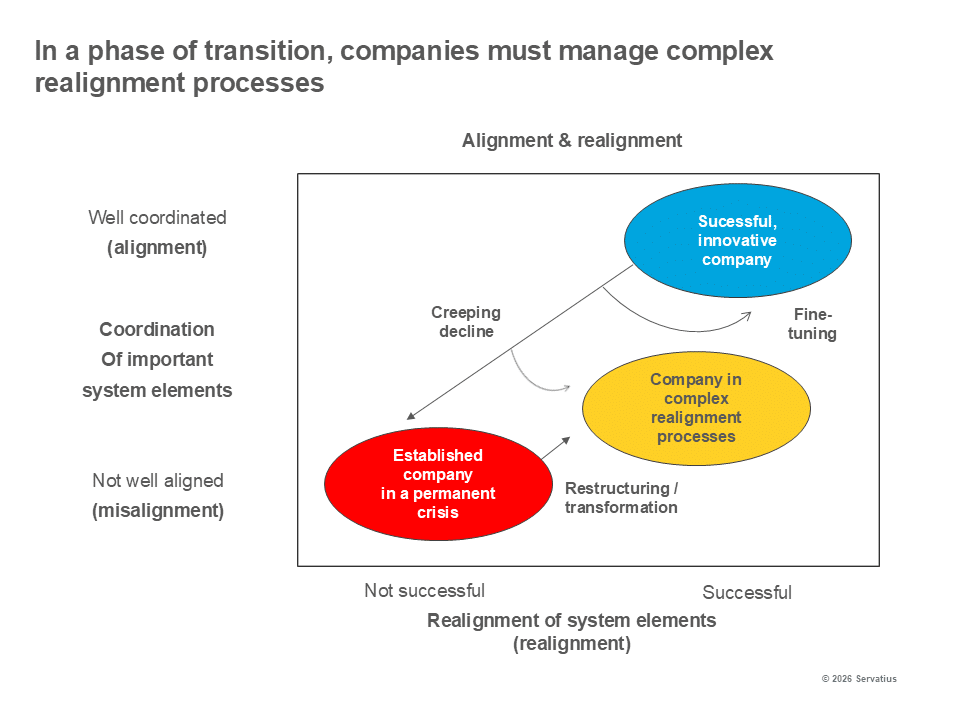
A longer-term goal of strategic realignments is the design of trustworthy high-performance systems.
Fields of action for trustworthy high-performance systems
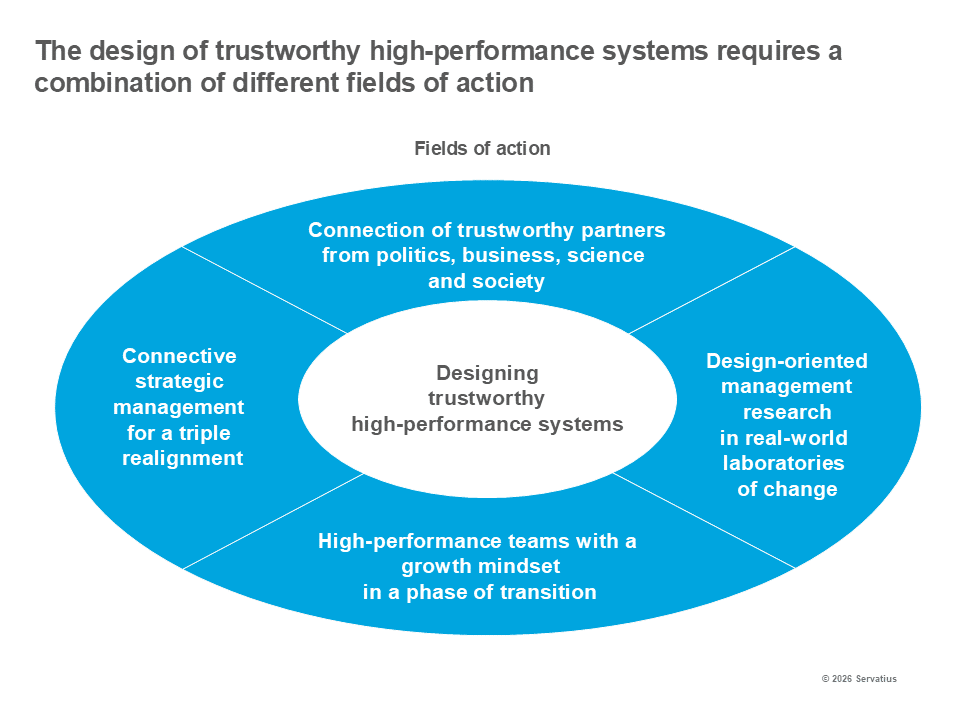
In times of increasing polarization, high-performance systems are characterized by their ability to bring people together. History teaches us that the risk of polarization increases during periods of technological and political upheaval. This also applies to the changes brought about by artificial intelligence (AI). It is crucial that people see themselves as active participants in shaping change rather than passive objects of it. The complementarity of humans and AI is a malleable system. The performance of such a system depends on the ability to improve connections between the actors and the system elements. In our application-oriented research and teaching, we start with the thesis that the following fields of action, shown in the figure, are important in the design of trustworthy high-performance systems:
- A connective strategic management for a triple realignment
- high-performance teams with a growth mindset in a phase of transition
- the connection of trustworthy partners from politics, business, science, and society, and
- design-oriented management research in real-world laboratories of change.
Interdisciplinary university teaching faces the task of imparting the relevant skills for these fields, e.g., in the area of entrepreneurship for AI applications.
In the following, I will discuss these fields of action and skills in more detail.
Connective strategic management for a triple realignment
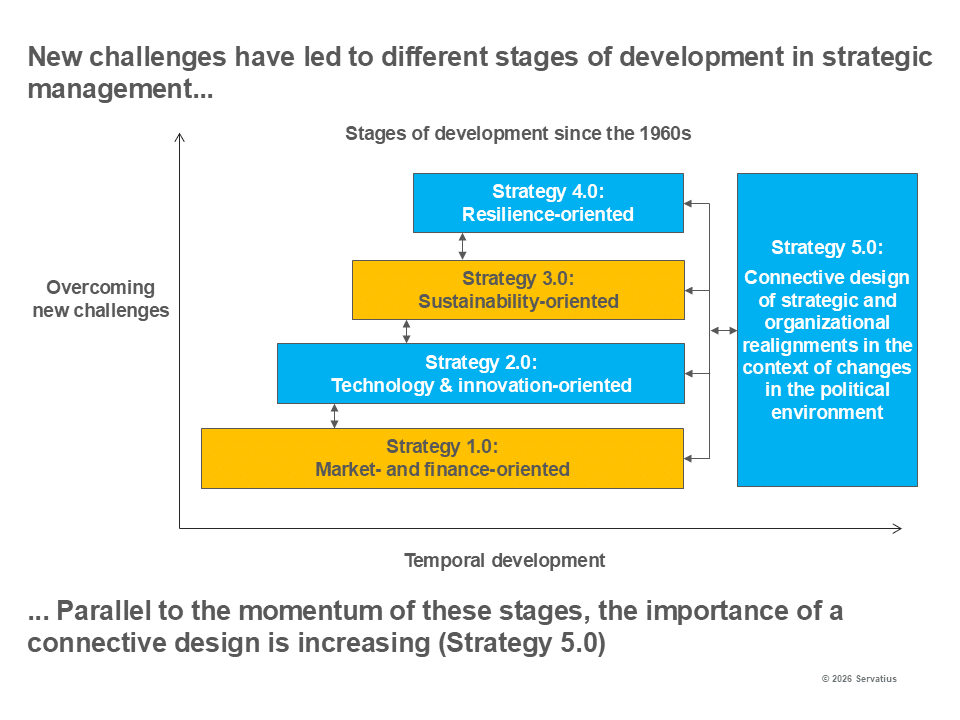
Since the 1960s, new challenges have led to various stages of development in strategic management.13 We distinguish between
- a market- and finance-oriented stage (Strategy 1.0)
- a technology- and innovation-oriented stage (Strategy 2.0)
- a sustainability-oriented stage (Strategy 3.0) and
- a resilience-oriented stage (Strategy 4.0).
In the current fifth stage of development (Strategy 5.0), the challenge lies in connecting the previous stages. Companies must become more resilient, more digital, and more sustainable at the same time.14 This requires the connective design of threefold strategic and organizational realignments. Such a triple realignment takes place in the context of serious changes in the political environment. The current situation is historically unprecedented. Therefore, the contextual intelligence of management plays an important role.15
German policymakers should create the framework for a cohesive strategic management approach through fundamental reforms. When the first signs of macroeconomic weakness appeared in 2018, they were harbingers of the most severe and longest industrial recession the Federal Republic has ever experienced. German industry has since lost much of its competitiveness. Experts are calling for new approaches to supply-oriented innovation policy and communication that conveys the need for a change of course. Politicians must implement the promised fundamental reforms. Such a new beginning can only succeed with solidarity instead of polarization.16
In this environment, resilience-oriented strategic management is becoming increasingly important.17 At this year’s World Economic Forum in Davos, the differing positions of the US president and European representatives clashed.18 Canadian Prime Minister Mark Carney suggests that in a world where major powers are becoming imperialists who blackmail other states, middle powers and smaller countries should form trustworthy partnerships.19
Such cooperation plays a decisive role not only at the geopolitical level, but also in high-performance teams.
High-performance teams with a growth mindset in a phase of transition
Black Forest Lab (BFL), currently Germany’s most valuable AI startup, is based in Freiburg, was founded in 2024, and develops AI models for image generation based on text. The founders are part of the core team behind the open-source AI model Stable Diffusion, the text-to-image model that generates digital images from text and, alongside ChatGPT, sparked the global AI hype in 2022. BFL’s Flux models are now one of Google’s biggest competitors. Important impetus for the work of the founding team came from Björn Ommer, a professor of computer science at LMU Munich. This example shows that high-performance teams can also emerge in Germany in the field of AI.20
New ideas and the creation of something new often originate from people who find a state of flow motivating. The term flow (in the sense of „being in the flow“) was coined by psychology professor Csikszentmihalyi back in 1975. It refers to being completely absorbed in an activity, which usually involves a high level of intrinsic motivation and a change in the perception of time. Interviews in which outstanding creative personalities from various fields look back on their working lives show that their motivation stems primarily from the creative process. For many people, the foundations for possible flow states are often laid in their youth, based on their growth mindset.21
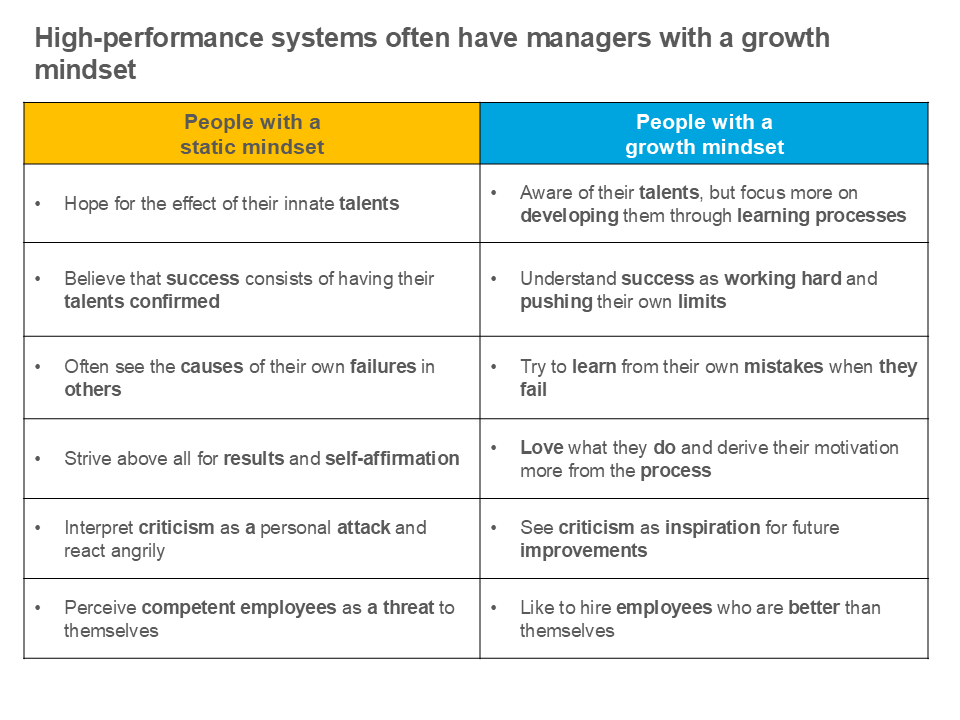
In her book Growth Mindset, Stanford professor Carol Dweck distinguishes between a static and a growth mindset.22 The following figure compares these two mindsets. High-performance systems often have leaders with a growth mindset. An important characteristic is that these people are aware of their talents, but place greater emphasis on their further development and learning processes. In contrast, people with a static worldview place greater hope in the effect of their innate talents.
Microsoft CEO Satya Nadella writes that the book had a strong influence on his personal development.23
A person’s self-image and their environment are closely linked. High performance therefore arises from an interplay between the two. Social psychologist Mary Murphy has extended the growth mindset concept to organizations, their culture, and the environment surrounding them:24
- According to this, a growth culture promotes the potential of all employees. This culture emphasizes collaboration, continuous learning, and the development of skills.
- A genius culture, on the other hand, believes in innate talent. This leads to internal competition, risk aversion, and a reluctance to admit mistakes.
Recommendations for action for managers are
- create psychological safety and
- giving constructive feedback.
However, simplistic application of this approach in practice underestimates the complexity of implementation. This can lead to demotivation among exceptional talents.
This raises the question of whether there are any current examples of a growth culture in Germany. A new bridge in South Westphalia has become a symbol of connective design. The Sauerland motorway is the most important transport link between the Ruhr area and Frankfurt. Due to the risk of collapse, the Rahmedetal bridge near Lüdenscheid, where I grew up, had to be suddenly closed in December 2021 and later blown up. This was a disaster for the economy with its many hidden champions and for the people in the region. Every day, 20,000 vehicles had to be diverted via bypasses and through residential areas. The German Economic Institute estimates the damage to businesses at around 1.5 billion euros. In Germany, new construction normally takes around eight to ten years. However, traffic is already rolling across one side of the A45 bridge via the after a record-breaking four years. This was made possible by smooth cooperation between the parties involved, a new planning procedure, and innovative construction methods. The German Chancellor sees this as a model for other renovations, and for the Minister President of North Rhine-Westphalia, the new benchmark for implementation speed in Germany is called „Rahmede“.25
We can therefore summarize that the culture of socio-technical systems is strongly influenced by the mindset-image of important stakeholders and prevailing design patterns.
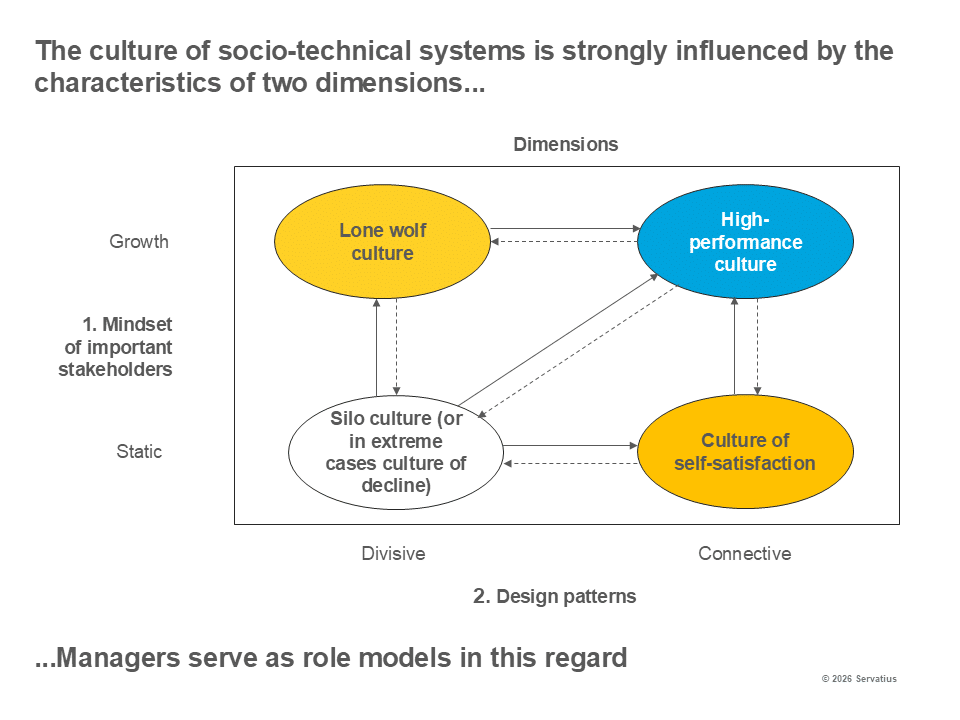
High-performance cultures are characterized by a growth mindset and a connective pattern. The opposite is a silo culture or, in extreme cases, a culture of self-satisfaction. Here, a static mindset and a divisive design dominate. Descriptions of outstanding leaders often heroize a lone wolf culture. These individuals are attributed with a growth mindset. At the same time, however, the impression is created that their successes were achieved single-handedly and in isolation from others, which is usually not the case. Until a few years ago, a culture of complacency was widespread in Germany. People rested on the successes of the past, but the mindset in politics and business was rather static and not very future-oriented.
Managers serve as role models in this regard. Their growth mindset is transferred to their employees. Conversely, managers with a static mindset and isolating behavior are responsible for the emergence of toxic cultures. Their position of power enables them to oust internal competitors and employees with a growth mindset that they perceive as a threat. Unfortunately, the role of consultants is often to secure and expand the position of power of the „static“ individuals. Attempts by external parties to change silo cultures are usually met with rejection and fail. It is therefore the task of supervisory bodies to review the dysfunctional mindsets of managers and take timely action. If this does not happen, there is a risk of system failure.
On its way to becoming a high-performance system, Europe currently finds itself in a difficult situation.
Connection of trustworthy partners from politics, business, science, and society
Europe first needs a resilience program against its enemies from outside and within. US political scientist Francis Fukuyama believes that Trumpism will continue even without Trump. For open democratic societies, this is an extremely dangerous development. He fears a relapse into the world order of the 19th century. It is therefore important that Western societies develop sufficient resilience. It should also be taken into account that tech billionaires primarily act in their own economic interests. The greatest danger for Europe is resignation.26
Marc Tüngler, head of the German Association for the Protection of Securities Holders, laments the lack of political support necessary for innovation and economic restructuring. Germany is no longer internationally competitive in terms of electricity prices, for example. Politicians are responsible for this. Important levers would therefore be an improved location policy and a more innovation-friendly climate. We are far from the necessary solidarity between business and politics. He expects 2026 to be a year of decisions for politicians.27
In his book „Wir Krisenakrobaten“ (We Crisis Acrobats), Stephan Grünewald, co-founder of the Cologne-based opinion research company Rheingold, describes the hope for self-efficacy that would enable our society to overcome the multitude of current crises. His recommendation consists of six points:
- Truthfulness (clear identification of problems)
- focus (successful national projects)
- participation (making one’s own contribution clear)
- fairness (unreasonable demands must be perceived as fair)
- culture of debate (dealing more productively with changes in perspective) and
- solidarity (which must be relearned).
Unfortunately, silo thinking („silodarity“) still prevails at present.28
Martin Keller has returned to Germany from the US to become the new president of the Helmholtz Association. The association comprises 18 independent research centers with almost 48,000 employees and a budget of more than six billion euros. Keller wants to use a plan of action to ensure that Germany remains or becomes a global leader in selected fields of innovation. This requires closer cooperation, e.g., in the context of public-private partnerships (PPP), in which politics, research, and business cooperate in order to become more competitive. He believes it is time to break down old structures.29
In his book „Visionen braucht das Land“ (The Country Needs Visions), Jochen Andritzky, co-initiator of Zukunft-Fabrik 2050, calls on politicians to develop visions of the future that can be discussed and provide guidance. This approach is more promising than short-term pseudo-solutions that merely combat the symptoms.30 This return to the power of vision provides important impetus for management research, which in the past has often been content with incremental improvements. Design-oriented management research aims to be more practice-oriented in this regard.
Design-oriented management research in real-world laboratories of change
A research project at Würth has given rise to an AI start-up that could revolutionize the crafts. The aim of the research project conducted by the wholesaler of mounting and fastening material Würth and the AI Lab at the Technical University of Munich was to process inquiries from trade customers in sales more quickly. This led to the spin-off Mercura AI in March 2024, which uses AI to try to solve several problems:
- Overcoming the shortage of skilled workers
- increasing productivity for highly complex tasks, and
- faster processing of inquiries and quotes.
Mercura AI combines semantic models, the recognition of requirements,
company-specific rules, and learning from previous quotes. The software processes both text and speech. The founders have combined AI expertise with industry experience. This example shows the potential of design-oriented management research in companies. 31
Nobel Prize winner Herbert Simon provided important impetus for design-oriented management research. His book „The Sciences of the Artificial,“ published in 1969, is not only a fundamental work on AI, but has also had a strong influence on design theory. The basic idea is that, in addition to the natural sciences, there is a universal science of design. This gave rise to the design methods movement. Not only the technical sciences, but also management science deal with the design of the possible (contingent). In the technical sciences, the design of new things is a natural goal. In management, political science, and social science, the diversity of individual systems and subsystems originating from humans has a specific complexity that is difficult to research purely empirically. Simon’s groundbreaking work emphasizes the interdisciplinarity of design.32
Real-world laboratories of change open up new possibilities for management research. A real-world laboratory (living lab or sandbox) is a research and application space in practice where, for example, companies and their partners design innovative business models. In doing so, they combine research, learning, and action, promote interdisciplinary collaboration, and enable the testing of new legal frameworks (e.g., through the application of experimentation clauses). The concept became known in the 1990s primarily through the work of the Media Lab at the Massachusetts Institute of Technology (MIT).33 In Europe, real-world laboratories are primarily intended to create modern forms of regulation (e.g., in urban development). Real-world laboratories have been used relatively little in management research to date. Empirical approaches dominate in dissertations. The advantage of real-world laboratories lies in their ability to better connect theory and practice.
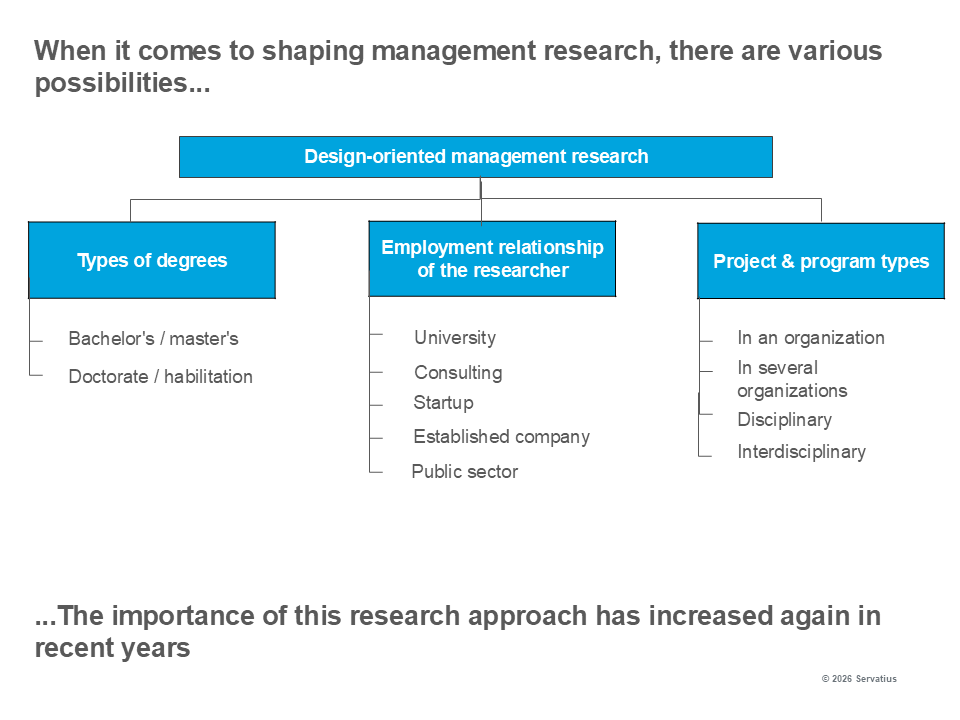
Design-oriented management research is not only taking place at universities, but also increasingly in practice. University lecturers are increasingly supervising creative research approaches by employees in their companies. This approach is mainly used in bachelor’s and master’s theses in dual study programs, in which the course of study is organized in parallel with practical work. In the past, this has also been done more frequently in external dissertations and postdoctoral theses, e.g., by management consultants. The focus here was more on practical relevance. Solving complex problems requires research by interdisciplinary teams, whose members then receive their degrees in their respective fields. Universities should work with partners in the field to combine such projects into programs that can also build on each other (e.g., to design a sovereign AI from Europe).34
The following figure summarizes various possible forms of design-oriented management research. Here, we distinguish between the type of degrees, the employment relationship of the researcher and the project and program types. In a part-time doctorate of a consulting employee, for example, it makes sense to compare the results of projects from several organizations and derive new insights from them. What seems important in this research approach is that design-oriented research projects based on theoretical foundations35 now focus more strongly on concrete application in practice.
In 2026, we will further develop this approach to management research in the context of designing high-performance systems in which trustworthiness has become an important competitive advantage. One model for this is the start-up ecosystem in Munich, from which other regions can learn.36
Conclusion
- High-performance systems are characterized by their success and trustworthiness. In the current transition phase, Europe should seize this as an opportunity.
- To do so, companies must master complex realignment processes and become more resilient, digital, and sustainable
- Such connective strategic management (Strategy 5.0) is one of the fields of action of trustworthy high-performance systems
- Another field of action is the promotion of high-performance teams with a growth mindset
- This requires trustworthy partners and closer cooperation between business and politics
- Real-world laboratories of change open up new opportunities for design-oriented management research.
Literature
[1] zu Fürstenberg, J., Kloepfer, I., How good we are is revealed in times of crisis – A wake-up call, Piper 2025
[2] Servatius, H.G., Trimming an organization for performance. In: Harvard Manager, 1988, No. 4, pp. 128-134
[3] Katzenbach, J.R., Smith, D.R., The wisdom of teams – Creating the high performance organization, Harvard Business School Press 1993
[4] de Waal, A., What makes a high performance organization, Warden Press 2019
[5] Servatius, H.G., AI as a tool for strategic management. In: Competivation Blog, May 1, 2025
[6] Sommer, U., US corporations are stronger than ever. In: Handelsblatt, December 29, 2025, pp. 1, 4-6
[7] Alvarez de Souza Soares, P., Holtermann, P., AMD wants to end Nvidia’s monopoly. In: Handelsblatt, January 7, 2026, pp. 18-19
[8] Knees, C., Disinformation as a business risk. In: Handelsblatt, January 7, 2026, pp. 20-21
[9] Merten, M., Companies sinking in AI junk. In: Handelsblatt, January 9, 2026, pp. 20-21
[10] Frankopan, P., „What does Europe have besides handbags and champagne?“ (Interview). In: Handelsblatt, December 19/20/21, 2025, pp. 12-13
[11] Fröndhoff, B., et al., Billions for restructuring. In: Handelsblatt, November 26, 2025, pp. 1, 4-5
[12] Servatius, H.G., Disruption of management education for AI-based realignments. In: Competivation Blog, October 10, 2025
[13] Servatius, H.G., Development and change in strategic management. In: Competivation Blog, September 19, 2025
[14] Servatius, H.G., Triple strategic realignment. In: Competivation Blog, June 7, 2024
[15] Servatius, H.G., Strategic leadership with contextual and relationship-oriented intelligence. In: Competivation Blog, March 14, 2023
[16] Huchzermeier, D. et al., Economy in reform gridlock. In: Handelsblatt, February 2/3/4, 2026, pp. 1, 6-7
[17] Servatius, H.G., Resilience-oriented strategic management. In: Competivation Blog, March 15, 2024
[18] Meiritz, A., „We will certainly remember a no.“ In: Handelsblatt, January 22, 2026, p. 1, 4-5
[19] Koch, M., Can an alliance of middle powers slow Trump down? In: Handelsblatt, January 22, 2026, p. 5
[20] Bomke, L., Germany’s AI hope. In: Handelsblatt, December 2, 2025, p. 1
[21] Czikszentmihalyi, M., Creativity – Flow and the psychology of discovery and invention, Harper Collins 1996
[22] Dweck, C., Mindset – The new psychology of success, Random House 2006
[23] Nadella, S., Hit Refresh – The quest to rediscover Microsoft’s soul and imagine a better future for everyone, Harper Collins 2017
[24] Murphy, M.C., Cultures of growth – How the new science of mindset can transform individuals, teams and organizations, Simon & Schuster 2024
[25] Herwig, M., Linnhoff, C., New A 45 bridge opened. In: Rheinische Post, December 23, 2025, p. A6
[26] Fukuyama, F., „Trumpism is a cry against modernity“ (interview). In: Handelsblatt, December 5/6/7, 2025, pp. 12-13
[27] Tüngler, M., „Friedrich Merz still has it in his hands“ (interview). In: Handelsblatt, December 11, 2025, pp. 22-23
[28] Grünewald, S., We crisis acrobats – Psychogram of an unsettled society, Kiepenheuer & Witsch 2025
[29] Delhaes, D., Architect of a German research breakthrough. In: Handelsblatt, December 30, 2025, p. 13
[30] Andritzky, J., The country needs visions – For long-term policies with the courage to face the future, Herder 2026
[31] Bomke, L., Revolutionizing the trade with AI. In: Handelsblatt, January 7, 2026, p. 26
[32] Simon, H.A., The sciences of the artificial, 3rd ed., MIT Press 1996
[33] Mitchell, W.J., City of bits – Space, place, and the infobahn, MIT Press 1995
[34] Servatius, H.G., AI and the future of management education. In: Competivation Blog, April 9, 2025
[35] Seckler, C., et al., Design sciences across industries – Building bridges for advancing impactful business research. In: Schmalenbach Journal of Business Research, December 9, 2025
[36] Banze, S., Freisinger, G.M., The Munich code. In: Manager Magazin, February 2026, pp. 30-36