

AI-supported strategic foresight | Competivation
Connecting causal AI with complex evolutionary systems

Connecting causal AI with complex evolutionary systems

In the field of artificial intelligence (AI), a paradigm shift is currently underway from purely statistical correlations to dynamic cause-and-effect models. The theory of complex, evolutionary systems—which our expert network Competivation has been applying to real-world management problems for several years—offers a promising foundation for this causal AI. The goal is to integrate these two lines of development. Investor interest in the Heidelberg-based startup Kausable AI demonstrates just how great the potential of this paradigm shift is.

In our new blog post, I explain how the management theory of complex, evolutionary systems can help causal AI achieve a breakthrough.


Early-stage investment in Kausable AI

AI models trained on historical data reach their limits when something unexpected occurs. They then have to be adjusted through a time-consuming process. The Heidelberg-based company Kausable AI started with the idea that a new generation of models must learn to cope better with constant change. To this end, Kausable has received an early-stage investment of 12 million euros from venture capitalists and renowned AI researchers. The model, trained using synthetic data, is designed to understand causes and effects, derive hypotheses from them, and learn from results to master new challenges. Whether this approach will work remains to be seen, but the need is great, as tackling complex problems is becoming increasingly demanding. For example, with their project TipPFN, the founders are attempting to identify tipping points at which systems suddenly change.1

In this context, innovative AI models require a practical theoretical foundation.


Applying the theory of complex, evolutionary systems to real-world management problems

I recently described the development of the theory of complex evolutionary systems and its application to real-world management problems in an article.2 For this connection with an AI that understands causes and effects, certain characteristics of these systems are significant, which I would like to briefly explain. This is particularly true with regard to the complex interactions between different levels, such as geopolitics, the environment, states, regions, companies, and administrations, as well as individuals and society.

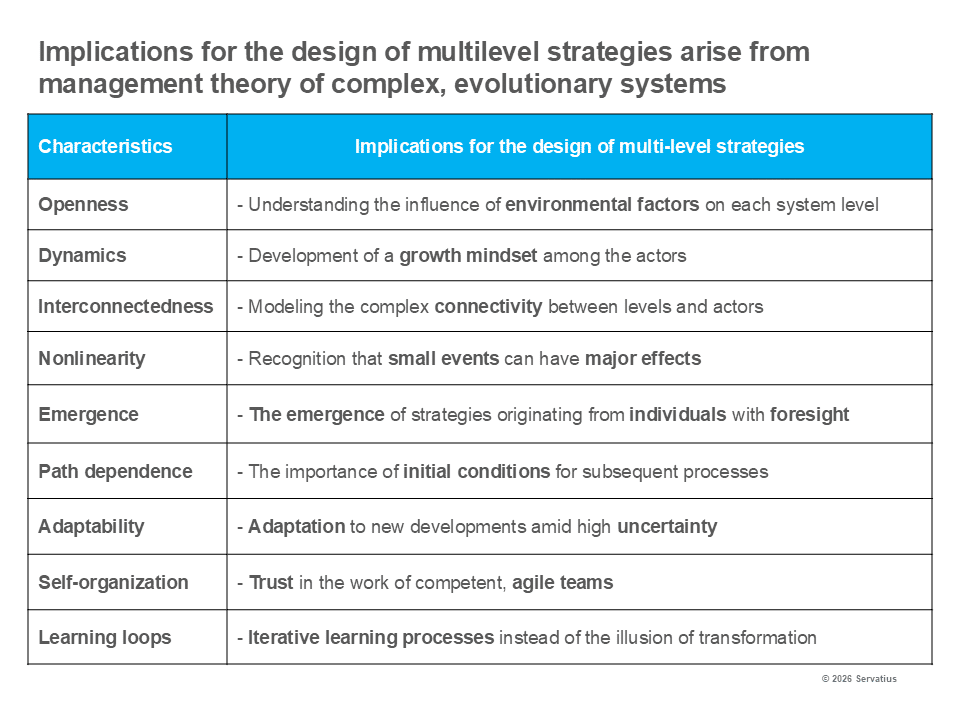
The implications for designing multilevel strategies are profound. AI support can help mitigate the shortcomings of traditional management practices.
Lernprozess Innovationsstrategie

A defining characteristic of complex, evolutionary systems is openness. It is therefore important to understand the influence of environmental factors at every level of the system. Currently, the interplay of various risks poses a new type of threat to the German economy.

This environment is characterized by high dynamism. Consequently, all relevant stakeholders face the challenge of developing a growth mindset. Leadership and human resources development provide important impetus for such a self-image.

Another key characteristic is interconnectedness. AI can help model the complex connectivity between levels and stakeholders. For example, problems related to the energy transition in the past have arisen from barriers between the sectors of politics, science, business, and society.

The nonlinearity of these processes is often underestimated. This refers to the realization that small events can have major effects. However, these effects are usually only recognized after tipping points have been reached.

A hallmark of many strategies is emergence. Contrary to the widespread belief that top management develops strategies, these often originate with individuals possessing exceptional foresight and spread from the outside or from the bottom up through the hierarchy.

Path dependence is also underestimated. This refers to the importance of initial conditions for subsequent processes. A typical example is strategies that are logically sound but fail due to a toxic organizational culture.

Complex, evolutionary systems are characterized by adaptivity. This adaptation to new developments amid high uncertainty has reached an extreme level due to the current geopolitical situation.

As a result, the framework conditions for self-organization are becoming increasingly important. Successful digital companies rely on the work of competent, agile teams. On the other hand, in “old-school” personnel management, agility is still a foreign concept.

Closely linked to this is the importance of learning loops. One indicator that these iterative learning processes are working is when leaders do not fall victim to a “transformation illusion” and believe that a new, stable state of equilibrium is achievable.

Understanding complex, evolutionary systems plays a key role in helping causal AI achieve a breakthrough. To this end, it is important to examine the significance of the three levels of a causality ladder for dynamic cause-and-effect models.


Significance of the three levels of the causality ladder

The significance of the three levels of causality developed by Turing Award winner Judea Pearl lies in overcoming the limitations of pure pattern recognition to create systems that understand cause-and-effect relationships, run through hypothetical scenarios, and act in a comprehensible manner. Pearl distinguishes between the levels of observation, action, and reflection.3

The first level of observation (association) involves capturing data and patterns. This is the foundation of classical deep learning. The problem here is that while these systems recognize correlations, they do not recognize causalities—in other words, they do not understand the “why.” When the framework conditions change (dataset shift), traditional AI models often fail.

The focus of the second level of action lies on actively intervening in a system and altering variables. At this stage, causal AI moves beyond its passive role. It can predict, to a limited extent, what might happen.

The third level of reflection (counterfactual thinking) explores alternative scenarios as part of a retrospective analysis. This stage bridges the gap to human cognition. It enables AI to truly learn from mistakes through hypothetical simulations.

For a definitive breakthrough in causal AI, progress is currently still lacking in the following four key areas:

  1. Automatic structure discovery. To identify cause and effect from observational data (causal discovery), the involvement of human experts with methodological and subject-matter expertise is required.
  2. The development of standardized software frameworks. There is a lack of both universal, easily understandable software libraries for specific applications and benchmarks for measuring the performance of causal models.
  3. A lack of real-world data regarding causality levels two and three. To simulate complex application domains, better methods for generating synthetic data are needed.
  4. The connection to deep learning. The strength of causal AI lies in logical thinking. Deep learning excels at processing unstructured data. Research institutes and tech giants are working to merge these two worlds (causal deep learning).

An AI-supported application of the theory of complex evolutionary systems in management practice focuses on these key areas.


Cooperation among different stakeholder groups

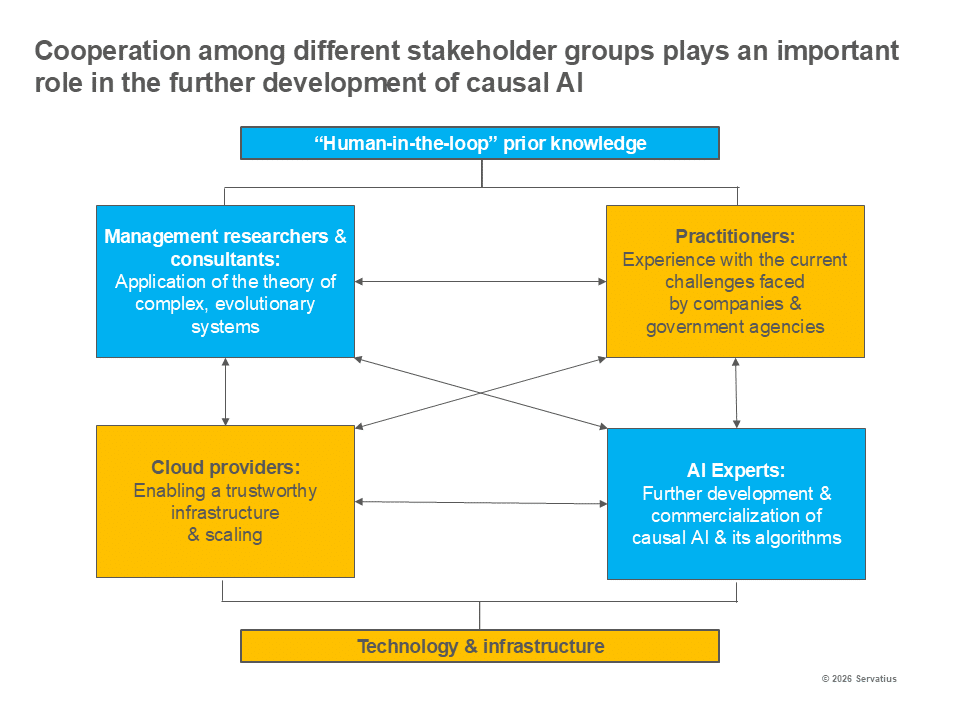
When combining causal AI with complex, evolutionary systems, cooperation among various stakeholder groups plays a crucial role. These groups include:

  • Management researchers and consultants who apply the theory of complex evolutionary systems, as well as
  • practitioners who have experience with the current challenges facing companies and government agencies.

These two groups provide the “human-in-the-loop” prior knowledge and should safeguard this valuable resource. In addition to this experiential level, there is the level of technology and infrastructure. Here, the following groups are active:

  • AI experts who work on the further development and commercialization of causal AI and its algorithms, as well as
  • cloud providers who enable the use of a trustworthy infrastructure and its scalability.

In the past, our network of experts has found that the connectivity among these stakeholders is a key success factor. In this respect, the topic is another building block of the fifth stage of development in connective strategic management, a concept we have coined.4
Lernprozess Innovationsstrategie

It is important to recognize that, even for digital giants, causal AI is something like the “Holy Grail” of the next generation of AI. Such “Next AI” relies more heavily on the Socratic method of critical, step-by-step questioning to reduce the hallucinations typical of language models.5 An interesting application of causal AI is the development of positive visions of the future through strategic foresight.


Development of positive visions of the future

Strategic foresight has a long history of development. Although the term “foresight” was not coined until the 1980s, key methods—such as scenario analysis—emerged as early as the 1960s, when research institutes in the U.S. shifted their focus from the military to the private sector following World War II.

The Game-Changer Radar, which we developed several years ago, aims to identify profound changes at an early stage in order to capitalize on emerging opportunities before competitors do.6 We used this method in our book on AI as a game changer, published in 2020.7

Strategic foresight should focus more on designing positive visions of the future that view the future as a space of possibilities that can be shaped.8  Causal AI can help systematically think through possible developments and interactions. Such visions of the future serve as the starting point for compelling narratives that foster a stronger emotional connection. Germany urgently needs such a narrative at this time.


Conclusion

  • Causal AI has the potential to prepare organizations for unexpected changes more effectively and cost-efficiently than traditional AI models
  • The application of the theory of complex, evolutionary systems in management and the characteristics of this theory provide an important foundation for causal AI
  • This theoretical base can contribute to a breakthrough in causal AI. This requires cooperation among different stakeholder groups
  • In practice, there is a great need for positive visions of the future, which we develop with the help of AI-supported strategic foresight.


References

[1] Bomke, L., Renowned AI Researchers Are Backing These German Founders. In: Handelsblatt, July 24, 25, and 26, 2026, p. 31

[2] Servatius, H.G., Learning to Design Solutions for Complex Management Problems. In: Competivation Blog, July 15, 2025

[3] Pearl, J., Mackenzie, D., The Book of Why – The New Science of Cause and Effect, New Edition, Basic Books 2026

[4] Servatius, H.G., Connective Strategic Management in the AI Era. In: Competivation Blog, May 22, 2026

[5] Bomke, L., Dehari, L., Fokuhl, J., Training AI with Socrates. In: Handelsblatt, August 12, 2026, pp. 26-27

[6] Servatius, H.G., Strategic Foresight with a Game-Changer Radar. In: Competivation Blog, January 27, 2021

[7] Kaufmann, T., Servatius, H.G., The Internet of Things and Artificial Intelligence as Game Changers – Paths to Management 4.0 and a Digital Architecture, SpringerVieweg 2020

[8] Schön, N., Peters, N., Europe Urgently Needs More Future Competence. In: Handelsblatt, August 5, 2026, p. 14

Connecting causal AI with complex evolutionary systems

AI as a tool for strategic management

Artificial intelligence (AI) is currently developing into a powerful tool for strategic management that accelerates, strengthens and changes learning processes. This applies to the corporate level as well as to the level of functional areas and business processes. Pioneering companies are using knowledge-specific AI in the various phases of strategic processes and achieving competitive advantages with innovative, AI-based business models. Generative AI has the character of a wake-up call.


In our series of blog posts on artificial intelligence, this article deals with the role of AI in strategic management. In it, I explain the increasing importance of AI in strategy processes.


Generative AI as a wake-up call

The use of artificial intelligence in strategic management is not new. Since the turn of the millennium, US digital companies such as Amazon have been using AI-based personalization as part of their innovative business models.1 Surprisingly, many users of these business models are not aware of the contribution of AI.

In our book The Internet of Things and Artificial Intelligence as Game Changers, published in 2020, we described the strategy process for new IoT- and AI-based business models2 and discussed relevant business model patterns.3 At that time, however, interest in the topic was still limited in Germany.

The real wake-up call that shook the general public awake came in November 2022, when OpenAI released its ChatGPT dialog program. This action triggered a hype around generative AI and large language models, which was followed by a certain disillusionment.4

Many companies are now asking themselves what role artificial intelligence can play in their strategy processes.


AI-supported strategy processes at corporate level

A study by the Massachusetts Institute of Technology (MIT) concludes that artificial intelligence accelerates and strengthens learning processes.5 Such augmented learning builds on existing learning capabilities. An important field of application are the various phases of innovative strategy processes that help companies to gain a new form of competitive advantage.

Lernprozess Innovationsstrategie

It starts with an AI audit to analyze the company’s initial strategic situation and its use of AI. This is followed by AI-supported strategic foresight, which enables faster and more efficient early detection. Knowledge-based AI is also a means of realigning business models. Another phase is the design of an AI-oriented stakeholder ecosystem. When selecting partners, it is important to find the right balance between cooperation and competition.

Innovative AI platform architectures form the basis for relevant applications, and companies generally need partners to implement them. Strategies are implemented with the help of agile, AI-supported performance management. This involves close coordination between the corporate level and the level of connected business processes.

Strategic learning loops, which take the form of rapid iterations, play a decisive role in agile strategy processes. This turns the analysis of the initial strategic situation into a dynamic process.


AI audit to analyze the initial strategic situation

A study by the German Economic Institute (IW) concludes that AI could contribute 330 billion euros to gross value added nationwide. One in five companies already uses AI. However, most applications are rather selective, e.g. in the form of chatbots for customer inquiries. Surprisingly, 66% of companies say that AI is not relevant to their business model. 36 percent consider integration into existing systems to be difficult. 47% complain about the lack of employee expertise. NRW Minister President Hendrik Wüst nevertheless believes that AI could be the driving force behind an economic upturn.6

To achieve this goal, companies should carry out an AI audit and use a SWOT analysis, for example, to gain an overview of their initial strategic situation.7 Interestingly, results of such an analysis of strengths, weaknesses, opportunities and threats are similar. One strength of companies is that they have a lot of specific knowledge that has the potential to be enhanced by AI. This is often offset by weaknesses in the systematic anchoring of AI in strategies and processes. The potential of AI lies both in increasing productivity and in innovation benefits through new products, services and business models. On the other hand, there are many threats from competitors, foreign stakeholder ecosystems and misuse of the power inherent in artificial intelligence.8

Lernprozess Innovationsstrategie

On this basis, the next step is to prepare even better for future developments with the help of AI-supported strategic foresight.


AI-supported strategic foresight

The term strategic foresight, coined in the 1980s, has a long history, during which methods such as scenario analysis, which are still widely used today, were developed. The Gamechanger Radar developed by us makes it possible to prepare for far-reaching changes.9 With AI-supported strategic foresight, pioneering companies are now writing a new chapter in foresight. This chapter assumes a change in the way people search for information on the internet.

For example, Google has developed the new search function „Overview with AI“, which provides summarized texts on topics. An example is shown in the following illustration. The topic I entered is: „Applying Complexity Theory in Management“. The answer that Google provides is surprisingly good. It describes the paradigm shift in strategic management that has taken place in recent decades more comprehensively and better than many individual publications on this topic.

Lernprozess Innovationsstrategie

Foresight users will learn to improve their prompting capabilities relatively quickly. In addition, AI-supported foresight platforms are currently emerging that simplify and accelerate the early recognition of new trends, which usually take the form of weak signals.

Of course, this development also poses a threat to Google’s traditional search engine business, which is linked to advertising. The start-up Perplexity, for example, is trying to take users away from Google with its user-friendly „answer engine“. It remains to be seen what effect this will have on the market leader’s profit driver10

Reasoning AI enables advantages for complex tasks such as strategic foresight. It is now offered by some AI developers. In reasoning, the AI breaks down possible queries into sub-problems and processes them step by step. Such slower thinking costs more computing power and electricity. Developers call the „reasoning“ of AI a chain of thought (CoT). Reasoning models achieve this through an additional training step that uses reinforcement learning to train detailed reasoning. Similar to an experienced employee, reasoning models analyze complex information step by step. To do this, they need a single precise prompt and a lot of context. However, the application of reasoning AI in strategic foresight is still at the experimental stage.11


AI-based realignment of business models

Innovative business models for AI-based robotics are currently emerging. This represents an opportunity for Europe. Stanford professor and great „godmother of AI“ Fei-Fei Li has founded the start-up World Labs, which develops AI models for the spatial intelligence of robots that support machines. Google subsidiary DeepMind and digital giant Nvidia are also working on partner networks for AI-based human-like robots. Many of the partners come from Europe. In addition to well-known robotics companies, start-ups such as Anybotics (Switzerland) and Agile Robots, Neura Robotics and Quantum Systems from Germany are emerging here, although they do not have as much funding as their competitors from the USA (e.g. Figure AI and Covariant). For Europe, it is important to seize the opportunities arising from the combination of in-depth industry-specific knowledge and innovative AI models as quickly as possible.12

Two dimensions are relevant for an AI-based realignment of business models. These dimensions are productivity orientation and innovation orientation. Most companies start with an AI-based increase in productivity and use AI in routine processes to reduce personnel costs. In addition, many fields of application for AI-based innovations have now emerged. When both dimensions come together, we speak of AI-based ambidexterity. The term ambidexterity originally refers to the ability to use both hands in sport. Applied to management, ambidextrous leadership describes leadership that strikes a good balance between innovation and productivity.13

Lernprozess Innovationsstrategie

The specific applications of these two dimensions in industries and companies result in a wide variety of AI-based ambidexterity. The new business models are embedded in AI-oriented stakeholder ecosystems.


AI-oriented stakeholder ecosystems

German and European policymakers are planning to boost the performance of their AI ecosystem. In view of the changing geopolitical situation, the coalition agreement of the new German government provides for a strengthening of digital sovereignty. The digital policy of the European Union (EU) aims in the same direction. Five gigantic data centers are planned in order to catch up in the field of artificial intelligence. The Jülich and Stuttgart sites are candidates for such a gigafactory in Germany. When it comes to AI regulation, the EU wants to focus more on competitiveness and reduce bureaucracy. An EU action plan has been drafted to this end. It remains to be seen whether these measures will be enough to reduce dependence on the large cloud providers (hyperscalers) from the USA.14

There are also two dimensions to consider when designing a company’s AI-oriented stakeholder ecosystem.15 One dimension is the dependence on powerful AI providers. In order to reduce this dependency, the second dimension for companies is improving their own skills in the development and application of artificial intelligence. In the hype phase of basic AI models, dependence on US providers has increased. The opportunity for Europe now lies primarily in knowledge-specific AI models for various applications. Hybrid AI ecosystems are emerging by connecting these two dimensions. Such connectivity requires specific skills.

Lernprozess Innovationsstrategie

In view of the geopolitical uncertainties, companies are faced with the difficult task of finding the right partners when designing their AI ecosystem. The transitions between cooperation and competition are fluid. The term coopetition describes such a situation.16 However, the theoretical basis for a combination of cooperation and competition is still lacking in AI ecosystems. An important field of application is the selection and in-house development of innovative AI platform architectures.


Innovative AI platform architectures

The chip manufacturer AMD and the Finnish start-up Silo AI, which belongs to AMD, are working together with the companies of the Swedish Wallenberg Group. The Nvidia competitor AMD has announced a partnership with 38 companies. These include AstraZeneca, Scania, Saab, Ericsson and IKEA. The collaboration is coordinated by the Wallenberg innovation network Combient. The aim is to scale company-specific AI models. While OpenAI trains its AI models on Nvidia chips, Silo AI uses chips from AMD. The role of Silo AI is to accelerate the deployment of AI models at companies that use AMD platforms. The infrastructure on which the work has begun plays an important role here, as a move is time-consuming. Silo AI uses multimodal AI agents, i.e. models that process images and audio files as well as speech.17

Established digital companies have been practising an organizational form with an IT platform at its center for some time now.18 With the increasing importance of artificial intelligence, this concept is becoming more and more relevant for established companies. Innovative AI platform architectures combine both the strategic and operational levels as well as centralized and decentralized organizational units. This enables all business processes and projects to have access to a common database. Due to their connecting role, AI platforms not only become a strategic building block, but also an important organizational design element. One question that is not easy to answer is how large the share of partners and the company’s own share should be in such an AI platform.

Lernprozess Innovationsstrategie

Innovative platform architectures also provide the infrastructure for AI-supported performance management.


AI-supported performance management

To answer the question of how artificial intelligence can improve performance management, it helps to take a look at the history of performance measurement. The Management by Objectives (MbO) developed by Peter Drucker and the goal-setting theory developed by organizational psychologist Edwin Locke provide important conceptual foundations. Back in the 1980s, Intel developed the agile Objectives and Key Results (OKR) method, which the venture capitalist Kleiner Perkins used at Google, for example.19 In Germany, the Balanced Scorecard method, which emerged from a best practice study by Robert Kaplan and David Norton, is much better known.20 An AI-supported performance management system designed by Kleiner Perkins and the start-up Betterworks now aims to better connect strategy and motivation.

Lernprozess Innovationsstrategie

Although artificial intelligence is one of the top management issues for 2025, many companies neither formulate specific AI targets nor measure the results. A global BCG study, in which 1,800 managers were surveyed, found that only 24% of companies track their operational and financial AI targets. AI-supported performance management faces three challenges. These challenges are:21

  1. Do not stall early trials
  2. define appropriate key results for the success of an individual measure and, in addition
  3. capture the longer-term effects resulting from the interaction of various measures.

The agile OKR method provides a conceptual basis for this, but requires adaptation. OKR pioneer Kleiner Perkins is one of the investors in performance management software provider Betterworks. The vision of the Palo Alto-based company, which was founded in 2013, is to further develop traditional performance management. AI plays an important role here as a co-pilot. Managers can thus invest time saved on routine tasks in better harmonization of strategic and operational projects. Important use cases are:22

  • Alignment of ambitious corporate goals and personal goals
  • data-based, motivating feedback and
  • the support of communication and learning processes.

The intended benefit, which contributes to the overall success, is

  • a reduction in bias, more fairness and objectivity
  • increased productivity and
  • better personal relationships.

This brings performance management one step closer to the motivational concept already pursued by goal-setting theory.

With the increasing importance of artificial intelligence in strategic management, geopolitical expertise in working with stakeholders is becoming ever more important alongside practical skills in using AI as a tool. One basis for this is a strong future narrative.


A strong future narrative as a basis

In our 2020 book on the gamechanging potential of artificial intelligence, we took a critical look at European and German digital policy.23 The new German government now faces the task of developing a strong future narrative that connects various policy areas.24 One approach to such a much-needed grand narrative is the application of trustworthy AI both to increase productivity and to solve the innovation and environmental problems of organizations. At the heart of this is the new form of ambidexterity outlined earlier.

Lernprozess Innovationsstrategie

Traditional ambidexterity strives for a balance between tapping innovation potential (exploration) and utilization of productivity (exploitation). With the help of AI, which should be trustworthy, it is now possible to simultaneously

  • reduce labor costs by increasing productivity, counter the shortage of skilled workers25 and
  • to make greater use of qualified personnel for the digital and ecological realignment of organizations26

In view of the changed geopolitical situation, there is a window of opportunity for AI made in Europe, which the „old continent“ should use to strive for global market leadership in the necessary sustainability innovations.27 Due to the large number of crises to be overcome, this initially requires resilience-oriented strategic management.28


Conclusion

  • Strategy processes become more efficient through the use of artificial intelligence
  • Knowledge-specific AI supports strategic foresight, the realignment of business models, the design of stakeholder ecosystems, innovative platform architectures and performance management
  • Pioneering companies are working on AI-based ambidextry
  • In view of the geopolitical challenges, choosing the right partners is crucial.


Literature

[1] Servatius, H.G., Competitive advantages with knowledge-specific AI. In: Competivation Blog, 11.02.2025

[2] Kaufmann, T., Servatius, H.G., Das Internet der Dinge und Künstliche Intelligenz als Game Changer – Wege zu einem Management 4.0 und einer digitalen Architektur, SpringerVieweg 2020, p. 56ff.

[3] Kaufmann, Servatius, op. cit. p. 34ff.

[4] Servatius, H.G., Development of AI technologies. In: Competivation Blog, 19.02.2025

[5] Alavi, M., Westerman, G., How GenAI Will Transform Knowledge Work. In: Harvard Business Review, November 7, 2023

[6] Höning, A., Kowalewski, R., Every fifth company in NRW uses AI. In: Rheinische Post, November 13, 2025, p. 1

[7] Servatius, H.G., Auditing the innovation system of a company. In: Competivation Blog, 19.03.2015

[8] Suleyman, M., Bhaskar, M., The Coming Wave – Technology, Power and the Twenty-First Century’s Greatest Dilemma, Crown 2013

[9] Servatius, H.G., Strategic foresight with a game changer radar. In: Competivation Blog, 27.01.2021

[10] Alvares de Souza Soares, P., Geldmaschine Google – Wie lange noch? In: Handelsblatt, April 25/26/27, 2025, p. 26-27

[11] Knees, L., Why users pay more for slow AI. In: Handelsblatt, March 31, 2025, pp. 24-25

[12] Holtermann, F., Schimroszik, N., The robots are coming! In: Handelsblatt, January 3/4/5, 2025, pp. 44-48

[13] O’Reilley, C., Tushman, M., Lead and Disrupt – How to Solve the Innovator’s Dilemma, Stanford Business Books 2016

[14] Bomke, L., et al, Europe wants to build its own AI factories. In: Handelsblatt, April 9, 2025, p. 6-7

[15] Servatius, H.G., Designing innovative stakeholder ecosystems. In: Competivation Blog, 10.01.2023

[16] Brandenburger, A.M., Nalebuff, B.J., Co-Opetition – A Revolutionary Mindset That Combines Competition and Co-Operation, Bantam 1996

[17] Holzki, L., AMD enters into partnership with the industry. In: Handelsblatt, January 30, 2025, p. 24

[18] Servatius, H.G., The resource platform with agile teams as a new organizational form. In: Competivation Blog, 12.01.2021

[19] Doerr, J., Measure What Matters – How Google, Bono and the Gates Foundation Rock the World with OKRs, Portfolio/Penguin 2018

[20] Kaplan, R.S., Norton, D.P., Balanced Scorecard – Translating Strategy into Action, Harvard Business School Press 1996

[21] Bomke, L., Höppner, A., Only a few companies measure their AI initiatives. In: Handelsblatt, January 16, 2025, p. 21

[22] Gouldsberry, M., The Pivotal Role of AI in Performance Management, January 11, 2025

[23] Kaufmann, Servatius, op. cit. p. 203ff.

[24] Servatius, H.G., On the way to a new economic policy narrative. In: Competivation Blog, 16.05.2022

[25] Servatius, H.G., Process-oriented AI to increase productivity. In: Competivation Blog, 12.03.2025

[26] Servatius, H.G., AI and the future of management education. In: Competivation Blog, 09.04.2025

[27] Servatius, H.G., Sustainability-oriented strategic management. In: Competivation Blog, 15.08.2024

[28] Servatius, H.G., Resilience-oriented strategic management. In: Competivation Blog, 15.03.2024

Interessiert?

CONNECTIVE MANAGEMENT

Vereinbaren Sie einen unverbindlichen Gesprächstermin:


    +49 (0)211 454 3731