
Triple Realignment | Competivation
Designing trustworthy high-performance systems

Designing trustworthy high-performance systems

In recent years, the importance of connective strategic management has continued to grow. In light of the dynamic development of artificial intelligence (AI) and new geopolitical challenges, the design of trustworthy high-performance systems has become a focal point of interest. In this context, the term „high performance“ is being reinterpreted in business and politics. An important field of action here is design-oriented management research.


In our first blog post of 2026, I address the question of what important areas of action for Europe in terms of trustworthy high-performance systems are.


High performance in business and politics reinterpreted

For Jeanette zu Fürstenberg, who is responsible for Europe at the US fund General Catalyst, there is an opportunity for the old continent in connecting startups with the world of established industrial companies. Her successful investments include Mistral in France and the defense company Helsing in Germany. These companies focus on artificial intelligence (AI) that uses highly specialized application knowledge. Her publication „Wie gut wir sind, zeigt sich in Krisenzeiten“ (How good we are is revealed in times of crisis) was named Management Book of the Year in 2025. For her, the basis for a European high-performance system that can achieve reindustrialization is resilience, which enables recovery as quickly as possible after external shocks.1 In 2025, the number of startups founded in Germany reached a record high.

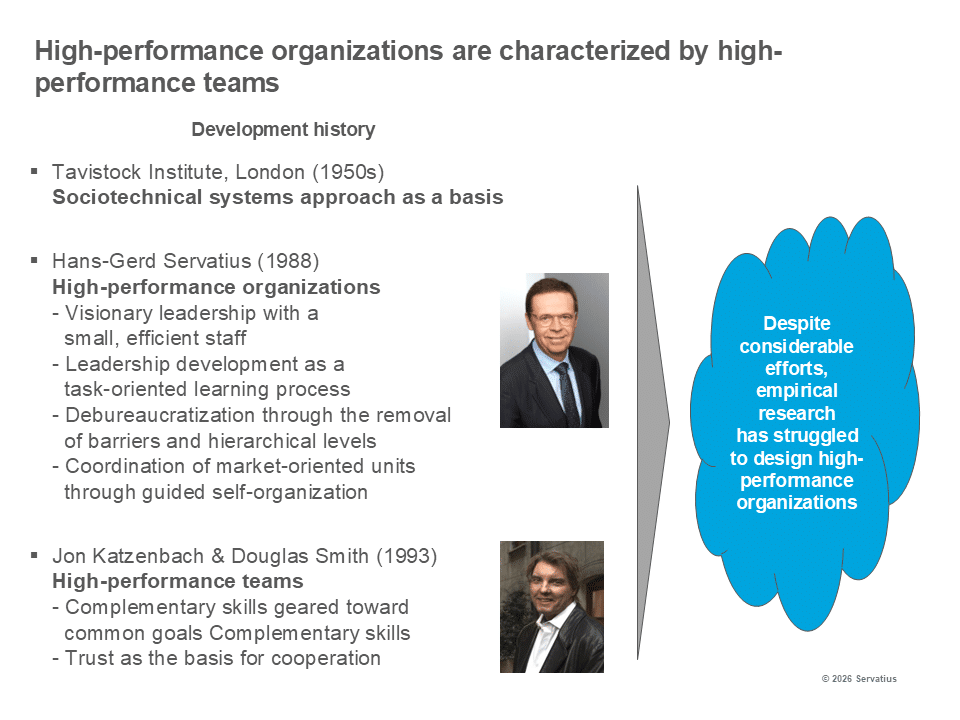
The topic of high-performance organizations is not new. High-performance organizations are characterized by high-performance teams. As early as the 1950s, the British Tavistock Institute developed an initial foundation with its socio-technical systems approach. I described the results of consulting projects on the characteristics of high-performance organizations in an article in Harvard Manager magazine in 1988. One important finding is that visionary leadership creates the framework for teams that work in a more self-organized manner.2

McKinsey consultants Jon Katzenbach and Douglas Smith examined the question of what characterizes high-performance teams.3 However, further developments have shown that, despite considerable efforts, empirical research is struggling with the design of high-performance organizations.4 AI is now giving performance management new impetus to improve the connection between strategy implementation and motivation.5
Lernprozess Innovationsstrategie

US tech companies with artificial intelligence (AI) now dominate the global economy. By the end of 2025, 61 of the world’s 100 most valuable companies will be from the US. The dominance of the US results from the unique strength of seven tech giants, which together have a market value of €18.3 trillion. An important driver of this development is the hype surrounding artificial intelligence (AI). Germany is represented in the top 100 ranking with the companies SAP (rank 40), Siemens (72), the European joint venture Airbus (91), and Allianz (100). In view of geopolitical changes, this concentration of power raises the question of how great the danger of dependence on the US is. 6 In the AI chip market, competitive pressure is increasing for market leader Nvidia.

AI chips are becoming increasingly powerful, but at the same time, AI increases the risk of disinformation. With a global market share of 85.2%, AI chip manufacturer Nvidia has a dominant position ahead of Broadcom (10.3%), Marvell (2.1%), and AMD (1.8%). Challengers AMD and Meta have announced a new AI system for data centers (Helios platform) that is expected to deliver a significant performance boost. Nvidia is countering with its new Rubin chip generation.7

However, there is a risk of a loss of trust in AI due to the risk of disinformation from fake accounts. AI bots falsify content, imitate people, and post automatically on social media. Such deepfakes can cause great economic damage and, for example, ruin a brand’s reputation.8

Large language models and free AI tools often lead to a loss of quality and trust because they are not trained for high performance, but rather for the production of average knowledge. When AI users are under time pressure and there are no quality standards in place, „AI slop“ can result. Although this produces faster results, the quality declines. Possible consequences include a loss of reputation and trust. When using AI, it is therefore important to supplement content with expert knowledge after quality control.9

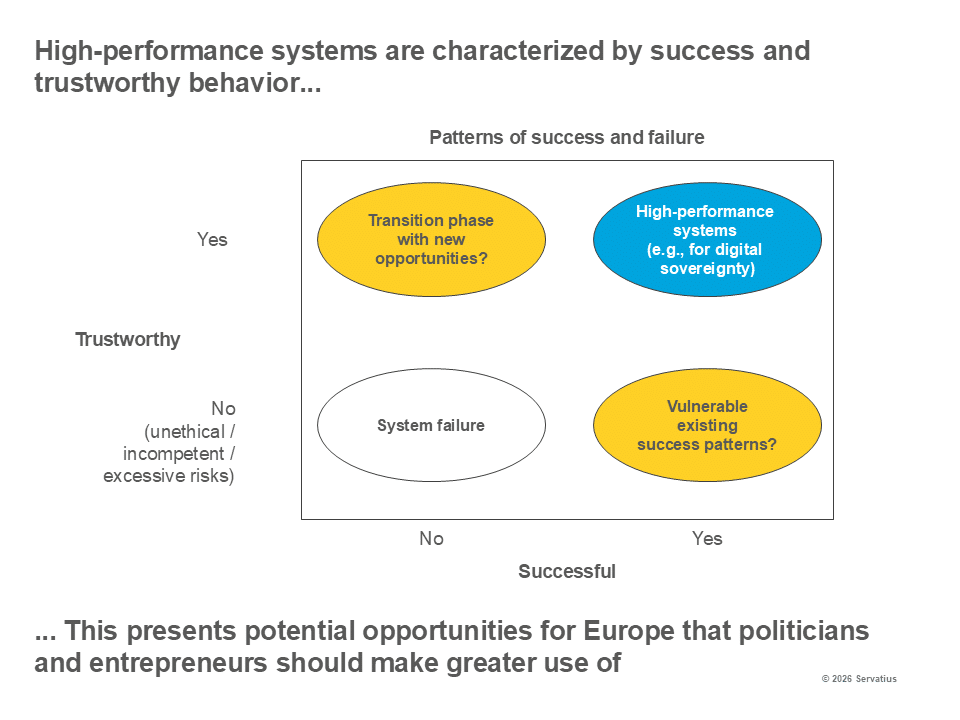
AI and geopolitical challenges are reinterpreting the concept of high performance. Not all AI is trustworthy. We understand a trustworthy high-performance system to be a system (e.g., a company, a region, or a state) that performs very well compared to the competition and is trusted by the recipients of its services. In addition, these service recipients are willing and able to pay for the services. High-performance systems must therefore justify their higher prices (e.g., through „German quality,“ technical superiority, or a luxury brand).

Reinterpreting high performance means that high-performance systems are characterized by both success and trustworthy behavior. If neither of these is the case, we speak of system failure. Most socio-technical systems fall somewhere in between. Cases where only one of the two criteria is met are interesting. An existing pattern of success is at risk when a previously successful system, such as that of the AI champions, loses trust. This could result in a transitional phase with new opportunities, for example, if Europe, which has been less successful in digitalization to date, scores points with trust.
Lernprozess Innovationsstrategie

Peter Frankopan, a British professor of global history teaching at Oxford, sees the world in a transitional phase similar to that of the 1920s, when the old order was not yet dead and a new one had not yet been born.10

The question is therefore how Europe can seize its opportunities and become a designer of trustworthy high-performance systems.


Strategic realignment in a phase of transition

In the first nine months of 2025, DAX companies spent €6 billion on restructuring. The highest restructuring costs in 2025 were incurred by Mercedes (€1.4 billion), Volkswagen (€900 million), Siemens and Commerzbank (€500 million each). The automotive, mechanical engineering, and chemical industries are particularly affected. At the end of September 2025, 120,300 fewer people were employed in German industry than a year earlier. Many companies are offering generous severance packages. Often, one round of restructuring is followed by another without solving the underlying problems. This would require a strategic realignment after restructuring.11

The term „strategic realignment“ describes an innovative approach to coordinating existing and new system elements (e.g., business model, strategy, technologies, customers, competencies, organization, culture, and environment). Realignments usually have a profound effect over a longer, undefined period of time in many parallel learning steps. Complex interactions play an important role in this process, resulting in specific patterns that are difficult to predict.

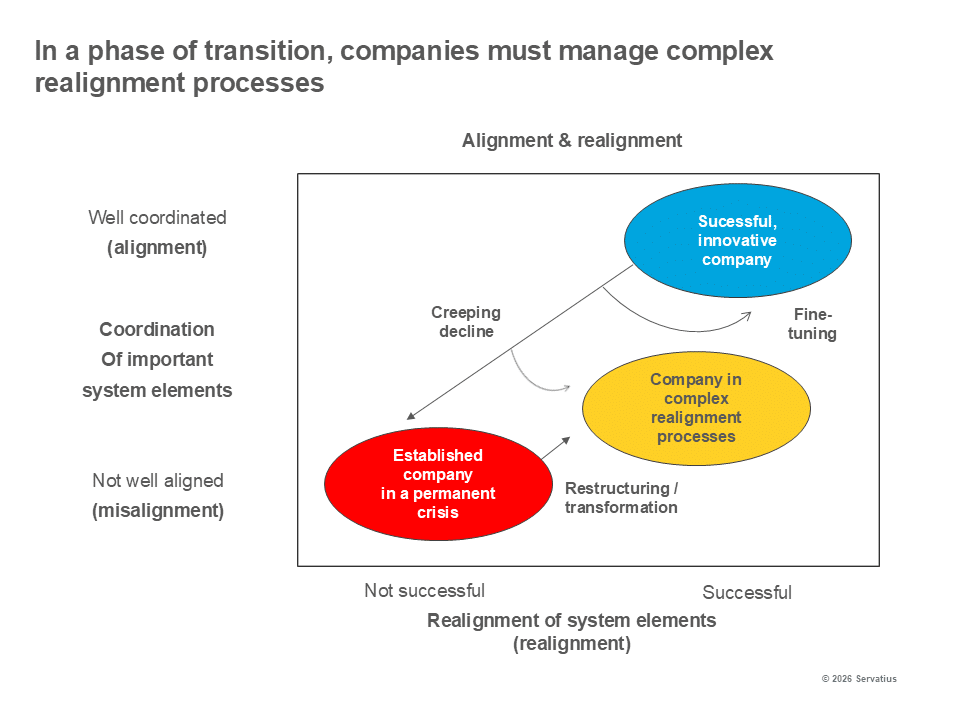
During a phase of transition, companies must manage complex realignment processes. In a successful, innovative company, important system elements are well coordinated. This alignment often takes place through fine-tuning, in which management continuously adapts the strategy to changes in the environment, for example. If this is not done, the company develops in the direction of misalignment. Management and supervisory boards often recognize this creeping decline too late. The result is an established company in a permanent crisis that requires restructuring.

The terms restructuring and transformation are now often used synonymously. Both terms describe a temporary, comprehensive change. Unfortunately, the inflationary use of the term transformation conveys the illusion that complex realignment processes are limited in time. The example of artificial intelligence clearly shows that such a static worldview is naive.
Lernprozess Innovationsstrategie

A longer-term goal of strategic realignments is the design of trustworthy high-performance systems.


Fields of action for trustworthy high-performance systems

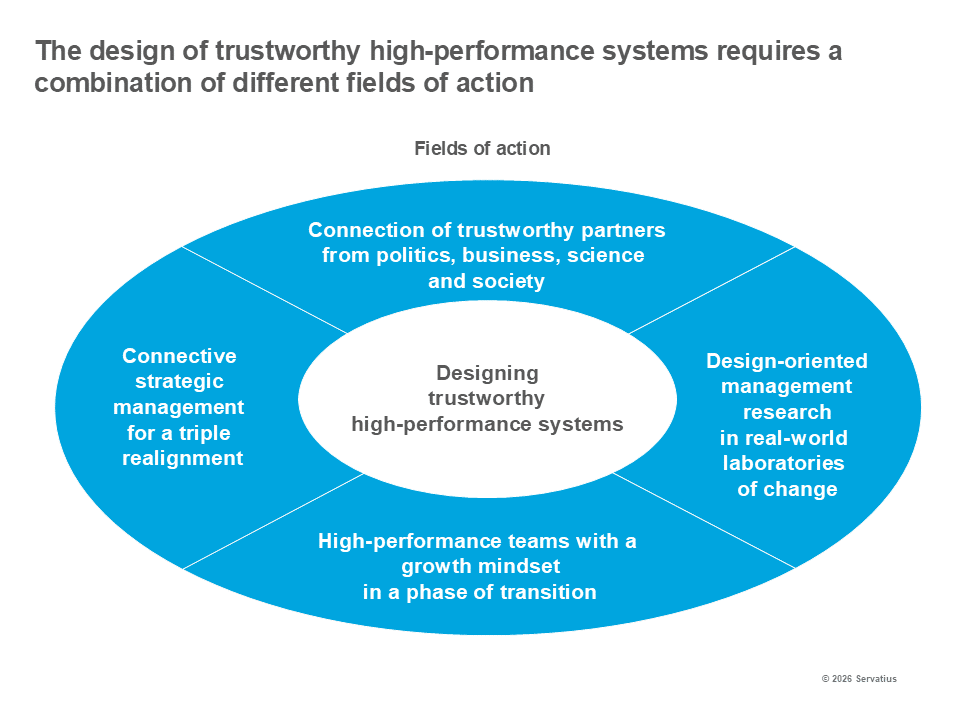
In times of increasing polarization, high-performance systems are characterized by their ability to bring people together. History teaches us that the risk of polarization increases during periods of technological and political upheaval. This also applies to the changes brought about by artificial intelligence (AI). It is crucial that people see themselves as active participants in shaping change rather than passive objects of it. The complementarity of humans and AI is a malleable system. The performance of such a system depends on the ability to improve connections between the actors and the system elements. In our application-oriented research and teaching, we start with the thesis that the following fields of action, shown in the figure, are important in the design of trustworthy high-performance systems:

  • A connective strategic management for a triple realignment
  • high-performance teams with a growth mindset in a phase of transition
  • the connection of trustworthy partners from politics, business, science, and society, and
  • design-oriented management research in real-world laboratories of change.

Interdisciplinary university teaching faces the task of imparting the relevant skills for these fields, e.g., in the area of entrepreneurship for AI applications.
Lernprozess Innovationsstrategie

In the following, I will discuss these fields of action and skills in more detail.


Connective strategic management for a triple realignment

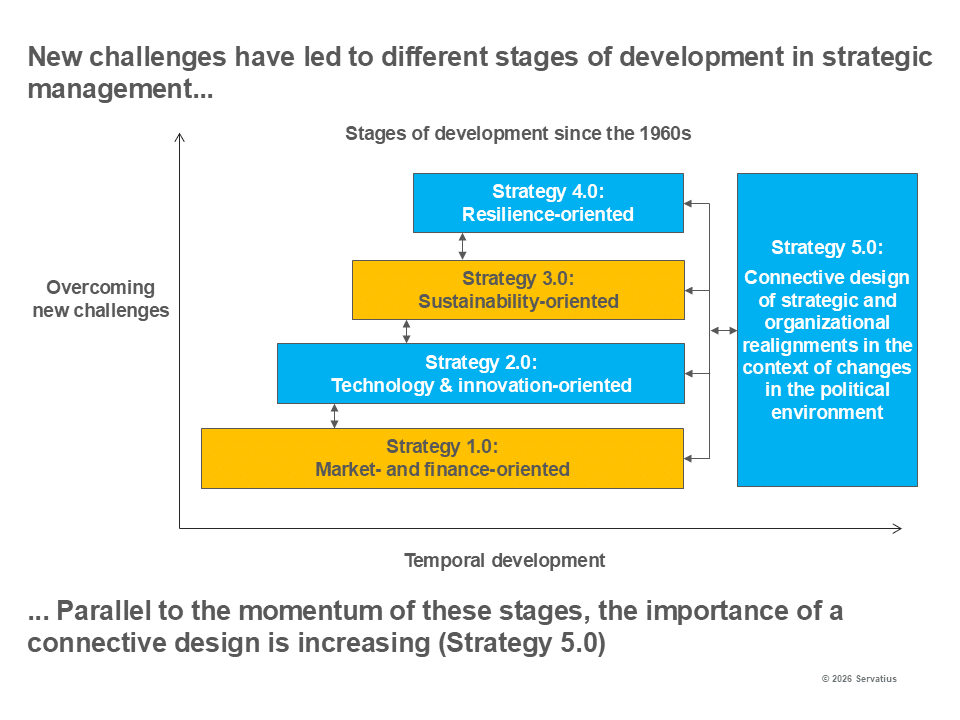
Since the 1960s, new challenges have led to various stages of development in strategic management.13 We distinguish between

  • a market- and finance-oriented stage (Strategy 1.0)
  • a technology- and innovation-oriented stage (Strategy 2.0)
  • a sustainability-oriented stage (Strategy 3.0) and
  • a resilience-oriented stage (Strategy 4.0).

In the current fifth stage of development (Strategy 5.0), the challenge lies in connecting the previous stages. Companies must become more resilient, more digital, and more sustainable at the same time.14 This requires the connective design of threefold strategic and organizational realignments. Such a triple realignment takes place in the context of serious changes in the political environment. The current situation is historically unprecedented. Therefore, the contextual intelligence of management plays an important role.15
Lernprozess Innovationsstrategie

German policymakers should create the framework for a cohesive strategic management approach through fundamental reforms. When the first signs of macroeconomic weakness appeared in 2018, they were harbingers of the most severe and longest industrial recession the Federal Republic has ever experienced. German industry has since lost much of its competitiveness. Experts are calling for new approaches to supply-oriented innovation policy and communication that conveys the need for a change of course. Politicians must implement the promised fundamental reforms. Such a new beginning can only succeed with solidarity instead of polarization.16

In this environment, resilience-oriented strategic management is becoming increasingly important.17  At this year’s World Economic Forum in Davos, the differing positions of the US president and European representatives clashed.18  Canadian Prime Minister Mark Carney suggests that in a world where major powers are becoming imperialists who blackmail other states, middle powers and smaller countries should form trustworthy partnerships.19

Such cooperation plays a decisive role not only at the geopolitical level, but also in high-performance teams.


High-performance teams with a growth mindset in a phase of transition

Black Forest Lab (BFL), currently Germany’s most valuable AI startup, is based in Freiburg, was founded in 2024, and develops AI models for image generation based on text. The founders are part of the core team behind the open-source AI model Stable Diffusion, the text-to-image model that generates digital images from text and, alongside ChatGPT, sparked the global AI hype in 2022. BFL’s Flux models are now one of Google’s biggest competitors. Important impetus for the work of the founding team came from Björn Ommer, a professor of computer science at LMU Munich. This example shows that high-performance teams can also emerge in Germany in the field of AI.20

New ideas and the creation of something new often originate from people who find a state of flow motivating. The term flow (in the sense of „being in the flow“) was coined by psychology professor Csikszentmihalyi back in 1975. It refers to being completely absorbed in an activity, which usually involves a high level of intrinsic motivation and a change in the perception of time. Interviews in which outstanding creative personalities from various fields look back on their working lives show that their motivation stems primarily from the creative process. For many people, the foundations for possible flow states are often laid in their youth, based on their growth mindset.21

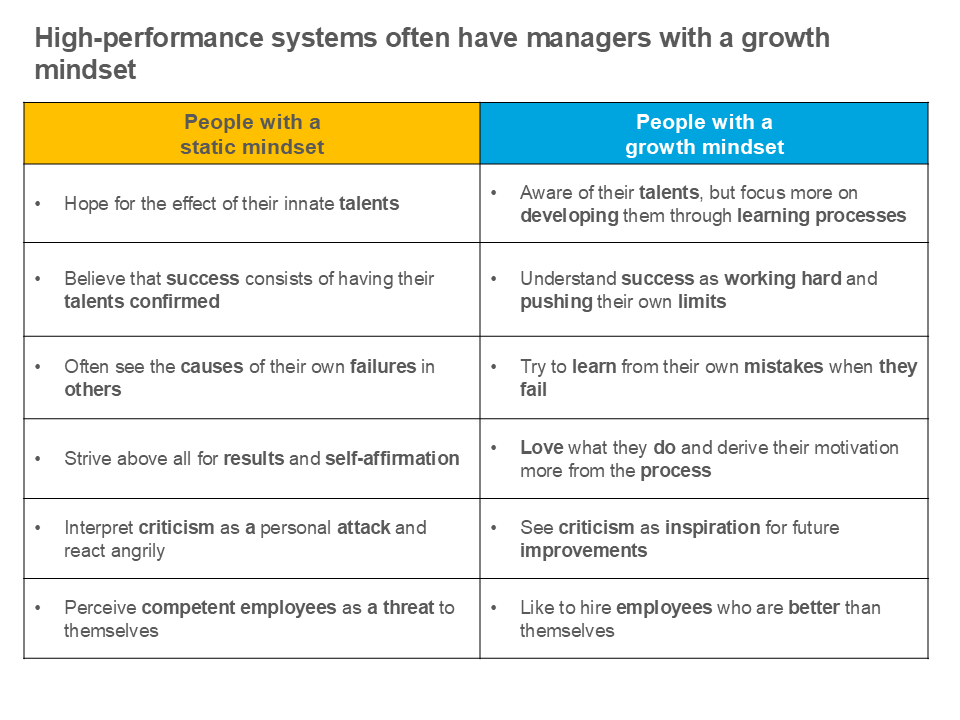
In her book Growth Mindset, Stanford professor Carol Dweck distinguishes between a static and a growth mindset.22 The following figure compares these two mindsets. High-performance systems often have leaders with a growth mindset. An important characteristic is that these people are aware of their talents, but place greater emphasis on their further development and learning processes. In contrast, people with a static worldview place greater hope in the effect of their innate talents.
Lernprozess Innovationsstrategie

Microsoft CEO Satya Nadella writes that the book had a strong influence on his personal development.23

A person’s self-image and their environment are closely linked. High performance therefore arises from an interplay between the two. Social psychologist Mary Murphy has extended the growth mindset concept to organizations, their culture, and the environment surrounding them:24

  • According to this, a growth culture promotes the potential of all employees. This culture emphasizes collaboration, continuous learning, and the development of skills.
  • A genius culture, on the other hand, believes in innate talent. This leads to internal competition, risk aversion, and a reluctance to admit mistakes.

Recommendations for action for managers are

  • create psychological safety and
  • giving constructive feedback.

However, simplistic application of this approach in practice underestimates the complexity of implementation. This can lead to demotivation among exceptional talents.

This raises the question of whether there are any current examples of a growth culture in Germany. A new bridge in South Westphalia has become a symbol of connective design. The Sauerland motorway is the most important transport link between the Ruhr area and Frankfurt. Due to the risk of collapse, the Rahmedetal bridge near Lüdenscheid, where I grew up, had to be suddenly closed in December 2021 and later blown up. This was a disaster for the economy with its many hidden champions and for the people in the region. Every day, 20,000 vehicles had to be diverted via bypasses and through residential areas. The German Economic Institute estimates the damage to businesses at around 1.5 billion euros. In Germany, new construction normally takes around eight to ten years. However, traffic is already rolling across one side of the A45 bridge via the after a record-breaking four years. This was made possible by smooth cooperation between the parties involved, a new planning procedure, and innovative construction methods. The German Chancellor sees this as a model for other renovations, and for the Minister President of North Rhine-Westphalia, the new benchmark for implementation speed in Germany is called „Rahmede“.25

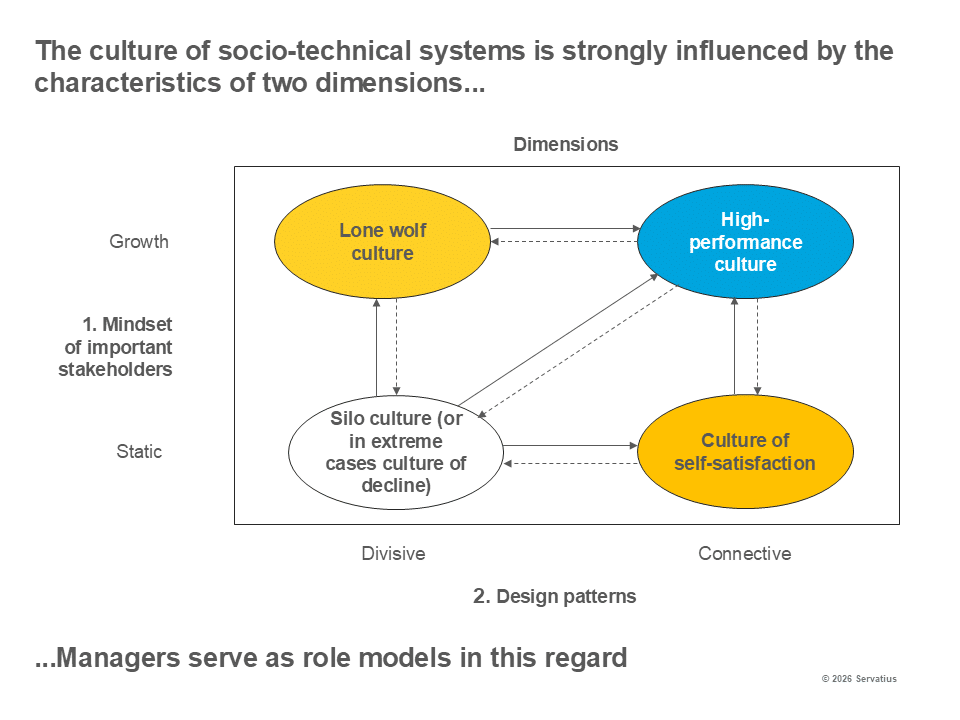
We can therefore summarize that the culture of socio-technical systems is strongly influenced by the mindset-image of important stakeholders and prevailing design patterns.
Lernprozess Innovationsstrategie

High-performance cultures are characterized by a growth mindset and a connective pattern. The opposite is a silo culture or, in extreme cases, a culture of self-satisfaction. Here, a static mindset and a divisive design dominate. Descriptions of outstanding leaders often heroize a lone wolf culture. These individuals are attributed with a growth mindset. At the same time, however, the impression is created that their successes were achieved single-handedly and in isolation from others, which is usually not the case. Until a few years ago, a culture of complacency was widespread in Germany. People rested on the successes of the past, but the mindset in politics and business was rather static and not very future-oriented.

Managers serve as role models in this regard. Their growth mindset is transferred to their employees. Conversely, managers with a static mindset and isolating behavior are responsible for the emergence of toxic cultures. Their position of power enables them to oust internal competitors and employees with a growth mindset that they perceive as a threat. Unfortunately, the role of consultants is often to secure and expand the position of power of the „static“ individuals. Attempts by external parties to change silo cultures are usually met with rejection and fail. It is therefore the task of supervisory bodies to review the dysfunctional mindsets of managers and take timely action. If this does not happen, there is a risk of system failure.

On its way to becoming a high-performance system, Europe currently finds itself in a difficult situation.


Connection of trustworthy partners from politics, business, science, and society

Europe first needs a resilience program against its enemies from outside and within. US political scientist Francis Fukuyama believes that Trumpism will continue even without Trump. For open democratic societies, this is an extremely dangerous development. He fears a relapse into the world order of the 19th century. It is therefore important that Western societies develop sufficient resilience. It should also be taken into account that tech billionaires primarily act in their own economic interests. The greatest danger for Europe is resignation.26

Marc Tüngler, head of the German Association for the Protection of Securities Holders, laments the lack of political support necessary for innovation and economic restructuring. Germany is no longer internationally competitive in terms of electricity prices, for example. Politicians are responsible for this. Important levers would therefore be an improved location policy and a more innovation-friendly climate. We are far from the necessary solidarity between business and politics. He expects 2026 to be a year of decisions for politicians.27

In his book „Wir Krisenakrobaten“ (We Crisis Acrobats), Stephan Grünewald, co-founder of the Cologne-based opinion research company Rheingold, describes the hope for self-efficacy that would enable our society to overcome the multitude of current crises. His recommendation consists of six points:

  1. Truthfulness (clear identification of problems)
  2. focus (successful national projects)
  3. participation (making one’s own contribution clear)
  4. fairness (unreasonable demands must be perceived as fair)
  5. culture of debate (dealing more productively with changes in perspective) and
  6. solidarity (which must be relearned).

Unfortunately, silo thinking („silodarity“) still prevails at present.28

Martin Keller has returned to Germany from the US to become the new president of the Helmholtz Association. The association comprises 18 independent research centers with almost 48,000 employees and a budget of more than six billion euros. Keller wants to use a plan of action to ensure that Germany remains or becomes a global leader in selected fields of innovation. This requires closer cooperation, e.g., in the context of public-private partnerships (PPP), in which politics, research, and business cooperate in order to become more competitive. He believes it is time to break down old structures.29

In his book „Visionen braucht das Land“ (The Country Needs Visions), Jochen Andritzky, co-initiator of Zukunft-Fabrik 2050, calls on politicians to develop visions of the future that can be discussed and provide guidance. This approach is more promising than short-term pseudo-solutions that merely combat the symptoms.30 This return to the power of vision provides important impetus for management research, which in the past has often been content with incremental improvements. Design-oriented management research aims to be more practice-oriented in this regard.


Design-oriented management research in real-world laboratories of change

A research project at Würth has given rise to an AI start-up that could revolutionize the crafts. The aim of the research project conducted by the wholesaler of mounting and fastening material Würth and the AI Lab at the Technical University of Munich was to process inquiries from trade customers in sales more quickly. This led to the spin-off Mercura AI in March 2024, which uses AI to try to solve several problems:

  • Overcoming the shortage of skilled workers
  • increasing productivity for highly complex tasks, and
  • faster processing of inquiries and quotes.

Mercura AI combines semantic models, the recognition of requirements,
company-specific rules, and learning from previous quotes. The software processes both text and speech. The founders have combined AI expertise with industry experience. This example shows the potential of design-oriented management research in companies. 31

Nobel Prize winner Herbert Simon provided important impetus for design-oriented management research. His book „The Sciences of the Artificial,“ published in 1969, is not only a fundamental work on AI, but has also had a strong influence on design theory. The basic idea is that, in addition to the natural sciences, there is a universal science of design. This gave rise to the design methods movement. Not only the technical sciences, but also management science deal with the design of the possible (contingent). In the technical sciences, the design of new things is a natural goal. In management, political science, and social science, the diversity of individual systems and subsystems originating from humans has a specific complexity that is difficult to research purely empirically. Simon’s groundbreaking work emphasizes the interdisciplinarity of design.32

Real-world laboratories of change open up new possibilities for management research. A real-world laboratory (living lab or sandbox) is a research and application space in practice where, for example, companies and their partners design innovative business models. In doing so, they combine research, learning, and action, promote interdisciplinary collaboration, and enable the testing of new legal frameworks (e.g., through the application of experimentation clauses). The concept became known in the 1990s primarily through the work of the Media Lab at the Massachusetts Institute of Technology (MIT).33 In Europe, real-world laboratories are primarily intended to create modern forms of regulation (e.g., in urban development). Real-world laboratories have been used relatively little in management research to date. Empirical approaches dominate in dissertations. The advantage of real-world laboratories lies in their ability to better connect theory and practice.

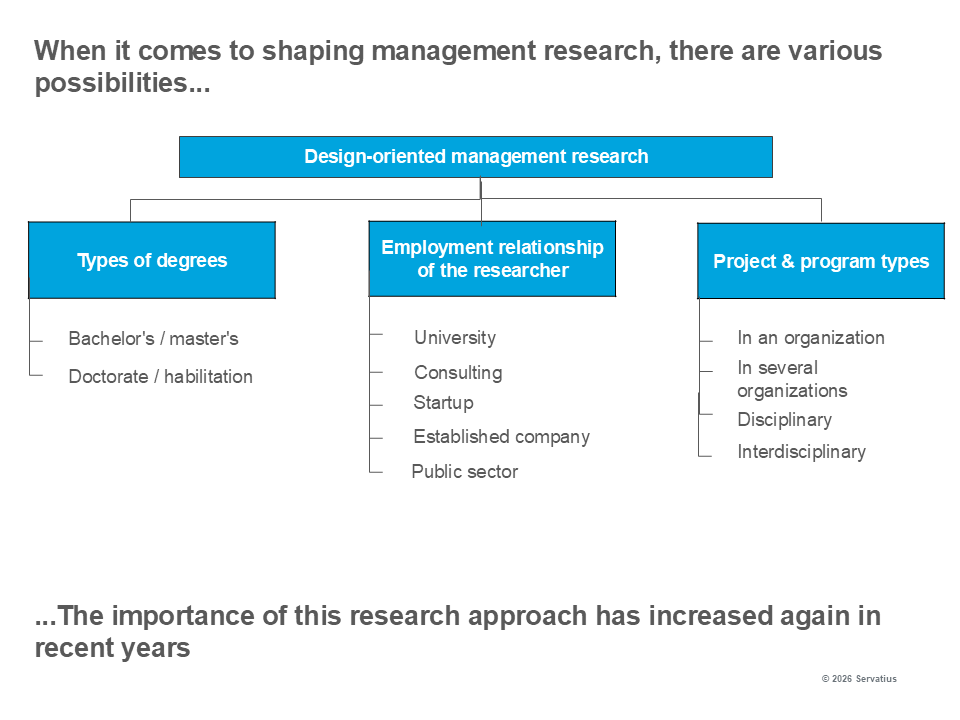
Design-oriented management research is not only taking place at universities, but also increasingly in practice. University lecturers are increasingly supervising creative research approaches by employees in their companies. This approach is mainly used in bachelor’s and master’s theses in dual study programs, in which the course of study is organized in parallel with practical work. In the past, this has also been done more frequently in external dissertations and postdoctoral theses, e.g., by management consultants. The focus here was more on practical relevance. Solving complex problems requires research by interdisciplinary teams, whose members then receive their degrees in their respective fields. Universities should work with partners in the field to combine such projects into programs that can also build on each other (e.g., to design a sovereign AI from Europe).34

The following figure summarizes various possible forms of design-oriented management research. Here, we distinguish between the type of degrees, the employment relationship of the researcher and the project and program types. In a part-time doctorate of a consulting employee, for example, it makes sense to compare the results of projects from several organizations and derive new insights from them. What seems important in this research approach is that design-oriented research projects based on theoretical foundations35 now focus more strongly on concrete application in practice.
Lernprozess Innovationsstrategie

In 2026, we will further develop this approach to management research in the context of designing high-performance systems in which trustworthiness has become an important competitive advantage. One model for this is the start-up ecosystem in Munich, from which other regions can learn.36


Conclusion

  • High-performance systems are characterized by their success and trustworthiness. In the current transition phase, Europe should seize this as an opportunity.
  • To do so, companies must master complex realignment processes and become more resilient, digital, and sustainable
  • Such connective strategic management (Strategy 5.0) is one of the fields of action of trustworthy high-performance systems
  • Another field of action is the promotion of high-performance teams with a growth mindset
  • This requires trustworthy partners and closer cooperation between business and politics
  • Real-world laboratories of change open up new opportunities for design-oriented management research.


Literature

[1] zu Fürstenberg, J., Kloepfer, I., How good we are is revealed in times of crisis – A wake-up call, Piper 2025

[2] Servatius, H.G., Trimming an organization for performance. In: Harvard Manager, 1988, No. 4, pp. 128-134

[3] Katzenbach, J.R., Smith, D.R., The wisdom of teams – Creating the high performance organization, Harvard Business School Press 1993

[4] de Waal, A., What makes a high performance organization, Warden Press 2019

[5] Servatius, H.G., AI as a tool for strategic management. In: Competivation Blog, May 1, 2025

[6] Sommer, U., US corporations are stronger than ever. In: Handelsblatt, December 29, 2025, pp. 1, 4-6

[7] Alvarez de Souza Soares, P., Holtermann, P., AMD wants to end Nvidia’s monopoly. In: Handelsblatt, January 7, 2026, pp. 18-19

[8] Knees, C., Disinformation as a business risk. In: Handelsblatt, January 7, 2026, pp. 20-21

[9] Merten, M., Companies sinking in AI junk. In: Handelsblatt, January 9, 2026, pp. 20-21

[10] Frankopan, P., „What does Europe have besides handbags and champagne?“ (Interview). In: Handelsblatt, December 19/20/21, 2025, pp. 12-13

[11] Fröndhoff, B., et al., Billions for restructuring. In: Handelsblatt, November 26, 2025, pp. 1, 4-5

[12] Servatius, H.G., Disruption of management education for AI-based realignments. In: Competivation Blog, October 10, 2025

[13] Servatius, H.G., Development and change in strategic management. In: Competivation Blog, September 19, 2025

[14] Servatius, H.G., Triple strategic realignment. In: Competivation Blog, June 7, 2024

[15] Servatius, H.G., Strategic leadership with contextual and relationship-oriented intelligence. In: Competivation Blog, March 14, 2023

[16] Huchzermeier, D. et al., Economy in reform gridlock. In: Handelsblatt, February 2/3/4, 2026, pp. 1, 6-7

[17] Servatius, H.G., Resilience-oriented strategic management. In: Competivation Blog, March 15, 2024

[18] Meiritz, A., „We will certainly remember a no.“ In: Handelsblatt, January 22, 2026, p. 1, 4-5

[19] Koch, M., Can an alliance of middle powers slow Trump down? In: Handelsblatt, January 22, 2026, p. 5

[20] Bomke, L., Germany’s AI hope. In: Handelsblatt, December 2, 2025, p. 1

[21] Czikszentmihalyi, M., Creativity – Flow and the psychology of discovery and invention, Harper Collins 1996

[22] Dweck, C., Mindset – The new psychology of success, Random House 2006

[23] Nadella, S., Hit Refresh – The quest to rediscover Microsoft’s soul and imagine a better future for everyone, Harper Collins 2017

[24] Murphy, M.C., Cultures of growth – How the new science of mindset can transform individuals, teams and organizations, Simon & Schuster 2024

[25] Herwig, M., Linnhoff, C., New A 45 bridge opened. In: Rheinische Post, December 23, 2025, p. A6

[26] Fukuyama, F., „Trumpism is a cry against modernity“ (interview). In: Handelsblatt, December 5/6/7, 2025, pp. 12-13

[27] Tüngler, M., „Friedrich Merz still has it in his hands“ (interview). In: Handelsblatt, December 11, 2025, pp. 22-23

[28] Grünewald, S., We crisis acrobats – Psychogram of an unsettled society, Kiepenheuer & Witsch 2025

[29] Delhaes, D., Architect of a German research breakthrough. In: Handelsblatt, December 30, 2025, p. 13

[30] Andritzky, J., The country needs visions – For long-term policies with the courage to face the future, Herder 2026

[31] Bomke, L., Revolutionizing the trade with AI. In: Handelsblatt, January 7, 2026, p. 26

[32] Simon, H.A., The sciences of the artificial, 3rd ed., MIT Press 1996

[33] Mitchell, W.J., City of bits – Space, place, and the infobahn, MIT Press 1995

[34] Servatius, H.G., AI and the future of management education. In: Competivation Blog, April 9, 2025

[35] Seckler, C., et al., Design sciences across industries – Building bridges for advancing impactful business research. In: Schmalenbach Journal of Business Research, December 9, 2025

[36] Banze, S., Freisinger, G.M., The Munich code. In: Manager Magazin, February 2026, pp. 30-36

Triple strategic realignment

Triple strategic realignment

Many companies are currently facing the task of becoming more digital, more sustainable and more resilient. The automotive industry provides an example of this triple strategic realignment. The necessary complex process requires the change of a system of interconnected fields of action. The question arises as to how companies can succeed in mastering such a process together with politics, science and society.


In this blog post, I explain the difference between the terms transformation and realignment and explain why the concept of transformation is based on an outdated understanding of management that is unfortunately still widespread.


Automotive companies that need to become more digital, sustainable and resilient

Established automotive companies are in the fifth development stage of a connective strategic management,1  in which they must become more digital, more sustainable and more resilient. So far, management theory and practice have provided little guidance for such a triple realignment. However, it is becoming increasingly clear that the idea of a comprehensive, temporary transformation is illusory and will not lead to the desired results.

When we published our book on the ecological reorientation of automotive companies in 1994, we never thought that the mobility turnaround in Germany would take so long.2 Ultimately, a strategic reorientation towards sustainable forms of propulsion only came about in response to political and competitive pressure. Traditional companies in the industry are now facing a threat from disruptive stakeholder ecosystems.3 They are looking for suitable answers and are preparing for a complex change with various options.

Digitalization is the second important area of realignment and is being driven primarily by large tech companies and start-ups. It has taken place in various waves and affects both the automotive product and key business processes. Digital technologies have the character of game changers, which the general public has become aware of at the latest since the hype surrounding generative artificial intelligence (AI).4 The design of innovative stakeholder ecosystems is also crucial in this field. Trustworthy AI certainly opens up opportunities for Europe.

Parallel to these developments, the geopolitical crises have increased the importance of a resilience-oriented realignment.5 The focus here is on improving the resilience of Western companies in the various stages of value creation. Relevant fields include raw materials, batteries, semiconductors and AI applications. For example, the leading US chip manufacturer Nvidia is heavily dependent on the Taiwanese contract manufacturer TSMC.6 This example shows that although this third dimension of realignment is linked to the other dimensions, it requires specific approaches.

The following diagram illustrates the three dimensions of realignment. The specific approaches relate to the transitions

– from analog to digital, but also trustworthy

– from primarily financially oriented to sustainable, but also realistic and

– from dependent to resilient but also strategic.

This is a key challenge for the European economy and politics in the coming years.

Lernprozess Innovationsstrategie

To this end, it is important to understand the difference between the widely used term transformation and the term realignment.


Difference between transformation and realignment

The term transformation has a long history of development. As early as 1944, Karl Polanyi used it as a political term of struggle to express his demand for a change in the capitalist system.7 In the 1990s, consultants understood the term transformation of organizations to mean comprehensive change.8 In doing so, they sought to differentiate themselves from the reengineering concept, which was perceived as too mechanistic. Today, transformation has become a buzzword with unclear content. This is clearly illustrated by the current term twin transformation, which suggests that digital and green change have a twin character. 9

In order to bring clarity to this confusion of terms, we differentiate between a temporal and a content dimension in organizational change. We define transformation as a temporary, comprehensive change. This brings a transformation task close to restructuring and is now also interpreted in this sense by many management consultants. In contrast, we understand realignment as a longer-term, specific change, e.g. with a focus on digitalization, sustainability or resilience.

Lernprozess Innovationsstrategie

The idea that a digital transformation is possible in the short term and comprehensively underestimates the complexity of the task. We believe this idea is illusory. Such a transformation illusion is the cause of many failures.

The term alignment of a company describes a well-coordinated connection of important system elements (e.g. business model, strategy, innovation, core competencies, organization, IT systems, culture and stakeholders) with regard to a common vision and purpose. In the course of their development, such alignment has been lost in many companies and at the same time the task of realignment in the sense of a realization arises.10

Based on these definitions, I would like to explore the question of what the complexity of a triple realignment consists of and what approach companies can use to overcome this complexity.


Complexity of a triple realignment

A key finding is that the complexity of a triple realignment lies in the connection of different fields of action. This triple realignment requires the change of a complex system. The transformation illusion consists of the assumption that such a change is possible with the help of one-off top-down planning. This mechanistic strategy paradigm is outdated and has now been superseded by a new paradigm that focuses on managing complexity.11 The diagram shows important fields of action for such a

Lernprozess Innovationsstrategie

Over the past sixty years, strategic management has developed in five stages. Strategy 5.0 connects the development stages. Companies manage this connectivity in various fields of action. A common vision plays an important role here as a bracket for an innovation, sustainability and resilience strategy. The focal points of a realignment of business models result from these strategies.

A second field of action is responding to or shaping disruptive stakeholder ecosystems. The research and development (R&D) management of companies, together with stakeholders from politics, science and society, is aimed at achieving competitive advantages in innovative technologies.

Field of action number three is digital, sustainable and resilient value creation. A current topic here is increasing productivity with AI-based business processes and knowledge-intensive applications. This topic affects almost all sectors and company sizes.

Mastering these fields of action requires a change in human resource management and culture as well as the development of new skills. Important impetus for overcoming complexity comes from connective leadership with agile methods, which start-ups and digital champions have implemented more consistently than established companies.

There is a close connection between this and changes in the organization, IT architecture and project management. Established companies find it difficult to transfer the concept of a platform organization with agile teams developed by digital champions to their own situation.

Action area number six is value enhancement with financial and non-financial reporting. Many companies limit themselves to a reactive approach in order to comply with new sustainability guidelines. It makes more sense to see sustainability as an opportunity for innovation.

A promising approach to this triple realignment, which connects various fields of action, is based on a breakdown into phases and learning loops. This approach differs fundamentally from rigid roadmap concepts,12 which are widely used in the literature but have often failed in practice.


Procedure for a triple realignment

Structuring the approach of complex tasks into phases and learning loops is based on the action learning model, which also forms the basis for agile methods. Similar to the scaling of agile teams, the challenge here is to bring the entire organization together in an iterative process. In practice, it has proven useful to divide each of the learning loops into the six phases shown in the diagram.

Lernprozess Innovationsstrategie

A realignment begins with an analysis of the company’s specific initial situation combined with a look into the future (foresight). Particular attention should be paid to the early recognition of possible radical changes. This requires a high level of contextual intelligence in order to correctly assess the complexity of external developments.

In the next phase, the task is to develop a vision for a triple realignment. One trigger may be the need to overcome crises and regain resilience. For many companies, the topic of sustainability has a meaningful effect. Digital technologies provide the potential for renewal. It is crucial to involve employees in this process and to credibly convey a spirit of optimism that provides the positive energy for the subsequent phases.

The vision forms the framework for prioritizing the dimensions of digital, sustainable and resilient as well as the fields of action for a realignment. In an initial learning loop, the company works on the challenges with the highest priority. Lower-priority tasks are completed according to the same pattern in later learning loops. This iterative approach makes an important contribution to overcoming complexity. Management often reassesses the current situation of the company and its environment after each learning loop.

In many companies, a triple realignment fails due to the existing governance model. By governance, we mean the interplay between human resource management, culture, organization and control. The supervisory board must ensure that the governance is suitable for changing this complex system and take appropriate measures if this is not the case. This fourth phase is therefore crucial to overall success. A misconceived approach to transformation contributes to an increased likelihood of joint failure between the board, management, employees and external advisors. It is possible that a restructuring may be necessary before the realignment. However, it is important to communicate this clearly and not hide behind a vaguely formulated transformation concept.

Another important hurdle is implementation in the form of programs and projects, which takes place in phase five. Coordinating the fields of action with the help of agile and transparent performance management has proven its worth here. A suitable approach is the Objectives and Key Results (OKR) method. This is used successfully by start-ups and successful digital giants, but still frequently encounters the barriers of a silo culture in established companies. In this respect, the success of the individual phases builds on each other. Without suitable governance in phase four, the coordination of the fields of action will not succeed. Feedback is therefore of great importance in this process.

The sixth and final phase is human resource development in the form of specific action learning by many. In view of the growing importance of generative AI, companies are increasingly faced with the question of how they should organize the further training of many employees during an ongoing digital realignment. As there has been nothing comparable in recent economic history, new approaches are needed here. These should start with school education. Unfortunately, Germany has largely missed out on this and is now facing the need to further develop its education system. However, the economy cannot wait for this and must take the initiative itself when it comes to human resource development.

Our practical experience shows that this approach has the character of a framework concept that each company must adapt to its specific situation. We support managers in this adaptation by combining consulting with personnel development. In this way, we achieve a better price-performance ratio for our clients than with traditional management consulting.


Conclusion

– Companies must currently master a triple strategic realignment and become more digital as well as more sustainable and resilient

– We understand the term realignment to mean a long-term, specific change

– The complexity of a triple realignment lies in the processing of different fields of action that are linked to each other

– In this form of change, an iterative process structured in phases and learning loops has proven its worth


Literature

[1] Servatius, H.G., Strategy 5.0 for mastering the new challenges. In: Competivation Blog, 28.06.2022

[2] Berger, R., Servatius, H.G., Krätzer, A., Die Zukunft des Autos hat erst begonnen – Ökologisches Umsteuern als Chance, Pieper 1994

[3] Servatius, H.G., Designing innovative stakeholder ecosystems. In: Competivation Blog, 10.01.2023

[4] Kaufmann, T., Servatius, H.G., Das Internet der Dinge und Künstliche Intelligenz als Game Changer – Wege zu einem Management 4.0 und einer digitalen Architektur, SpringerVieweg 2020

[5] Servatius, H.G., Resilience-oriented strategic management. In: Competivation Blog, 15.03.2023

[6] Hofer, J. et al, Nvidia’s Taiwan risk. In: Handelsblatt, May 28, 2024, p.1, 4-5

[7] Polanyi, K., The Great Transformation – Political and Economic Origins of Societies and Economic Systems, Suhrkamp 1973

[8] Goullart, F.J., Kelly, J.N., Transforming the Organization, Mc Graw Hill 1995

[9] Christmann, A.S., et al, The Twin Transformation Butterfly. In: Business Information Systems Engineering, January 23, 2024

[10] Trevor, J., Re:Align – A Leadership Blueprint for Overcoming Disruption and Improving Performance, Bloomsbury 2022

[11] Servatius, H.G., With a strategy 5.0 to success with Digital GreenTech. In: Fesidis, B., Röß, S.A., Rummel, S.(Eds.), With digitalization and sustainability to a climate-neutral company, SpringerGabler 2023, pp.71-94

[12] Rogers, D.L., The Digital Transformation Roadmap – Rebuild Your Organization for Continuous Change, Columbia Business School Publishing 2023

Triple strategic realignment

Dreifache strategische Neuausrichtung

Gegenwärtig stehen viele Unternehmen vor der Aufgabe, digitaler, nachhaltiger und resilienter zu werden. Ein Beispiel für diese dreifache strategische Neuausrichtung liefert die Automobilindustrie. Der notwendige komplexe Prozess erfordert den Wandel eines Systems verbundener Handlungsfelder. Es stellt sich die Frage, wie es Unternehmen gemeinsam mit der Politik, Wissenschaft und Gesellschaft gelingen kann, einen derartigen Prozess zu meistern.


In diesem Blogpost erläutere ich den Unterschied zwischen den Begriffen Transformation und Neuausrichtung und begründe, warum das Transformationskonzept auf einem nicht mehr zeitgemäßen Managementverständnis basiert, das leider immer noch weit verbreitet ist.


Automobilunternehmen, die digitaler, nachhaltiger und resilienter werden müssen

Etablierte Automobilunternehmen befinden sich in der fünften Entwicklungsstufe eines verbindenden strategischen Managements,1 in der sie digitaler, nachhaltiger und resilienter werden müssen. Für eine solche dreifache Neuausrichtung (Triple Realignment) liefern die Managementtheorie und -praxis bislang kaum Anleitungen. Immer deutlicher wird aber, dass die Vorstellung von einer umfassenden, befristeten Transformation illusionär ist und nicht zu den gewünschten Ergebnissen führt.

Als wir 1994 unser Buch zum ökologischen Umsteuern von Automobilunternehmen publiziert haben, hätten wir nicht gedacht, dass die Mobilitätswende in Deutschland so lange dauert.2 Letztlich ist eine strategische Neuausrichtung auf nachhaltige Antriebsformen erst als Reaktion auf den Druck der Politik und des Wettbewerbs erfolgt. Die traditionellen Unternehmen der Branche befinden sich heute in einer Bedrohungslage, die von disruptiven Stakeholder-Ökosystemen ausgeht.3 Sie sind auf der Suche nach geeigneten Antworten und stellen sich auf einen komplexen Wandel mit verschiedenen Optionen ein.

Die Digitalisierung als zweites wichtiges Feld einer Neuausrichtung wird vor allen von den großen Tech-Konzernen und von Start-ups getrieben. Sie ist in verschiedenen Wellen verlaufen und betrifft sowohl das Produkt Automobil als auch wesentliche Geschäftsprozesse. Digitale Technologien haben den Charakter von Game Changern, was spätestens seit dem Hype um die generative Künstliche Intelligenz (KI) einer breiten Öffentlichkeit bewusst geworden ist.4 Auch in diesem Feld kommt es entscheidend auf die Gestaltung von innovativen Stakeholder-Ökosystemen an. Dabei eröffnet eine vertrauenswürdige KI für Europa durchaus Chancen.

Parallel zu diesen Entwicklungen hat mit den geopolitischen Krisen die Bedeutung einer resilienzorientierten Neuausrichtung zugenommen.5 Im Mittelpunkt steht dabei eine Verbesserung der Widerstandskraft westlicher Unternehmen in den verschiedenen Stufen der Wertschöpfung. Relevante Felder sind Rohstoffe, Batterien, Halbleiter und KI-Anwendungen. So ist z.B. der führende US-Chiphersteller Nvidia stark von dem taiwanesischen Auftragsfertiger TSMC abhängig.6 Das Beispiel zeigt, dass diese dritte Dimension einer Neuausrichtung zwar mit den anderen Dimensionen verbunden ist, aber spezifische Ansätze erfordert.

Die folgende Abbildung veranschaulicht die drei Dimensionen einer Neuausrichtung. Die spezifischen Ansätze betreffen die Übergänge

– von analog zu digitaler, aber auch vertrauenswürdig

– von primär finanzorientiert zu nachhaltiger, aber auch realistisch und

– von abhängig zu resilienter, aber auch strategisch.

Für die europäische Wirtschaft und Politik ist dies eine zentrale Herausforderung der nächsten Jahre.

Lernprozess Innovationsstrategie

Hierzu ist es wichtig, den Unterschied zwischen dem weit verbreiteten Begriff Transformation und dem Begriff Neuausrichtung zu verstehen.


Unterschied zwischen Transformation und Neuausrichtung

Der Begriff Transformation hat eine längere Entwicklungsgeschichte. Bereits 1944 verwendet ihn Karl Polanyi als politischen Kampfbegriff, um seiner Forderung nach einem Wandel des kapitalistischen Systems Ausdruck zu verleihen.7 In den 1990er Jahren verstehen Consultants unter dem Begriff Transformation von Organisationen einen umfassenden Wandel.8 Damit streben sie eine Abgrenzung von dem als zu mechanistisch empfundenen Reengineering-Konzept an. Heute ist Transformation zu einem Schlagwort mit unklarem Inhalt geworden. Deutlich wird dies am Beispiel des aktuellen Begriffs Twin Transformation, der suggeriert, dass der digitale und der grüne Wandel einen Zwillingscharakter hätten.9

Um Ordnung in diese Begriffsunklarheiten zu bringen, unterscheiden wir beim Wandel von Organisationen zwischen einer zeitlichen und einer inhaltlichen Dimension. Als Transformation bezeichnen wir einen zeitlich befristeten, umfassenden Wandel. Damit rückt eine Transformationsaufgabe in die Nähe der Sanierung und wird von vielen Managementberatern inzwischen auch in diesem Sinne interpretiert. Demgegenüber verstehen wir unter einer Neuausrichtung einen längerfristig orientierten, spezifischen Wandel z.B. mit den Schwerpunkten Digitalisierung, Nachhaltigkeit oder Resilienz.

Lernprozess Innovationsstrategie

Die Vorstellung, eine digitale Transformation sei kurzfristig und umfassend möglich, unterschätzt die Komplexität der Aufgabe. Wir halten diese Vorstellung für illusionär. Eine solche Transformationsillusion ist die Ursache für viele Fehlschläge.

Der Begriff der Ausrichtung (Alignment) eines Unternehmens beschreibt eine gut abgestimmte Verbindung wichtiger Systemelemente (z.B. Geschäftsmodell, Strategie, Innovation, Kernkompetenzen, Organisation, IT-Systeme, Kultur und Stakeholder) im Hinblick auf eine gemeinsame Vision und einen Sinn. Im Verlauf ihrer Entwicklung ist in vielen Unternehmen ein solches Alignment verloren gegangen und gleichzeitig stellt sich die Aufgabe einer Neuausrichtung im Sine eines Realignments.10

Ausgehend von diesen Definitionen möchte ich im folgenden der Frage nachgehen, worin die Komplexität einer dreifachen Neuausrichtung besteht und mit welcher Vorgehensweise Unternehmen diese Komplexität bewältigen können.


Komplexität einer dreifachen Neuausrichtung

Eine zentrale Erkenntnis ist, dass die Komplexität einer dreifachen Neuausrichtung in der Verbindung verschiedener Handlungsfelder liegt. Dieses Triple Realignment erfordert den Wandel eines komplexen Systems. Die Transformationsillusion besteht in der Annahme, ein solcher Wandel sei mit Hilfe einer einmaligen Top-down-Planung möglich. Dieses mechanistische Strategie-Paradigma ist überholt und inzwischen von einem neuen Paradigma verdrängt worden, in dessen Zentrum die Bewältigung von Komplexität steht.11 In der Abbildung sind wichtige Handlungsfelder einer solchen Neuausrichtung dargestellt.

Lernprozess Innovationsstrategie

In den vergangenen sechzig Jahren ist die Entwicklung des strategischen Managements in fünf Stufen verlaufen. Eine Strategie 5.0 verbindet die Entwicklungsstufen. Unternehmen bewältigen diese Konnektivität in verschiedenen Handlungsfeldern. Eine wichtige Rolle spielt dabei die gemeinsame Vision als Klammer für eine Innovations-, Nachhaltigkeits- und Resilienzstrategie. Aus diesen Strategien ergeben sich die Schwerpunkte einer Neuausrichtung der Geschäftsmodelle.

Ein zweites Handlungsfeld ist die Reaktion auf oder Gestaltung von disruptiven Stakeholder-Ökosystemen. Dabei ist das Forschungs- und Entwicklungs (F&E-) Management von Unternehmen gemeinsam mit Akteuren aus Politik, Wissenschaft und Gesellschaft auf das Erreichen von Wettbewerbsvorteilen bei innovativen Technologien gerichtet.

Handlungsfeld Nummer drei ist die digitale, nachhaltige und resiliente Wertschöpfung. Ein aktuelles Thema ist hierbei gegenwärtig die Produktivitätssteigerung mit KI-basierten Geschäftsprozessen und wissensintensiven Anwendungen. Dieses Thema betrifft nahezu alle Branchen und Unternehmensgrößen.

Die Bewältigung dieser Handlungsfelder erfordert einen Wandel der Personalführung und Kultur sowie die Entwicklung von neuen Kompetenzen. Wichtige Impulse zur Komplexitätsbewältigung gehen dabei von einer verbindenden Führung mit agilen Methoden aus, die Start-ups und Digital-Champions konsequenter umgesetzt haben als etablierte Unternehmen.

Hierbei besteht ein enger Zusammenhang zum Wandel der Organisation, der IT-Architektur und des Projektmanagements. Etablierten Unternehmen fällt es schwer, das bei Digital-Champions entstandene Konzept einer Plattform-Organisation mit agilen Teams auf ihre eigene Situation zu übertragen.

Handlungsfeld Nummer sechs ist die Wertsteigung mit einer finanziellen und nicht-finanziellen Berichterstattung. Viele Unternehmen beschränken sich auf ein reaktives Vorgehen zur Erfüllung von neuen Nachhaltigkeitsrichtlinien. Sinnvoller erscheint es, das Thema Nachhaltigkeit als Innovationschance zu sehen.

Ein Erfolg versprechendes Vorgehen bei dieser dreifachen Neuausrichtung, das verschiedene Handlungsfelder verbindet, geht von einer Gliederung in Phasen und Lernschleifen aus. Dieses Vorgehen unterscheidet sich grundlegend von starren Roadmap-Konzepten,12 die in der Literatur weit verbreitet, in der Praxis aber häufig gescheitert sind.


Vorgehen bei einer dreifachen Neuausrichtung

Eine Gliederung des Vorgehens bei komplexen Aufgaben in Phasen und Lernschleifen basiert auf dem Modell des Action Learning, das auch die Grundlage für agile Methoden bildet. Ähnlich wie bei der Skalierung agiler Teams liegt die Herausforderung hier darin, die gesamte Organisation in einem iterativen Prozess zusammenzuführen. In der Praxis hat es sich bewährt, jede der Lernschleifen in die in der Abbildung dargestellten sechs Phasen zu gliedern.

Lernprozess Innovationsstrategie

Am Anfang einer Neuausrichtung steht die Analyse der spezifischen Ausgangssituation des Unternehmens verbunden mit einem Blick in die Zukunft (Foresight). Ein besonderes Augenmerk sollte dabei auf der Früherkennung möglicher radikaler Veränderungen liegen. Dies erfordert eine ausgeprägte kontextuelle Intelligenz, um die Komplexität externer Entwicklungen richtig einzuschätzen.

In einer nächsten Phase stellt sich die Aufgabe, für die dreifache Neuausrichtung eine Vision zu entwickeln. Ein Auslöser kann die Notwendigkeit sein, Krisen zu meistern und Resilienz zurückzugewinnen. Sinn stiftend wirkt dabei für viele Unternehmen das Thema Nachhaltigkeit. Dabei liefern digitale Technologien das Potenzial für eine Erneuerung. Entscheidend ist, die Mitarbeitenden in diesen Prozess einzubeziehen und glaubwürdig eine Aufbruchsstimmung zu vermitteln, die die positive Energie für die nachfolgenden Phasen liefert.

Die Vision bildet den Rahmen für eine Priorisierung der Dimensionen digital, nachhaltig und resilient sowie der Handlungsfelder einer Neuausrichtung. In einer ersten Lernschleife bearbeitet das Unternehmen die Herausforderungen mit der höchsten Priorität. Die Erledigung von geringer priorisierten Aufgaben erfolgt nach dem gleichen Muster in späteren Lernschleifen. Dieses iterative Vorgehen leistet einen wichtigen Beitrag zur Komplexitätsbewältigung. Häufig bewertet die Führung nach jeder Lernschleife die aktuelle Situation des Unternehmens und seines Umfelds neu.

In vielen Unternehmen scheitert eine dreifache Neuausrichtung an dem vorhandenen Governance-Modell. Dabei verstehen wir unter Governance das Zusammenspiel von Personalführung, Kultur, Organisation und Kontrolle. Der Aufsichtsrat muss sicherstellen, dass die Governance für den Wandel dieses komplexen Systems geeignet ist und entsprechende Maßnahmen ergreifen, wenn dies nicht der Fall ist. Daher ist diese vierte Phase für den Gesamterfolg von entscheidender Bedeutung. Ein falsch verstandenes Transformationskonzept trägt dazu bei, dass sich die Wahrscheinlichkeit eines gemeinsames Versagens von Aufsichtsgremium, Führung, Mitarbeitenden und externen Beratern erhöht. Dabei kann es möglich sein, dass vor der Neuausrichtung eine Sanierung erforderlich ist. Wichtig ist, dies dann aber auch klar zu kommunizieren und sich nicht hinter einem vage formulierten Transformationsbegriff zu verstecken.

Eine weitere wichtige Hürde ist die Umsetzung in Form von Programmen und Projekten, die in Phase fünf erfolgt. Hierbei hat sich die Koordination der Handlungsfelder mit Hilfe eines agilen und transparenten Performance Managements bewährt. Ein geeigneter Ansatz ist die Objectives and Key Results (OKR-) Methode. Diese wird von Start-ups und erfolgreichen Digital-Giganten erfolgreich angewendet, stößt in etablierten Unternehmen aber immer noch häufig auf die Barrieren einer Silo-Kultur. Insofern baut der Erfolg der einzelnen Phasen aufeinander auf. Ohne eine geeignete Governance in Phase vier wird die Koordination der Handlungsfelder nicht gelingen. Daher sind bei diesem Prozess die Rückkopplungen von großer Bedeutung.

Die sechste und letzte Phase ist die Personalentwicklung in Form eines spezifischen Handlungslernen von Vielen. Angesichts der zunehmenden Bedeutung der generativen KI stehen Unternehmen zunehmend vor der Frage, wie sie während einer laufenden digitalen Neuausrichtung die Weiterbildung vieler Mitarbeitender gestalten sollen. Da es in der jüngeren Wirtschaftsgeschichte nichts Vergleichbares gegeben hat, sind hier neue Wege gefragt. Diese müssten schon bei der Schulausbildung beginnen. Leider hat Deutschland das weitgehend verschlafen und steht nun vor einer Weiterentwicklung seines Bildungssystems. Hierauf kann die Wirtschaft aber nicht warten und muss beim Thema Personalentwicklung selbst die Initiative ergreifen.

Unsere praktische Erfahrung zeigt, dass diese Vorgehensweise den Charakter eines Rahmenkonzepts hat, das jedes Unternehmen an seine spezifische Situation anpassen muss. Wir unterstützen Führungskräfte bei dieser Anpassung, indem wir Beratung mit Personalentwicklung verknüpfen. Auf diese Weise erreichen wir für unsere Klienten ein besseres Preis-Leistungsverhältnis als beim klassischen Management Consulting.


Fazit

  • Unternehmen müssen gegenwärtig eine dreifache strategische Neuausrichtung  meistern und sowohl digitaler als auch nachhaltiger und resilienter   werden
  • Dabei verstehen wir unter dem Begriff Neuausrichtung einen längerfristig orientierten, spezifischen Wandel
  • Die Komplexität einer dreifachen Neuausrichtung besteht in der Bearbeitung verschiedener Handlungsfelder, die miteinander verbunden sind
  • Bei dieser Form des Wandels hat sich einer iterativer Prozess bewährt, der in Phasen und Lernschleifen gegliedert ist


Literatur

[1] Servatius, H.G., Strategie 5.0 zur Bewältigung der neuen Herausforderungen. In: Competivation Blog, 28.06.2022

[2] Berger, R., Servatius, H.G., Krätzer, A., Die Zukunft des Autos hat erst begonnen – Ökologisches Umsteuern als Chance, Pieper 1994

[3] Servatius, H.G., Gestaltung von innovativen Stakeholder-Ökosystemen. In: Competivation Blog, 10.01.2023

[4] Kaufmann, T., Servatius, H.G., Das Internet der Dinge und Künstliche Intelligenz als Game Changer – Wege zu einem Management 4.0 und einer digitalen Architektur, SpringerVieweg 2020

[5] Servatius, H.G., Resilienzorientiertes strategisches Management. In: Competivation Blog, 15.03.2023

[6] Hofer, J. et al., NvidiasTaiwan-Risiko. In: Handelsblatt, 28.Mai 2024, S.1, 4-5

[7] Polanyi, K., The Great Transformation – Politische und ökonomische Ursprünge von Gesellschaften und Wirtschaftssystemen, Suhrkamp 1973

[8] Goullart, F.J., Kelly, J.N., Transforming the Organization, Mc Graw Hill 1995

[9] Christmann, A.S., et al., The Twin Transformation Butterfly. In: Business Information Systems Engineering, 23.Januar 2024

[10] Trevor, J., Re:Align – A Leadership Blueprint for Overcoming Disruption and Improving Performance, Bloomsbury 2022

[11] Servatius, H.G., Mit einer Strategie 5.0 zu Erfolgen bei Digital GreenTech. In: Fesidis, B., Röß, S.A., Rummel, S.(Hrsg.), Mit Digitalisierung und Nachhaltigkeit zum klimaneutralen Unternehmen, SpringerGabler 2023, S.71-94

[12] Rogers, D.L., The Digital Transformation Roadmap – Rebuild Your Organization for Continuous Change, Columbia Business School Publishing 2023

Interessiert?

CONNECTIVE MANAGEMENT

Vereinbaren Sie einen unverbindlichen Gesprächstermin:


    +49 (0)211 454 3731