Transformation | Competivation
Designing trustworthy high-performance systems

Designing trustworthy high-performance systems

In recent years, the importance of connective strategic management has continued to grow. In light of the dynamic development of artificial intelligence (AI) and new geopolitical challenges, the design of trustworthy high-performance systems has become a focal point of interest. In this context, the term „high performance“ is being reinterpreted in business and politics. An important field of action here is design-oriented management research.


In our first blog post of 2026, I address the question of what important areas of action for Europe in terms of trustworthy high-performance systems are.


High performance in business and politics reinterpreted

For Jeanette zu Fürstenberg, who is responsible for Europe at the US fund General Catalyst, there is an opportunity for the old continent in connecting startups with the world of established industrial companies. Her successful investments include Mistral in France and the defense company Helsing in Germany. These companies focus on artificial intelligence (AI) that uses highly specialized application knowledge. Her publication „Wie gut wir sind, zeigt sich in Krisenzeiten“ (How good we are is revealed in times of crisis) was named Management Book of the Year in 2025. For her, the basis for a European high-performance system that can achieve reindustrialization is resilience, which enables recovery as quickly as possible after external shocks.1 In 2025, the number of startups founded in Germany reached a record high.

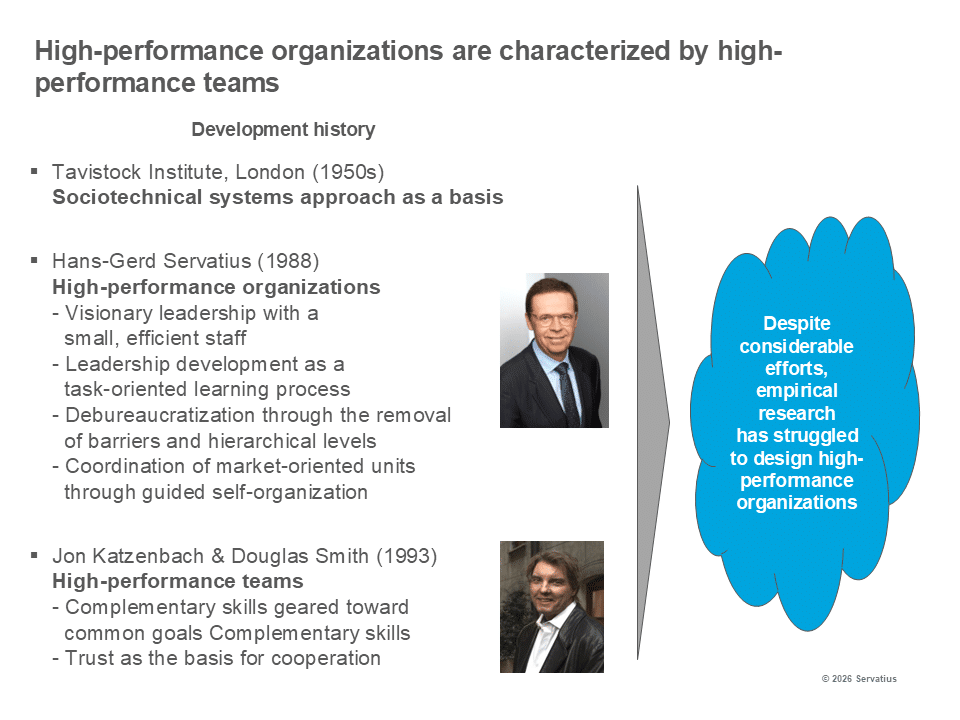
The topic of high-performance organizations is not new. High-performance organizations are characterized by high-performance teams. As early as the 1950s, the British Tavistock Institute developed an initial foundation with its socio-technical systems approach. I described the results of consulting projects on the characteristics of high-performance organizations in an article in Harvard Manager magazine in 1988. One important finding is that visionary leadership creates the framework for teams that work in a more self-organized manner.2

McKinsey consultants Jon Katzenbach and Douglas Smith examined the question of what characterizes high-performance teams.3 However, further developments have shown that, despite considerable efforts, empirical research is struggling with the design of high-performance organizations.4 AI is now giving performance management new impetus to improve the connection between strategy implementation and motivation.5
Lernprozess Innovationsstrategie

US tech companies with artificial intelligence (AI) now dominate the global economy. By the end of 2025, 61 of the world’s 100 most valuable companies will be from the US. The dominance of the US results from the unique strength of seven tech giants, which together have a market value of €18.3 trillion. An important driver of this development is the hype surrounding artificial intelligence (AI). Germany is represented in the top 100 ranking with the companies SAP (rank 40), Siemens (72), the European joint venture Airbus (91), and Allianz (100). In view of geopolitical changes, this concentration of power raises the question of how great the danger of dependence on the US is. 6 In the AI chip market, competitive pressure is increasing for market leader Nvidia.

AI chips are becoming increasingly powerful, but at the same time, AI increases the risk of disinformation. With a global market share of 85.2%, AI chip manufacturer Nvidia has a dominant position ahead of Broadcom (10.3%), Marvell (2.1%), and AMD (1.8%). Challengers AMD and Meta have announced a new AI system for data centers (Helios platform) that is expected to deliver a significant performance boost. Nvidia is countering with its new Rubin chip generation.7

However, there is a risk of a loss of trust in AI due to the risk of disinformation from fake accounts. AI bots falsify content, imitate people, and post automatically on social media. Such deepfakes can cause great economic damage and, for example, ruin a brand’s reputation.8

Large language models and free AI tools often lead to a loss of quality and trust because they are not trained for high performance, but rather for the production of average knowledge. When AI users are under time pressure and there are no quality standards in place, „AI slop“ can result. Although this produces faster results, the quality declines. Possible consequences include a loss of reputation and trust. When using AI, it is therefore important to supplement content with expert knowledge after quality control.9

AI and geopolitical challenges are reinterpreting the concept of high performance. Not all AI is trustworthy. We understand a trustworthy high-performance system to be a system (e.g., a company, a region, or a state) that performs very well compared to the competition and is trusted by the recipients of its services. In addition, these service recipients are willing and able to pay for the services. High-performance systems must therefore justify their higher prices (e.g., through „German quality,“ technical superiority, or a luxury brand).

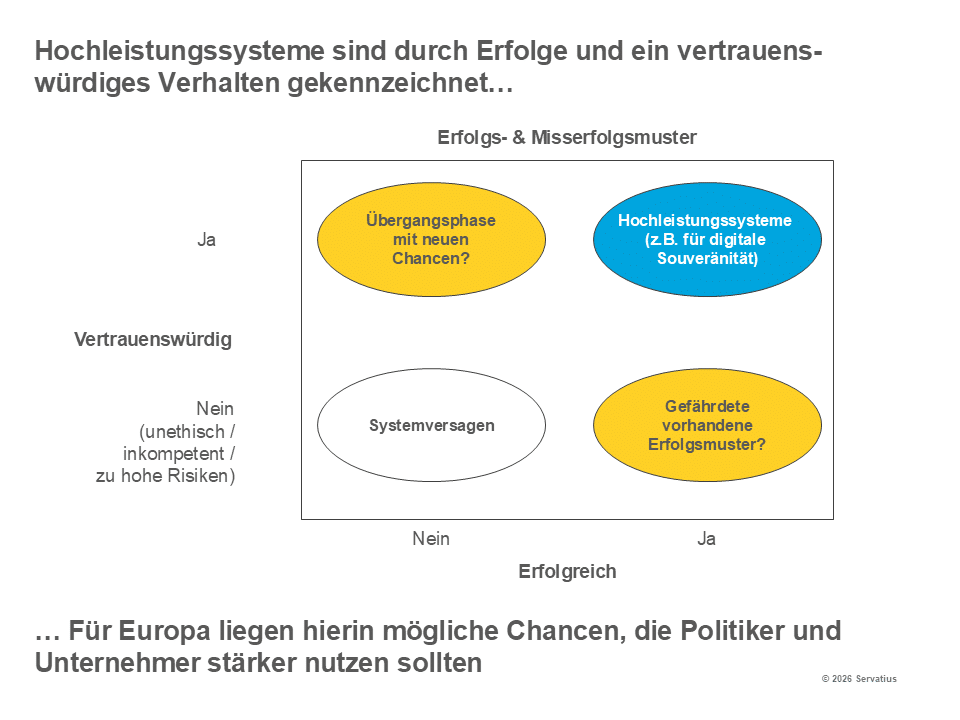
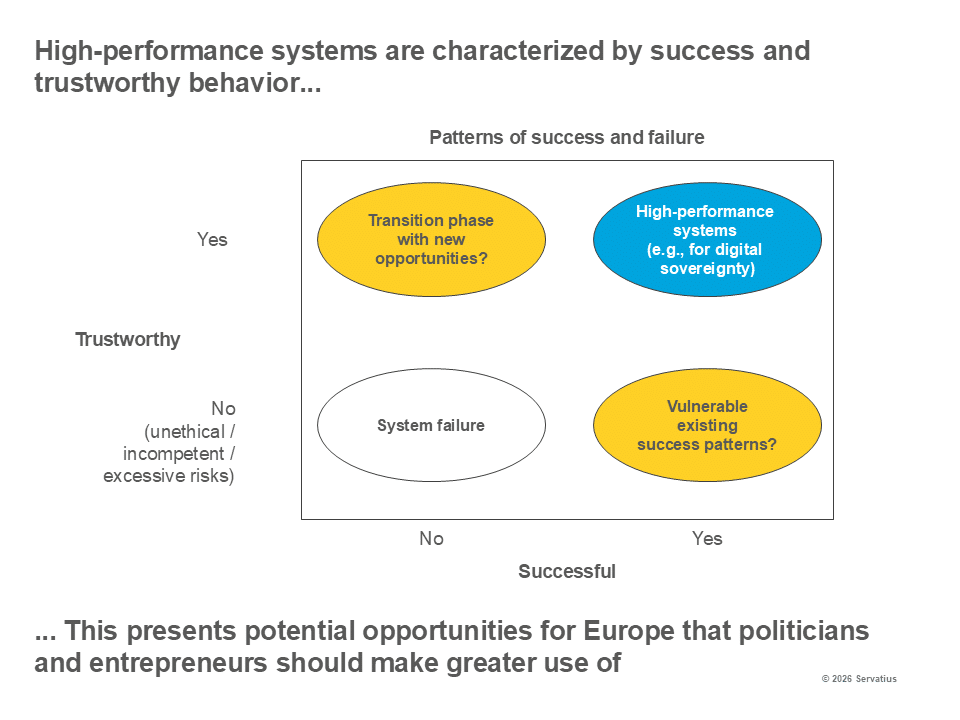
Reinterpreting high performance means that high-performance systems are characterized by both success and trustworthy behavior. If neither of these is the case, we speak of system failure. Most socio-technical systems fall somewhere in between. Cases where only one of the two criteria is met are interesting. An existing pattern of success is at risk when a previously successful system, such as that of the AI champions, loses trust. This could result in a transitional phase with new opportunities, for example, if Europe, which has been less successful in digitalization to date, scores points with trust.
Lernprozess Innovationsstrategie

Peter Frankopan, a British professor of global history teaching at Oxford, sees the world in a transitional phase similar to that of the 1920s, when the old order was not yet dead and a new one had not yet been born.10

The question is therefore how Europe can seize its opportunities and become a designer of trustworthy high-performance systems.


Strategic realignment in a phase of transition

In the first nine months of 2025, DAX companies spent €6 billion on restructuring. The highest restructuring costs in 2025 were incurred by Mercedes (€1.4 billion), Volkswagen (€900 million), Siemens and Commerzbank (€500 million each). The automotive, mechanical engineering, and chemical industries are particularly affected. At the end of September 2025, 120,300 fewer people were employed in German industry than a year earlier. Many companies are offering generous severance packages. Often, one round of restructuring is followed by another without solving the underlying problems. This would require a strategic realignment after restructuring.11

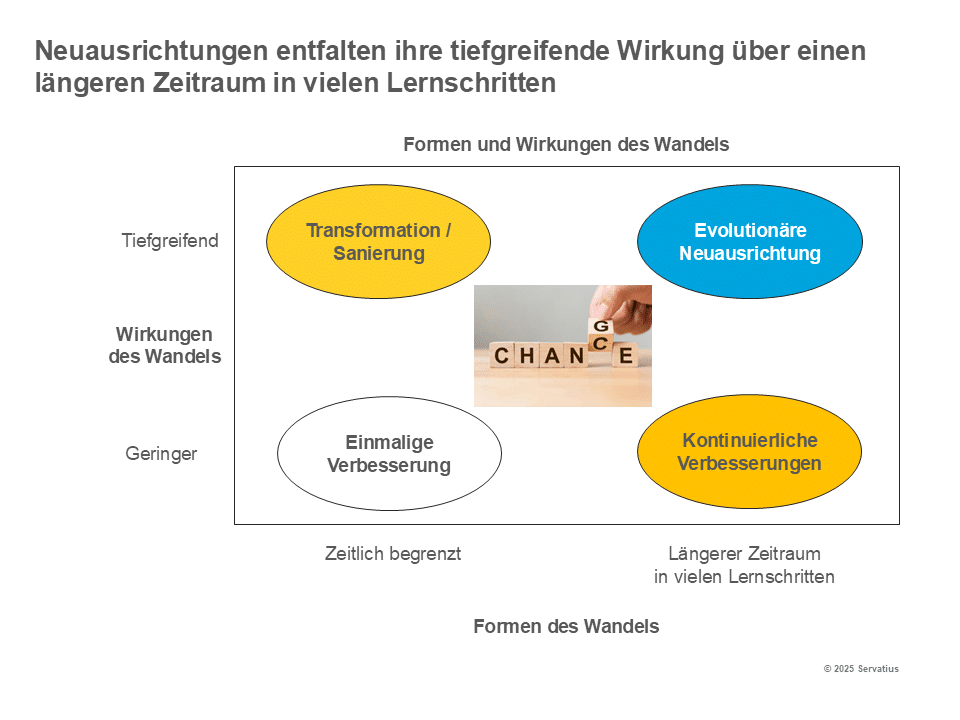
The term „strategic realignment“ describes an innovative approach to coordinating existing and new system elements (e.g., business model, strategy, technologies, customers, competencies, organization, culture, and environment). Realignments usually have a profound effect over a longer, undefined period of time in many parallel learning steps. Complex interactions play an important role in this process, resulting in specific patterns that are difficult to predict.

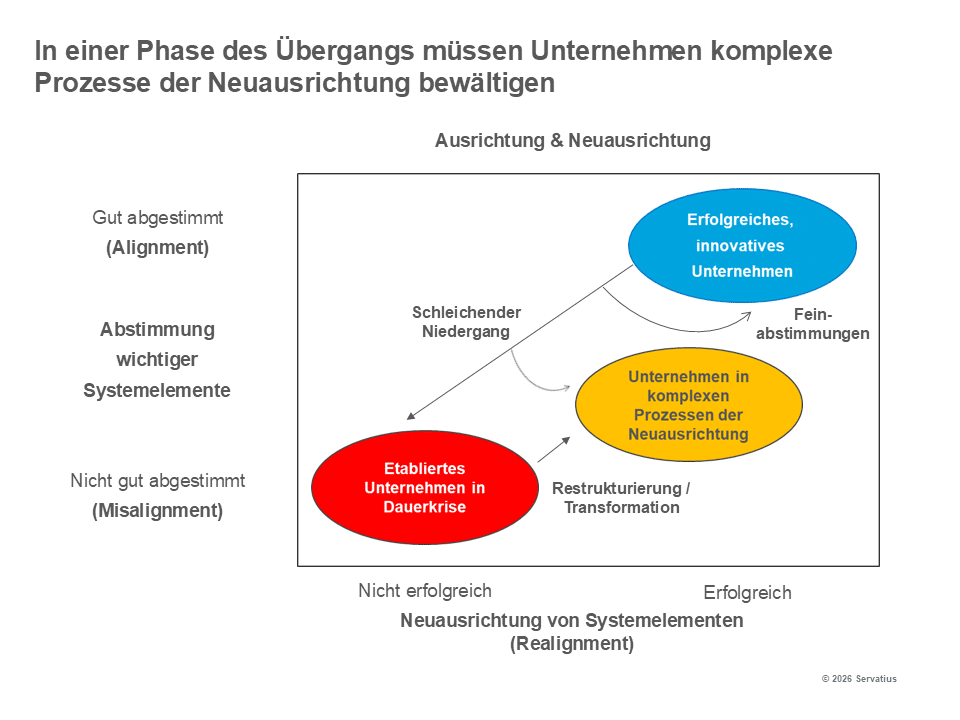
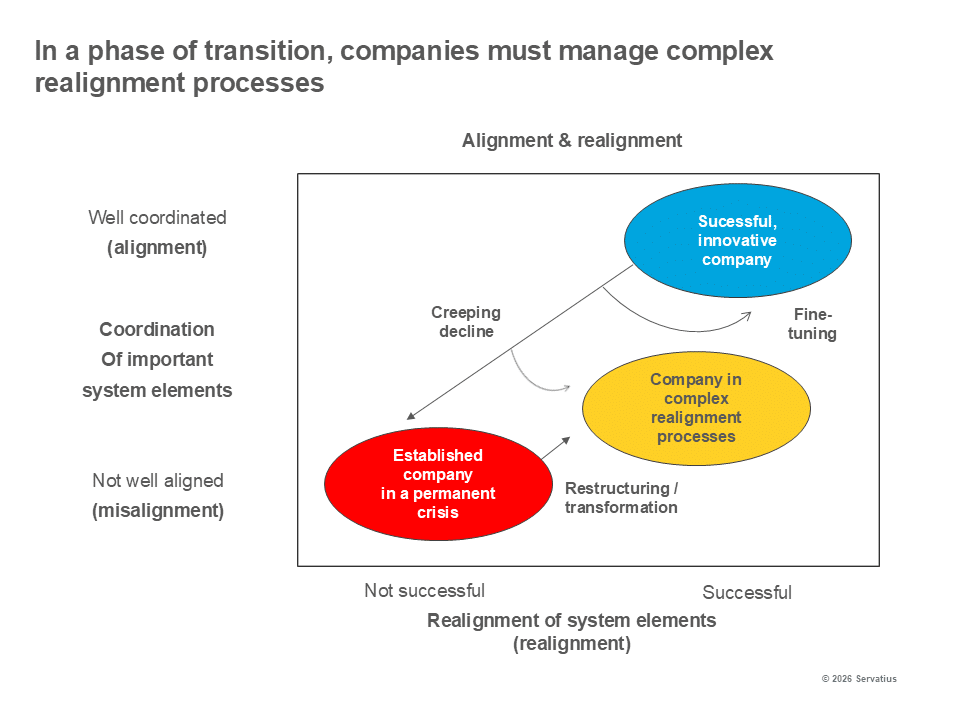
During a phase of transition, companies must manage complex realignment processes. In a successful, innovative company, important system elements are well coordinated. This alignment often takes place through fine-tuning, in which management continuously adapts the strategy to changes in the environment, for example. If this is not done, the company develops in the direction of misalignment. Management and supervisory boards often recognize this creeping decline too late. The result is an established company in a permanent crisis that requires restructuring.

The terms restructuring and transformation are now often used synonymously. Both terms describe a temporary, comprehensive change. Unfortunately, the inflationary use of the term transformation conveys the illusion that complex realignment processes are limited in time. The example of artificial intelligence clearly shows that such a static worldview is naive.
Lernprozess Innovationsstrategie

A longer-term goal of strategic realignments is the design of trustworthy high-performance systems.


Fields of action for trustworthy high-performance systems

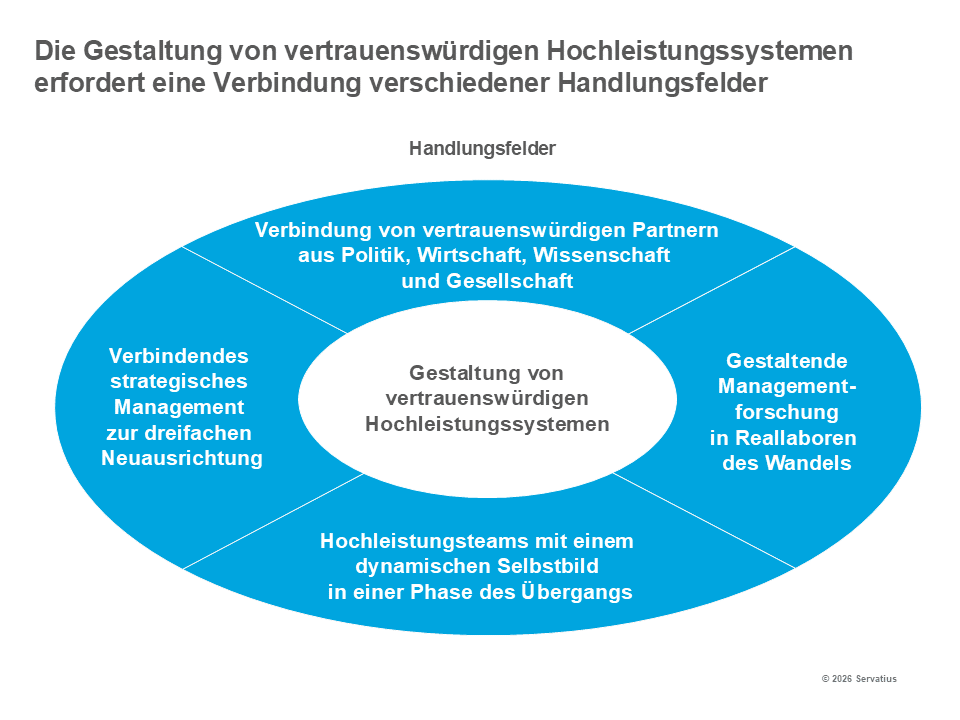
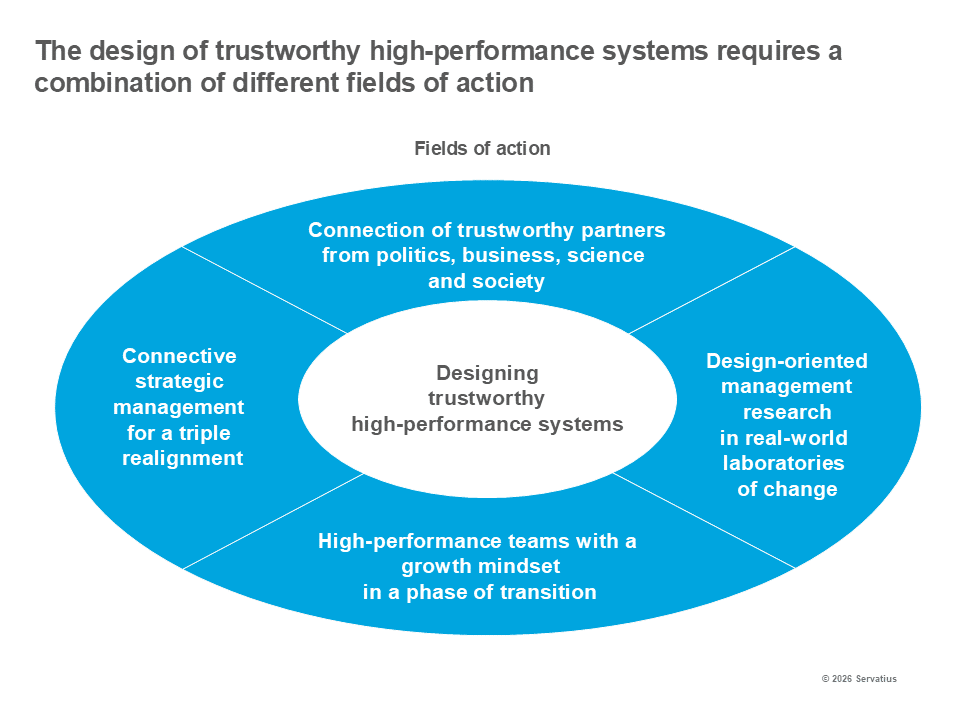
In times of increasing polarization, high-performance systems are characterized by their ability to bring people together. History teaches us that the risk of polarization increases during periods of technological and political upheaval. This also applies to the changes brought about by artificial intelligence (AI). It is crucial that people see themselves as active participants in shaping change rather than passive objects of it. The complementarity of humans and AI is a malleable system. The performance of such a system depends on the ability to improve connections between the actors and the system elements. In our application-oriented research and teaching, we start with the thesis that the following fields of action, shown in the figure, are important in the design of trustworthy high-performance systems:

  • A connective strategic management for a triple realignment
  • high-performance teams with a growth mindset in a phase of transition
  • the connection of trustworthy partners from politics, business, science, and society, and
  • design-oriented management research in real-world laboratories of change.

Interdisciplinary university teaching faces the task of imparting the relevant skills for these fields, e.g., in the area of entrepreneurship for AI applications.
Lernprozess Innovationsstrategie

In the following, I will discuss these fields of action and skills in more detail.


Connective strategic management for a triple realignment

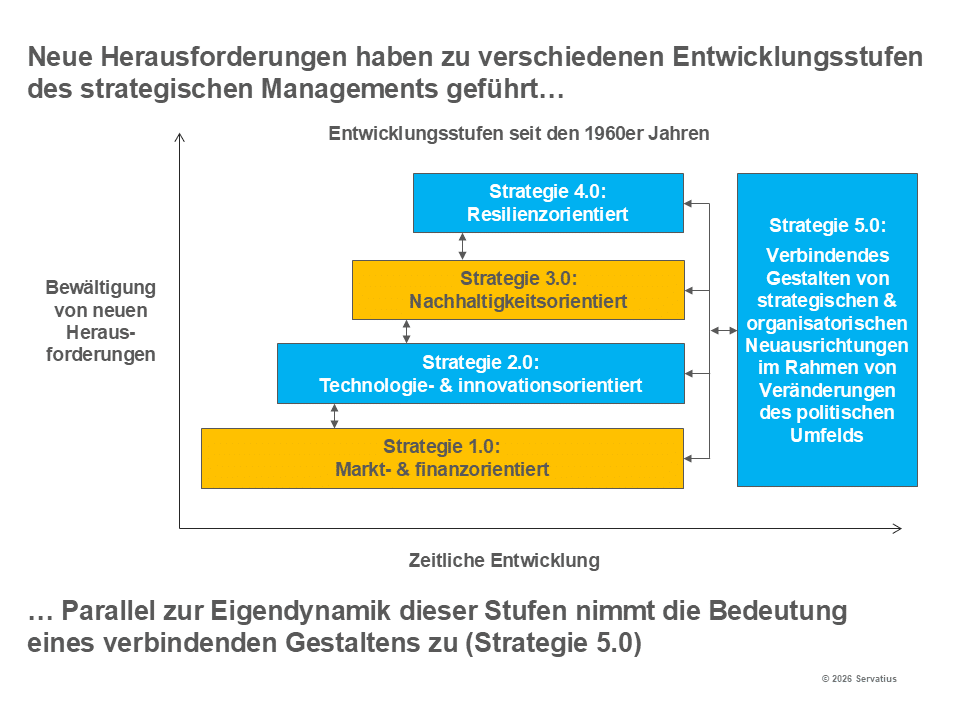
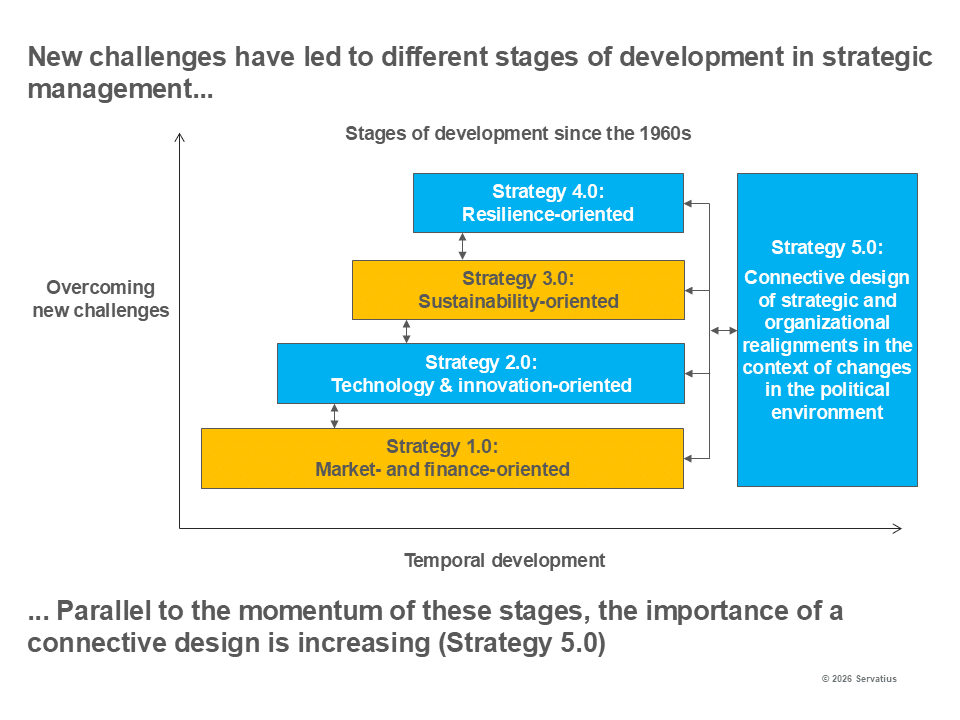
Since the 1960s, new challenges have led to various stages of development in strategic management.13 We distinguish between

  • a market- and finance-oriented stage (Strategy 1.0)
  • a technology- and innovation-oriented stage (Strategy 2.0)
  • a sustainability-oriented stage (Strategy 3.0) and
  • a resilience-oriented stage (Strategy 4.0).

In the current fifth stage of development (Strategy 5.0), the challenge lies in connecting the previous stages. Companies must become more resilient, more digital, and more sustainable at the same time.14 This requires the connective design of threefold strategic and organizational realignments. Such a triple realignment takes place in the context of serious changes in the political environment. The current situation is historically unprecedented. Therefore, the contextual intelligence of management plays an important role.15
Lernprozess Innovationsstrategie

German policymakers should create the framework for a cohesive strategic management approach through fundamental reforms. When the first signs of macroeconomic weakness appeared in 2018, they were harbingers of the most severe and longest industrial recession the Federal Republic has ever experienced. German industry has since lost much of its competitiveness. Experts are calling for new approaches to supply-oriented innovation policy and communication that conveys the need for a change of course. Politicians must implement the promised fundamental reforms. Such a new beginning can only succeed with solidarity instead of polarization.16

In this environment, resilience-oriented strategic management is becoming increasingly important.17  At this year’s World Economic Forum in Davos, the differing positions of the US president and European representatives clashed.18  Canadian Prime Minister Mark Carney suggests that in a world where major powers are becoming imperialists who blackmail other states, middle powers and smaller countries should form trustworthy partnerships.19

Such cooperation plays a decisive role not only at the geopolitical level, but also in high-performance teams.


High-performance teams with a growth mindset in a phase of transition

Black Forest Lab (BFL), currently Germany’s most valuable AI startup, is based in Freiburg, was founded in 2024, and develops AI models for image generation based on text. The founders are part of the core team behind the open-source AI model Stable Diffusion, the text-to-image model that generates digital images from text and, alongside ChatGPT, sparked the global AI hype in 2022. BFL’s Flux models are now one of Google’s biggest competitors. Important impetus for the work of the founding team came from Björn Ommer, a professor of computer science at LMU Munich. This example shows that high-performance teams can also emerge in Germany in the field of AI.20

New ideas and the creation of something new often originate from people who find a state of flow motivating. The term flow (in the sense of „being in the flow“) was coined by psychology professor Csikszentmihalyi back in 1975. It refers to being completely absorbed in an activity, which usually involves a high level of intrinsic motivation and a change in the perception of time. Interviews in which outstanding creative personalities from various fields look back on their working lives show that their motivation stems primarily from the creative process. For many people, the foundations for possible flow states are often laid in their youth, based on their growth mindset.21

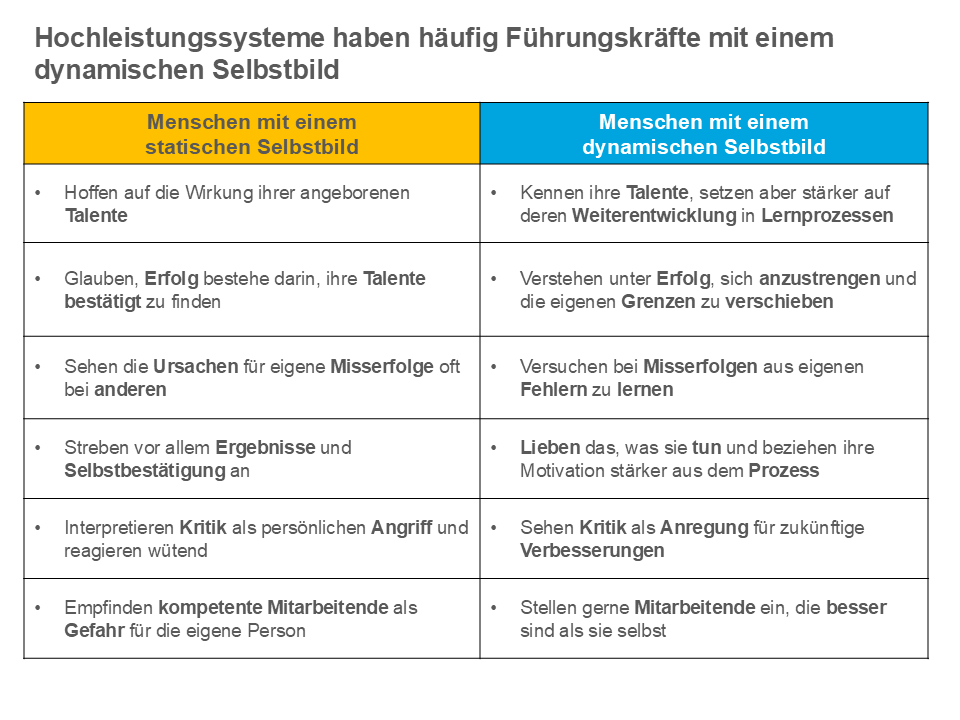
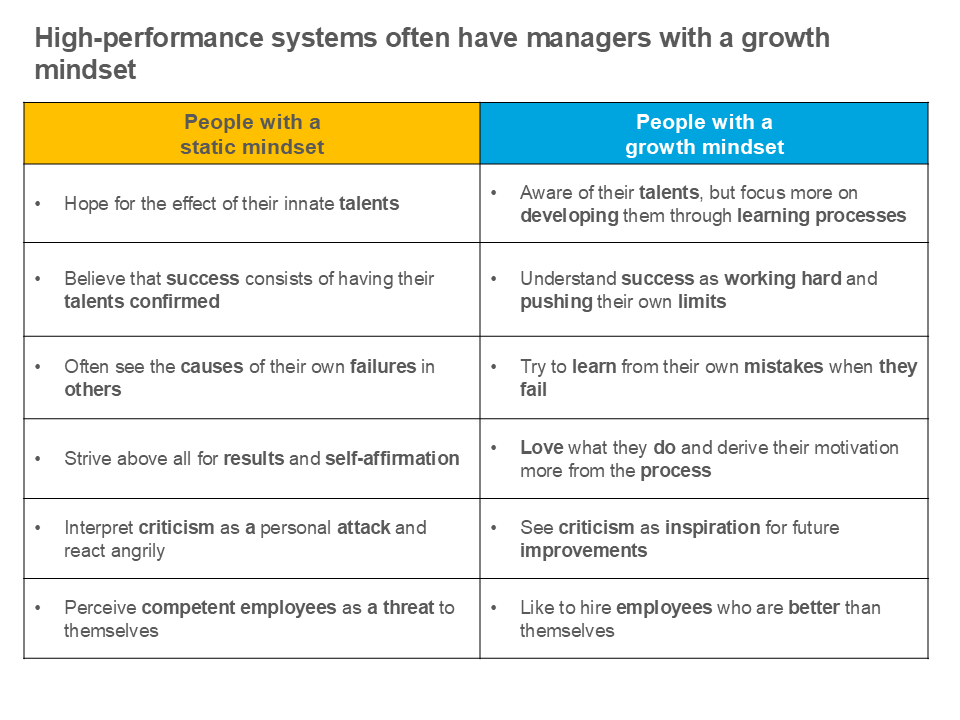
In her book Growth Mindset, Stanford professor Carol Dweck distinguishes between a static and a growth mindset.22 The following figure compares these two mindsets. High-performance systems often have leaders with a growth mindset. An important characteristic is that these people are aware of their talents, but place greater emphasis on their further development and learning processes. In contrast, people with a static worldview place greater hope in the effect of their innate talents.
Lernprozess Innovationsstrategie

Microsoft CEO Satya Nadella writes that the book had a strong influence on his personal development.23

A person’s self-image and their environment are closely linked. High performance therefore arises from an interplay between the two. Social psychologist Mary Murphy has extended the growth mindset concept to organizations, their culture, and the environment surrounding them:24

  • According to this, a growth culture promotes the potential of all employees. This culture emphasizes collaboration, continuous learning, and the development of skills.
  • A genius culture, on the other hand, believes in innate talent. This leads to internal competition, risk aversion, and a reluctance to admit mistakes.

Recommendations for action for managers are

  • create psychological safety and
  • giving constructive feedback.

However, simplistic application of this approach in practice underestimates the complexity of implementation. This can lead to demotivation among exceptional talents.

This raises the question of whether there are any current examples of a growth culture in Germany. A new bridge in South Westphalia has become a symbol of connective design. The Sauerland motorway is the most important transport link between the Ruhr area and Frankfurt. Due to the risk of collapse, the Rahmedetal bridge near Lüdenscheid, where I grew up, had to be suddenly closed in December 2021 and later blown up. This was a disaster for the economy with its many hidden champions and for the people in the region. Every day, 20,000 vehicles had to be diverted via bypasses and through residential areas. The German Economic Institute estimates the damage to businesses at around 1.5 billion euros. In Germany, new construction normally takes around eight to ten years. However, traffic is already rolling across one side of the A45 bridge via the after a record-breaking four years. This was made possible by smooth cooperation between the parties involved, a new planning procedure, and innovative construction methods. The German Chancellor sees this as a model for other renovations, and for the Minister President of North Rhine-Westphalia, the new benchmark for implementation speed in Germany is called „Rahmede“.25

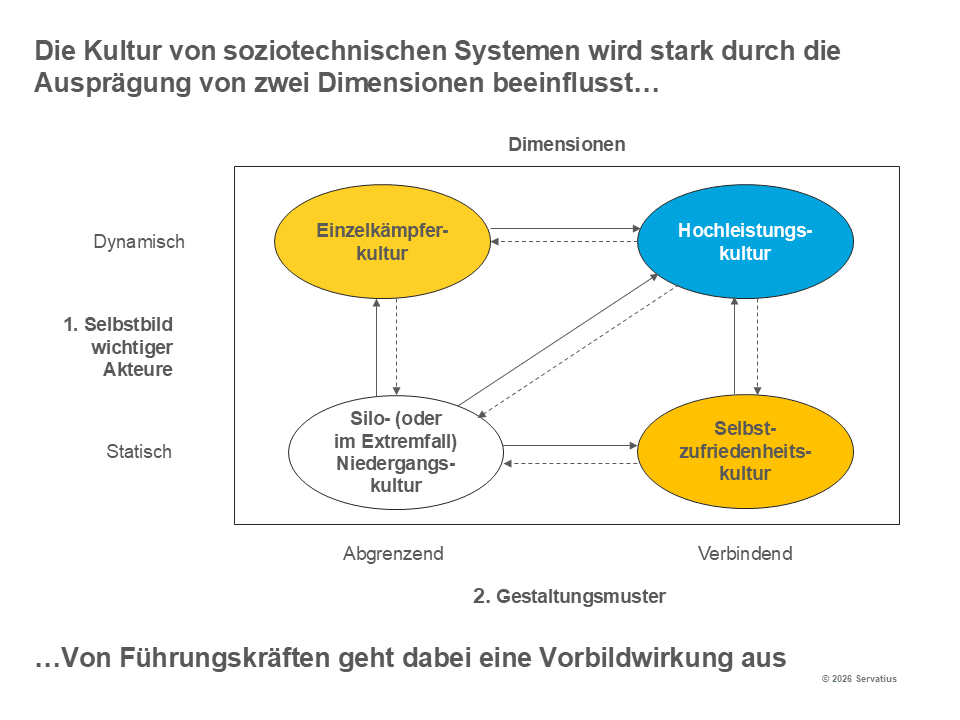
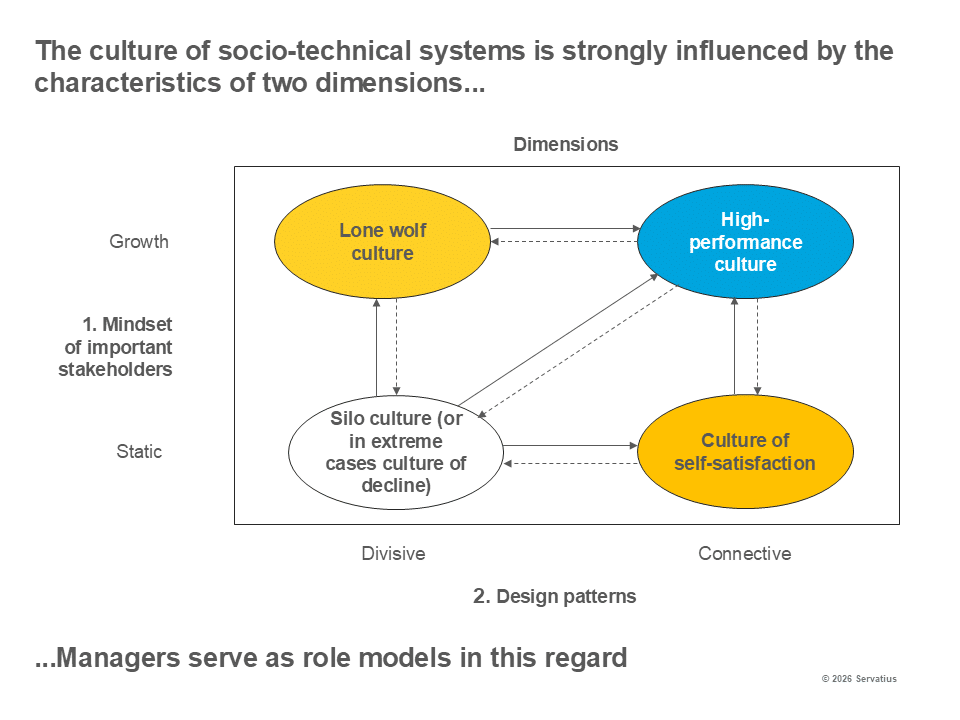
We can therefore summarize that the culture of socio-technical systems is strongly influenced by the mindset-image of important stakeholders and prevailing design patterns.
Lernprozess Innovationsstrategie

High-performance cultures are characterized by a growth mindset and a connective pattern. The opposite is a silo culture or, in extreme cases, a culture of self-satisfaction. Here, a static mindset and a divisive design dominate. Descriptions of outstanding leaders often heroize a lone wolf culture. These individuals are attributed with a growth mindset. At the same time, however, the impression is created that their successes were achieved single-handedly and in isolation from others, which is usually not the case. Until a few years ago, a culture of complacency was widespread in Germany. People rested on the successes of the past, but the mindset in politics and business was rather static and not very future-oriented.

Managers serve as role models in this regard. Their growth mindset is transferred to their employees. Conversely, managers with a static mindset and isolating behavior are responsible for the emergence of toxic cultures. Their position of power enables them to oust internal competitors and employees with a growth mindset that they perceive as a threat. Unfortunately, the role of consultants is often to secure and expand the position of power of the „static“ individuals. Attempts by external parties to change silo cultures are usually met with rejection and fail. It is therefore the task of supervisory bodies to review the dysfunctional mindsets of managers and take timely action. If this does not happen, there is a risk of system failure.

On its way to becoming a high-performance system, Europe currently finds itself in a difficult situation.


Connection of trustworthy partners from politics, business, science, and society

Europe first needs a resilience program against its enemies from outside and within. US political scientist Francis Fukuyama believes that Trumpism will continue even without Trump. For open democratic societies, this is an extremely dangerous development. He fears a relapse into the world order of the 19th century. It is therefore important that Western societies develop sufficient resilience. It should also be taken into account that tech billionaires primarily act in their own economic interests. The greatest danger for Europe is resignation.26

Marc Tüngler, head of the German Association for the Protection of Securities Holders, laments the lack of political support necessary for innovation and economic restructuring. Germany is no longer internationally competitive in terms of electricity prices, for example. Politicians are responsible for this. Important levers would therefore be an improved location policy and a more innovation-friendly climate. We are far from the necessary solidarity between business and politics. He expects 2026 to be a year of decisions for politicians.27

In his book „Wir Krisenakrobaten“ (We Crisis Acrobats), Stephan Grünewald, co-founder of the Cologne-based opinion research company Rheingold, describes the hope for self-efficacy that would enable our society to overcome the multitude of current crises. His recommendation consists of six points:

  1. Truthfulness (clear identification of problems)
  2. focus (successful national projects)
  3. participation (making one’s own contribution clear)
  4. fairness (unreasonable demands must be perceived as fair)
  5. culture of debate (dealing more productively with changes in perspective) and
  6. solidarity (which must be relearned).

Unfortunately, silo thinking („silodarity“) still prevails at present.28

Martin Keller has returned to Germany from the US to become the new president of the Helmholtz Association. The association comprises 18 independent research centers with almost 48,000 employees and a budget of more than six billion euros. Keller wants to use a plan of action to ensure that Germany remains or becomes a global leader in selected fields of innovation. This requires closer cooperation, e.g., in the context of public-private partnerships (PPP), in which politics, research, and business cooperate in order to become more competitive. He believes it is time to break down old structures.29

In his book „Visionen braucht das Land“ (The Country Needs Visions), Jochen Andritzky, co-initiator of Zukunft-Fabrik 2050, calls on politicians to develop visions of the future that can be discussed and provide guidance. This approach is more promising than short-term pseudo-solutions that merely combat the symptoms.30 This return to the power of vision provides important impetus for management research, which in the past has often been content with incremental improvements. Design-oriented management research aims to be more practice-oriented in this regard.


Design-oriented management research in real-world laboratories of change

A research project at Würth has given rise to an AI start-up that could revolutionize the crafts. The aim of the research project conducted by the wholesaler of mounting and fastening material Würth and the AI Lab at the Technical University of Munich was to process inquiries from trade customers in sales more quickly. This led to the spin-off Mercura AI in March 2024, which uses AI to try to solve several problems:

  • Overcoming the shortage of skilled workers
  • increasing productivity for highly complex tasks, and
  • faster processing of inquiries and quotes.

Mercura AI combines semantic models, the recognition of requirements,
company-specific rules, and learning from previous quotes. The software processes both text and speech. The founders have combined AI expertise with industry experience. This example shows the potential of design-oriented management research in companies. 31

Nobel Prize winner Herbert Simon provided important impetus for design-oriented management research. His book „The Sciences of the Artificial,“ published in 1969, is not only a fundamental work on AI, but has also had a strong influence on design theory. The basic idea is that, in addition to the natural sciences, there is a universal science of design. This gave rise to the design methods movement. Not only the technical sciences, but also management science deal with the design of the possible (contingent). In the technical sciences, the design of new things is a natural goal. In management, political science, and social science, the diversity of individual systems and subsystems originating from humans has a specific complexity that is difficult to research purely empirically. Simon’s groundbreaking work emphasizes the interdisciplinarity of design.32

Real-world laboratories of change open up new possibilities for management research. A real-world laboratory (living lab or sandbox) is a research and application space in practice where, for example, companies and their partners design innovative business models. In doing so, they combine research, learning, and action, promote interdisciplinary collaboration, and enable the testing of new legal frameworks (e.g., through the application of experimentation clauses). The concept became known in the 1990s primarily through the work of the Media Lab at the Massachusetts Institute of Technology (MIT).33 In Europe, real-world laboratories are primarily intended to create modern forms of regulation (e.g., in urban development). Real-world laboratories have been used relatively little in management research to date. Empirical approaches dominate in dissertations. The advantage of real-world laboratories lies in their ability to better connect theory and practice.

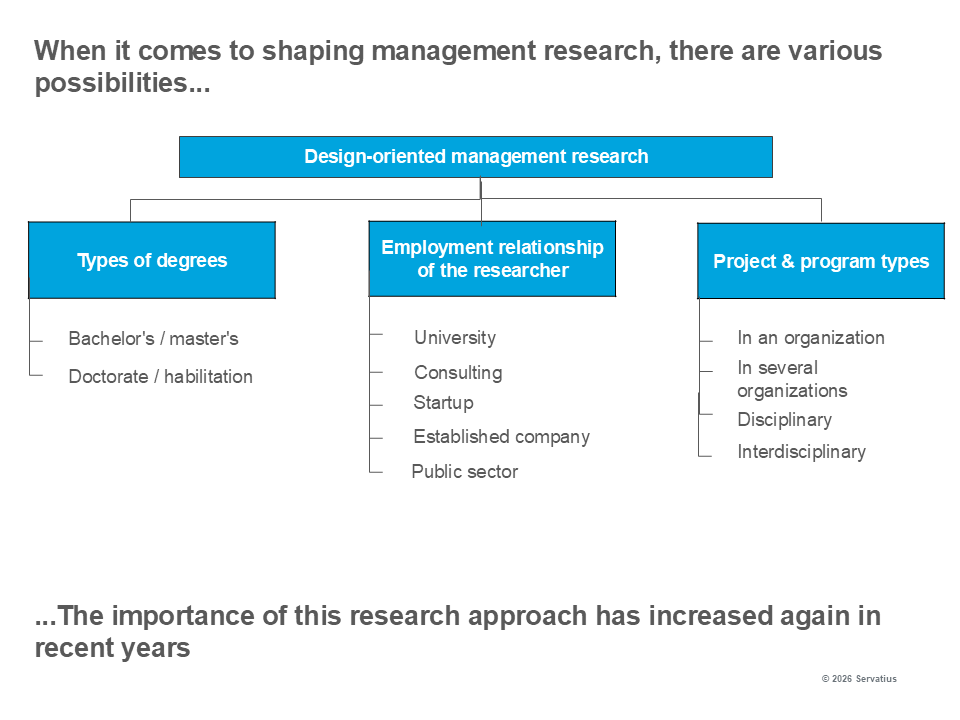
Design-oriented management research is not only taking place at universities, but also increasingly in practice. University lecturers are increasingly supervising creative research approaches by employees in their companies. This approach is mainly used in bachelor’s and master’s theses in dual study programs, in which the course of study is organized in parallel with practical work. In the past, this has also been done more frequently in external dissertations and postdoctoral theses, e.g., by management consultants. The focus here was more on practical relevance. Solving complex problems requires research by interdisciplinary teams, whose members then receive their degrees in their respective fields. Universities should work with partners in the field to combine such projects into programs that can also build on each other (e.g., to design a sovereign AI from Europe).34

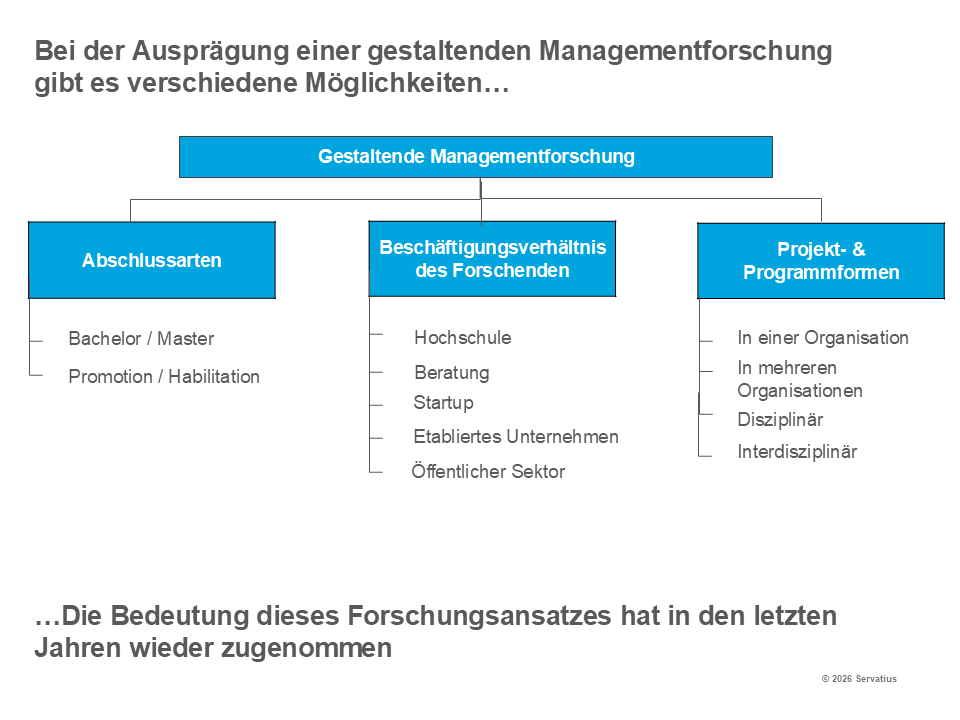
The following figure summarizes various possible forms of design-oriented management research. Here, we distinguish between the type of degrees, the employment relationship of the researcher and the project and program types. In a part-time doctorate of a consulting employee, for example, it makes sense to compare the results of projects from several organizations and derive new insights from them. What seems important in this research approach is that design-oriented research projects based on theoretical foundations35 now focus more strongly on concrete application in practice.
Lernprozess Innovationsstrategie

In 2026, we will further develop this approach to management research in the context of designing high-performance systems in which trustworthiness has become an important competitive advantage. One model for this is the start-up ecosystem in Munich, from which other regions can learn.36


Conclusion

  • High-performance systems are characterized by their success and trustworthiness. In the current transition phase, Europe should seize this as an opportunity.
  • To do so, companies must master complex realignment processes and become more resilient, digital, and sustainable
  • Such connective strategic management (Strategy 5.0) is one of the fields of action of trustworthy high-performance systems
  • Another field of action is the promotion of high-performance teams with a growth mindset
  • This requires trustworthy partners and closer cooperation between business and politics
  • Real-world laboratories of change open up new opportunities for design-oriented management research.


Literature

[1] zu Fürstenberg, J., Kloepfer, I., How good we are is revealed in times of crisis – A wake-up call, Piper 2025

[2] Servatius, H.G., Trimming an organization for performance. In: Harvard Manager, 1988, No. 4, pp. 128-134

[3] Katzenbach, J.R., Smith, D.R., The wisdom of teams – Creating the high performance organization, Harvard Business School Press 1993

[4] de Waal, A., What makes a high performance organization, Warden Press 2019

[5] Servatius, H.G., AI as a tool for strategic management. In: Competivation Blog, May 1, 2025

[6] Sommer, U., US corporations are stronger than ever. In: Handelsblatt, December 29, 2025, pp. 1, 4-6

[7] Alvarez de Souza Soares, P., Holtermann, P., AMD wants to end Nvidia’s monopoly. In: Handelsblatt, January 7, 2026, pp. 18-19

[8] Knees, C., Disinformation as a business risk. In: Handelsblatt, January 7, 2026, pp. 20-21

[9] Merten, M., Companies sinking in AI junk. In: Handelsblatt, January 9, 2026, pp. 20-21

[10] Frankopan, P., „What does Europe have besides handbags and champagne?“ (Interview). In: Handelsblatt, December 19/20/21, 2025, pp. 12-13

[11] Fröndhoff, B., et al., Billions for restructuring. In: Handelsblatt, November 26, 2025, pp. 1, 4-5

[12] Servatius, H.G., Disruption of management education for AI-based realignments. In: Competivation Blog, October 10, 2025

[13] Servatius, H.G., Development and change in strategic management. In: Competivation Blog, September 19, 2025

[14] Servatius, H.G., Triple strategic realignment. In: Competivation Blog, June 7, 2024

[15] Servatius, H.G., Strategic leadership with contextual and relationship-oriented intelligence. In: Competivation Blog, March 14, 2023

[16] Huchzermeier, D. et al., Economy in reform gridlock. In: Handelsblatt, February 2/3/4, 2026, pp. 1, 6-7

[17] Servatius, H.G., Resilience-oriented strategic management. In: Competivation Blog, March 15, 2024

[18] Meiritz, A., „We will certainly remember a no.“ In: Handelsblatt, January 22, 2026, p. 1, 4-5

[19] Koch, M., Can an alliance of middle powers slow Trump down? In: Handelsblatt, January 22, 2026, p. 5

[20] Bomke, L., Germany’s AI hope. In: Handelsblatt, December 2, 2025, p. 1

[21] Czikszentmihalyi, M., Creativity – Flow and the psychology of discovery and invention, Harper Collins 1996

[22] Dweck, C., Mindset – The new psychology of success, Random House 2006

[23] Nadella, S., Hit Refresh – The quest to rediscover Microsoft’s soul and imagine a better future for everyone, Harper Collins 2017

[24] Murphy, M.C., Cultures of growth – How the new science of mindset can transform individuals, teams and organizations, Simon & Schuster 2024

[25] Herwig, M., Linnhoff, C., New A 45 bridge opened. In: Rheinische Post, December 23, 2025, p. A6

[26] Fukuyama, F., „Trumpism is a cry against modernity“ (interview). In: Handelsblatt, December 5/6/7, 2025, pp. 12-13

[27] Tüngler, M., „Friedrich Merz still has it in his hands“ (interview). In: Handelsblatt, December 11, 2025, pp. 22-23

[28] Grünewald, S., We crisis acrobats – Psychogram of an unsettled society, Kiepenheuer & Witsch 2025

[29] Delhaes, D., Architect of a German research breakthrough. In: Handelsblatt, December 30, 2025, p. 13

[30] Andritzky, J., The country needs visions – For long-term policies with the courage to face the future, Herder 2026

[31] Bomke, L., Revolutionizing the trade with AI. In: Handelsblatt, January 7, 2026, p. 26

[32] Simon, H.A., The sciences of the artificial, 3rd ed., MIT Press 1996

[33] Mitchell, W.J., City of bits – Space, place, and the infobahn, MIT Press 1995

[34] Servatius, H.G., AI and the future of management education. In: Competivation Blog, April 9, 2025

[35] Seckler, C., et al., Design sciences across industries – Building bridges for advancing impactful business research. In: Schmalenbach Journal of Business Research, December 9, 2025

[36] Banze, S., Freisinger, G.M., The Munich code. In: Manager Magazin, February 2026, pp. 30-36
Designing trustworthy high-performance systems

Gestaltung von vertrauenswürdigen Hochleistungssystemen

In den letzten Jahren hat die Bedeutung eines verbindenden strategischen Managements weiter zugenommen. Angesichts der dynamischen Entwicklung der Künstlichen Intelligenz (KI) und neuer geopolitischer Herausforderungen ist die Gestaltung von vertrauenswürdigen Hochleistungssystemen in den Mittelpunkt des Interesses gerückt. In diesem Zusammenhang erlebt der Begriff Hochleistung in Unternehmen und in der Politik eine Neuinterpretation. Ein wichtiges Handlungsfeld ist hierbei die gestaltende Managementforschung.


In unserem ersten Blogpost des Jahres 2026 beschäftige ich mich mit der Frage, was für Europa wichtige Handlungsfelder von vertrauenswürdigen Hochleistungssystemen sind.


Hochleistung in Unternehmen und in der Politik neu interpretiert

Für Jeanette zu Fürstenberg, die Europa-Verantwortliche des US-Fonds General Catalyst, besteht eine Chance für den alten Kontinent in der Verbindung von Startups mit der Welt der etablierten Industrieunternehmen. Zu ihren erfolgreichen Investments gehören Mistral in Frankreich und das Rüstungsunternehmen Helsing in Deutschland. Der Fokus dieser Unternehmen liegt auf einer Künstlichen Intelligenz (KI), die hochspezialisiertes Anwendungswissen nutzt. Ihre Publikation „Wie gut wir sind, zeigt sich in Krisenzeiten“ wurde 2025 Managementbuch des Jahres. Die Grundlage für ein europäisches Hochleistungssystem, mit dem eine Reindustrialisierung gelingen kann, bildet für sie Resilienz, die es ermöglicht, sich nach externen Schocks so schnell wie möglich zu erholen.1 2025 hat die Zahl der in Deutschland gegründeten Startups einen Rekordwert erreicht.

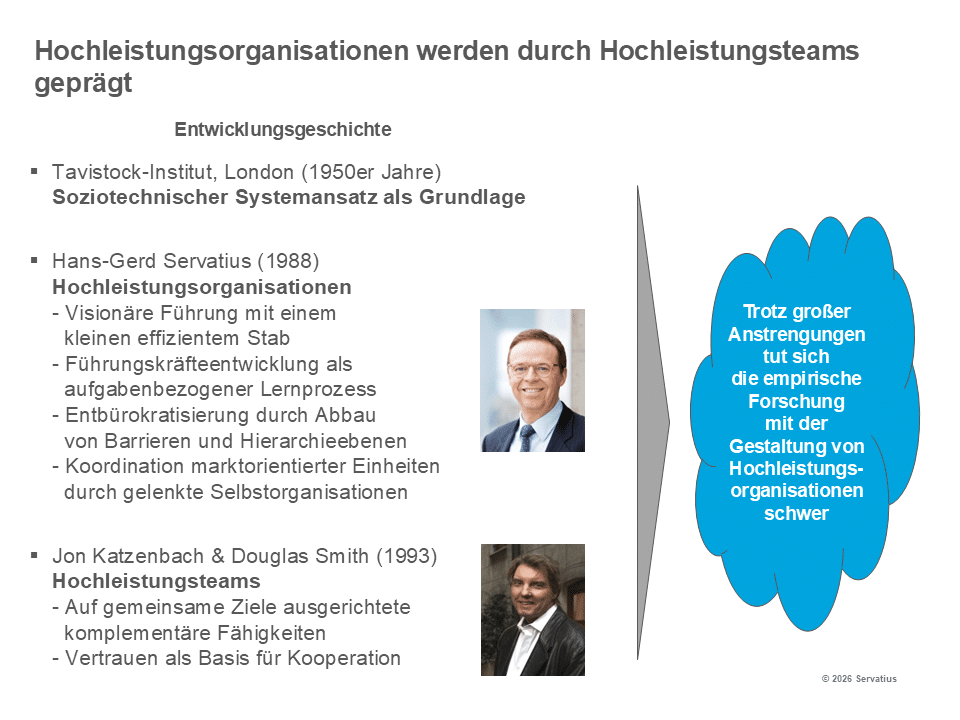
Das Thema Hochleistungsorganisation ist nicht neu. Dabei werden Hochleistungsorganisationen durch Hochleistungsteams geprägt. Bereits in den 1950er Jahren hat das britische Tavistock-Institut mit dem soziotechnischen Systemansatz eine erste Grundlage entwickelt. Die Ergebnisse von Beratungsprojekten zu Merkmalen von Hochleistungsorganisationen habe ich1988 in einem Artikel der Zeitschrift Harvard Manager beschrieben. Eine wichtige Erkenntniss ist, dass eine visionäre Führung den Rahmen für stärker selbstorganisiert arbeitende Teams schafft.2

Die McKinsey-Berater Jon Katzenbach und Douglas Smith beschäftigten sich mit der Frage, was Hochleistungsteams kennzeichnet.3 Die weitere Entwicklung hat jedoch gezeigt, dass sich die empirische Forschung trotz großer Anstrengungen mit der Gestaltung von Hochleistungsorganisationen schwertut.4 Durch KI bekommt das Performance Management nun neue Impulse zu einer besseren Verbindung zwischen Strategieumsetzung und Motivation.5

Lernprozess Innovationsstrategie

Inzwischen dominieren US-Tech-Konzerne mit Künstlicher Intelligenz (KI) die Weltwirtschaft. Ende 2025 kommen 61 der 100 wertvollsten Unternehmen der Welt aus den USA. Die Dominanz der USA resultiert aus einer einmaligen Stärke von sieben Tech-Giganten, die zusammen einen Börsenwert von 18,3 Billionen Euro erzielen. Ein wichtiger Treiber dieser Entwicklung ist der Hype um Künstliche Intelligenz (KI). Deutschland ist im Top-100-Ranking mit den Unternehmen SAP (Rang 40), Siemens (72), dem europäischen Gemeinschaftsunternehmen Airbus (91) und der Allianz (100) vertreten. Angesichts der geopolitischen Veränderungen stellt sich bei dieser Machtkonzentration die Frage, wie groß die Gefahr einer Abhängigkeit von den USA ist.6 Bei KI-Chips nimmt für den Marktführer Nvidia der Wettbewerbsdruck zu.

KI-Chips werden immer leistungsfähiger, aber gleichzeitig steigt durch KI das Desinformationsrisiko. Der KI-Chiphersteller Nvidia hat mit einem Weltmarktanteil von 85,2% eine dominierende Position vor Broadcom (10,3%), Marvell (2,1%) und AMD (1,8%). Der Herausforderer AMD und Meta haben ein neues KI-System für Rechenzentren angekündigt (Helios-Plattform), das eine signifikante Leistungssteigerung bringen soll. Nvidia kontert mit der neuen Chipgeneration Rubin.7

Ein Vertrauensverlust droht allerdings bei KI durch das Risiko von Desinformationen aufgrund von Fake Accounts. Dabei fälschen KI-Bots Inhalte, imitieren Personen und posten automatisiert in sozialen Medien. Solche Deepfakes können große wirtschaftliche Schäden anrichten und z.B. den Ruf einer Marke ruinieren.8

Große Sprachmodelle und kostenlose KI-Tools führen nicht selten zu Qualitäts- und Vertrauensverlusten, da sie nicht auf Hochleistung trainiert sind, sondern auf die Produktion von Durchschnittswissen. Wenn KI-Anwender unter Zeitdruck stehen und keine Qualitätsstandards existieren, kann „KI-Brei“ (AI Workslop) entstehen. Zwar liegen so schneller Ergebnisse vor, aber die Qualität sinkt. Mögliche Folgen sind Reputations- und Vertrauensverluste. Wichtig beim Einsatz von KI ist daher nach einer Qualitätskontrolle die fachliche Ergänzung von Inhalten.9

Durch KI und geopolitische Herausforderungen erlebt der Begriff Hochleistung eine Neuinterpretation. Denn nicht jede KI ist vertrauenswürdig. Unter einem vertrauenswürdigen Hochleistungssystem verstehen wir ein System (z.B. ein Unternehmen, eine Region oder einen Staat), das im Vergleich zum Wettbewerb sehr hohe Leistungen erbringt und dem die Empfänger der Leistungen trauen. Außerdem sind diese Leistungsempfänger bereit und in der Lage, für die Leistungen zu zahlen. Hochleistungssysteme müssen daher ihre höheren Preise rechtfertigen (z.B. durch „German Quality“, technische Überlegenheit oder eine Luxusmarke).

Hochleistung neu interpretiert bedeutet, dass Hochleistungssysteme sowohl durch Erfolge als auch durch ein vertrauenswürdiges Verhalten gekennzeichnet sind. Ist weder das eine noch das andere der Fall, sprechen wir von einem Systemversagen. Die meisten soziotechnischen Systeme befinden sich irgendwo dazwischen. Interessant sind die Fälle, bei denen nur eines der beiden Kriterien erfüllt ist. Ein gefährdetes vorhandenes Erfolgsmuster liegt vor, wenn ein bislang erfolgreiches System wie z.B. das der KI-Champions an Vertrauen verliert. Hieraus könnte sich eine Übergangsphase mit neuen Chancen ergeben, wenn z.B. das bislang bei der Digitalisierung weniger erfolgreiche Europa mit Vertrauen punktet.

Lernprozess Innovationsstrategie

Der in Oxford lehrende britische Professor für Globalgeschichte Peter Frankopan sieht die Welt in einer Übergangsphase wie in den 1920er Jahren, in der die alte Ordnung noch nicht tot ist und eine neue noch nicht geboren wurde.10

Die Frage ist daher, wie Europa seine Chancen nutzen und zum Gestalter von vertrauenswürdigen Hochleistungssysteme werden kann.


Strategische Neuausrichtung in einer Phase des Übergangs

In den ersten neun Monaten des Jahres 2025 haben Dax-Unternehmen sechs Milliarden Euro für Restrukturierungen aufgewendet. Die höchsten Restrukturierungskosten gab es 2025 bei Mercedes (1,4 Mrd. €), Volkswagen (900 Mill. €) sowie Siemens und der Commerzbank (jeweils 500 Mill. €). Besonders betroffen sind die Branchen Automobil, Maschinenbau und Chemie. In der deutschen Industrie waren Ende September 2025 120.300 Menschen weniger beschäftigt als ein Jahr früher. Dabei setzen viele Unternehmen auf üppige Abfindungen. Häufig folgt auf eine Restrukturierungsrunde die nächste, ohne die grundlegenden Probleme zu lösen. Hierzu müsste nach einer Restrukturierung eine strategische Neuausrichtung stattfinden.11

Der Begriff strategische Neuausrichtung eines Unternehmens (Realignment) beschreibt einen innovativen Ansatz zur Abstimmung vorhandener und neuer Systemelemente (z.B. Geschäftsmodell, Strategie, Technologien, Kunden, Kompetenzen, Organisation, Kultur und Umfeld). Neuausrichtungen entfalten ihre tiefgreifende Wirkung meist über einen längeren, nicht klar bestimmten Zeitraum in vielen parallelen Lernschritten. Eine wichtige Rolle spielen dabei komplexe Interaktionen, aus deren Verlauf sich spezifische Muster ergeben, die schwer prognostizierbar sind.12

In einer Phase des Übergangs müssen Unternehmen komplexe Prozesse der Neuausrichtung bewältigen. In einem erfolgreichen, innovativen Unternehmen sind wichtige Systemelemente gut aufeinander abgestimmt. Dieses Alignment erfolgt häufig durch Feinabstimmungen, bei denen das Management z.B. die Strategie kontinuierlich an Veränderungen des Umfelds anpasst. Wenn dies unterbleibt, entwickelt sich das Unternehmen in Richtung auf ein Misalignment. Diesen schleichenden Niedergang erkennen Management und Aufsichtsgremium oft zu spät. Das Ergebnis ist ein etabliertes Unternehmen in einer Dauerkrise, die eine Restrukturierung erforderlich macht.

Die Begriffe Restrukturierung und Transformation werden inzwischen häufig synonym verwendet. Beide Begriffe beschreiben einen zeitlich befristeten, umfassenden Wandel. Die inflationäre Verwendung des Transformationsbegriffs vermittelt leider die Illusion einer zeitlichen Begrenztheit komplexer Neuausrichtungsprozesse. Am Beispiel der Künstlichen Intelligenz wird deutlich, dass ein solches statisches Weltbild naiv ist.

Lernprozess Innovationsstrategie

Ein längerfristiges Ziel von strategischen Neuausrichtungen ist die Gestaltung von vertrauenswürdigen Hochleistungssystemen.


Handlungsfelder von vertrauenswürdigen Hochleistungssystemen

Bei zunehmenden Polarisierungen zeichnen sich Hochleistungssysteme durch die Fähigkeit eines verbindenden Gestaltens aus. Die Geschichte lehrt uns, dass in Phasen technologischer und politischer Umbrüche die Gefahr einer Polarisierung zunimmt. Dies gilt auch für die von Künstlicher Intelligenz (KI) ausgehenden Veränderungen. Entscheidend ist, dass Menschen sich selbst dabei als aktive Gestalter und nicht als passive Objekte des Wandels sehen. Die Komplementarität von Mensch und KI ist ein gestaltbares System. Die Leistungsfähigkeit eines solchen Systems hängt von der Fähigkeit ab, Verbindungen zwischen den Akteuren und den Systemelementen zu verbessern. Im Rahmen unserer anwendungsorientierten Forschung und Lehre gehen wir von der These aus, dass es bei der Gestaltung von vertrauenswürdigen Hochleistungssystemen auf die folgenden, in der Abbildung dargestellten Handlungsfelder ankommt:

  • Ein verbindendes strategisches Management zur dreifachen Neuausrichtung
  • Hochleistungsteams mit einem dynamischen Selbstbild in einer Phase des Übergangs
  • die Verbindung von vertrauenswürdigen Partnern aus Politik, Wirtschaft, Wissenschaft und Gesellschaft sowie
  • eine gestaltende Managementforschung in Reallaboren des Wandels.

Eine interdisziplinäre Hochschullehre steht vor der Aufgabe, für diese Felder die relevanten Kompetenzen zu vermitteln, z.B. beim Thema Unternehmertum für KI-Anwendungen.

Lernprozess Innovationsstrategie

Im Folgenden gehe ich auf diese Handlungsfelder und Kompetenzen näher ein.


Verbindendes strategisches Management zur dreifachen Neuausrichtung

Neue Herausforderungen haben seit den 1960er Jahren zu verschiedenen Entwicklungsstufen des strategischen Managements geführt.13 Wir unterscheiden zwischen

  • einer markt- und finanzorientierten Stufe (Strategie 1.0)
  • einer technologie- und innovationsorientierten Stufe (Strategie 2.0)
  • einer nachhaltigkeitsorientierten Stufe (Stratege 3.0) und
  • einer resilienzorientierten Stufe (Strategie 4.0).

In der gegenwärtigen fünften Entwicklungsstufe (Strategie 5.0) liegt die Herausforderung in einer Verbindung der früheren Stufen. Unternehmen müssen gleichzeitig resilienter, digitaler und nachhaltiger werden.14 Dies erfordert ein verbindendes Gestalten von dreifachen strategischen und organisatorischen Neuausrichtungen. Ein solches Triple Realignment erfolgt im Rahmen von gravierenden Veränderungen des politischen Umfelds. Die gegenwärtige Situation ist historisches Neuland. Daher spielt die kontextuelle Intelligenz des Managements eine wichtige Rolle.15

Lernprozess Innovationsstrategie

Die deutsche Politik sollte mit grundlegenden Reformen den Rahmen für ein verbindendes strategisches Management schaffen. Als sich 2018 erste Zeichen einer gesamtwirtschaftlichen Schwäche zeigten, waren dies Vorboten der schwersten und längsten Industrierezession, die die Bundesrepublik erlebt hat. Die deutsche Industrie hat inzwischen stark an Wettbewerbsfähigkeit verloren. Experten fordern neue Ansätze zu einer angebotsorientierten Innovationspolitik und eine Kommunikation, die die Notwendigkeit eines Kurswechsels vermittelt. Die Politik muss die versprochenen grundlegenden Reformen umsetzen. Ein solcher Aufbruch gelingt nur mit Verbundenheit anstelle von Polarisierung.16

In diesem Umfeld erlebt das resilienzorientierte strategische Management einen Bedeutungszuwachs.17 Beim diesjährigen Weltwirtschaftsforum in Davos sind die unterschiedlichen Positionen des US-Präsidenten und der europäischen Vertreter aufeinander geprallt.18 Der kanadische Premierminister Mark Carney regt an, dass sich in einer Welt, in der Großmächte zu Imperialisten werden, die andere Staaten erpressen, Mittelmächte und kleinere Länder vertrauenswürdige Partnerschaften bilden sollten.19

Eine solche Zusammenarbeit spielt nicht nur auf der geopolitischen Ebene eine entscheidende Rolle, sondern auch in Hochleistungsteams.


Hochleistungsteams mit einem dynamischen Selbstbild in einer Phase des Übergangs

Black Forest Lab (BFL), das gegenwärtig wertvollste deutsche KI-Startup, kommt aus Freiburg, wurde 2024 gegründet und entwickelt KI-Modelle zur Bildgenerierung ausgehend von Texten. Die Gründer gehören zum Kernteam des Open-Source-KI-Modells Stable Diffusion, dem Text-Bild-Modell, das digitale Bilder aus Texten generiert und 2022 neben ChatGPT den weltweiten KI-Hype auslöste. Die Flux-Modelle von BFL sind inzwischen einer der größten Konkurrenten von Google. Wichtige Impulse für die Arbeit des Gründerteams sind von dem an der LMU München lehrenden Informatik-Professor Björn Ommer ausgegangen. Das Beispiel zeigt, dass auch beim Thema KI in Deutschland Hochleistungsteams entstehen können.20

Neue Ideen und die Gestaltung von etwas Neuem gehen häufig von Personen aus, die einen Flow-Zustand als motivierend empfinden. Den Begriff Flow (im Sinne von „im Fluss sein“) hat der Psychologie-Professor Csikszentmihalyi bereits 1975 geprägt. Gemeint ist damit das völlige Aufgehen in einer Tätigkeit, die meist mit hoher intrinsischer Motivation erfolgt und bei der sich die Zeitwahrnehmung verändert. Interviews, in denen herausragende kreative Persönlichkeiten aus unterschiedlichen Bereichen auf ihr Arbeitsleben zurückblicken, zeigen, dass bei diesen die Motivationswirkung vor allem von dem kreativen Prozess ausgeht. Die Grundlagen für mögliche Flow-Zustände entstehen bei vielen Menschen häufig bereits in deren Jugend ausgehend von ihrem dynamischen Selbstbild.21

In ihrem Buch Growth Mindset unterscheidet die Stanford-Professorin Carol Dweck zwischen einem statischen und einem dynamischen Selbstbild.22 In der folgenden Abbildung sind diese beiden Selbstbilder gegenübergestellt. Hochleistungssysteme haben häufig Führungskräfte mit einem dynamischen Selbstbild. Ein wichtiges Kennzeichen ist, dass diese Menschen zwar ihre Talente kennen, aber stärker auf deren Weiterentwicklung und Lernprozesse setzen. Demgegenüber hoffen Menschen mit einem statischen Weltbild stärker auf die Wirkung ihrer angeborenen Talente.

Lernprozess Innovationsstrategie

Der Microsoft-Chef Satya Nadella schreibt, das Buch habe seine persönliche Entwicklung stark geprägt.23

Das Selbstbild einer Person und ihr Umfeld sind eng miteinander verbunden. Daher entsteht Hochleistung aus einem Zusammenspiel. Die Sozialpsychologin Mary Murphy hat das Selbstbild-Konzept auf Organisationen, ihre Kultur und das sie umgebende Umfeld erweitert:24

  • Danach fördere eine Wachstumskultur das Potenzial aller Mitarbeitenden. Diese Kultur betont Zusammenarbeit, kontinuierliches Lernen und die Entwicklung von Fähigkeiten
  • Eine Geniekultur glaube hingegen an angeborene Talente. Dies führe zu internem Wettbewerb, Risikoaversion und einer geringen Bereitschaft, Fehler zuzugeben.

Handlungsempfehlungen für Führungskräfte sind

  • psychologische Sicherheit schaffen und
  • konstruktives Feedback geben.

Eine vereinfachende Anwendung dieses Ansatzes in der Praxis unterschätzt allerdings die Komplexität der Umsetzung. Dies kann zu einer Demotivation von außergewöhnlichen Talenten führen.

Somit stellt sich die Frage, ob es in Deutschland aktuelle Erfolgsbeispiele für eine Wachstumskultur gibt. Zum Symbol für verbindendes Gestalten ist ein Brückenneubau in Südwestfalen geworden. Die Autobahn Sauerlandlinie ist die wichtigste Verkehrsverbindung zwischen dem Ruhrgebiet und Hessen. Wegen Einsturzgefahr musste die Rahmedetalbrücke bei Lüdenscheid, wo ich aufgewachsen bin, im Dezember 2021 plötzlich gesperrt und später gesprengt werden. Für die Wirtschaft mit ihren vielen Hidden Champions und die Menschen in der Region war das eine Katastrophe. Täglich mussten 20.000 Fahrzeuge über Umgehungsstraßen und durch Wohnsiedlungen umgeleitet werden. Das Institut der deutschen Wirtschaft beziffert den Schaden für Betriebe auf rund 1,5 Milliarden Euro. Ein Neubau dauert in Deutschland normalerweise etwa acht bis zehn Jahre. Über die eine Seite der A45-Brücke rollt der Verkehr aber schon wieder nach rekordverdächtigen vier Jahren. Möglich wurde dies durch eine reibungslose Zusammenarbeit der Akteure, ein neues Planungsverfahren und innovative Baumethoden. Der Bundeskanzler sieht hierin ein Vorbild für andere Sanierungen und für den NRW-Ministerpräsidenten heißt der neue Maßstab für Umsetzungsgeschwindigkeit in Deutschland „Rahmede“.25

Wir können daher zusammenfassen, dass die Kultur von soziotechnischen Systemen stark durch das Selbstbild wichtiger Akteure und vorherrschende Gestaltungsmuster beeinflusst wird.

Lernprozess Innovationsstrategie

Hochleistungskulturen sind durch ein dynamisches Selbstbild und verbindendes Gestalten geprägt. Das Gegenteil ist eine Silo- oder im Extremfall Niedergangskultur. Hier dominieren ein statisches Selbstbild und abgrenzendes Gestalten. Beschreibungen von herausragenden Führungspersönlichkeiten heroisieren häufig eine Einzelkämpferkultur. Diesen Personen wird zwar ein dynamisches Selbstbild zugeschrieben. Gleichzeitig entsteht aber der Eindruck, ihre Erfolge seien im Alleingang und in Abgrenzung zu anderen Personen erzielt worden, was so meist nicht der Fall ist. In Deutschland verbreitet war bis vor einigen Jahren eine Selbstzufriedenheitskultur. Man ruhte sich auf den Erfolgen der Vergangenheit aus, das Selbstbild in Politik und Wirtschaft war aber eher statisch und wenig auf die Zukunft gerichtet.

Von Führungskräften geht dabei eine Vorbildwirkung aus. Ihr dynamisches Selbstbild überträgt sich auf die Mitarbeitenden. Umgekehrt sind Führungskräfte mit einem statischen Selbstbild und abgrenzendem Verhalten für das Entstehen von toxischen Kulturen verantwortlich. Ihre Machtposition ermöglicht es Ihnen, Konkurrenten und Mitarbeitende mit einem dynamischen Selbstbild, das sie als Bedrohung empfinden, zu verdrängen. Die Rolle von Beratern ist leider häufig, die Machtposition der „Statiker“ zu sichern und auszubauen. Versuche der Externen, statische Selbstbilder zu verändern, stoßen meist auf Ablehnung und scheitern. Eine Überprüfung der dysfunktionale Selbstbilder von Führungskräften ist daher Aufgabe von Aufsichtsgremien, die rechtzeitig Konsequenzen ziehen müssen. Geschieht dies nicht, droht ein Systemversagen.

Auf dem Weg zu einem Hochleistungssystem befindet sich Europa gegenwärtig in einer schwierigen Lage.


Verbindung von vertrauenswürdigen Partnern aus Politik, Wirtschaft, Wissenschaft und Gesellschaft

Europa benötigt zunächst ein Resilienzprogramm gegen seine Feinde von außen und innen. Der US-amerikanische Politologe Francis Fukuyama geht davon aus, dass der Trumpismus auch ohne Trump fortbestehen wird. Für offene demokratische Gesellschaften sei das eine brandgefährliche Entwicklung. Er befürchtet einen Rückfall in die Weltordnung des 19. Jahrhunderts. Daher käme es darauf an, dass die westlichen Gesellschaften genügend Widerstandskraft entwickeln. Es sei auch zu berücksichtigen, dass die Tech-Milliardäre primär nach ihren eigenen wirtschaftlichen Interessen handeln. Die größte Gefahr für Europa sei Resignation.26

Marc Tüngler, der Chef der Deutschen Schutzvereinigung für Wertpapierbesitz, beklagt den fehlenden Rückenwind aus der Politik, der für Innovationen und die Neuaufstellung der Wirtschaft notwendig sei. Deutschland sei z.B. beim Strompreis international nicht mehr wettbewerbsfähig. Verantwortlich dafür sei die Politik. Wichtige Hebel wären daher eine verbesserte Standortpolitik und ein innovationsfreundlicheres Klima. Von dem notwendigen Schulterschluss zwischen Wirtschaft und Politik seien wir weit entfernt. Für 2026 erwartet er von der Politik ein Jahr der Entscheidungen.27

In seinem Buch „Wir Krisenakrobaten“ beschreibt Stephan Grünewald, der Mitgründer des Kölner Meinungsforschungsunternehmens Rheingold die Hoffnung auf Selbstwirksamkeit, die es unserer Gesellschaft ermöglichen würde, die Vielzahl der gegenwärtigen Krisen zu meistern. Seine Empfehlung besteht in sechs Punkten:

  1. Wahrhaftigkeit (klare Benennung von Problemen)
  2.  Fokussierung (erfolgreiche nationale Projekte)
  3. Beteiligung (den eigenen Beitrag deutlich machen)
  4. Fairness (Zumutungen müssen als gerecht empfunden werden)
  5. Streitkultur (produktiver mit Perspektivwechseln umgehen) und
  6. Verbundenheit, (die wieder neu gelernt werden muss).

Gegenwärtig würde leider noch ein Silodenken vorherrschen („Silodarität“).28

Um neuer Präsident der Helmholtz-Gemeinschaft zu werden, ist Martin Keller aus den USA nach Deutschland zurückgekehrt. In der Gemeinschaft arbeiten 18 selbstständige Forschungszentren mit fast 48.000 Menschen und einem Etat von mehr als sechs Milliarden Euro. Keller möchte mit einem Plan for Action erreichen, dass Deutschland in ausgewählten Innovationsfeldern weltweit führend bleibt oder wird. Hierzu sei eine engere Zusammenarbeit notwendig, z.B. im Rahmen von Public-Private-Partnerships (PPP), in denen Politik, Forschung und Unternehmen kooperieren, um so wettbewerbsfähiger zu werden. Er meint, es sei an der Zeit, alte Strukturen aufzubrechen.29

In seinem Buch „Visionen braucht das Land“ fordert der Mitinitiator der Zukunft-Fabrik 2050 Jochen Andritzky von der Politik die Entwicklung von Zukunftsbildern, über die man diskutieren kann und die Orientierung geben: Dieser Ansatz sei erfolgversprechender als kurzfristige Scheinlösungen zur Symptombekämpfung.30 Eine solche Rückbesinnung auf die Kraft von Visionen liefert wichtige Impulse für die Managementforschung, die sich in der Vergangenheit oft mit inkrementellen Verbesserungen zufrieden gegeben hat. Die gestaltende Managementforschung strebt hierbei eine stärkere Praxisorientierung an.


Gestaltende Managementforschung in Reallaboren des Wandels

Aus einem Forschungsprojekt bei Würth ist ein KI-Startup hervorgegangen, das das Handwerk revolutionieren könnte. Ziel des Forschungsprojekts des Großhändlers von Montage- und Befestigungsmaterial Würth und des KI-Labs der TU München war es, Anfragen von Handwerkskunden im Vertrieb schneller zu bearbeiten. Hieraus ist im März 2024 die Ausgründung Mercura AI entstanden, die mit Hilfe von KI versucht, mehrere Probleme zu lösen:

  • Eine Bewältigung des Fachkräftemangels
  • die Produktivitätssteigerung bei Aufgaben mit hoher Komplexität und
  • eine schnellere Bearbeitung von Anfragen und Angeboten.

Mercura AI kombiniert semantische Modelle, das Erkennen von Anforderungen,
unternehmensspezifische Regeln und das Lernen aus bisherigen Angeboten. Dabei verarbeitet die Software neben Text auch Sprache. Die Gründer haben KI-Kompetenz mit Branchenerfahrung verbunden. Das Beispiel zeigt, welches Potenzial eine gestaltende Managementforschung in Unternehmen hat.31

Wichtige Impulse für die gestaltende Managementforschung sind von dem Nobelpreisträger Herbert Simon ausgegangen. Sein 1969 erschienenes Buch „The Sciences of the Artificial“ ist nicht nur ein Grundlagenwerk für KI, sondern hat auch die Design-Theorie stark geprägt. Die Grundidee ist, dass es neben den Naturwissenschaften eine universelle Wissenschaft des Gestaltens gibt. Hieraus hat sich die Design-Methoden-Bewegung entwickelt. Mit einer Gestaltung des Möglichen (contingent) beschäftigen sich nicht nur die Technikwissenschaften, sondern auch die Managementwissenschaft. In den Technikwissenschaften ist die Gestaltung von Neuem ein selbstverständliches Ziel. In den Wirtschafts-, Politik- und Sozialwissenschaften hat die von Menschen ausgehende Komplexität einzelner Systeme und Subsysteme eine spezifische Vielfalt, die rein empirisch schwer zu erforschen ist. Die bahnbrechende Arbeit von Simon betont die Interdisziplinarität des Gestaltens.32

Reallabore des Wandels eröffnen für die Managementforschung neue Möglichkeiten. Unter einem Reallabor (Living Lab, Real World Lab oder Sandbox) versteht man einen Forschungs- und Anwendungsraum in der realen Welt, in dem z.B. Unternehmen mit ihren Partnern innovative Geschäftsmodelle gestalten. Dabei verbinden sie Forschen, Lernen und Handeln, fördern die interdisziplinäre Zusammenarbeit und ermöglichen die Erprobung neuer rechtlicher Rahmenbedingung (z.B. durch eine Anwendung von Experimentierklauseln). Das Konzept ist in den 1990er Jahren vor allem durch die Arbeiten des Media Lab am Massachusetts Institute of Technology (MIT) bekannt geworden.33 In Europa möchte man mit Reallaboren vor allem moderne Formen der Regulierung schaffen (z.B. bei der Stadtentwicklung). In der Managementforschung werden Reallabore bislang relativ wenig angewendet. So dominieren bei Dissertationen empirische Ansätze. Der Vorteil von Reallaboren liegt in einer besseren Verbindung von Theorie und Praxis.

Eine gestaltende Managementforschung findet nicht nur an Hochschulen, sondern auch stärker in der Praxis statt. Hochschullehrer betreuen zunehmend gestaltungsorientierte Forschungsansätze von Mitarbeitenden in deren Unternehmen. Angewendet wird dieser Ansatz vor allem bei Bachelor- und Masterarbeiten in dualen Studiengängen, in denen das Studium parallel zu einer Tätigkeit in der Praxis organisiert ist. In der Vergangenheit ist dies häufiger auch in externen Dissertationen und Habilitationen z.B. von Managementberatern erfolgt. Der Fokus lag hier stärker auf praktischer Relevanz. Die Lösung komplexer Probleme erfordert eine Forschung durch interdisziplinäre Teams, deren Mitglieder dann ihren Abschluss in ihrem jeweiligen Fachgebiet erhalten. Hochschulen sollten gemeinsam mit Praxispartnern derartige Projekte in Programmen zusammenfassen, die auch aufeinander aufbauen können (z.B. zur Gestaltung einer souveränen KI aus Europa).34

In der folgenden Abbildung sind verschiedene Ausprägungsmöglichkeiten einer gestaltenden Managementforschung zusammengefasst. Hierbei unterscheiden wir zwischen der Abschlussart, dem Beschäftigungsverhältnis des Forschenden sowie den Projekt- und Programmformen. Für eine berufsbegleitende Promotion des Mitarbeitenden einer Beratung bietet es sich z.B. an, die Ergebnisse von Projekten aus mehreren Organisationen zu vergleichen und daraus neue Erkenntnisse abzuleiten. Wichtig bei diesem Forschungsansatz erscheint, dass gestaltungsorientierte Forschungsprojekte ausgehend von den theoretischen Grundlagen35 der Fokus nun stärker auf einer konkreten Anwendung in der Praxis liegt.

Lernprozess Innovationsstrategie

2026 werden wir diesen Ansatz der Managementforschung im Rahmen der Gestaltung von Hochleistungssystemen weiterentwickeln, in denen Vertrauenswürdigkeit zu einem wichtigen Wettbewerbsvorteil geworden ist. Ein Vorbild ist dabei das Startup-Ökosystem in München, von dem andere Regionen lernen können.36


Fazit

  • Hochleistungssysteme zeichnen sich dadurch aus, dass sie sowohl erfolgreich als auch vertrauenswürdig sind. In der gegenwärtigen Übergangsphase sollte Europa dies als Chance nutzen
  • Hierzu müssen Unternehmen komplexe Prozesse einer Neuausrichtung bewältigen und sowohl resilienter als auch digitaler und nachhaltiger werden
  • Ein solches verbindendes strategisches Management (Strategie 5.0) ist eines der Handlungsfelder von vertrauenswürdigen Hochleistungssystemen
  • Ein weiteres Handlungsfeld ist die Förderung von Hochleistungsteams mit einem dynamischen Selbstbild
  • Dies erfordert vertrauenswürdige Partner und einen stärkeren Schulterschluss zwischen Wirtschaft und Politik
  • Reallabore des Wandels eröffnen neue Möglichkeiten für eine gestaltende Managementforschung.


Literatur

[1] zu Fürstenberg, J., Kloepfer, I., Wie gut wir sind, zeigt sich in Krisenzeiten – Ein Weckruf, Piper 2025

[2] Servatius, H.G., Eine Organisation auf Leistung trimmen. In: Harvard Manager, 1988, Nr. 4, S. 128-134

[3] Katzenbach, J.R., Smith, D.R., The Wisdom of Teams – Creating the High Performance Organization, Harvard Business School Press 1993

[4] de Waal, A., What Makes a High Performance Organization, Warden Press 2019

[5] Servatius, H.G., KI als Werkzeug für das strategische Management. In: Competivation Blog, 01.05.2025

[6] Sommer, U., US-Konzerne sind so stark wie nie. In: Handelsblatt, 29. Dezember 2025, S. 1, 4-6

[7] Alvarez de Souza Soares, P., Holtermann, P., AMD will Nvidias Monopol beenden. In: Handelsblatt, 7. Januar 2026, S. 18-19

[8] Knees, C., Desinformation als Geschäftsrisiko. In: Handelsblatt, 7. Januar 2026, S. 20-21

[9] Merten, M., Unternehmen versinken in KI-Schrott. In: Handelsblatt, 9. Januar 2026, S. 20-21

[10] Frankopan, P., „Was hat Europa außer Handtaschen und Champagner?“ (Interview). In: Handelsblatt, 19./ 20./ 21. Dezember 2025, S. 12-13

[11] Fröndhoff, B., et al., Milliarden für den Umbau. In: Handelsblatt, 26. November 2025, S. 1, 4-5

[12] Servatius, H.G., Disruption der Management Education für KI-basierte Neuausrichtungen. In: Competivation Blog, 10.10.2025

[13] Servatius, H.G., Entwicklung und Wandel des strategischen Managements. In: Competivation Blog, 19.09.2025

[14] Servatius, H.G., Dreifache strategische Neuausrichtung. In: Competivation Blog, 07.06.2024

[15] Servatius, H.G., Strategisch führen mit kontextueller und beziehungsorientierter Intelligenz. In: Competivation Blog, 14.03.2023

[16] Huchzermeier, D. et al., Wirtschaft im Reformstau. In: Handelsblatt, 2./ 3./ 4. Jamuar 2026, S. 1, 6-7

[17] Servatius, H.G., Resilienzorientiertes strategisches Management. In: Competivation Blog, 15.03.2024

[18] Meiritz, A., „Ein Nein werden wir uns sicherlich merken“. In: Handelsblatt, 22. Januar 2026, S. 1, 4-5

[19] Koch, M., Kann eine Allianz der Mittelmächte Trump bremsen? In: Handelsblatt, 22. Januar 2026, S. 5

[20] Bomke, L., Deutschlands KI-Hoffnung. In: Handelsblatt, 2. Dezember 2025, S. 1

[21] Czikszentmihalyi, M., Creativity – Flow and the Psychology of Discovery and Invention, Harper Collins 1996

[22] Dweck, C., Mindset – The New Psychology of Success, Random House 2006

[23] Nadella, S., Hit Refresh – The Quest to Rediscover Microsoft´s Soul and Imagine a Better Future for Everyone, Harper Collins 2017

[24] Murphy, M.C., Cultures of Growth – How the New Science of Mindset Can Transform Individuals, Teams and Organizations, Simon & Schuster 2024

[25] Herwig, M., Linnhoff, C., Neue A 45-Brücke freigegeben. In: Rheinische Post, 23. Dezember 2025, S. A6

[26] Fukuyama, F., „Der Trumpismus ist ein Aufschrei gegen die Moderne“ (Interview). In: Handelsblatt, 5./ 6./ 7. Dezember 2025, S. 12-13

[27] Tüngler, M., „Friedric Merz hat es – noch – in der Hand“ (Interview). In: Handelsblatt, 11. Dezember 2025, S. 22-23

[28] Grünewald, S., Wir Krisenakrobaten – Psychogramm einer verunsicherten Gesellschaft, Kiepenheuer & Witsch 2025

[29] Delhaes, D., Architekt eines deutschen Forschungsaufbruchs. In: Handelsblatt, 30. Dezember 2025, S. 13

[30] Andritzky, J., Visionen braucht das Land – Für eine langfristige Politik mit Mut zur Zukunft, Herder 2026

[31] Bomke, L., Mit KI das Handwerk revolutionieren. In: Handelsblatt, 7. Januar 2026, S. 26

[32] Simon, H.A., The Sciences of the Artificial, 3. Aufl., MIT Press 1996

[33] Mitchell, W.J., City of Bits – Space, Place, and the Infobahn, MIT Press 1995

[34] Servatius, H.G., KI und die Zukunft der Management Education. In: Competivation Blog, 09.04.2025

[35] Seckler, C., et al., Design Sciences Across Industries – Building Bridges for Advancing Impactful Business Research. In: Schmalenbach Journal of Business Research, 09. Dezember 2025

[36] Banze, S., Freisinger, G.M., Der München-Code. In: Manager Magazin, Februar 2026, S. 30-36

Disruption der Management Education für KI-basierte Neuausrichtungen

Disruption der Management Education für KI-basierte Neuausrichtungen

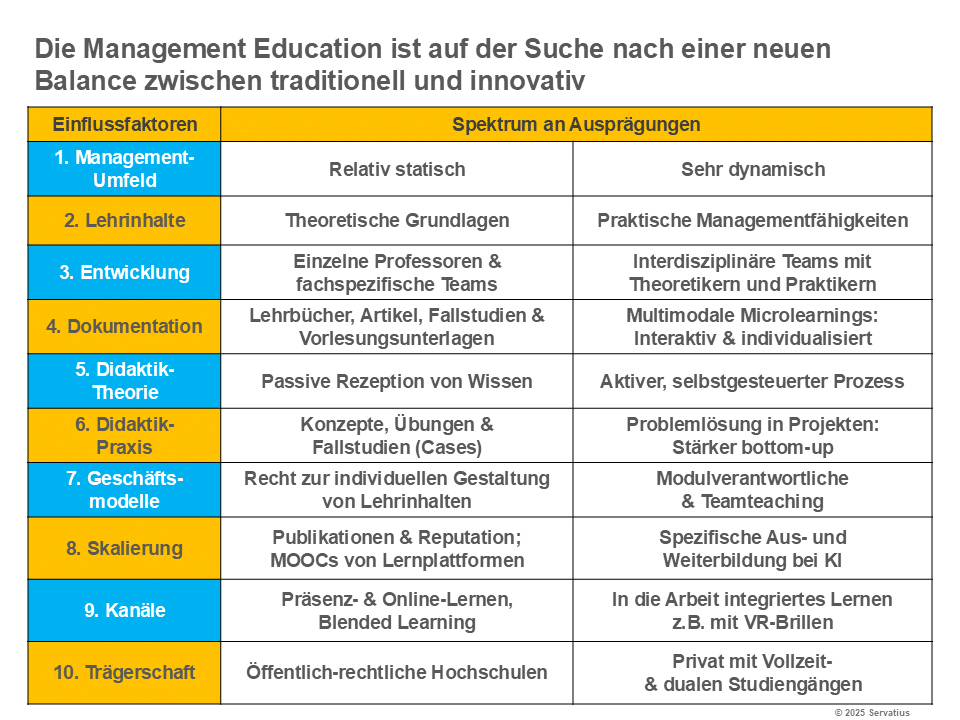
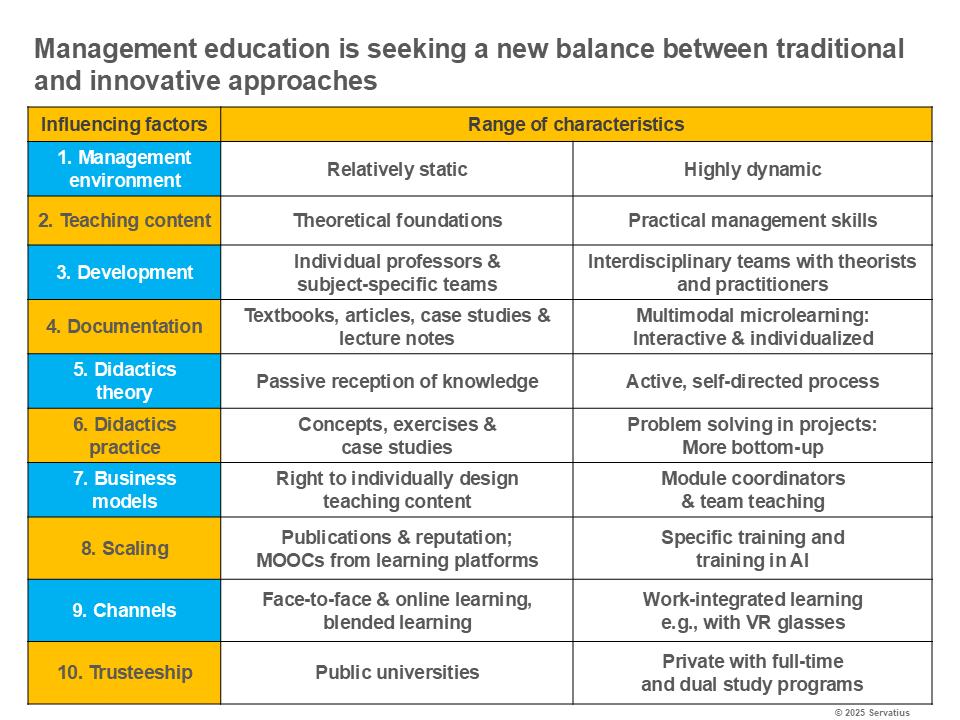
Eine der großen Herausforderungen, vor der Europa steht, ist die KI-basierte, strategische und organisatorische Neuausrichtung von Unternehmen. Eine wichtige Erfolgsvoraussetzung für diese Aufgabe ist die Verbesserung der Management Education im Rahmen eines lebenslangen Lernens. Dabei sind die Hochschullehre und die Personalentwicklung auf der Suche nach einer neuen Balance zwischen traditionellen und innovativen Ansätzen. Anhand von zehn Einflussfaktoren skizziere ich das Spektrum der vorhandenen Ausprägungen. Hieraus ergeben sich für Bildungsanbieter Chancen zur Differenzierung in einem härter werdenden internationalen Wettbewerb. Spannende Fragen sind, wer die seit langem begonnene Disruption der Management Education in welcher Form weiter vorantreibt.


In diesem Blogpost berichte ich über meine Erfahrungen in der Hochschullehre und Beratung zum Thema Personalentwicklung bei Neuausrichtungen.


Wettbewerbsvorteile durch KI-Qualifikation

Die Wettbewerbsvorteile im vergangenen Jahrhundert verdanken deutsche Unternehmen in einem erheblichen Maß ihren weltweit anerkannten Ingenieuren. Ähnlich wichtig für die Zukunft ist möglicherweise die Qualifikation bei der Entwicklung und Anwendung von Künstlicher Intelligenz (KI). Die Schlussfolgerung wäre, dass dann der Teil der Welt am erfolgreichsten ist, der seine Führungskräfte und Mitarbeitenden am besten in KI aus- und weiterbildet. Für die Zusammenarbeit von Unternehmen und Bildungsanbietern ergeben sich hieraus neue Möglichkeiten. Eine wichtige Rolle spielt dabei die Management-Didaktik für KI-basierte strategische und organisatorische Neuausrichtungen.1 Am Anfang steht eine Klärung grundlegender Begriffe.


Neuausrichtung und Transformation

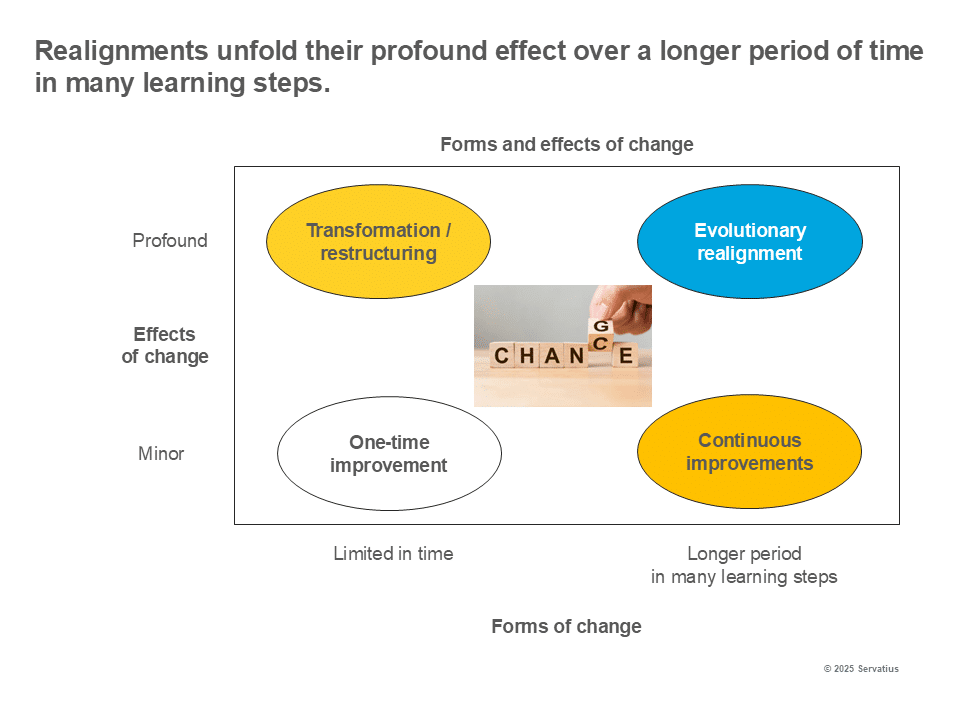
Die Begriffe Neuausrichtung und Transformation haben eine Gemeinsamkeit und einen Unterschied. Die Gemeinsamkeit betrifft die Wirkungen des Wandels. Diese sind sowohl bei Neuausrichtungen als auch bei Transformationen tiefgreifend. Bei geringeren Wirkungen spricht man demgegenüber von einer Verbesserung. Unterschiedlich sind hingegen die Formen des Wandels.

Unter dem Begriff Neuausrichtung (Realignment oder besser „Innoalignment“) von Unternehmen verstehen wir einen innovativen Ansatz zur Abstimmung wichtiger Systemelemente z.B. Kunden, Geschäftsmodell, Strategie, Technologien, Mitarbeitende, Organisation und Kultur. Dabei kommt es darauf an, diese Systemelemente im Zusammenhang zu sehen. Neuausrichtungen entfalten ihre tiefgreifende Wirkung meist über einen längeren, nicht klar bestimmten Zeitraum in vielen parallelen Lernschritten. So verläuft z.B. der digitale Wandel seit Jahrzehnten in immer neuen Wellen. Durch diesen evolutionären Charakter unterscheiden sich Neuausrichtungen von zeitlich begrenzten Transformationen, bei denen der Wandel in einem großen Sprung erfolgt, der häufig auch Abwehrreaktionen auslöst.2 Damit ähneln Transformationsprojekte Sanierungen, bei denen aber eine reaktive Krisenbewältigung im Vordergrund steht.

Lernprozess Innovationsstrategie

Der weit verbreitete Begriff Transformation lässt die Frage unbeantwortet, was danach passiert, wenn sich z.B. das Umfeld dynamisch weiterentwickelt oder der erhoffte Transformationserfolg ausbleibt. Möglicherweise liegt gerade in diesem illusionären Charakter des Begriffs ein Grund für dessen unreflektierte Verwendung. Daher ist es zu begrüßen, dass sich namenhafte Wissenschaftler wie der Soziologe Armin Nassehi inzwischen kritisch mit dem Thema Transformation auseinandersetzen.3

Offensichtlich meinen viele, die den Begriff Transformation verwenden, eigentlich einen zeitlich nicht begrenzten Prozess der Neuausrichtung oder hoffen zumindest, nach einer erfolgreichen Transformation würde sich irgendwann ein neuer stabiler Gleichgewichtszustand einstellen. Eine realitätsnahe Management Education sollte hingegen von klar definierten begrifflichen Grundlagen ausgehen.

Bei KI-basierten Neuausrichtungen, die durch eine hohe Unsicherheit geprägt sind, ist ein realitätsnahes Verständnis des Wandels eine wichtige Erfolgsvoraussetzung. Daneben kommt es auch auf die Vermeidung von Fehlern an.


Fehler bei KI-Initiativen

Verschiedene Studien belegen, dass nur ein geringer Teil der KI-Initiativen erfolgreich ist. Die Gründe hierfür sind vielfältig.4 Häufig gibt es überzogene Erwartungen und es fehlt eine gut aufbereitete Datengrundlage. Weitere mögliche Gründe sind unklare Richtlinien und eine unkoordinierte Anwendung von zu vielen KI-Tools. Die Hauptursache liegt aber wohl im Personalbereich angefangen bei überforderten Führungskräften über Defizite der Weiterbildungsangebote bis zur Sorge der Mitarbeitenden um ihren Arbeitsplatz. Daher sollten Unternehmen bei KI-basierten Neuausrichtungen dem Thema Management Education eine stärkere Bedeutung beimessen. So wird die Management-Didaktik immer mehr zu einem Innovationsfeld.


Management-Didaktik als Innovationsfeld

Unter dem Begriff Management-Didaktik versteht man die Theorie und Praxis des Lehrens und Lernens im Fachgebiet Management. Wichtige Innovationstreiber sind grundlegende Veränderungen der Arbeitswelt, die neue Managementkonzepte erfordern und der Einsatz von KI-unterstützten Lerntechnologien.

Seit der Prägung des aus dem Altgriechischen abgeleiteten Begriffs durch den Pädagogen und Theologen Comenius im frühen 17. Jahrhundert hat sich die Didaktik in vielfältiger Weise weiterentwickelt. Dennoch ist die Management-Didaktik ein Innovationsfeld, dessen Bedeutung lange von vielen unterschätzt wurde. Dies zeigt sich unter anderem daran, dass Hochschullehrer über keine Didaktik-Ausbildung verfügen müssen, sondern sich entsprechende Fähigkeiten im Verlauf ihrer Tätigkeit meist selbst aneignen. Ein solches Learning by Doing führt natürlich zu unterschiedlichen Ergebnissen.


Management Education auf der Suche nach einer Balance

Angesichts neuer Herausforderungen und Lerntechnologien verändert sich die Aus- und Weiterbildung im Management. Dabei gibt es eine Reihe von Einflussfaktoren, die jeweils ein breites Spektrum an Ausprägungen haben können. Ein Beispiel ist die Dokumentation von Lehrinhalten, die schon heute weniger in klassischen Lehrbüchern und stärker in Microlearnings erfolgt. Bei diesen Einflussfaktoren ist die Management-Didaktik auf der Suche nach einer neuen Balance zwischen traditionell und innovativ. Damit eröffnet sich für das immer wichtiger werdende lebenslange Lernen eine Vielfalt an Möglichkeiten. Bildungsanbieter wie Hochschulen und Verlage stehen vor der Aufgabe, sich in diesem Dschungel selbst neu auszurichten und den Lernenden interessante Karrierepfade zu eröffnen.

Aus meiner praktischen Tätigkeit als Hochschullehrer und Berater haben sich zehn Einflussfaktoren mit einem breiten Spektrum an Ausprägungen herauskristallisiert, die ich im Folgenden erläutere.

Lernprozess Innovationsstrategie

Die ersten beiden Faktoren sind das Management-Umfeld und die Lehrinhalte.


Management-Umfeld und Lehrinhalte

Im Vergleich zu heute war das Management-Umfeld früher relativ statisch und die Notwendigkeit eines lebenslangen Lernens erst in Ansätzen erkennbar. Dies hat sich grundlegend geändert. Das Ergebnis der hohen Umfelddynamik ist eine Verkürzung der Halbwertszeit des Wissens und Könnens.

Ein Beispiel liefert die generative Künstliche Intelligenz. Ende 2022 löste die Vorstellung des Textroboters ChatGPT durch OpenAI einen extremen Hype aus.5 Dem ist inzwischen eine gewisse Ernüchterung gefolgt und Experten warnen vor einer KI-Illusion.6 An Bedeutung hinzugewonnen hat hingegen die wissensspezifische (domain-specific) KI, die KI-Werkzeuge gezielt mit Anwendungen verbindet.7 Aus dieser Umfelddynamik ergibt sich die Notwendigkeit einer agilen Anpassung der Lehrinhalte. Dabei kommt es darauf an, Modewellen realistisch einzuordnen und das kritische Denken der Lernenden zu trainieren.

Neben der Dynamik der Lehrinhalte spielt die Balance zwischen Theorie und Praxis eine wichtige Rolle. Der Schwerpunkt des klassischen Management-Studiums liegt bei theoretischen Grundlagen und Konzepten, die primär wissenschaftlich orientierte Lehrende vermitteln. In den letzten Jahrzehnten haben die Bedeutung und der Einfluss von Managementberatern als Brückenschläger zwischen Theorie und Praxis zugenommen. In einem Prozess der Zusatzqualifikation verbessern externe Berater und Inhouse Consultants on-the-Job ihre praktischen Managementfähigkeiten in Form eines problemorientierten Lernens.8 Hochschulen sind gut beraten, diese komplexitätsbewältigende Form der Weiterbildung stärker in ihre Lehre zu integrieren.

Hieraus ergeben sich wichtige Implikationen für die Entwicklung und Dokumentation von Lehrinhalten.


Entwicklung und Dokumentation

Die Entwicklung von richtungsweisenden Lehrinhalten ist in der Vergangenheit vor allem durch einzelne Professoren erfolgt, die gemeinsam mit ihren Doktoranden fachspezifische Managementthemen bearbeitet haben. Bei den Lernenden ist so ein Baukasten aus abgegrenzten Elementen an Fachwissen entstanden. Dieses traditionelle Konzept bedarf der Ergänzung. Ein neuer Ansatz ist die Entwicklung von verbindenden Fähigkeiten durch interdisziplinäre Teams, die sowohl aus stärker theoretisch als auch stärker praktisch orientierten Mitgliedern bestehen.

Ein spannendes Anwendungsbeispiel liefert die wissensspezifische KI. Die Lehrinhalte verbinden KI-Grundlagen mit einer Anwendung in einzelnen Managementfeldern.9 Von Praktikern lernen die Studierenden, wie die Umsetzung einer strategischen und organisatorischen Neuausrichtung von Unternehmen gelingt.

Die Dokumentation von Lehrinhalten ist in der Vergangenheit vor allem in Form von fachspezifischen Lehrbüchern, Artikeln, Fallstudien und Vorlesungsunterlagen erfolgt. Lehrbuch-Klassiker sind zum Teil über Jahrzehnte in immer neuen Auflagen erschienen und dabei sehr umfangreich geworden. Derartige „Wälzer“ werden aber immer weniger geschrieben und noch weniger gelesen. Für Lernende ist es schwierig zu unterscheiden, welche Inhalte bei einem Werk mit mehreren hundert Seiten noch relevant sind und welche nicht. Die zukünftige Dokumentation von Lehrinhalten gleicht allerdings noch eher einem Experimentierfeld.

Auch hier spielt KI eine wichtige Rolle. Das Ziel sind multimodale Microlearnings, die interaktiv nutzbar und individualisiert sind. Bei der Gestaltung dieser Microlearnings arbeiten Anbieter von Inhalten und neuen Lerntechnologien wie Learning Experience Platforms (LXP) zusammen.10

Damit einher geht eine Veränderung der Theorie und Praxis der Management-Didaktik.


Theorie und Praxis der Management-Didaktik

Die Theorie der Management-Didaktik ist lange Zeit auf eine passive Rezeption von Wissen fokussiert gewesen. Der Anteil eines kreativen Gestaltens z.B. von neuen Geschäftsmodellen war dabei erstaunlich gering, obwohl in Fächern wie dem Innovationsmanagement bei dieser Fähigkeit ein Schwerpunkt liegen sollte. Auch hier findet gegenwärtig ein Veränderungsprozess statt. Dabei verlagert sich der Fokus in Richtung auf einen stärker aktiven, selbstgesteuerten Prozess. Eine Grundlage hierfür liefert die systemisch-konstruktivistische Pädagogik.11

Die neue Generation der Lernenden wächst mit KI-Werkzeugen auf, und eine intelligente Eingabe (Prompting) wird gegenwärtig zur Kernkompetenz. KI beschleunigt aber nicht nur Routinearbeiten, sondern verbessert auch die Suche nach kreativen Lösungen.12 Den Lehrenden und ihren Organisationen kommt die Aufgabe zu, hierfür geeignete Lernumgebungen zu schaffen.

Bei der Praxis der Management-Didaktik gibt es große Unterschiede z.B. zwischen Deutschland und den USA. Während bei uns das Erlernen von Konzepten und die Anwendung in Übungen im Vordergrund steht, ist die Managementlehre in den USA seit Jahrzehnten durch Fallstudien (Cases) geprägt. Von Managementberatungen sind wichtige Impulse zur Problemlösung in Projekten ausgegangen. Das Collaborative Learning betont stärker bottom-up ablaufende Lernprozesse durch unternehmensinterne Teams, bei denen Trainern eine Coaching-Rolle zukommt.13

Innovative Bildungsanbieter arbeiten daran, ein solches KI-unterstütztes Projektlernen bereits frühzeitig in der Ausbildung zu schulen. So verbessern sie die Karrierechancen der Lernenden und differenzieren sich von traditionellen Universitäten.

Dabei verändern sich die Geschäftsmodelle und Skalierungsmöglichkeiten der Bildungsanbieter.


Geschäftsmodelle und Skalierungsmöglichkeiten

Das traditionelle „Geschäftsmodell“ von führenden Universitäten basiert auf dem Prinzip der Wissenschaftsfreiheit, das in Deutschland durch das Grundgesetz gesichert ist. Danach haben Professoren das Recht, ihre Lehrinhalte individuell zu gestalten. Bei privaten Hochschulen, die an mehrehren Standorten tätig sind, kommen Lehrinhalte zunehmend von Modulverantwortlichen, die die Unterlagen weniger erfahrenen Dozenten als Anregung zur Verfügung stellen. Beim Teamteaching entwickeln interdisziplinäre Teams mit einem unterschiedlichen Erfahrungshintergrund die Lehrinhalte. Diese veränderten Geschäftsmodelle können sowohl auf eine Kostensenkung als auch auf die Realisierung von Preisprämien ausgerichtet sein.

Der verstorbene Harvard-Professor Clayton Christensen hat bereits 2010 auf das Disruptionspotenzial von Geschäftsmodell-Innovationen in der Management Education hingewiesen, das sich immer stärker entfaltet.14

Das klassische Modell der Skalierung von Universitäten basiert auf der weltweiten Verbreitung der Bücher und Artikel von Management-Gurus, Case Studies und der Reputation der Bildungsanbieter. Diese Reputation ermöglicht die hohen Preise von MBA-Programmen und einer zum Teil unternehmensspezifischen Executive Education. Mit den in den 2010er Jahren entstandenen Massive Open Online Courses (MOOCs) sind neue Möglichkeiten für Lernplattformen hinzugekommen, um relativ kostengünstig eine große Anzahl von Lernenden zu erreichen.

Es ist abzusehen, dass in den nächsten Jahren die meisten Unternehmen beim Thema KI eine auf die spezifischen Bedürfnisse zugeschnittene Weiterbildung ihrer Mitarbeitenden benötigen.15 Den sozialen Sprengstoff dieses Themas sollten Unternehmen nicht unterschätzen, wenn sie eine Vielzahl von Beschäftigten entlassen müssen.

Weitere Faktoren sind daher die Kanäle und die Trägerschaft einer Management Education.


Kanäle und Trägerschaft

Während das klassische Präsenzlernen einer großen Anzahl von Studierenden wenig Interaktionsmöglichkeiten bietet, sind Kleingruppen relativ kostenintensiv. Online-Lernen hat eine Reihe von Vorteilen, aber häufig nicht die Erlebnisqualität eines persönlichen Lernens in Dialogen. Daher versuchen innovative Bildungsanbieter mit neuen Formen die Vorteile der verschiedenen Kanäle zu verbinden. Weit verbreitet ist inzwischen ein Blended Learning mit Präsenz- und Onlineveranstaltungen. Eine Lernform mit langer Tradition, die eine Renaissance erleben könnte, ist das in die Arbeit integrierte Lernen. Die Wurzeln liegen bei der im Handwerk verbreiteten dualen Berufsausbildung. Eine Neuinterpretation geht vom Einsatz digitaler Technologien wie der Virtual Reality (VR) aus.

Seit einigen Jahren setzen Unternehmen VR-Brillen zur Aus- und Weiterbildung am Arbeitsplatz ein. Auch Business Schools wie Insead experimentieren mit VR-Brillen in der Management Education.16

Hochschulen in öffentlich-rechtlicher Trägerschaft stehen bei der Management Education in einem zunehmenden Wettbewerb mit privaten Bildungsanbietern, die höhere Preise verlangen, aber auch als individueller und flexibler gelten. Diese bieten häufig neben Vollzeit-Studiengängen auch duale Programme an, in denen die Studierenden einen Teil ihrer Arbeitszeit bei einem Partnerunternehmen verbringen. Duale Studiengänge sind sehr populär, haben aus meiner Sicht ihr volles Potenzial aber noch nicht ausgeschöpft. Eine Verbesserungsmöglichkeit besteht in der gezielten Koordination zwischen dem Lernen an der Hochschule und dem Sammeln von passgenauen, praktischen Erfahrungen im Unternehmen.

Daher bieten wir den Studierenden individuell zugeschnittene Aufgaben für ein handlungsorientiertes Lernen bei ihren Praxispartnern an. Spannend wird es, wenn sich in ein solches Projektlernen z.B. beim Thema KI auch die Vorgesetzten der Studierenden mit ihrer Erfahrung einbringen.17


KI-basierte Disruption der Management Education

Die Skizze dieser Faktoren mit ihren unterschiedlichen Ausprägungen zeigt das Potenzial einer KI-basierten Disruption der Management Education.18 Dabei liefert die Künstliche Intelligenz sowohl neue Inhalte als auch neue Werkzeuge für eine Aus- und Weiterbildung im Management mit weit reichenden Implikationen für die Geschäftsmodelle von Hochschulen, Unternehmen, Verlagen und Anbietern von Lerntechnologien.

Unter dem Begriff Geschäftsmodell-Disruption versteht man ein Geschäftsmodell mit einem neuen Wertversprechen für Kunden und Barrieren, die für etablierte Wettbewerber schwer zu überwinden sind.19 So tun sich z.B. die traditionellen Universitäten schwer, veränderte Studiengänge mit KI als Grundlagen- und Querschnittsdisziplin sowie innovativen Inhalten und Lerntechnologien zu realisieren. Die größte Barriere ist hier das ausgeprägte Beharrungsbestreben der Verantwortlichen, das Neuausrichtungen erschwert.

Das Thema KI eröffnet für die Management Education Disruptionsmöglichkeiten mit einem Ausmaß, das noch nicht in vollem Umfang absehbar ist.20 Ein möglicher Weg führt über die KI-unterstützte Verbesserung der individuellen Qualität der Lehre. In der folgenden Abbildung sind hierzu einige Punkte zusammengefasst.

Lernprozess Innovationsstrategie

Der Grundgedanke besteht darin, dass KI den Lehrenden nicht ersetzt, sondern ihn dabei unterstützt, die Qualität seiner Arbeit zu verbessern. Eine wichtige Leitidee ist, dass der individuelle Lehrstil, den die KI erkennt, erhalten bleibt. Anhand vorgegebener Kriterien führt die KI dann anhand von Lehrproben eine Stärken-Schwächen-Analyse durch. Ein erster Ansatzpunkt ist der Ausbau von Stärken z.B. die Verwendung von anschaulichen Beispielen und eine Verringerung von Schwächen wie z.B. zu viel Frontalunterricht.

Ein Punkt mit Optimierungspotenzial bei vielen Lehrenden verfolgt das Ziel, die Karrierechancen der Lernenden im KI-Zeitalter zu verbessern. Ein wichtiger Beitrag hierzu ist, Lehrinhalte zu vermitteln, die technologische Anwendungserfahrung mit sozialen Fähigkeiten verbinden.21 Die eigentlichen Future Skills erfordern eine Kombination der Kompetenz verschiedener Spezialisten, die KI unterstützen kann. Dies gilt insbesondere für komplexe Aufgaben bei der Interaktion mit Kunden und Mitarbeitenden z.B. im Rahmen von anspruchsvollen Verkaufsgesprächen oder Konflikten in Teams.

Eine Aufgabe, die viele Lehrende seit langem überfordert, ist die kontinuierliche und gezielte Aktualisierung ihrer Lehrinhalte in Form von Beispielen, Fragen und kurzen Fallstudien. Auch bei einer Bewältigung dieser Herausforderung kann KI helfen und zur Gestaltung neuer Lehrinhalte beitragen.

Ein weiterer Punkt ist der Einsatz von KI-Chatbots, um die Lernenden dabei zu begleiten, die Lehrinhalte Schritt für Schritt zu erschließen. Dieses Ziel verfolgt z.B. Google mit dem KI-Modell Gemini und der Software Guided Learning, die anstrebt, Neugier und kritisches Denken zu fördern.22 Die Zukunftsvision ist, dass jeder Mensch einen persönlichen KI-Tutor erhält, der sich an seine individuellen Lernbedürfnisse anpasst.

Neben einer Individualisierung des Lernens z.B. bei komplexen Projekten wird die Zusammenarbeit von Lehrenden immer wichtiger. Die KI unterstützt im Rahmen des Teamteaching die Verbindung zu benachbarten Themen z.B. bei interdisziplinären Aufgabenstellungen.

Mehr Freiraum für diese qualitativen Verbesserungen schaffen KI-Werkzeuge, die Effizienzpotenziale bei Routinetätigkeiten ausschöpfen. Ein Beispiel ist die Unterstützung bei der Bewertung von Prüfungsleistungen, die viel Zeit in Anspruch nimmt.

Insgesamt führen diese und weitere Punkte zu einer nächsten Generation der Management Education, bei der Lehrende und Lernende KI-unterstützt zusammenarbeiten. Dies kann dazu beitragen, den Mindset in den jeweiligen Lebensabschnitten weiterzuentwickeln. Die Frage ist nun, wie es gelingt, eine solche Management Education in die Praxis umzusetzen.


Konzepte für eine KI-unterstützte Management Education umsetzen

Vielen Hochschulen und Unternehmen scheint nicht bewusst zu sein, wie stark sich die Managementaus- und -weiterbildung im KI-Zeitalter verändert. Zwar fehlt es nicht an Literatur zu den theoretischen Grundlagen einer solchen Neuausrichtung,23 wohl aber an Konzepten für die praktische Umsetzung.

Man hat den Eindruck, dass sich die meisten Akteure noch in individuellen Experimentierphasen befinden, die sie mit begrenztem Einsatz und Zurückhaltung durchlaufen. Anders agieren große KI-Anbieter, die ihren Kunden kostenlose Schulungsprogramme offerieren, um sie so an sich zu binden. Der Ansatz hat den Vorteil, dass zumindest mit einer klaren Zielsetzung gehandelt wird. Es ist aber notwendig, dass Hochschulen und Unternehmen ihre eigenen Konzepte für eine KI-unterstützte Management Education realisieren.

Ein Kennzeichen erfolgreicher Konzepte ist die verbindende Gestaltung der folgenden drei Dimensionen:

  1. Die gemeinsame Erarbeitung und kontinuierliche Aktualisierung von relevanten interdisziplinären Lehrinhalten
  2. die Realisierung einer innovativen Management-Didaktik und
  3. die individuelle Anpassung an unterschiedliche Zielgruppen von Schülern über Studierende bis zu Berufstätigen und Führungskräften.

Die Entwicklung und Umsetzung dieser Konzepte wird vielen Akteuren nicht im Alleingang gelingen. Eine absehbare Konsequenz der Disruption der Management Education ist, dass z.B. private Bildungsanbieter, die veraltete Lehrinhalte und -methoden anbieten, irgendwann vom Markt verschwinden.

Lernprozess Innovationsstrategie

Den größten Handlungsdruck beim Wandel von Bildungsökosystemen haben vermutlich die Unternehmen, die eine große Zahl ihrer Mitarbeitenden bei KI-basierten Neuausrichtungen weiterbilden müssen. Diese Unternehmen werden verstärkt eine Zusammenarbeit mit innovativen Partnern anstreben. Daher gilt auch hier die Erkenntnis, dass in jeder Disruption eine Chance liegt. Diese Chance nutzen weltweit Learning Ecosystems, die KI als Gamechanger verstehen.


KI als Gamechanger für Learning Ecosystems

In unserem 2020 erschienenen Buch zu KI als Gamechanger haben wir Defizite der deutschen Digitalpolitik benannt.24 Dese Defizite bestehen bis heute auch in der Bildungspolitik, die innovationsfördernde Rahmenbedingungen für die Entwicklung und Anwendung von KI schaffen müsste. Wichtige Anregungen kommen dabei von KI-Initiativen in anderen Teilen der Welt. So ist in der Zukunftsstadt Masdar nahe Abu Dhabi in den Vereinigten Arabischen Emiraten die erste reine KI-Universität der Welt entstanden. In Saudi-Arabien haben mittlerweile 86 Prozent der Bachelor-Studiengänge einen KI-Fokus.25

Im weltweiten Wettbewerb um die beste KI-Unterstützung der Management Education werden mit hoher Wahrscheinlichkeit Learning Ecosystems eine führende Rolle spielen, in denen verschiedene Partner zusammenarbeiten. Zu den möglichen Partnern zählen neben dem Staat Bildungsinstitutionen, KI- und LearnTech-Anbieter sowie Unternehmen und öffentliche Organisationen als Kunden. In den USA, in China, in den Golfstaaten und auch in Europa zeichnen sich neue Formen der Zusammenarbeit ab, aber der Ausgang des Rennens ist offen.

Studien zum Einsatz von KI gehen davon aus, dass für viele Unternehmen zunächst die Steigerung der Produktivität im Vordergrund steht. Darüber hinaus eröffnet KI vielfältige Möglichkeiten zur Geschäftsmodell-Innovation.26 Beide Ansätze haben einen großen Einfluss auf die Zukunft der Arbeit. Neben einem Stellenabbau bei Routineaufgaben entstehen neue Jobprofile z.B. bei der Kontrolle von KI-Ergebnissen.27 Hierauf müssen sich Bildungsanbieter einstellen. Ein wichtiger Erfolgsfaktor ist, Lernende für die Arbeit mit KI zu motivieren.


Das Beste aus zwei Welten verbinden

Neben meiner Tätigkeit als Honorarprofessor an der Universität Stuttgart arbeite ich seit langem als externer Dozent in dualen Studiengängen von privaten Business Schools. Universitäten und Business Schools haben unterschiedliche Stärken, die sich eigentlich ideal ergänzen. Hierzu zählen bei den Business Schools

  • Lehrkräfte mit Erfahrung außerhalb des Bildungssektors
  • Studierende, die neben ihrem Studium in der Praxis arbeiten und
  • Unternehmen als Praxispartner, die eine KI-basierte Neuausrichtung bewältigen müssen.

Stärken von Universitäten sind demgegenüber

  • ein breites Spektrum an relevanten Fachgebieten wie Betriebswirtschaft, Informatik und Ingenieurwissenschaften
  • Professoren und Doktoranden mit einem Fokus auf die Forschung sowie
  • eine Finanzierung durch den öffentlichen Sektor und durch Drittmittel.

Daher würde es nahe liegen, dass diese beiden Anbietertypen beim Thema KI kooperieren.

In der Praxis ist dies bislang aber eher die Ausnahme als die Regel. Ein möglicher Ansatz wären gemeinsame Projekte, in denen Akteure aus beiden „Lagern“ mit klar definierten Zielen zusammenarbeiten. Dem steht gegenwärtig jedoch eine ausgeprägte Distanz der öffentlichen und privaten Hochschulen im Wege.

Ein erfolgversprechender Weg, um das Beste aus zwei Welten zu verbinden wäre, die Bearbeitung komplexer Probleme in Unternehmen zum Gegenstand von Abschlussarbeiten zu machen. Ein Beispiel ist der Einsatz von KI im Vertrieb gemeinsam mit Start-ups wie dem Berliner Unternehmen Parloa. Dabei trainieren die Lehrenden und die Lernenden gemeinsam die Anwendung von Problemlösungsmethoden in Projekten, also eine Kompetenz, die im KI-Zeitalter immer wichtiger wird. Gleichzeitig entsteht eine anwendungsorientierte Alternative zu der stark empirieorientierten Managementforschung, die in den letzten Jahrzehnten immer dominanter geworden ist, für Praktiker aber häufig eine relativ geringe Relevanz hat.


Fazit

  • Im Rahmen von KI-basierten strategischen und organisatorischen Neuausrichtungen von Unternehmen spielt die Aus- und Weiterbildung eine wichtige Rolle
  • Bei der Gestaltung einer innovativen Management-Didaktik wirken eine Reihe von Einflussfaktoren zusammen.
  • Das Disruptionspotenzial der KI kann in der Management Education zu einer Marktbereinigung beitragen.
  • Bei der Umsetzung einer KI-unterstützten Management Education verändern innovative Learning Ecosystems die Spielregeln des Wettbewerbs.


Literatur

[1] Servatius, H.G., Entwicklung und Wandel des strategischen Managements. In: Competivation Blog, 19.09.2025

[2] Servatius, H.G., Dreifache strategische Neuausrichtung. In: Competivation Blog, 07.06.2024

[3] Nassehi, A., Kritik der großen Geste – Anders über gesellschaftliche Transformation nachdenken, 2. Aufl., C.H.Beck 2024

[4] Merten, M., Wie kann KI wirklich Mehrwert bringen? In: Handelsblatt, 2. September 2025, S. 24-25

[5] Bomke, L., Holtermann, F., Scheuer, S., Zwischen Hype und Ernüchterung. In: Handelsblatt, 29./30./31. August 2025, S. 48-53

[6] Dörner, A., Holtermann, F., Wiebe, F., Die KI-Illusion. In: Handelsblatt, 22./23./24. August 2025, S. 1, 4-7

[7] Servatius, H.G., Entwicklung der KI-Technologien. In: Competivation Blog, 19.02.2025

[8] Servatius, H.G., Lernen, Lösungen für komplexe Managementprobleme zu gestalten. In: Competivation Blog, 15.07.2025

[9] Servatius, H.G., Wettbewerbsvorteile mit wissensspezifischer KI. In: Competivation Blog, 11.02.2025

[10] Floor, N., This is Learning Experience Design – What it is, how it works, and why it matters, Pearson Education 2023

[11] Reich, K., Systemisch-konstruktivistische Pädagogik – Einführung in die Grundlagen einer interaktionistisch-konstruktivistischen Pädagogik, Beltz 2010

[12] Servatius, H.G., KI als Werkzeug für das strategische Management. In: Competivation Blog, 01.05.2025

[13] Hernandez, N., Collaborative Learning – How to Upskill from Within and Turn L&D into Your Competitive Advantage, Kogan Page 2023

[14] Christensen, C.M., Horn, M.B., Johnson, C.W., Disrupting Class – How Disruptive Innovation Will Change the Way the World Learns, McGraw-Hill 2010

[15] Servatius, H.G., Generative KI und ein Mass Customized Action Learning. In: Competivation Blog, 28.08.2023

[16] Stern, I., Epstein, A., Landau, D., Making VR a Reality in Business Classrooms. In: Harvard Business Review, 8. November 2021

[17] Jones, D., Modern PBL – Project-Based-Learning in the Digital Age, Teacher Goals 2024

[18] Servatius, H.G., KI und die Zukunft der Management Education. In: Competivation Blog, 09.04.2025

[19] Servatius, H.G., Woran erkennt man ein disruptives Geschäftsmodell? In: Competivation Blog, 27.07.2016

[20] Servatius, H.G., Disruption in der Management Education. In: Competivation Blog, 29.05.2019

[21] von Schwanewede, S., Den eigenen Arbeitswert im KI-Zeitalter sichern. In: Handelsblatt, 16. September 2025, S. 22-23

[22] Scheuer, S., Chatbot Gemini soll beim Lernen helfen. In: Handelsblatt, 8. September 2025, S. 24

[23] de Witt, C., Gloerfeld, C., Wrede, S.E. (Hrsg.), Künstliche Intelligenz in der Bildung, Springer 2023

[24] Kaufmann, T., Servatius, H.G., Das Internet der Dinge und Künstliche Intelligenz als Game Changer – Wege zu einem Management 4.0 und einer digitalen Architektur, SpringerVieweg 2020, S. 203 ff.

[25] Witsch, K., Bomke, L., Rogg, I., Die neuen Tech-Großmächte. In: Handelsblatt, 2./3./4./5. Oktober 2025, S. 42-48

[26] Hübner, G., Künstliche Intelligenz als Wachstumstreiber. In: Handelsblatt, 28. November 2025, S. 28

[27] Burkhardt, K., Effizienz und neue Aufgaben. In: Handelsblatt, 25. September 2025, S. 30

Disruption der Management Education für KI-basierte Neuausrichtungen

Disruption of management education for AI-based realignments

One of the major challenges facing Europe is the AI-based strategic and organizational realignment of companies. An important prerequisite for success in this task is the improvement of management education within the framework of lifelong learning. In this context, university teaching and human resources development are seeking a new balance between traditional and innovative approaches. Using ten influencing factors, I outline the spectrum of existing characteristics. This presents opportunities for education providers to differentiate themselves in an increasingly competitive international market. Exciting questions arise as to who will continue to drive forward the long-standing disruption of management education and in what form.


In this blog post, I report on my experiences in university teaching and consulting on the topic of personnel development in the context of realignments.


Competitive advantages through AI qualifications

German companies owe their competitive advantages in the past century to a large extent to their globally recognized engineers. Qualifications in the development and application of artificial intelligence (AI) may be similarly important for the future. The conclusion would be that the part of the world that trains and educates its managers and employees best in AI will be the most successful. This opens up new opportunities for cooperation between companies and education providers. Management didactics for AI-based strategic and organizational realignments play an important role here.1 The first step is to clarify basic terms.


Realignment and transformation

The terms realignment and transformation have one thing in common and one difference. The commonality concerns the effects of change. These are profound in both realignments and transformations. In contrast, when the effects are minor, we speak of improvement. What differs, however, are the forms of change.

By the term realignment (or, better, „innoalignment“) of companies, we mean an innovative approach to coordinating important system elements, e.g., customers, business model, strategy, technologies, employees, organization, and culture. It is important to view these system elements in context. Realignments usually unfold their profound effects over a longer, not clearly defined period of time in many parallel learning steps. For example, digital change has been progressing for decades in ever new waves. This evolutionary character distinguishes realignments from time-limited transformations, in which change takes place in a big leap that often triggers defensive reactions.2 In this respect, transformation projects are similar to restructuring projects, which, however, focus on reactive crisis management.

Lernprozess Innovationsstrategie

The widely used term „transformation“ leaves unanswered the question of what happens afterwards, for example, if the environment continues to develop dynamically or if the hoped-for success of the transformation fails to materialize. Perhaps it is precisely this illusory nature of the term that is one reason for its unreflective use. It is therefore to be welcomed that renowned scientists such as sociologist Armin Nassehi are now taking a critical look at the topic of transformation.3

It seems that many who use the term transformation actually mean a process of realignment that is not limited in time, or at least hope that a new stable equilibrium will eventually be established after a successful transformation. Realistic management education, on the other hand, should be based on clearly defined conceptual foundations.

In the case of AI-based realignments, which are characterized by a high degree of uncertainty, a realistic understanding of change is an important prerequisite for success. It is also important to avoid mistakes.


Mistakes in AI initiatives

Various studies show that only a small proportion of AI initiatives are successful. There are many reasons for this.4 Often,expectations are exaggerated and there is a lack of well-prepared data. Other possible reasons include unclear guidelines and the uncoordinated use of too many AI tools. However, the main cause probably lies in the area of human resources, ranging from overburdened managers and a lack of training opportunities to employees‘ concerns about their jobs. Companies should therefore attach greater importance to management education when undertaking AI-based realignments. Management didactics is thus increasingly becoming a field of innovation.


Management didactics as a field of innovation

The term „management didactics“ refers to the theory and practice of teaching and learning in the field of management. Important drivers of innovation include fundamental changes in the world of work, which require new management concepts, and the use of AI-supported learning technologies.

Since the term, derived from ancient Greek, was coined by the educator and theologian Comenius in the early 17th century, didactics has evolved in many ways. Nevertheless, management didactics is a field of innovation whose importance has long been underestimated by many. This is evident, among other things, in the fact that university teachers are not required to have any training in didactics, but usually acquire the relevant skills themselves in the course of their work. Such learning by doing naturally leads to varying results.


Management education in search of a balance

In light of new challenges and learning technologies, management education and training are changing. There are a number of influencing factors, each of which can have a wide range of characteristics. One example is the documentation of teaching content, which is already less common in traditional textbooks and more prevalent in microlearning. In light of these influencing factors, management didactics is searching for a new balance between traditional and innovative approaches. This opens up a wide range of possibilities for lifelong learning, which is becoming increasingly important. Educational providers such as universities and publishers are faced with the task of reorienting themselves in this jungle and opening up interesting career paths for learners.

From my practical experience as a professor and consultant, ten influencing factors with a wide range of characteristics have emerged, which I will explain below.

Lernprozess Innovationsstrategie

The first two factors are the management environment and the teaching content.


Management environment and teaching content

Compared to today, the management environment used to be relatively static, and the need for lifelong learning was only beginning to emerge. This has changed fundamentally. The result of the highly dynamic environment is a shortening of the half-life of knowledge and skills.

One example is generative artificial intelligence. At the end of 2022, the introduction of the text robot ChatGPT by OpenAI triggered extreme hype.5 This has since been followed by a certain disillusionment, and experts are warning of an AI illusion.6 On the other hand, domain-specific AI, which specifically combines AI tools with applications, has gained in importance.7 These dynamic circumstances necessitate agile adaptation of teaching content. It is important to realistically assess trends and train learners to think critically.

In addition to the dynamics of teaching content, the balance between theory and practice plays an important role. The focus of traditional management studies is on theoretical foundations and concepts that are primarily taught by academically oriented instructors. In recent decades, the importance and influence of management consultants as bridge builders between theory and practice has increased. In a process of additional qualification, external consultants and in-house consultants improve their practical management skills on the job in the form of problem-oriented learning.8 Universities would be well advised to integrate this complexity-managing form of continuing education more strongly into their teaching.

This has important implications for the development and documentation of teaching content.


Development and documentation

In the past, the development of pioneering teaching content has been carried out primarily by individual professors who have worked on subject-specific management topics together with their doctoral students. This has resulted in a modular system of distinct elements of specialist knowledge for learners. This traditional concept needs to be supplemented. A new approach is the development of connecting skills by interdisciplinary teams consisting of both more theoretically and more practically oriented members.

Domain-specific AI provides an exciting example of this approach. The teaching content combines AI fundamentals with applications in individual management fields.9 Students learn from practitioners how to successfully implement a strategic and organizational realignment of companies.

In the past, teaching content has mainly been documented in the form of subject-specific textbooks, articles, case studies, and lecture notes. Some classic textbooks have been published in new editions over decades and have become very comprehensive. However, such „tomes“ are being written less and less and read even less. It is difficult for learners to distinguish which content in a work of several hundred pages is still relevant and which is not. However, the future documentation of teaching content is still more like a field of experimentation.

AI also plays an important role here. The goal is multimodal microlearning that is interactive and individualized. Content providers and new learning technologies such as learning experience platforms (LXP) are working together to design this microlearning.

This is accompanied by a change in the theory and practice of management didactics.10


Theory and practice of management didactics

For a long time, management didactics theory has focused on the passive reception of knowledge. The proportion of creative design, e.g., of new business models, was surprisingly low, even though subjects such as innovation management should focus on this skill. Here, too, a process of change is currently taking place. The focus is shifting toward a more active, self-directed process. Systemic-constructivist pedagogy provides a basis for this.11

The new generation of learners is growing up with AI tools, and intelligent input (prompting) is currently becoming a core competency. AI not only speeds up routine tasks, but also improves the search for creative solutions.12 Teachers and their organizations have the task of creating suitable learning environments for this.

There are major differences in the practice of management didactics between Germany and the USA, for example. While the focus in Germany is on learning concepts and applying them in exercises, management teaching in the USA has been dominated by case studies for decades. Management consultancies have provided important impetus for problem solving in projects. Collaborative learning places greater emphasis on bottom-up learning processes through internal company teams, in which trainers take on a coaching role.13

Innovative education providers are working to incorporate AI-supported project-based learning into education at an early stage. In this way, they are improving the career opportunities of learners and differentiating themselves from traditional universities.

This is changing the business models and scaling options of education providers.


Business models and scaling opportunities

The traditional „business model“ of leading universities is based on the principle of academic freedom, which is enshrined in Germany’s Basic Law. According to this principle, professors have the right to design their teaching content individually. At private business schools that operate at multiple locations, teaching content increasingly comes from module coordinators, who make the materials available to less experienced lecturers as inspiration. In team teaching, interdisciplinary teams with different backgrounds develop the teaching content. These changed business models can be geared toward both cost reduction and the realization of price premiums.

The late Harvard professor Clayton Christensen pointed out as early as 2010 the disruptive potential of business model innovations in management education, which is becoming increasingly apparent.14

The classic model of university scaling is based on the worldwide distribution of books and articles by management gurus, case studies, and the reputation of educational providers. This reputation enables the high prices of MBA programs and, in some cases, company-specific executive education. With the emergence of Massive Open Online Courses (MOOCs) in the 2010s, new opportunities have arisen for learning platforms to reach a large number of learners at relatively low cost.

It is foreseeable that in the coming years, most companies will need to provide their employees with continuing education tailored to their specific needs in the field of AI.15 Companies should not underestimate the social explosiveness of this issue if they have to lay off a large number of employees.

Other factors to consider are the channels and trusteeship of management education.


Channels and trusteeship

While traditional classroom learning offers little opportunity for interaction among large numbers of students, small groups are relatively cost-intensive. Online learning has a number of advantages, but often lacks the experiential quality of face-to-face learning through dialogue. Innovative education providers are therefore trying to combine the advantages of different channels with new formats. Blended learning, combining face-to-face and online events, is now widespread. One form of learning with a long tradition that could be experiencing a renaissance is work-integrated learning. Its roots lie in the dual vocational training system common in the skilled trades. A new interpretation is based on the use of digital technologies such as virtual reality (VR).

For several years now, companies have been using VR glasses for training and further education in the workplace. Business schools such as Insead are also experimenting with VR glasses in management education.16

Publicly funded universities are facing increasing competition in management education from private education providers, which charge higher prices but are also considered more individual and flexible. In addition to full-time courses, these often offer dual programs in which students spend part of their working time at a partner company. Dual study programs are very popular, but in my opinion, they have not yet reached their full potential. One area for improvement is the targeted coordination between learning at the business school and gaining relevant, practical experience in the company.

That is why we offer students individually tailored tasks for action-oriented learning with their practical partners. It becomes exciting when, for example, in a project learning situation on the topic of AI, the students‘ supervisors also contribute their experience.17


AI-supported disruption of management education

The outline of these factors with their different characteristics shows the potential for AI-supported disruption in management education.18 Artificial intelligence provides both new content and new tools for management education and training, with far-reaching implications for the business models of universities, companies, publishers, and providers of learning technologies.

The term business model disruption refers to a business model with a new value proposition for customers and barriers that are difficult for established competitors to overcome.19 Traditional universities, for example, are struggling to implement changed degree programs with AI as a basic and cross-disciplinary subject, as well as innovative content and learning technologies. The biggest barrier here is the pronounced reluctance of those responsible to change, which makes realignment difficult.

The topic of AI opens up opportunities for disruption in management education on a scale that cannot yet be fully predicted.20 One possible path is through AI-supported improvement of the individual quality of teaching. The following figure summarizes a few points on this topic.

Lernprozess Innovationsstrategie

The basic idea is that AI does not replace teachers, but rather supports them in improving the quality of their work. An important guiding principle is that the individual teaching style recognized by AI is retained. Based on specified criteria, AI then performs a strengths and weaknesses analysis using teaching samples. A first starting point is the development of strengths, e.g., the use of illustrative examples, and a reduction of weaknesses, e.g., too much frontal teaching.

One area with potential for optimization among many teachers is the goal of improving students‘ career opportunities in the AI age. An important contribution to this is to teach content that combines technological application experience with social skills.21 The actual future skills require a combination of the expertise of various specialists, which AI can support. This is particularly true for complex tasks involving interaction with customers and employees, e.g., in the context of challenging sales talks or conflicts within teams.

One task that has long overwhelmed many teachers is the continuous and targeted updating of their teaching content in the form of examples, questions, and short case studies. AI can also help to overcome this challenge and contribute to the design of new teaching content.

Another point is the use of AI chatbots to help learners explore the teaching content step by step. Google, for example, is pursuing this goal with its Gemini AI model and Guided Learning software, which aims to promote curiosity and critical thinking.22 The vision for the future is that every person will have a personal AI tutor who adapts to their individual learning needs.

In addition to individualizing learning, e.g., in complex projects, collaboration between teachers is becoming increasingly important. AI supports team teaching by helping to connect related topics, e.g., in interdisciplinary tasks.

AI tools that exploit efficiency potential in routine activities create more scope for these qualitative improvements. One example is support in the evaluation of exam performance, which is very time-consuming.

Overall, these and other points are leading to a next generation of management education in which teachers and learners work together with the support of AI. This can help to further develop the mindset in the respective stages of life. The question now is how to successfully implement AI-supported management education in practice.


Implementing concepts for AI-supported management education

Many universities and companies do not seem to be aware of how much management education and training is changing in the age of AI. Although there is no shortage of literature on the theoretical foundations of such a realignment,23 there is a lack of concepts for practical implementation.

One gets the impression that most players are still in individual experimental phases, which they are going through with limited commitment and caution. Large AI providers are acting differently, offering their customers free training programs in order to retain them. This approach has the advantage that it is at least based on clear objectives. However, it is necessary for universities and companies to implement their own concepts for AI-supported management education.

A hallmark of successful concepts is the connective design of the following three dimensions:

  1. The joint development and continuous updating of relevant interdisciplinary teaching content
  2. The implementation of innovative management teaching methods
  3. Individual adaptation to different target groups, from school pupils and students to professionals and executives.

Many players will not be able to develop and implement these concepts on their own. One foreseeable consequence of the disruption of management education is that private education providers offering outdated teaching content and methods, for example, will eventually disappear from the market.

Lernprozess Innovationsstrategie

The greatest pressure to act in the change of educational ecosystems is likely to be felt by companies that need to retrain a large number of their employees in AI-supported realignments. These companies will increasingly seek to collaborate with innovative partners. Therefore, the realization that every disruption presents an opportunity also applies here. Learning ecosystems around the world that understand AI as a game changer are taking advantage of this opportunity.


AI as a game changer for learning ecosystems

In our book on AI as a game changer, published in 2020, we identified shortcomings in German digital policy.24 These shortcomings still exist today in education policy, which should create conditions that promote innovation for the development and application of AI. Important inspiration comes from AI initiatives in other parts of the world. For example, the world’s first AI-only university has been established in the future city of Masdar near Abu Dhabi in the United Arab Emirates. In Saudi Arabia, 86 percent of bachelor’s degree programs now have an AI focus.25

In the global competition for the best AI support for management education, learning ecosystems in which various partners work together are likely to play a leading role. Possible partners include educational institutions, AI and LearnTech providers, as well as companies and public organizations as customers. New forms of cooperation are emerging in the US, China, the Gulf states, and Europe, but the outcome of the race is still open.

Studies on the use of AI assume that for many companies, the initial focus will be on increasing productivity. In addition, AI opens up a wide range of opportunities for business model innovation.26 Both approaches have a major impact on the future of work. In addition to job cuts in routine tasks, new job profiles are emerging, e.g., in the monitoring of AI results.27 Education providers must adapt to this. An important success factor is motivating learners to work with AI.


Combining the best of both worlds

In addition to my work as an honorary professor at the University of Stuttgart, I have long been an external lecturer in dual degree programs at private business schools. Universities and business schools have different strengths that actually complement each other perfectly. In the case of business schools, these include

  • teachers with experience outside the education sector
  • students who work in the field alongside their studies, and
  • companies as practical partners that need to manage an AI-supported realignment.

The strengths of universities, on the other hand, are

  • a broad spectrum of relevant subject areas such as business administration, computer science, and engineering
  • professors and doctoral students with a focus on research, as well as
  • funding from the public sector and third-party sources.

It would therefore seem logical for these two types of providers to cooperate on the subject of AI.

In practice, however, this has been the exception rather than the rule. One possible approach would be joint projects in which actors from both „camps“ work together with clearly defined goals. Currently, however, this is hindered by a pronounced distance between public and private business schools.

One promising way to combine the best of both worlds is to make the solution of complex problems in companies the subject of final theses. One example is the use of AI in sales and the cooperation with start-ups such as the Berlin-based company Parloa. In this context, teachers and students jointly train the application of problem-solving methods in projects, a skill that is becoming increasingly important in the age of AI. At the same time, this creates an application-oriented alternative to the strongly empirical management research that has become dominant in recent decades but is often of relatively little relevance to practitioners.


Conclusion

  • Training and further education play an important role in the AI-supported strategic and organizational realignment of companies
  • A number of influencing factors come together in the design of innovative management didactics
  • The disruptive potential of AI can contribute to market consolidation in management education
  • When implementing AI-supported management education, innovative learning ecosystems are changing the rules of competition.


Literature

[1] Servatius, H.G., Development and change in strategic management. In: Competivation Blog, September 19, 2025

[2] Servatius, H.G., Triple strategic realignment. In: Competivation Blog, June 7, 2024

[3] Nassehi, A., Critique of the grand gesture – Thinking differently about social transformation, 2nd edition, C.H.Beck 2024

[4] Merten, M., How can AI really add value? In: Handelsblatt, September 2, 2025, pp. 24-25

[5] Bomke, L., Holtermann, F., Scheuer, S., Between hype and disillusionment. In: Handelsblatt, August 29/30/31, 2025, pp. 48-53

[6] Dörner, A., Holtermann, F., Wiebe, F., The AI illusion. In: Handelsblatt, August 22/23/24, 2025, pp. 1, 4-7

[7] Servatius, H.G., Development of AI technologies. In: Competivation Blog, February 19, 2025

[8] Servatius, H.G., Learning to design solutions for complex management problems. In: Competivation Blog, July 15, 2025

[9] Servatius, H.G., Competitive advantages with knowledge-specific AI. In: Competivation Blog, February 11, 2025

[10] Floor, N., This is learning experience design – What it is, how it works, and why it matters, Pearson Education 2023

[11] Reich, K., Systemic-constructivist pedagogy – Introduction to the fundamentals of interactionist-constructivist pedagogy, Beltz 2010

[12] Servatius, H.G., AI as a tool for strategic management. In: Competivation Blog, May 1, 2025

[13] Hernandez, N., Collaborative learning – How to upskill from within and turn L&D into your competitive advantage, Kogan Page 2023

[14] Christensen, C.M., Horn, M.B., Johnson, C.W., Disrupting class – How disruptive innovation will change the way the world learns, McGraw-Hill 2010

[15] Servatius, H.G., Generative AI and Mass Customized Action Learning. In: Competivation Blog, August 28, 2023

[16] Stern, I., Epstein, A., Landau, D., Making VR a Reality in Business Classrooms. In: Harvard Business Review, November 8, 2021

[17] Jones, D., Modern PBL – Project-based learning in the digital age, Teacher Goals 2024

[18] Servatius, H.G., AI and the future of management education. In: Competivation Blog, April 9, 2025

[19] Servatius, H.G., How to recognize a disruptive business model. In: Competivation Blog, July 27, 2016

[20] Servatius, H.G., Disruption in management education. In: Competivation Blog, May 29, 2019

[21] von Schwanewede, S., Securing your own job value in the age of AI. In: Handelsblatt, September 16, 2025, pp. 22-23

[22] Scheuer, S., Chatbot Gemini to help with learning. In: Handelsblatt, September 8, 2025, p. 24

[23] de Witt, C., Gloerfeld, C., Wrede, S.E. (eds.), Artificial intelligence in education, Springer 2023

[24] Kaufmann, T., Servatius, H.G., The internet of things and artificial intelligence as game changers – Paths to Management 4.0 and a Digital Architecture, SpringerVieweg 2020, p. 203 ff.

[25] Witsch, K., Bomke, L., Rogg, I., The new tech superpowers. In: Handelsblatt, October 2/3/4/5, 2025, pp. 42-48

[26] Hübner, G., Artificial intelligence as a growth driver. In: Handelsblatt, November 28, 2025, p. 28

[27] Burkhardt, K., Efficiency and new tasks. In: Handelsblatt, September 25, 2025, p. 30

Triple strategic realignment

Triple strategic realignment

Many companies are currently facing the task of becoming more digital, more sustainable and more resilient. The automotive industry provides an example of this triple strategic realignment. The necessary complex process requires the change of a system of interconnected fields of action. The question arises as to how companies can succeed in mastering such a process together with politics, science and society.


In this blog post, I explain the difference between the terms transformation and realignment and explain why the concept of transformation is based on an outdated understanding of management that is unfortunately still widespread.


Automotive companies that need to become more digital, sustainable and resilient

Established automotive companies are in the fifth development stage of a connective strategic management,1  in which they must become more digital, more sustainable and more resilient. So far, management theory and practice have provided little guidance for such a triple realignment. However, it is becoming increasingly clear that the idea of a comprehensive, temporary transformation is illusory and will not lead to the desired results.

When we published our book on the ecological reorientation of automotive companies in 1994, we never thought that the mobility turnaround in Germany would take so long.2 Ultimately, a strategic reorientation towards sustainable forms of propulsion only came about in response to political and competitive pressure. Traditional companies in the industry are now facing a threat from disruptive stakeholder ecosystems.3 They are looking for suitable answers and are preparing for a complex change with various options.

Digitalization is the second important area of realignment and is being driven primarily by large tech companies and start-ups. It has taken place in various waves and affects both the automotive product and key business processes. Digital technologies have the character of game changers, which the general public has become aware of at the latest since the hype surrounding generative artificial intelligence (AI).4 The design of innovative stakeholder ecosystems is also crucial in this field. Trustworthy AI certainly opens up opportunities for Europe.

Parallel to these developments, the geopolitical crises have increased the importance of a resilience-oriented realignment.5 The focus here is on improving the resilience of Western companies in the various stages of value creation. Relevant fields include raw materials, batteries, semiconductors and AI applications. For example, the leading US chip manufacturer Nvidia is heavily dependent on the Taiwanese contract manufacturer TSMC.6 This example shows that although this third dimension of realignment is linked to the other dimensions, it requires specific approaches.

The following diagram illustrates the three dimensions of realignment. The specific approaches relate to the transitions

– from analog to digital, but also trustworthy

– from primarily financially oriented to sustainable, but also realistic and

– from dependent to resilient but also strategic.

This is a key challenge for the European economy and politics in the coming years.

Lernprozess Innovationsstrategie

To this end, it is important to understand the difference between the widely used term transformation and the term realignment.


Difference between transformation and realignment

The term transformation has a long history of development. As early as 1944, Karl Polanyi used it as a political term of struggle to express his demand for a change in the capitalist system.7 In the 1990s, consultants understood the term transformation of organizations to mean comprehensive change.8 In doing so, they sought to differentiate themselves from the reengineering concept, which was perceived as too mechanistic. Today, transformation has become a buzzword with unclear content. This is clearly illustrated by the current term twin transformation, which suggests that digital and green change have a twin character. 9

In order to bring clarity to this confusion of terms, we differentiate between a temporal and a content dimension in organizational change. We define transformation as a temporary, comprehensive change. This brings a transformation task close to restructuring and is now also interpreted in this sense by many management consultants. In contrast, we understand realignment as a longer-term, specific change, e.g. with a focus on digitalization, sustainability or resilience.

Lernprozess Innovationsstrategie

The idea that a digital transformation is possible in the short term and comprehensively underestimates the complexity of the task. We believe this idea is illusory. Such a transformation illusion is the cause of many failures.

The term alignment of a company describes a well-coordinated connection of important system elements (e.g. business model, strategy, innovation, core competencies, organization, IT systems, culture and stakeholders) with regard to a common vision and purpose. In the course of their development, such alignment has been lost in many companies and at the same time the task of realignment in the sense of a realization arises.10

Based on these definitions, I would like to explore the question of what the complexity of a triple realignment consists of and what approach companies can use to overcome this complexity.


Complexity of a triple realignment

A key finding is that the complexity of a triple realignment lies in the connection of different fields of action. This triple realignment requires the change of a complex system. The transformation illusion consists of the assumption that such a change is possible with the help of one-off top-down planning. This mechanistic strategy paradigm is outdated and has now been superseded by a new paradigm that focuses on managing complexity.11 The diagram shows important fields of action for such a

Lernprozess Innovationsstrategie

Over the past sixty years, strategic management has developed in five stages. Strategy 5.0 connects the development stages. Companies manage this connectivity in various fields of action. A common vision plays an important role here as a bracket for an innovation, sustainability and resilience strategy. The focal points of a realignment of business models result from these strategies.

A second field of action is responding to or shaping disruptive stakeholder ecosystems. The research and development (R&D) management of companies, together with stakeholders from politics, science and society, is aimed at achieving competitive advantages in innovative technologies.

Field of action number three is digital, sustainable and resilient value creation. A current topic here is increasing productivity with AI-based business processes and knowledge-intensive applications. This topic affects almost all sectors and company sizes.

Mastering these fields of action requires a change in human resource management and culture as well as the development of new skills. Important impetus for overcoming complexity comes from connective leadership with agile methods, which start-ups and digital champions have implemented more consistently than established companies.

There is a close connection between this and changes in the organization, IT architecture and project management. Established companies find it difficult to transfer the concept of a platform organization with agile teams developed by digital champions to their own situation.

Action area number six is value enhancement with financial and non-financial reporting. Many companies limit themselves to a reactive approach in order to comply with new sustainability guidelines. It makes more sense to see sustainability as an opportunity for innovation.

A promising approach to this triple realignment, which connects various fields of action, is based on a breakdown into phases and learning loops. This approach differs fundamentally from rigid roadmap concepts,12 which are widely used in the literature but have often failed in practice.


Procedure for a triple realignment

Structuring the approach of complex tasks into phases and learning loops is based on the action learning model, which also forms the basis for agile methods. Similar to the scaling of agile teams, the challenge here is to bring the entire organization together in an iterative process. In practice, it has proven useful to divide each of the learning loops into the six phases shown in the diagram.

Lernprozess Innovationsstrategie

A realignment begins with an analysis of the company’s specific initial situation combined with a look into the future (foresight). Particular attention should be paid to the early recognition of possible radical changes. This requires a high level of contextual intelligence in order to correctly assess the complexity of external developments.

In the next phase, the task is to develop a vision for a triple realignment. One trigger may be the need to overcome crises and regain resilience. For many companies, the topic of sustainability has a meaningful effect. Digital technologies provide the potential for renewal. It is crucial to involve employees in this process and to credibly convey a spirit of optimism that provides the positive energy for the subsequent phases.

The vision forms the framework for prioritizing the dimensions of digital, sustainable and resilient as well as the fields of action for a realignment. In an initial learning loop, the company works on the challenges with the highest priority. Lower-priority tasks are completed according to the same pattern in later learning loops. This iterative approach makes an important contribution to overcoming complexity. Management often reassesses the current situation of the company and its environment after each learning loop.

In many companies, a triple realignment fails due to the existing governance model. By governance, we mean the interplay between human resource management, culture, organization and control. The supervisory board must ensure that the governance is suitable for changing this complex system and take appropriate measures if this is not the case. This fourth phase is therefore crucial to overall success. A misconceived approach to transformation contributes to an increased likelihood of joint failure between the board, management, employees and external advisors. It is possible that a restructuring may be necessary before the realignment. However, it is important to communicate this clearly and not hide behind a vaguely formulated transformation concept.

Another important hurdle is implementation in the form of programs and projects, which takes place in phase five. Coordinating the fields of action with the help of agile and transparent performance management has proven its worth here. A suitable approach is the Objectives and Key Results (OKR) method. This is used successfully by start-ups and successful digital giants, but still frequently encounters the barriers of a silo culture in established companies. In this respect, the success of the individual phases builds on each other. Without suitable governance in phase four, the coordination of the fields of action will not succeed. Feedback is therefore of great importance in this process.

The sixth and final phase is human resource development in the form of specific action learning by many. In view of the growing importance of generative AI, companies are increasingly faced with the question of how they should organize the further training of many employees during an ongoing digital realignment. As there has been nothing comparable in recent economic history, new approaches are needed here. These should start with school education. Unfortunately, Germany has largely missed out on this and is now facing the need to further develop its education system. However, the economy cannot wait for this and must take the initiative itself when it comes to human resource development.

Our practical experience shows that this approach has the character of a framework concept that each company must adapt to its specific situation. We support managers in this adaptation by combining consulting with personnel development. In this way, we achieve a better price-performance ratio for our clients than with traditional management consulting.


Conclusion

– Companies must currently master a triple strategic realignment and become more digital as well as more sustainable and resilient

– We understand the term realignment to mean a long-term, specific change

– The complexity of a triple realignment lies in the processing of different fields of action that are linked to each other

– In this form of change, an iterative process structured in phases and learning loops has proven its worth


Literature

[1] Servatius, H.G., Strategy 5.0 for mastering the new challenges. In: Competivation Blog, 28.06.2022

[2] Berger, R., Servatius, H.G., Krätzer, A., Die Zukunft des Autos hat erst begonnen – Ökologisches Umsteuern als Chance, Pieper 1994

[3] Servatius, H.G., Designing innovative stakeholder ecosystems. In: Competivation Blog, 10.01.2023

[4] Kaufmann, T., Servatius, H.G., Das Internet der Dinge und Künstliche Intelligenz als Game Changer – Wege zu einem Management 4.0 und einer digitalen Architektur, SpringerVieweg 2020

[5] Servatius, H.G., Resilience-oriented strategic management. In: Competivation Blog, 15.03.2023

[6] Hofer, J. et al, Nvidia’s Taiwan risk. In: Handelsblatt, May 28, 2024, p.1, 4-5

[7] Polanyi, K., The Great Transformation – Political and Economic Origins of Societies and Economic Systems, Suhrkamp 1973

[8] Goullart, F.J., Kelly, J.N., Transforming the Organization, Mc Graw Hill 1995

[9] Christmann, A.S., et al, The Twin Transformation Butterfly. In: Business Information Systems Engineering, January 23, 2024

[10] Trevor, J., Re:Align – A Leadership Blueprint for Overcoming Disruption and Improving Performance, Bloomsbury 2022

[11] Servatius, H.G., With a strategy 5.0 to success with Digital GreenTech. In: Fesidis, B., Röß, S.A., Rummel, S.(Eds.), With digitalization and sustainability to a climate-neutral company, SpringerGabler 2023, pp.71-94

[12] Rogers, D.L., The Digital Transformation Roadmap – Rebuild Your Organization for Continuous Change, Columbia Business School Publishing 2023

Interessiert?

CONNECTIVE MANAGEMENT

Vereinbaren Sie einen unverbindlichen Gesprächstermin:


    +49 (0)211 454 3731