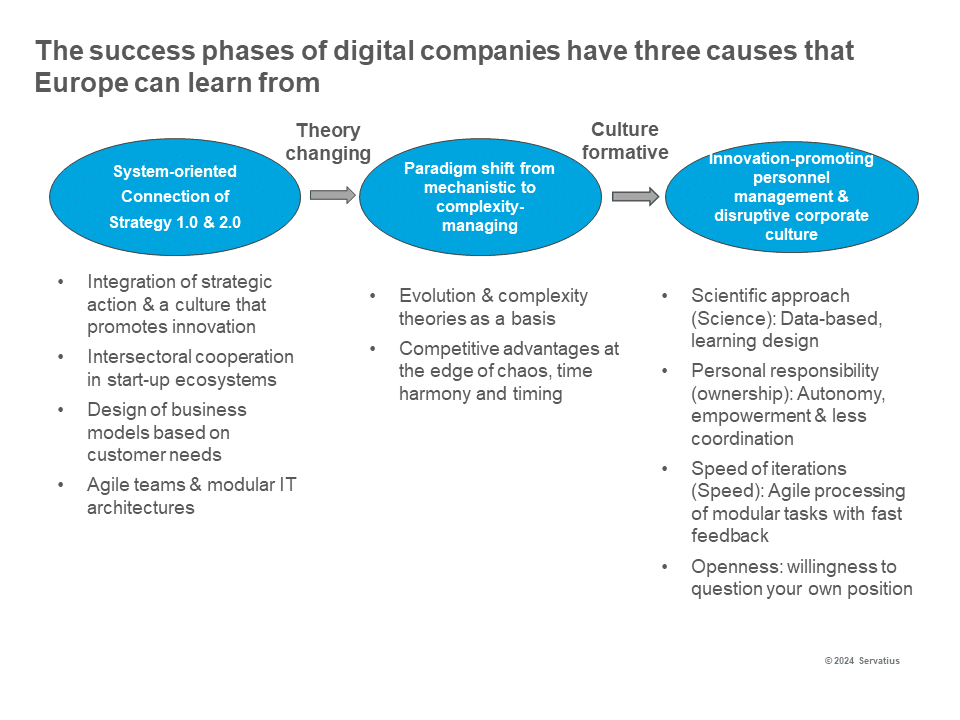

Development and change in strategic management
The task of strategic management is to shape corporate development and overcome challenges. New opportunities and threats mean that board members and managing directors are constantly faced with the need to learn. Improved didactics in executive education and training should take this change in strategic management into account. In the current phase of upheaval, the focus is on AI-based strategic and organizational realignments. We refer to the combination of these fields of action, which are changing the labor market and requiring new leadership skills, as innostrategizing.
In this blog post, I explain the stages of development of strategic management and the paradigm shift that is shaping the evolution of the field.
AI is also changing the job market for young professionals
The increasing importance of artificial intelligence (AI) is leading to a decline in demand for clearly structured, repetitive fields of activity, even for young professionals.Many of these tasks are already being performed faster, more cost-effectively, and with sufficient quality by AI. At the same time, new tasks are emerging, e.g., in AI training and the use of AI tools. In addition to AI skills, other qualifications are becoming more important. These include, for example, the ability to work on interdisciplinary projects. As this change affects all areas of management, innovative education providers are realigning their bachelor’s programs. In addition, the requirements for managers are also changing.
New requirements for managers
In the past, completing an MBA program increased the likelihood of a successful management career. For example, 18 percent of the board members of German listed companies have a Master of Business Administration (MBA), 88 percent of whom obtained their degree abroad. An important motivation for pursuing an MBA program is the desire to develop further and improve one’s own strategic skills. For business economists and especially for graduates of technical degree programs, MBA programs at renowned universities act as career accelerators. For universities in Germany and abroad that offer MBA programs, it is important to note that the challenges facing companies and thus also the field of strategic management have been undergoing fundamental changes for some time. Innovative education providers are equipping their students to cope with the complexity associated with these changes. The negative effects of US ’s policies on the country’s education system are an opportunity for Europe that universities should take advantage of.
Of particular importance here is an understanding of the changes in strategic management over the course of its development.
Stages of development in strategic management
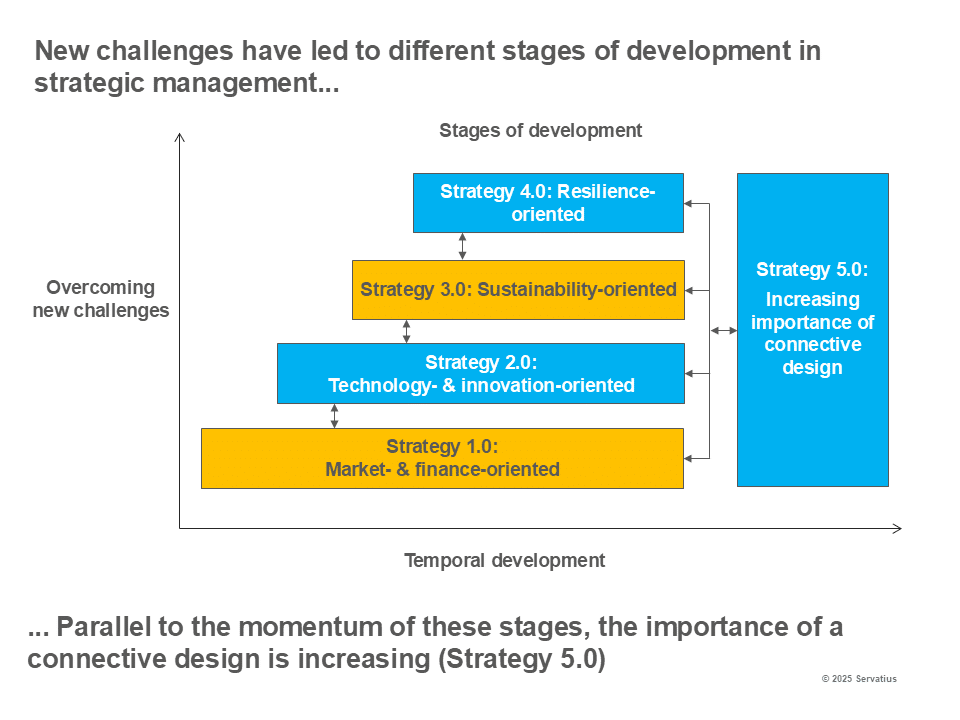
We have divided the development of strategic management since the 1960s into the following stages, which characterize the respective focus:3
- Market- and finance-oriented (Strategy 1.0)
- technology- and innovation-oriented (Strategy 2.0)4
- sustainability-oriented (Strategy 3.0)5 and
- resilience-oriented to overcome the current multi-crisis (Strategy 4.0)6 .
Parallel to the momentum of these stages, the importance of a connective design is increasing. By this we mean
- to plan and implement
- objects, systems, or problem solutions
- carried out jointly by actors from different disciplines, levels, or organizations.
We consider such connective design to be the fifth stage of development in strategic management (Strategy 5.0). This stage connects and expands on the previous stages.7
An important foundation for connective design was laid by Nobel Prize winner Herbert Simon (1978) in his book The Sciences of the Artificial, which has shaped design theory.8 Even though this groundbreaking work is little known in Germany, hidden champions have been practicing this management approach for decades, which deals with questions such as how to connect new customer needs and technologies.
University teaching on strategic management still focuses primarily on the first stage of development, which is market- and finance-oriented. The second and third stages have given rise to the independent disciplines of technology, innovation and entrepreneurship, and sustainability. However, the integrative aspect of connecting the stages is usually neglected. In addition, there are the specialist areas of human resource management, organization, IT management, and change management, which are also often not linked to strategic management.
Connective design
Although the ability to create connections is rarely taught at universities, it has always been and continues to be relevant at all strategic levels. This is illustrated by the following tasks:
- Designing business portfolios with the aim of permanently increasing company value (Strategy 1.0)
- designing the innovation system of companies by connecting relevant fields of action and innovation ecosystems (Strategy 2.0)
- designing the sustainability system of companies and GreenTech ecosystems, as well as jointly overcoming conflicts of interest between economics, ecology, and social issues (Strategy 3.0)
- the design of resilient systems by connecting the levels of government, companies, and individuals, e.g., to overcome geopolitical crises (Strategy 4.0)
- designing connections between the stages of development, e.g., in the areas of sustainability innovation and climate resilience (Strategy 5.0).
In addition to these stages of development and a unifying perspective, the change of strategic management is characterized by a paradigm shift.
Paradigm shift in strategic management
The term paradigm describes a fundamental pattern that serves as a guide in a particular field. In science, a paradigm forms a framework for theories, concepts, and practices. A paradigm shift is a transition from an older to a new fundamental pattern. The science historian Thomas Kuhn uses the term to describe scientific revolutions.9 One of the critics of this idea is the philosopher Stephen Toulmin. For him, a scientific paradigm is a loosely connected bundle of individual theories that must prove themselves in an evolutionary process.10 The paradigm shift in strategic management has a rather evolutionary character.
Since the 1990s, this paradigm shift has been taking place from top-down-oriented analyses to a growing dynamic, complexity, and uncertainty emanating from successful digital companies and a changed geopolitical landscape.11 Analysis in the old paradigm aims to break down problems. The following figure summarizes the factors that characterize the evolutionary paradigm shift.
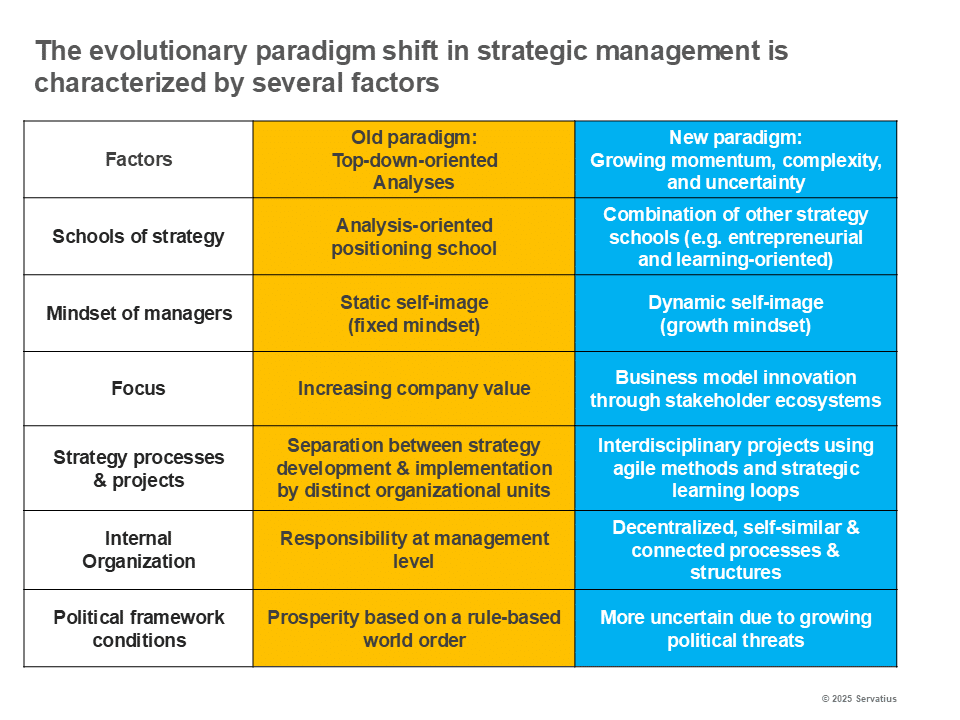
The transition from the old to the new paradigm is changing the influence of various schools of strategy. The analysis-oriented positioning school has lost importance. A combination of other schools of strategy, such as the entrepreneurial school and the learning school, has become more relevant.12
Another important change concerns the mindset of managers. While a rather static self-image dominates in many established companies, the culture of successful digital companies is characterized by a dynamic self-image (growth mindset), which often begins to develop in childhood.13
The focus of the old strategy paradigm is on increasing company value. The new paradigm focuses more on business model innovation through stakeholder ecosystems. Artificial intelligence (AI) now plays an important role in managing the complexity associated with this.14
Strategy processes and projects have also changed. The old paradigm was dominated by a separation between strategy development and implementation by distinct organizational units. This separation encourages the emergence of silo cultures. The new paradigm is characterized by interdisciplinary projects using agile methods such as design thinking and Scrum. A common feature of these projects is the iterative approach in learning loops.15
The internal organization also differs accordingly. In the old paradigm, responsibility for strategic management lies at the management level. The new paradigm is characterized by more decentralized, self-similar (fractal) processes and structures. Strategy units with different tasks are connected to each other and to a central office.16
Currently, an important change is emanating from the political framework conditions. The old paradigm is based on the idea that prosperity arises from a rule-based world order. This idea is increasingly being called into question. Due to growing political threats, the framework conditions for strategies have become much more uncertain. A current example is the tariff crisis initiated by the US government. In this situation, the world seems to lack a reliable compass.17
AI-based strategic and organizational realignments
In summary, it can be said that the change in strategic management is characterized by the following two determinants:
- Development in stages with an increasingly important connective perspective, and
- an evolutionary paradigm shift.
Characteristic of the early approaches to strategic management according to the old paradigm are top-own-oriented analyses based on problem decomposition. These approaches determined the first stage of development and the beginning of the second stage. In contrast, the new paradigm focuses on growing dynamics, complexity, and uncertainty.
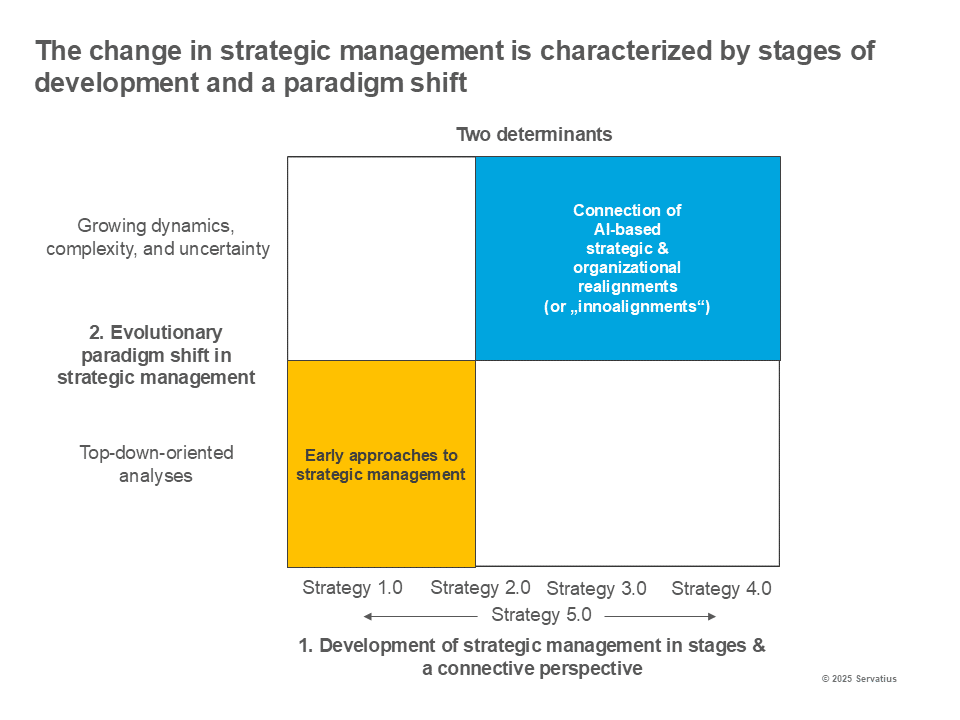
If one is looking for a term to describe current strategic management, the neologism „innoalignment“ comes to mind. By this we mean the connection of AI-based strategic and organizational realignments. The strategic realignments are aimed at making companies more resilient, digital, and sustainable.18 In organizational realignments, AI-supported performance management measures the success of leaner structures, networked processes and projects, and an innovative AI platform architecture.19 There are still few examples of such innoalignment. This makes it all the more important for application-oriented research and teaching to focus more on this topic. The further development of management didactics plays a central role in this.
Key players in management didactics
In recent decades, various players have shaped didactics in management education. Their approaches have specific advantages and disadvantages. In view of new challenges, innovative education providers are currently developing didactic concepts that focus on AI-supported solutions to complex management problems. 20
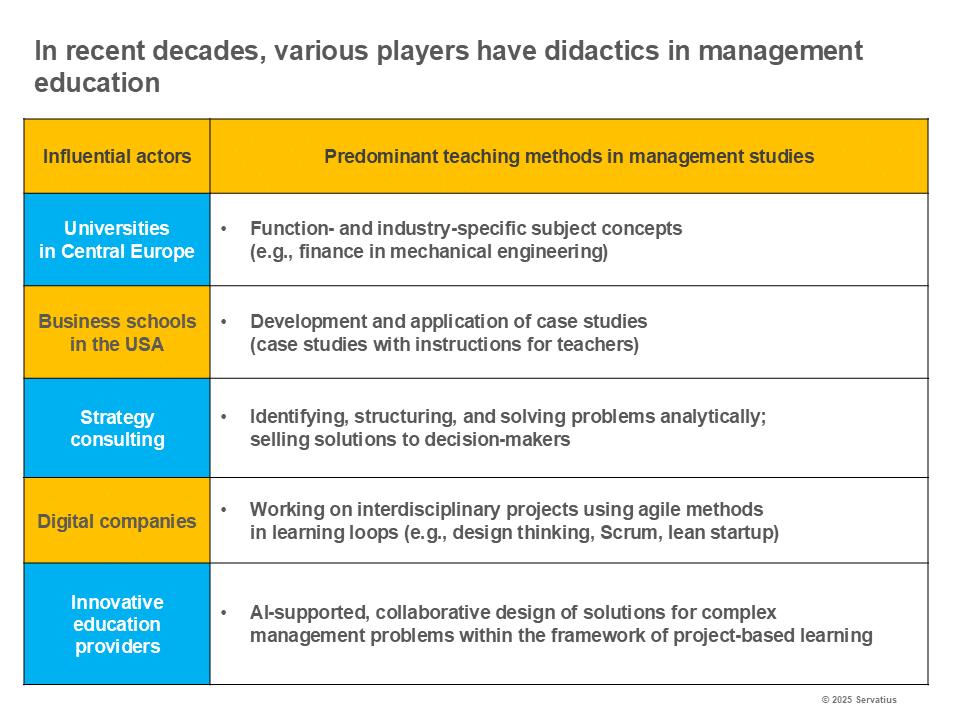
The prevailing management didactics at universities in Central Europe have long been function- and industry-specific subject concepts. The focus of business administration functional teaching (e.g., finance) and technical industry teaching (e.g., mechanical engineering) is on training specialists who work in hierarchies with clearly defined organizational units. This approach encourages the emergence of interface problems that are difficult for companies to overcome due to a rigid culture.
In the USA, Harvard Business School transferred the case study method from legal education to management education in 1920. The basic idea is that lecturers condense interesting practical examples into case studies, which form the focus of teaching. The promise of benefit here is to learn from actors who have attempted to solve a specific problem. This didactic approach differs fundamentally from subject-based learning. One disadvantage of the case study method is that the rapid transfer of a known solution often does not do justice to the complexity of new tasks.
The major strategy consultancies, which are influenced by the teaching methods used at business schools, have supplemented the case study approach with a specific form of further training for their consultants. This on-the-job training focuses on teaching the ability to identify problems, structure them, and solve them analytically. The final step is to sell the solutions by having experienced consultants convince decision-makers. A common criticism of this classic approach by consultants is that they leave their clients to implement the solutions on their own. This is where performance management, which emerged in the 1980s, comes in with the formulation of objectives and key results.
Successful digital companies and their venture capitalists rely less on external consultants and more often work on interdisciplinary projects themselves using agile methods such as design thinking or Scrum. In this iterative approach, the actors apply the concept of learning loops, which is well known in organizational development. The lean startup method is also based on this approach.
Since all of these approaches have specific strengths and weaknesses, innovative education providers build on what is already known and develop it further. The result is project-based learning that focuses on AI-supported, collaborative design of solutions for complex management problems.21 Such action-oriented learning can begin with simple problems and then move on to individual learning steps addressing current challenges for which there are no known solutions yet. The new education providers have recognized that this approach is best mastered by a heterogeneous teaching staff in which academics work together with practitioners who have different backgrounds and experience. An interesting question is how organizations can promote the further development of a dynamic self-image. The role model function of leadership plays an important role here.
This change in strategic management, combined with innovative didactics, opens up an opportunity for Europe that the „old continent“ should seize.
Change as an opportunity for Europe
Strategic management started as an import from the US, with its first stage of development spreading across Europe since the 1970s. Europe has been overtaken in many areas by the waves of digitalization, which have mainly originated from US companies. At the same time, changing geopolitical conditions are increasing Europe’s dependence on the US and China. It therefore seems high time for Europe to refocus on its strengths. Politicians have begun to rethink their approach, placing greater emphasis on competitiveness once again. One opportunity of global significance is the combination of digitalization and sustainability (digital green tech), where Europe should strive to take a leading role.22 The basis for this is an improvement in education systems.
The outlined change in strategic management creates a framework for joint programs between politics, science, business, and society in specific growth areas, such as the realignment of power grids with AI.23 This depends on the ability to design solutions for complex management problems. Overall, this change represents an opportunity for Europe if it succeeds in becoming more resilient in crisis management through a joint effort.
Advanced didactics in management play a central role in this. These methods must also address the question of what causes the basic patterns of error that Germany has made in the past, for example in digitization and the energy transition. An important insight is that such basic patterns of error are the fragmented interests of individual actors or groups. The theory and practice of connective design can help to overcome this basic pattern of error.
Conclusion
- The development of strategic management has proceeded in stages, with the importance of a connective perspective increasing
- Parallel to this, there has been an evolutionary paradigm shift with a change in a number of factors
- These two determinants shape innostrategizing, which combines AI-based strategic and organizational realignments
- To this end, innovative education providers are further developing management didactics
- Europe should see this increasingly apparent change as an opportunity.
Literature
[1] Bomke, L., Müller, A., Telser, F., AI displaces career starters. In: Handelsblatt, August 12, 2025, pp. 16-17
[2] Westkämper, A., On the board thanks to an MBA – that’s what matters. In: Handelsblatt, July 18/19/20, 2025, pp. 54-55
[3] Servatius, H.G., Strategy 5.0 for overcoming new challenges. In: Competivation Blog, June 28, 2022
[4] Servatius, H.G., Evolution of strategic management. In: Competivation Blog, June 28, 2024
[5] Servatius, H.G., Sustainability-oriented strategic management. In: Competivation Blog, August 15, 2024
[6] Servatius, H.G., Resilience-oriented strategic management. In: Competivation Blog, March 15, 2024
[7] Servatius, H.G., Strategic leadership with contextual and relationship-oriented intelligence. In: Competivation Blog, March 14, 2023
[8] Simon, H.A., The sciences of the artificial, 3rd edition, MIT Press 1996
[9] Kuhn, T.S., The structure of scientific revolutions, Suhrkamp 1996
[10] Toulmin, S.E., Critique of collective reason, Suhrkamp 1983
[11] Servatius, H.G., Learning from successful digital companies. In: Competivation Blog, July 12, 2024
[12] Mintzberg, H., Ahlstrand, B., Lampel, J., Strategy safari: A journey through the wilderness of strategic management, Carl Ueberreuter 1999
[13] Dweck, C., Self-image – How our thinking causes success or failure, 7th edition, Piper 2017
[14] Servatius, H.G., AI as a tool for strategic management. In: Competivation Blog, May 1, 2025
[15] Servatius, H.G., GenAI-based strategic learning loops as a connecting process pattern. In: Competivation Blog, November 1, 2024
[16] Servatius, H.G., Fractal organization of strategy 5.0 labs. In: Competivation Blog, March 28, 2023
[17] Riecke, T., The struggle for a new world order. In: Handelsblatt, August 8/9/10, 2025, pp. 24-25
[18] Servatius, H.G., Triple strategic realignment. In: Competivation Blog, June 7, 2024
[19] Servatius, H.G., Process-oriented AI for increased productivity. In: Competivation Blog, March 12, 2025
[20] Servatius, H.G., AI and the future of management education. In: Competivation Blog, April 9, 2024
[21] Servatius, H.G., Learning to design solutions for complex management Problems. In: Competivation Blog, July 15, 2025
[22] Servatius, H.G., Achieving success in digital greentech with a Strategy 5.0. In: Fesidis, B., Röß, S.A. Rummel, S. (Eds.), (Towards a Climate-Neutral Company through Digitalization and Sustainability), SpringerGabler 2023, pp. 72-94
[23] Stratmann, K., Build less, digitize more. In: Handelsblatt, August 12, 2025, pp. 20-21