
MBA programs | Competivation
How AI is changing management consulting

How AI is changing management consulting

For decades, the global success of management consulting has been based on identifying new challenges early on and developing solutions that are both theoretically sound and practical. Artificial intelligence (AI) is one such challenge that is also fundamentally changing the consulting industry itself. Starting with an explanation of this evolution, I explore the implications it has for management theory and research.

In this new article, I examine the impact of artificial intelligence on the evolution of management consulting. At the same time, universities and business schools are facing a profound change, which our network of experts has investigated.


Management consulting as a career accelerator

For a long time, working at one of the leading consulting firms was considered an important step toward an accelerated career in management. In particular, the major strategy firms hired candidates with strong analytical and communication skills who were able to contribute to solving complex problems and support their implementation. A consulting career typically began with several busy years of research and preparing presentations, which were critically evaluated by project managers. Through this learning process, young consultants developed skills that universities had not taught them.1 Today, AI models handle a significant portion of this work, operating at breathtaking speed, at comparatively low cost, and with surprisingly good results. The world of consulting has changed.


Key factors and consequences of the evolution of traditional management consulting

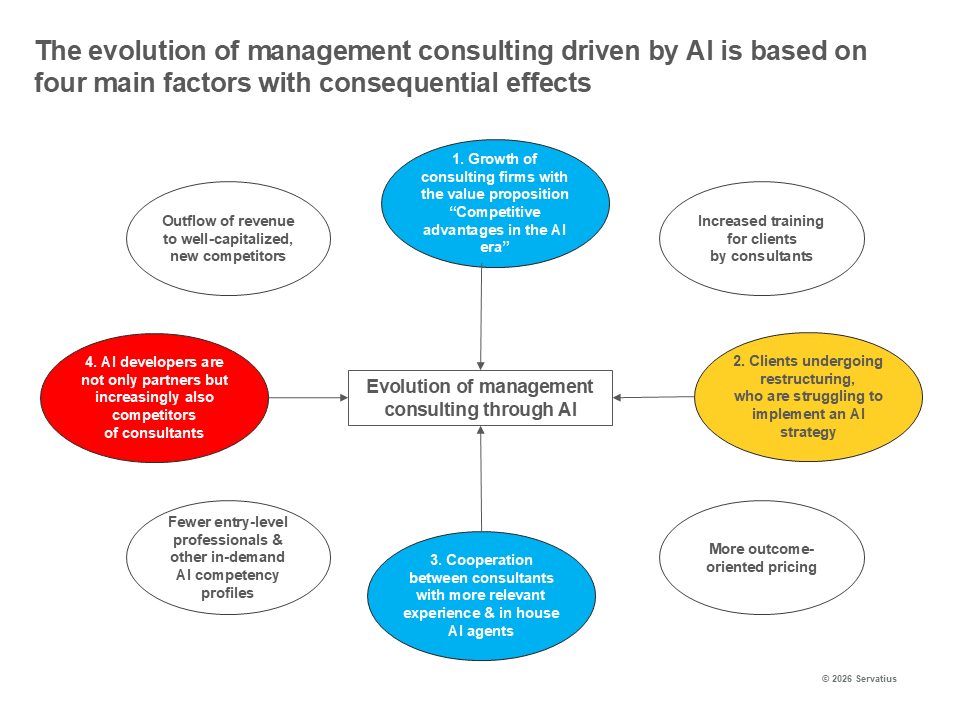
Traditional management consulting is currently undergoing what is arguably the most significant evolution of the past decades. The catalyst for this change is artificial intelligence.2 An examination of the causes points to the following four key factors:

  1. Potential growth for consulting firms offering clients the value proposition of “competitive advantages in the AI era”
  2. Clients undergoing restructuring processes who are struggling to successfully implement an AI strategy
  3. Cooperation between consultants with more relevant experience and in-house AI agents, as well as
  4. AI developers who are not only partners of the consulting firms but are increasingly becoming their competitors as well.

These key factors lead to further consequential effects.
Lernprozess Innovationsstrategie

The value proposition for clients and their internal challenges create a need for consultants to provide clients with more training. For example, in 2024, Accenture acquired Udacity, a provider of Massive Open Online Courses (MOOCs), and realigned its business model more toward B2B.

Since billing by the hour is no longer appropriate when using in-house AI agents, pricing is becoming more outcome-oriented. However, it is not easy to determine who is ultimately responsible for unsatisfactory results and what the reasons for them are.

As routine tasks are increasingly taken over by AI for clients and consulting firms, both are faced with the question of whether they should hire fewer entry-level professionals. This is changing organizational structures and skill profiles. But the people with AI experience that firms are seeking are also finding interesting opportunities elsewhere.

In addition, major developers of AI models—who in recent years have gone from being partners of consulting firms to their competitors—are increasingly relying on Forward Deployed Engineering (FDE), a methodology developed at Palantir, when implementing AI strategies. This is resulting in a loss of revenue in the growing AI consulting segment to very well-capitalized new competitors who are seeking to create a lock-in effect among corporate clients.3

Compounding these factors is the fact that we are currently witnessing the transition to a new era of management.


Transition to a new era of management

Throughout the history of consulting, there have been several transitions to new or significantly altered management eras. For me personally, it was particularly formative to witness how the market- and finance-oriented strategic management of the early 1980s gave rise to a second stage of development that was more strongly focused on technological innovations.4

During these phases of transition, visionary researchers and consulting pioneers often outpace current management practices. This can lead to innovative consultants having difficulty conveying their ideas to clients for a time. As a result, these consultants are always on the lookout for thought leaders on the client side. Problems arise when there is a shortage of thought leaders and trailblazers in a given country.

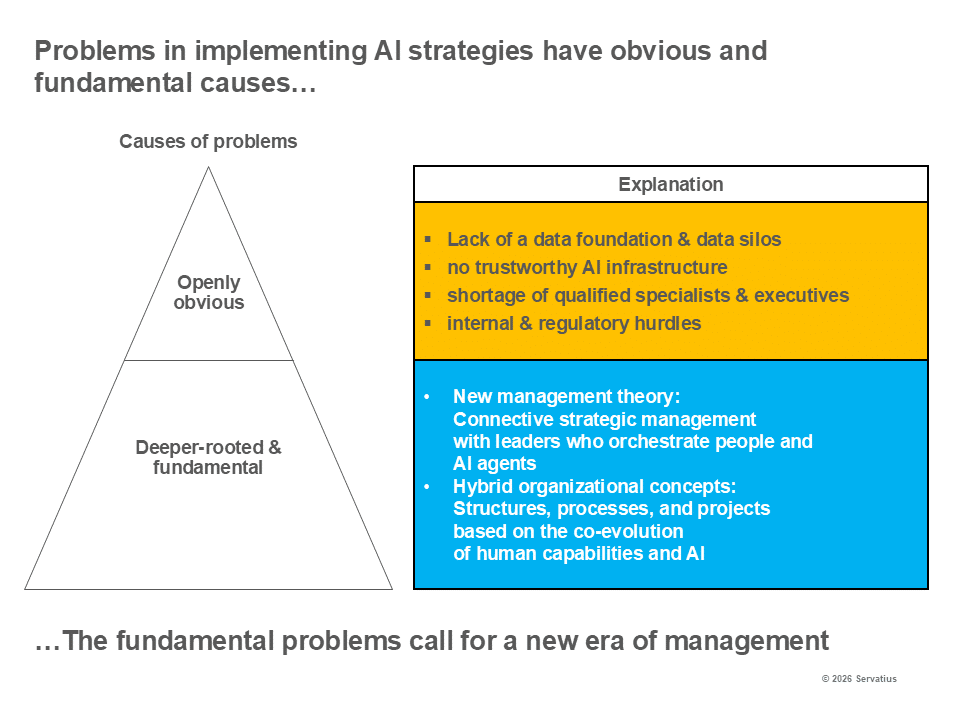
There are currently significant challenges in implementing AI strategies. In addition to obvious causes, these implementation difficulties are compounded by deeper-rooted and more fundamental issues. Many companies clearly face problems such as

  • a lack of a data foundation and data silos
  • no trustworthy AI infrastructure
  • a shortage of qualified specialists and executives, as well as
  • internal and regulatory hurdles.

As part of a further development of the management practices used to date, it should be possible to overcome these challenges. The situation is different when it comes to fundamental problems. Mastering them marks the transition to a new era of management.
Lernprozess Innovationsstrategie

Characteristics of this emerging next stage include a new management theory and hybrid organizational concepts.

As early as 1954 and 1969, Peter Drucker shaped an entire era with his groundbreaking publications on Management by Objectives (MbO) and the knowledge society.5 At the heart of a new theory lies connective strategic management (Strategy 5.0), with leaders who orchestrate both people and AI agents.6 In parallel, hybrid organizations are emerging with structures, processes, and projects based on the co-evolution of human capabilities and AI.

The necessary realignment toward a corresponding Management Education 5.0 for the AI era is a fundamental challenge that Germany must overcome.7 There is a strong tendency toward inertia here, and disruption in management education and training is, at best, only beginning to emerge.8


Changes in management theory and research on AI

Traditional business administration programs essentially teach the theoretical foundations for entry-level positions. This is due, among other things, to the fact that university professors are primarily academically qualified. When they are appointed, the focus is on publications in top-tier journals rather than on experience outside the academic world. Consequently, at prestigious consulting firms, it typically takes another three “years of apprenticeship” before a consultant with top grades and a Ph.D. is promoted to project manager. This raises the question of the implications for educational providers if, in management consulting and beyond—in the business world in general—not only are many entry-level positions being eliminated due to AI, but the required qualifications are also changing at all hierarchical levels.

For example, a study by the online platform Indeed shows that the number of entry-level positions has fallen by more than two-thirds between the boom year of 2022 and the fall of 2026. The decline was particularly sharp in marketing, at 75 percent.9 Alongside the economic downturn, AI is a major driver of this trend.

Both management consulting firms and their clients have a strong interest in recruiting candidates from universities who are better prepared for the AI era. There are at least three reasons for this:

  1. Newly hired consultants coming straight from college should be able to work on this new type of consulting project without extensive training
  2. Consulting firms, whose revenue depends more heavily on the success of cooperative project work, need clients with broad AI expertise—expertise they can only partially develop from external sources—and
  3. If AI developers and consultants use the “Forward Deployed Engineering” approach—originated at Palantir—when implementing their clients’ strategies, this results in a systematic outflow of knowledge from the client to the service provider, which weakens the client’s competitiveness in the medium term. This cannot be in the client’s best interest.

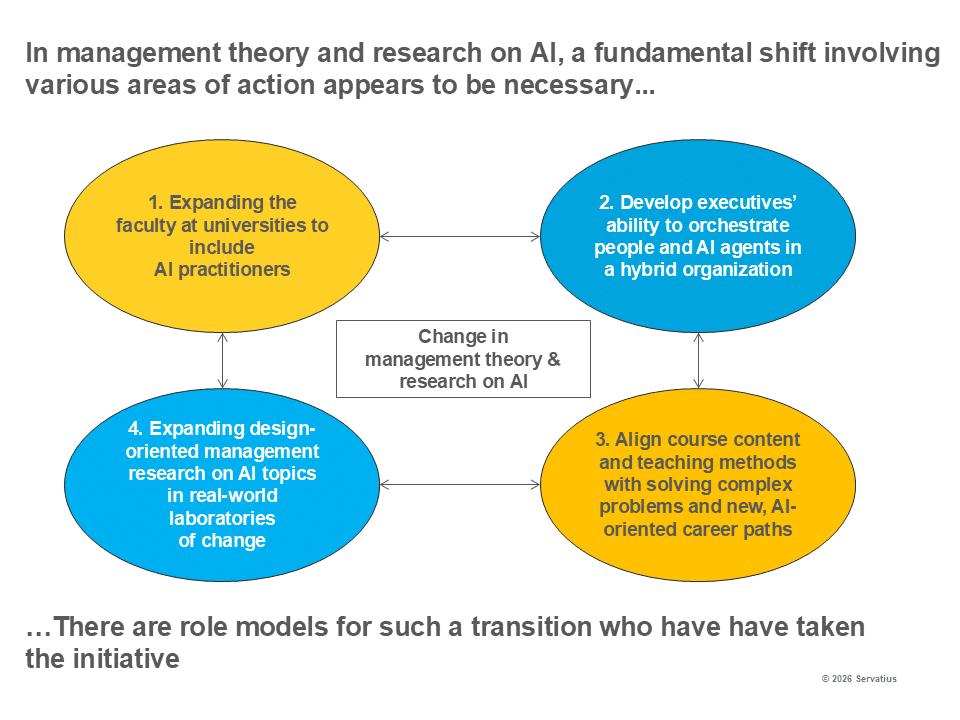
In management theory and research on AI, a fundamental shift therefore appears necessary, encompassing the following four areas of action:

  1. Expanding university faculty to include AI practitioners
  2. executive development aimed at orchestrating people and AI agents within a hybrid organization
  3. aligning course content and teaching methods with the solving of complex problems and new, AI-oriented career profiles
  4. expanding design-oriented management research on AI topics conducted in real-world laboratories of change.

There are role models both abroad and in Germany that have taken the initiative to drive such a transformation.
Lernprozess Innovationsstrategie

For decades, there has been a tension in management theory and research between scientific rigor and practical relevance. At U.S. business schools, a stronger scientific orientation began in the late 1950s with the help of quantitative empirical research. This approach was adopted by German universities. In the U.S., however, a pragmatic reorientation toward a “both-and” approach took place much earlier than in Germany, driven by market pressures. At high-cost elite universities, for example, renowned practitioners (Professors of Practice) complement the academic faculty. In the age of artificial intelligence, this mixed staffing structure is gaining importance worldwide.10 Anyone who invests a substantial sum in an MBA program wants that business school to prepare its students—both theoretically and practically—for a job market that is undergoing dramatic change due to AI. Universities in Germany are now also striving for such a realignment. Overall, however, there is a relatively strong tendency here to cling to the status quo.

The starting point for change is often executive development in general and company-specific (customized) Executive MBA programs. Today, aspiring executives must learn how to successfully orchestrate hybrid teams composed of people and AI agents. Interestingly, in a Financial Times ranking of customized executive development programs aimed at corporate realignment, European universities such as SDA Bocconi (Milan), London Business School, and IMD (Lausanne) occupy the top spots. U.S. business schools such as MIT, Stanford, and Wharton score highly for their expertise in AI technologies.

Furthermore, in many fields, it is crucial to improve the ability to solve complex problems and to develop skills for new job profiles. Only a few universities are prepared for this kind of reskilling. However, this is critical to Europe’s efforts to catch up in the field of AI. The necessary impetus for a corresponding realignment of course content and teaching methods comes primarily from innovative educational providers and foundations that draw on international best practices.11 The justified Gen Z demonstrations make it clear that the pressure is mounting. Today’s students should learn how to use AI to solve complex problems faster and more effectively. They can then demonstrate this ability in their theses by using AI as a sparring partner—for example, to refine research questions, examine a topic from different angles, and identify gaps. In the old world of consulting, this was one of the basic skills that “consulting trainees” learned. With AI, the whole process has become much simpler, and universities should teach this skill as early as the first semesters.

Another area of focus is design-oriented management research on AI topics. Experts are watching Germany with great interest and expect a stronger integration of engineering knowledge and industrial AI expertise with new management skills. German global market leaders and startups are demonstrating how such research works in real-world laboratories of change. To support this, an innovation policy that overcomes traditional silo thinking must create suitable framework conditions. At the University of Stuttgart, where I have been teaching strategy and organization since the 1980s, we have long been practicing this research approach within the framework of technically oriented business administration.12 Personally, I have always found teaching and research to be very enriching, alongside leadership positions in management consulting. However, it is time for Germany to better institutionalize this dual role.


Conclusion

  • Artificial intelligence is leading to a fundamental change of both the business model and organizational structure of management consulting firms, as well as the relevant competencies of consultants
  • This evolution is taking place as we transition into a new era of management, in which executives will, for the first time, orchestrate both people and AI agents. This requires new approaches to management education
  • For a number of reasons, both management consulting firms and their clients have a vested interest in universities better preparing students for the AI era
  • To achieve this, universities must make their education and research more practice-oriented and more design-oriented. In doing so, they must overcome forces of inertia.


References

[1] Kiechel, W., The Lords of Strategy – The Secret Intellectual History of the New Corporate World, Harvard Business Press 2010

[2] Duncan, D.S., Anderson, T., Saviano, J., AI is Changing the Structure of Consulting Firms. In: Harvard Business Review, September 10, 2025

[3] Servatius, H.G., Implementing AI Strategies with a Forward Deployed Engineering approach. In: Competivation Blog, October 29, 2026

[4] Servatius, H.G., Development and change in strategic management. In: Competivation Blog, September 19, 2025

[5] Drucker, P.F., The Practice of Management, Harper 1954, p. 121 ff.

Drucker, P.F., The Age of Discontinuity – Guidelines to Our Changing Society, Heinemann 1969, pp. 247 ff.

[6] Servatius, H.G., Connective strategic management in the age of AI. In: Competivation Blog, May 22, 2026

[7] Servatius, H.G., Management Education 5.0 for Dialog-based Action. In: Competivation Blog, January 13, 2024

[8] Servatius, H.G., Disruption of management education for AI-based realignments. In: Competivation Blog, October 10, 2025

[9] Indeed, Starting a Career Is Getting Harder—Two-Thirds Fewer Entry-Level Jobs Since 2022, but Apprenticeship Positions Are Holding Steady, September 23, 2026

[10] Servatius, H.G., AI and the future of management education. In: Competivation Blog, April 9, 2025

[11] Servatius, H.G., Generative AI and Mass-Customized Action Learning. In: Competivation Blog, August 28, 2023

[12] Servatius, H.G., Design-oriented innovation research on AI applications. In: Competivation Blog, March 25, 2026
How AI is changing management consulting

Development and change in strategic management


The task of strategic management is to shape corporate development and overcome challenges. New opportunities and threats mean that board members and managing directors are constantly faced with the need to learn. Improved didactics in executive education and training should take this change in strategic management into account. In the current phase of upheaval, the focus is on AI-based strategic and organizational realignments. We refer to the combination of these fields of action, which are changing the labor market and requiring new leadership skills, as innostrategizing.


In this blog post, I explain the stages of development of strategic management and the paradigm shift that is shaping the evolution of the field.


AI is also changing the job market for young professionals

The increasing importance of artificial intelligence (AI) is leading to a decline in demand for clearly structured, repetitive fields of activity, even for young professionals.Many of these tasks are already being performed faster, more cost-effectively, and with sufficient quality by AI. At the same time, new tasks are emerging, e.g., in AI training and the use of AI tools. In addition to AI skills, other qualifications are becoming more important. These include, for example, the ability to work on interdisciplinary projects. As this change affects all areas of management, innovative education providers are realigning their bachelor’s programs. In addition, the requirements for managers are also changing.


New requirements for managers

In the past, completing an MBA program increased the likelihood of a successful management career. For example, 18 percent of the board members of German listed companies have a Master of Business Administration (MBA), 88 percent of whom obtained their degree abroad. An important motivation for pursuing an MBA program is the desire to develop further and improve one’s own strategic skills. For business economists and especially for graduates of technical degree programs, MBA programs at renowned universities act as career accelerators. For universities in Germany and abroad that offer MBA programs, it is important to note that the challenges facing companies and thus also the field of strategic management have been undergoing fundamental changes for some time. Innovative education providers are equipping their students to cope with the complexity associated with these changes. The negative effects of US ’s policies on the country’s education system are an opportunity for Europe that universities should take advantage of.

Of particular importance here is an understanding of the changes in strategic management over the course of its development.


Stages of development in strategic management

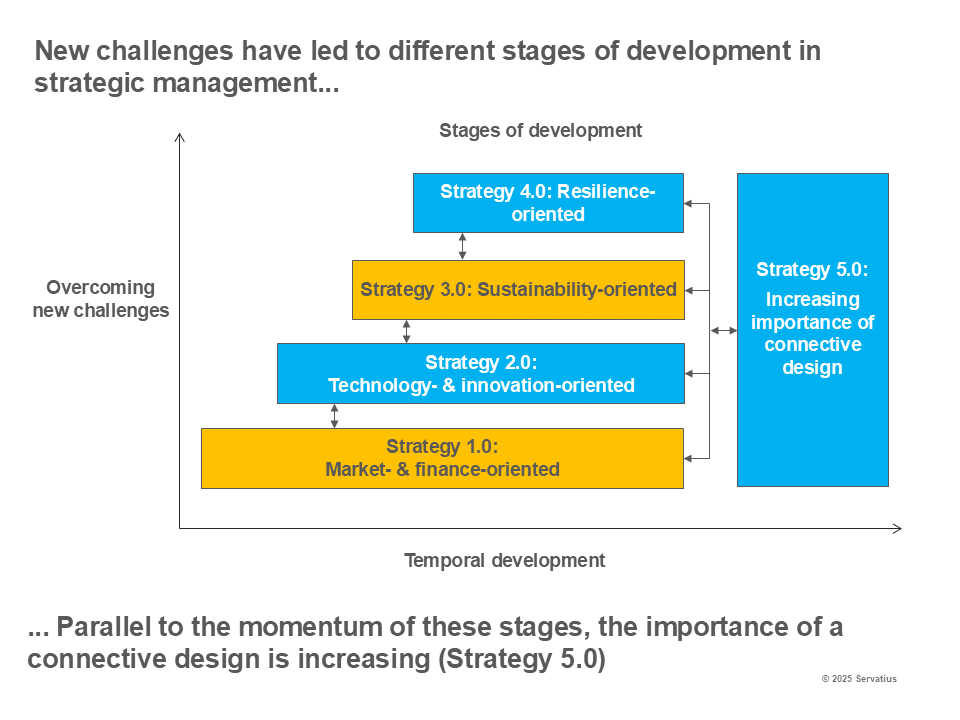
We have divided the development of strategic management since the 1960s into the following stages, which characterize the respective focus:3

  • Market- and finance-oriented (Strategy 1.0)
  • technology- and innovation-oriented (Strategy 2.0)4
  • sustainability-oriented (Strategy 3.0)5 and
  • resilience-oriented to overcome the current multi-crisis (Strategy 4.0)6 .

Parallel to the momentum of these stages, the importance of a connective design is increasing. By this we mean

  • to plan and implement
  • objects, systems, or problem solutions
  • carried out jointly by actors from different disciplines, levels, or organizations.

We consider such connective design to be the fifth stage of development in strategic management (Strategy 5.0). This stage connects and expands on the previous stages.7

Lernprozess Innovationsstrategie

An important foundation for connective design was laid by Nobel Prize winner Herbert Simon (1978) in his book The Sciences of the Artificial, which has shaped design theory.8 Even though this groundbreaking work is little known in Germany, hidden champions have been practicing this management approach for decades, which deals with questions such as how to connect new customer needs and technologies.

University teaching on strategic management still focuses primarily on the first stage of development, which is market- and finance-oriented. The second and third stages have given rise to the independent disciplines of technology, innovation and entrepreneurship, and sustainability. However, the integrative aspect of connecting the stages is usually neglected. In addition, there are the specialist areas of human resource management, organization, IT management, and change management, which are also often not linked to strategic management.


Connective design

Although the ability to create connections is rarely taught at universities, it has always been and continues to be relevant at all strategic levels. This is illustrated by the following tasks:

  • Designing business portfolios with the aim of permanently increasing company value (Strategy 1.0)
  • designing the innovation system of companies by connecting relevant fields of action and innovation ecosystems (Strategy 2.0)
  • designing the sustainability system of companies and GreenTech ecosystems, as well as jointly overcoming conflicts of interest between economics, ecology, and social issues (Strategy 3.0)
  • the design of resilient systems by connecting the levels of government, companies, and individuals, e.g., to overcome geopolitical crises (Strategy 4.0)
  • designing connections between the stages of development, e.g., in the areas of sustainability innovation and climate resilience (Strategy 5.0).

In addition to these stages of development and a unifying perspective, the change of strategic management is characterized by a paradigm shift.


Paradigm shift in strategic management

The term paradigm describes a fundamental pattern that serves as a guide in a particular field. In science, a paradigm forms a framework for theories, concepts, and practices. A paradigm shift is a transition from an older to a new fundamental pattern. The science historian Thomas Kuhn uses the term to describe scientific revolutions.9 One of the critics of this idea is the philosopher Stephen Toulmin. For him, a scientific paradigm is a loosely connected bundle of individual theories that must prove themselves in an evolutionary process.10 The paradigm shift in strategic management has a rather evolutionary character.

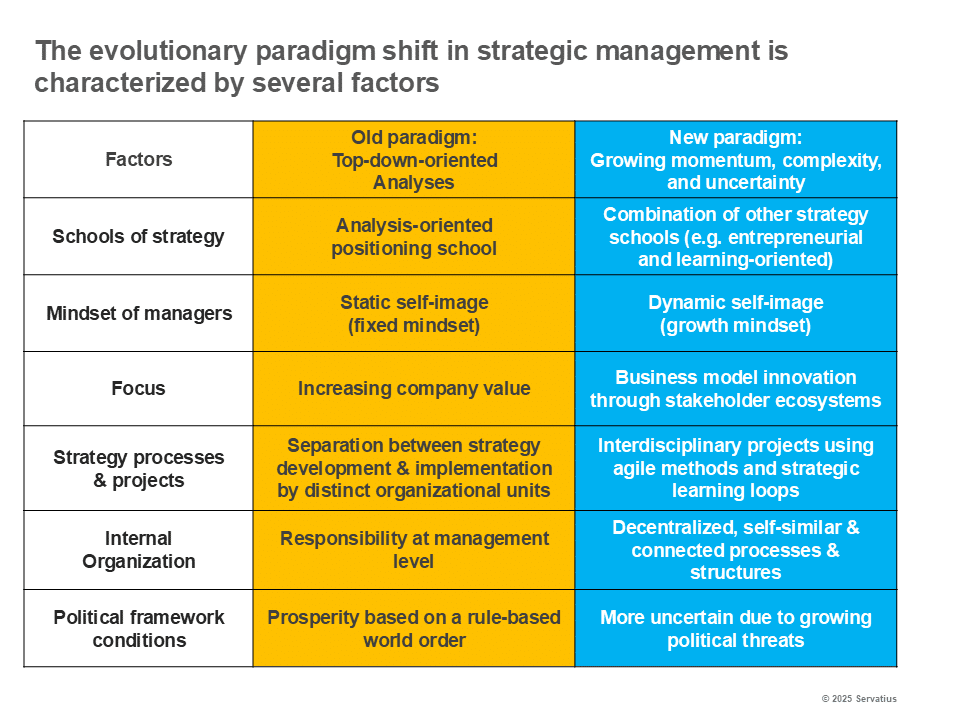
Since the 1990s, this paradigm shift has been taking place from top-down-oriented analyses to a growing dynamic, complexity, and uncertainty emanating from successful digital companies and a changed geopolitical landscape.11 Analysis in the old paradigm aims to break down problems. The following figure summarizes the factors that characterize the evolutionary paradigm shift.

Lernprozess Innovationsstrategie

The transition from the old to the new paradigm is changing the influence of various schools of strategy. The analysis-oriented positioning school has lost importance. A combination of other schools of strategy, such as the entrepreneurial school and the learning school, has become more relevant.12

Another important change concerns the mindset of managers. While a rather static self-image dominates in many established companies, the culture of successful digital companies is characterized by a dynamic self-image (growth mindset), which often begins to develop in childhood.13

The focus of the old strategy paradigm is on increasing company value. The new paradigm focuses more on business model innovation through stakeholder ecosystems. Artificial intelligence (AI) now plays an important role in managing the complexity associated with this.14

Strategy processes and projects have also changed. The old paradigm was dominated by a separation between strategy development and implementation by distinct organizational units. This separation encourages the emergence of silo cultures. The new paradigm is characterized by interdisciplinary projects using agile methods such as design thinking and Scrum. A common feature of these projects is the iterative approach in learning loops.15

The internal organization also differs accordingly. In the old paradigm, responsibility for strategic management lies at the management level. The new paradigm is characterized by more decentralized, self-similar (fractal) processes and structures. Strategy units with different tasks are connected to each other and to a central office.16

Currently, an important change is emanating from the political framework conditions. The old paradigm is based on the idea that prosperity arises from a rule-based world order. This idea is increasingly being called into question. Due to growing political threats, the framework conditions for strategies have become much more uncertain. A current example is the tariff crisis initiated by the US government. In this situation, the world seems to lack a reliable compass.17


AI-based strategic and organizational realignments

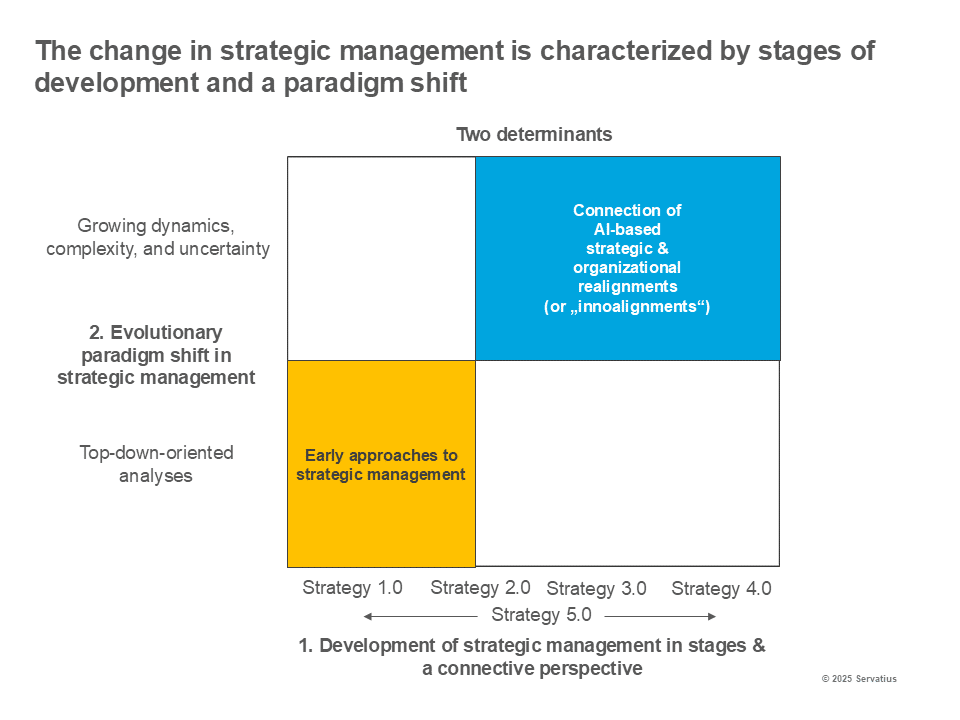
In summary, it can be said that the change in strategic management is characterized by the following two determinants:

  1. Development in stages with an increasingly important connective perspective, and
  2. an evolutionary paradigm shift.

Characteristic of the early approaches to strategic management according to the old paradigm are top-own-oriented analyses based on problem decomposition. These approaches determined the first stage of development and the beginning of the second stage. In contrast, the new paradigm focuses on growing dynamics, complexity, and uncertainty.

Lernprozess Innovationsstrategie

If one is looking for a term to describe current strategic management, the neologism „innoalignment“ comes to mind. By this we mean the connection of AI-based strategic and organizational realignments. The strategic realignments are aimed at making companies more resilient, digital, and sustainable.18 In organizational realignments, AI-supported performance management measures the success of leaner structures, networked processes and projects, and an innovative AI platform architecture.19 There are still few examples of such innoalignment. This makes it all the more important for application-oriented research and teaching to focus more on this topic. The further development of management didactics plays a central role in this.


Key players in management didactics

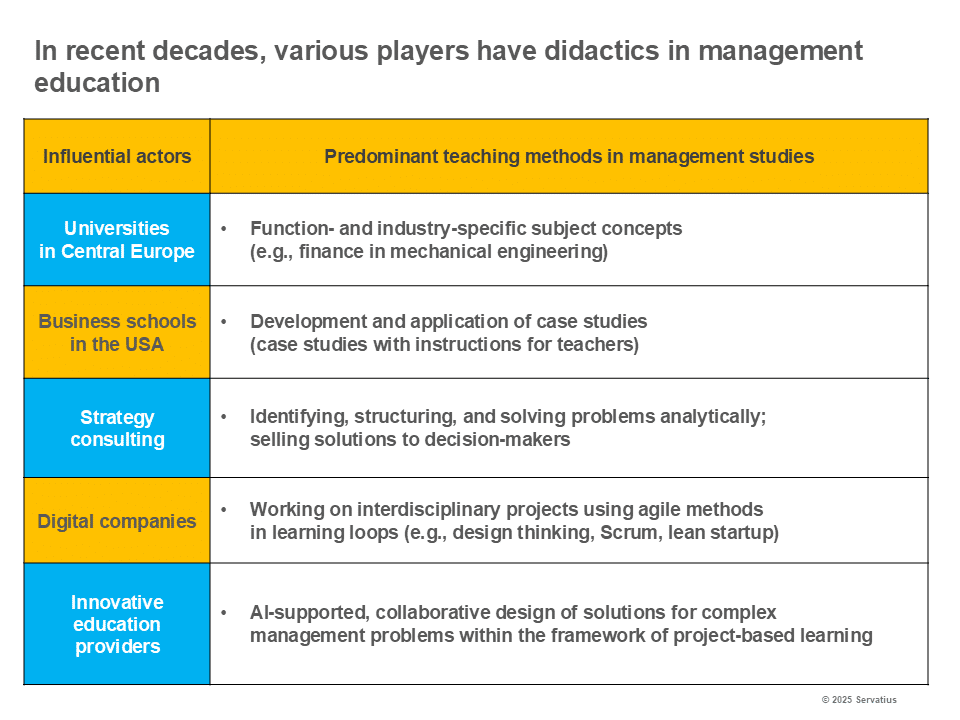
In recent decades, various players have shaped didactics in management education. Their approaches have specific advantages and disadvantages. In view of new challenges, innovative education providers are currently developing didactic concepts that focus on AI-supported solutions to complex management problems. 20

Lernprozess Innovationsstrategie

The prevailing management didactics at universities in Central Europe have long been function- and industry-specific subject concepts. The focus of business administration functional teaching (e.g., finance) and technical industry teaching (e.g., mechanical engineering) is on training specialists who work in hierarchies with clearly defined organizational units. This approach encourages the emergence of interface problems that are difficult for companies to overcome due to a rigid culture.

In the USA, Harvard Business School transferred the case study method from legal education to management education in 1920. The basic idea is that lecturers condense interesting practical examples into case studies, which form the focus of teaching. The promise of benefit here is to learn from actors who have attempted to solve a specific problem. This didactic approach differs fundamentally from subject-based learning. One disadvantage of the case study method is that the rapid transfer of a known solution often does not do justice to the complexity of new tasks.

The major strategy consultancies, which are influenced by the teaching methods used at business schools, have supplemented the case study approach with a specific form of further training for their consultants. This on-the-job training focuses on teaching the ability to identify problems, structure them, and solve them analytically. The final step is to sell the solutions by having experienced consultants convince decision-makers. A common criticism of this classic approach by consultants is that they leave their clients to implement the solutions on their own. This is where performance management, which emerged in the 1980s, comes in with the formulation of objectives and key results.

Successful digital companies and their venture capitalists rely less on external consultants and more often work on interdisciplinary projects themselves using agile methods such as design thinking or Scrum. In this iterative approach, the actors apply the concept of learning loops, which is well known in organizational development. The lean startup method is also based on this approach.

Since all of these approaches have specific strengths and weaknesses, innovative education providers build on what is already known and develop it further. The result is project-based learning that focuses on AI-supported, collaborative design of solutions for complex management problems.21 Such action-oriented learning can begin with simple problems and then move on to individual learning steps addressing current challenges for which there are no known solutions yet. The new education providers have recognized that this approach is best mastered by a heterogeneous teaching staff in which academics work together with practitioners who have different backgrounds and experience. An interesting question is how organizations can promote the further development of a dynamic self-image. The role model function of leadership plays an important role here.

This change in strategic management, combined with innovative didactics, opens up an opportunity for Europe that the „old continent“ should seize.


Change as an opportunity for Europe

Strategic management started as an import from the US, with its first stage of development spreading across Europe since the 1970s. Europe has been overtaken in many areas by the waves of digitalization, which have mainly originated from US companies. At the same time, changing geopolitical conditions are increasing Europe’s dependence on the US and China. It therefore seems high time for Europe to refocus on its strengths. Politicians have begun to rethink their approach, placing greater emphasis on competitiveness once again. One opportunity of global significance is the combination of digitalization and sustainability (digital green tech), where Europe should strive to take a leading role.22 The basis for this is an improvement in education systems.

The outlined change in strategic management creates a framework for joint programs between politics, science, business, and society in specific growth areas, such as the realignment of power grids with AI.23 This depends on the ability to design solutions for complex management problems. Overall, this change represents an opportunity for Europe if it succeeds in becoming more resilient in crisis management through a joint effort.

Advanced didactics in management play a central role in this. These methods must also address the question of what causes the basic patterns of error that Germany has made in the past, for example in digitization and the energy transition. An important insight is that such basic patterns of error are the fragmented interests of individual actors or groups. The theory and practice of connective design can help to overcome this basic pattern of error.


Conclusion

  • The development of strategic management has proceeded in stages, with the importance of a connective perspective increasing
  • Parallel to this, there has been an evolutionary paradigm shift with a change in a number of factors
  • These two determinants shape innostrategizing, which combines AI-based strategic and organizational realignments
  • To this end, innovative education providers are further developing management didactics
  • Europe should see this increasingly apparent change as an opportunity.


Literature

[1] Bomke, L., Müller, A., Telser, F., AI displaces career starters. In: Handelsblatt, August 12, 2025, pp. 16-17

[2] Westkämper, A., On the board thanks to an MBA – that’s what matters. In: Handelsblatt, July 18/19/20, 2025, pp. 54-55

[3] Servatius, H.G., Strategy 5.0 for overcoming new challenges. In: Competivation Blog, June 28, 2022

[4] Servatius, H.G., Evolution of strategic management. In: Competivation Blog, June 28, 2024

[5] Servatius, H.G., Sustainability-oriented strategic management. In: Competivation Blog, August 15, 2024

[6] Servatius, H.G., Resilience-oriented strategic management. In: Competivation Blog, March 15, 2024

[7] Servatius, H.G., Strategic leadership with contextual and relationship-oriented intelligence. In: Competivation Blog, March 14, 2023

[8] Simon, H.A., The sciences of the artificial, 3rd edition, MIT Press 1996

[9] Kuhn, T.S., The structure of scientific revolutions, Suhrkamp 1996

[10] Toulmin, S.E., Critique of collective reason, Suhrkamp 1983

[11] Servatius, H.G., Learning from successful digital companies. In: Competivation Blog, July 12, 2024

[12] Mintzberg, H., Ahlstrand, B., Lampel, J., Strategy safari: A journey through the wilderness of strategic management, Carl Ueberreuter 1999

[13] Dweck, C., Self-image – How our thinking causes success or failure, 7th edition, Piper 2017

[14] Servatius, H.G., AI as a tool for strategic management. In: Competivation Blog, May 1, 2025

[15] Servatius, H.G., GenAI-based strategic learning loops as a connecting process pattern. In: Competivation Blog, November 1, 2024

[16] Servatius, H.G., Fractal organization of strategy 5.0 labs. In: Competivation Blog, March 28, 2023

[17] Riecke, T., The struggle for a new world order. In: Handelsblatt, August 8/9/10, 2025, pp. 24-25

[18] Servatius, H.G., Triple strategic realignment. In: Competivation Blog, June 7, 2024

[19] Servatius, H.G., Process-oriented AI for increased productivity. In: Competivation Blog, March 12, 2025

[20] Servatius, H.G., AI and the future of management education. In: Competivation Blog, April 9, 2024

[21] Servatius, H.G., Learning to design solutions for complex management Problems. In: Competivation Blog, July 15, 2025

[22] Servatius, H.G., Achieving success in digital greentech with a Strategy 5.0. In: Fesidis, B., Röß, S.A. Rummel, S. (Eds.), (Towards a Climate-Neutral Company through Digitalization and Sustainability), SpringerGabler 2023, pp. 72-94

[23] Stratmann, K., Build less, digitize more. In: Handelsblatt, August 12, 2025, pp. 20-21


Interessiert?

CONNECTIVE MANAGEMENT

Vereinbaren Sie einen unverbindlichen Gesprächstermin:


    +49 (0)211 454 3731