

knowledge society | Competivation
How AI is changing management consulting

How AI is changing management consulting

For decades, the global success of management consulting has been based on identifying new challenges early on and developing solutions that are both theoretically sound and practical. Artificial intelligence (AI) is one such challenge that is also fundamentally changing the consulting industry itself. Starting with an explanation of this evolution, I explore the implications it has for management theory and research.

In this new article, I examine the impact of artificial intelligence on the evolution of management consulting. At the same time, universities and business schools are facing a profound change, which our network of experts has investigated.


Management consulting as a career accelerator

For a long time, working at one of the leading consulting firms was considered an important step toward an accelerated career in management. In particular, the major strategy firms hired candidates with strong analytical and communication skills who were able to contribute to solving complex problems and support their implementation. A consulting career typically began with several busy years of research and preparing presentations, which were critically evaluated by project managers. Through this learning process, young consultants developed skills that universities had not taught them.1 Today, AI models handle a significant portion of this work, operating at breathtaking speed, at comparatively low cost, and with surprisingly good results. The world of consulting has changed.


Key factors and consequences of the evolution of traditional management consulting

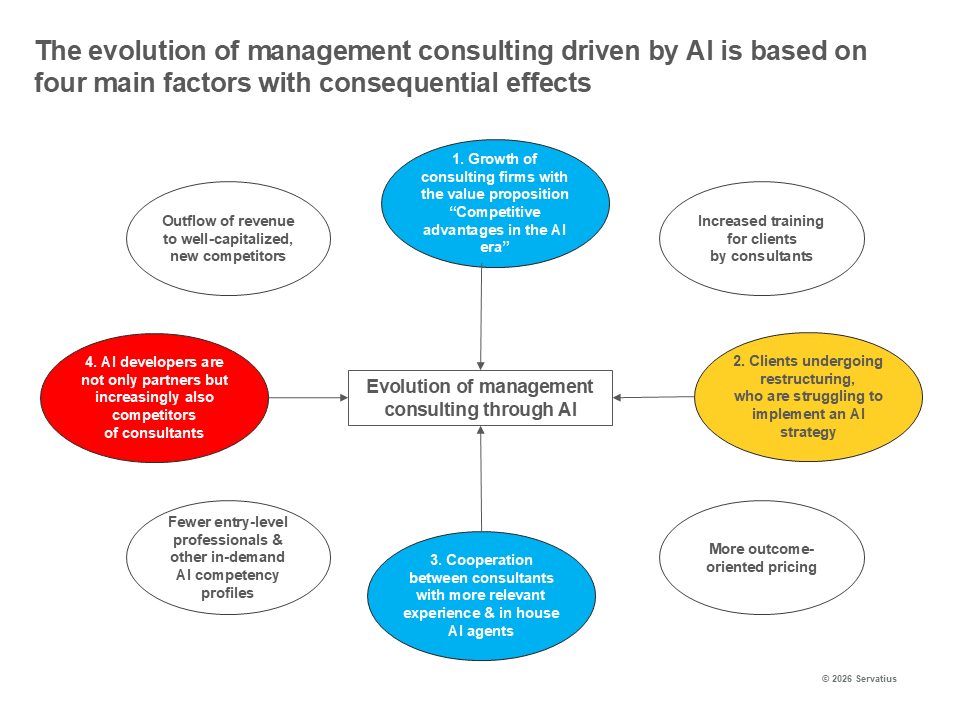
Traditional management consulting is currently undergoing what is arguably the most significant evolution of the past decades. The catalyst for this change is artificial intelligence.2 An examination of the causes points to the following four key factors:

  1. Potential growth for consulting firms offering clients the value proposition of “competitive advantages in the AI era”
  2. Clients undergoing restructuring processes who are struggling to successfully implement an AI strategy
  3. Cooperation between consultants with more relevant experience and in-house AI agents, as well as
  4. AI developers who are not only partners of the consulting firms but are increasingly becoming their competitors as well.

These key factors lead to further consequential effects.
Lernprozess Innovationsstrategie

The value proposition for clients and their internal challenges create a need for consultants to provide clients with more training. For example, in 2024, Accenture acquired Udacity, a provider of Massive Open Online Courses (MOOCs), and realigned its business model more toward B2B.

Since billing by the hour is no longer appropriate when using in-house AI agents, pricing is becoming more outcome-oriented. However, it is not easy to determine who is ultimately responsible for unsatisfactory results and what the reasons for them are.

As routine tasks are increasingly taken over by AI for clients and consulting firms, both are faced with the question of whether they should hire fewer entry-level professionals. This is changing organizational structures and skill profiles. But the people with AI experience that firms are seeking are also finding interesting opportunities elsewhere.

In addition, major developers of AI models—who in recent years have gone from being partners of consulting firms to their competitors—are increasingly relying on Forward Deployed Engineering (FDE), a methodology developed at Palantir, when implementing AI strategies. This is resulting in a loss of revenue in the growing AI consulting segment to very well-capitalized new competitors who are seeking to create a lock-in effect among corporate clients.3

Compounding these factors is the fact that we are currently witnessing the transition to a new era of management.


Transition to a new era of management

Throughout the history of consulting, there have been several transitions to new or significantly altered management eras. For me personally, it was particularly formative to witness how the market- and finance-oriented strategic management of the early 1980s gave rise to a second stage of development that was more strongly focused on technological innovations.4

During these phases of transition, visionary researchers and consulting pioneers often outpace current management practices. This can lead to innovative consultants having difficulty conveying their ideas to clients for a time. As a result, these consultants are always on the lookout for thought leaders on the client side. Problems arise when there is a shortage of thought leaders and trailblazers in a given country.

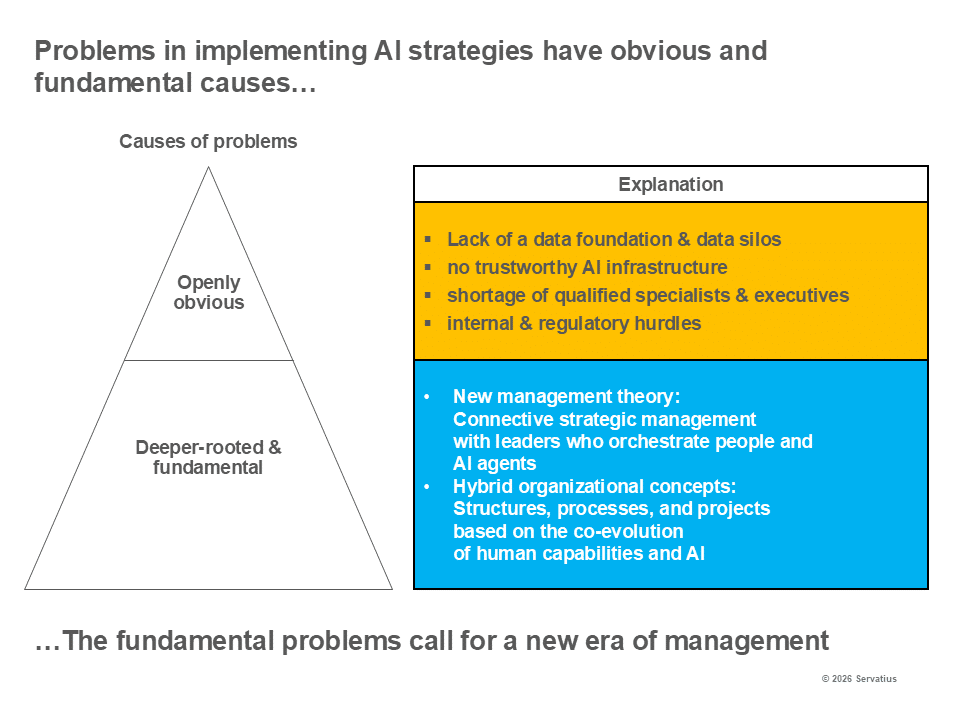
There are currently significant challenges in implementing AI strategies. In addition to obvious causes, these implementation difficulties are compounded by deeper-rooted and more fundamental issues. Many companies clearly face problems such as

  • a lack of a data foundation and data silos
  • no trustworthy AI infrastructure
  • a shortage of qualified specialists and executives, as well as
  • internal and regulatory hurdles.

As part of a further development of the management practices used to date, it should be possible to overcome these challenges. The situation is different when it comes to fundamental problems. Mastering them marks the transition to a new era of management.
Lernprozess Innovationsstrategie

Characteristics of this emerging next stage include a new management theory and hybrid organizational concepts.

As early as 1954 and 1969, Peter Drucker shaped an entire era with his groundbreaking publications on Management by Objectives (MbO) and the knowledge society.5 At the heart of a new theory lies connective strategic management (Strategy 5.0), with leaders who orchestrate both people and AI agents.6 In parallel, hybrid organizations are emerging with structures, processes, and projects based on the co-evolution of human capabilities and AI.

The necessary realignment toward a corresponding Management Education 5.0 for the AI era is a fundamental challenge that Germany must overcome.7 There is a strong tendency toward inertia here, and disruption in management education and training is, at best, only beginning to emerge.8


Changes in management theory and research on AI

Traditional business administration programs essentially teach the theoretical foundations for entry-level positions. This is due, among other things, to the fact that university professors are primarily academically qualified. When they are appointed, the focus is on publications in top-tier journals rather than on experience outside the academic world. Consequently, at prestigious consulting firms, it typically takes another three “years of apprenticeship” before a consultant with top grades and a Ph.D. is promoted to project manager. This raises the question of the implications for educational providers if, in management consulting and beyond—in the business world in general—not only are many entry-level positions being eliminated due to AI, but the required qualifications are also changing at all hierarchical levels.

For example, a study by the online platform Indeed shows that the number of entry-level positions has fallen by more than two-thirds between the boom year of 2022 and the fall of 2026. The decline was particularly sharp in marketing, at 75 percent.9 Alongside the economic downturn, AI is a major driver of this trend.

Both management consulting firms and their clients have a strong interest in recruiting candidates from universities who are better prepared for the AI era. There are at least three reasons for this:

  1. Newly hired consultants coming straight from college should be able to work on this new type of consulting project without extensive training
  2. Consulting firms, whose revenue depends more heavily on the success of cooperative project work, need clients with broad AI expertise—expertise they can only partially develop from external sources—and
  3. If AI developers and consultants use the “Forward Deployed Engineering” approach—originated at Palantir—when implementing their clients’ strategies, this results in a systematic outflow of knowledge from the client to the service provider, which weakens the client’s competitiveness in the medium term. This cannot be in the client’s best interest.

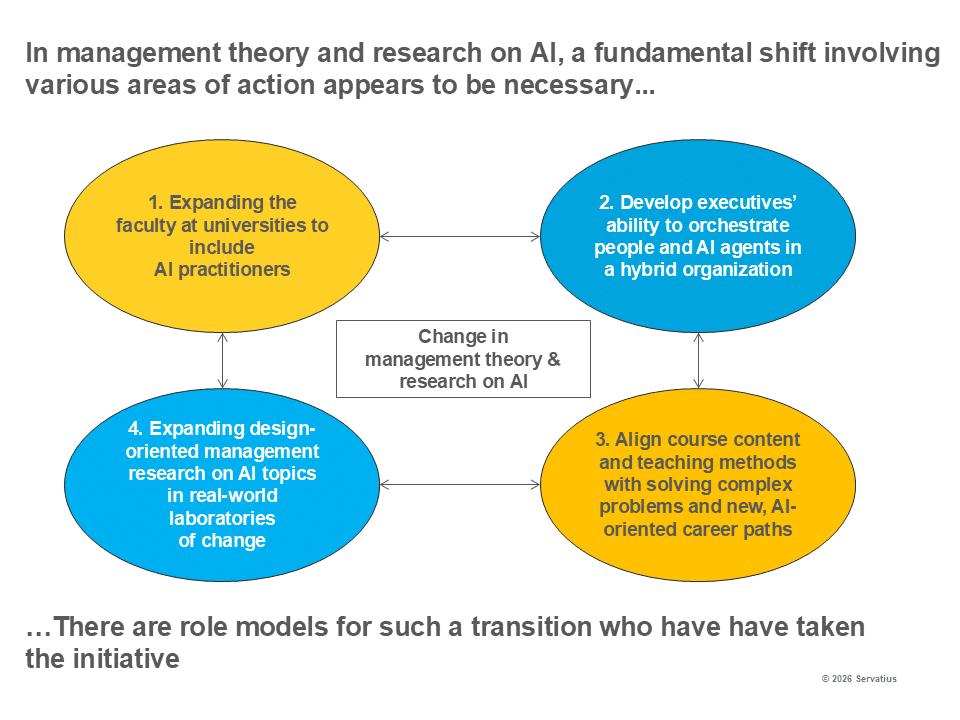
In management theory and research on AI, a fundamental shift therefore appears necessary, encompassing the following four areas of action:

  1. Expanding university faculty to include AI practitioners
  2. executive development aimed at orchestrating people and AI agents within a hybrid organization
  3. aligning course content and teaching methods with the solving of complex problems and new, AI-oriented career profiles
  4. expanding design-oriented management research on AI topics conducted in real-world laboratories of change.

There are role models both abroad and in Germany that have taken the initiative to drive such a transformation.
Lernprozess Innovationsstrategie

For decades, there has been a tension in management theory and research between scientific rigor and practical relevance. At U.S. business schools, a stronger scientific orientation began in the late 1950s with the help of quantitative empirical research. This approach was adopted by German universities. In the U.S., however, a pragmatic reorientation toward a “both-and” approach took place much earlier than in Germany, driven by market pressures. At high-cost elite universities, for example, renowned practitioners (Professors of Practice) complement the academic faculty. In the age of artificial intelligence, this mixed staffing structure is gaining importance worldwide.10 Anyone who invests a substantial sum in an MBA program wants that business school to prepare its students—both theoretically and practically—for a job market that is undergoing dramatic change due to AI. Universities in Germany are now also striving for such a realignment. Overall, however, there is a relatively strong tendency here to cling to the status quo.

The starting point for change is often executive development in general and company-specific (customized) Executive MBA programs. Today, aspiring executives must learn how to successfully orchestrate hybrid teams composed of people and AI agents. Interestingly, in a Financial Times ranking of customized executive development programs aimed at corporate realignment, European universities such as SDA Bocconi (Milan), London Business School, and IMD (Lausanne) occupy the top spots. U.S. business schools such as MIT, Stanford, and Wharton score highly for their expertise in AI technologies.

Furthermore, in many fields, it is crucial to improve the ability to solve complex problems and to develop skills for new job profiles. Only a few universities are prepared for this kind of reskilling. However, this is critical to Europe’s efforts to catch up in the field of AI. The necessary impetus for a corresponding realignment of course content and teaching methods comes primarily from innovative educational providers and foundations that draw on international best practices.11 The justified Gen Z demonstrations make it clear that the pressure is mounting. Today’s students should learn how to use AI to solve complex problems faster and more effectively. They can then demonstrate this ability in their theses by using AI as a sparring partner—for example, to refine research questions, examine a topic from different angles, and identify gaps. In the old world of consulting, this was one of the basic skills that “consulting trainees” learned. With AI, the whole process has become much simpler, and universities should teach this skill as early as the first semesters.

Another area of focus is design-oriented management research on AI topics. Experts are watching Germany with great interest and expect a stronger integration of engineering knowledge and industrial AI expertise with new management skills. German global market leaders and startups are demonstrating how such research works in real-world laboratories of change. To support this, an innovation policy that overcomes traditional silo thinking must create suitable framework conditions. At the University of Stuttgart, where I have been teaching strategy and organization since the 1980s, we have long been practicing this research approach within the framework of technically oriented business administration.12 Personally, I have always found teaching and research to be very enriching, alongside leadership positions in management consulting. However, it is time for Germany to better institutionalize this dual role.


Conclusion

  • Artificial intelligence is leading to a fundamental change of both the business model and organizational structure of management consulting firms, as well as the relevant competencies of consultants
  • This evolution is taking place as we transition into a new era of management, in which executives will, for the first time, orchestrate both people and AI agents. This requires new approaches to management education
  • For a number of reasons, both management consulting firms and their clients have a vested interest in universities better preparing students for the AI era
  • To achieve this, universities must make their education and research more practice-oriented and more design-oriented. In doing so, they must overcome forces of inertia.


References

[1] Kiechel, W., The Lords of Strategy – The Secret Intellectual History of the New Corporate World, Harvard Business Press 2010

[2] Duncan, D.S., Anderson, T., Saviano, J., AI is Changing the Structure of Consulting Firms. In: Harvard Business Review, September 10, 2025

[3] Servatius, H.G., Implementing AI Strategies with a Forward Deployed Engineering approach. In: Competivation Blog, October 29, 2026

[4] Servatius, H.G., Development and change in strategic management. In: Competivation Blog, September 19, 2025

[5] Drucker, P.F., The Practice of Management, Harper 1954, p. 121 ff.

Drucker, P.F., The Age of Discontinuity – Guidelines to Our Changing Society, Heinemann 1969, pp. 247 ff.

[6] Servatius, H.G., Connective strategic management in the age of AI. In: Competivation Blog, May 22, 2026

[7] Servatius, H.G., Management Education 5.0 for Dialog-based Action. In: Competivation Blog, January 13, 2024

[8] Servatius, H.G., Disruption of management education for AI-based realignments. In: Competivation Blog, October 10, 2025

[9] Indeed, Starting a Career Is Getting Harder—Two-Thirds Fewer Entry-Level Jobs Since 2022, but Apprenticeship Positions Are Holding Steady, September 23, 2026

[10] Servatius, H.G., AI and the future of management education. In: Competivation Blog, April 9, 2025

[11] Servatius, H.G., Generative AI and Mass-Customized Action Learning. In: Competivation Blog, August 28, 2023

[12] Servatius, H.G., Design-oriented innovation research on AI applications. In: Competivation Blog, March 25, 2026

Competitive advantages with knowledge-based AI

Competitive advantages with knowledge-based AI

In the past, there has probably never been a battle for competitive advantage that has been as dynamic as the current race in the field of artificial intelligence (AI). New opportunities are arising for Europe with knowledge-specific (domain-specific) AI. These opportunities build on the traditional strengths of the „old continent“. In order to catch up, it seems necessary to take a closer look at the topic of knowledge and its long history of development.

As part of our series on AI as a tool for strategies, this new blog post follows on from my explanation of strategic learning loops. First of all, it deals with the combination of knowledge management and AI technologies in the context of the fifth development stage of connective strategic management.


Battle for leadership in AI

The five companies with the highest market capitalization worldwide (as of December 2024) are Apple, Nvidia, Microsoft, Amazon and Alphabet. Artificial intelligence is an important value driver. Apple is worth 3.7 trillion euros. All 40 DAX companies together are only worth 1.9 trillion euros.1

At the end of January 2025, the Chinese start-up Deepseek surprised the global public with a new AI language model that is said to be able to compete with the best models from Western tech giants, but requires less computing power and costs less. The news triggered a slide in US technology stocks. In the meantime, share price losses amounted to one trillion US dollars. The company, founded by Liang Wenfeng in 2023, relies on open source, i.e. the software is freely available to others. It is also said to have been trained without high-tech chips. This raises the question of whether the billions invested by US companies are really necessary. Deepseek’s good price-performance ratio is probably the result of a combination of different approaches, e.g. the composition of many small expert models, of which only the relevant ones are activated.2 For European AI providers with less capital strength, this development may represent an opportunity.


Competitive advantages with AI from Europe

When it comes to artificial intelligence, Europe faces the task of catching up and reducing its dependence on large tech companies. It is also important to secure critical infrastructures and protect the intellectual property of organizations based here. This is particularly important for the many hidden champions and their outstanding expertise in specialist areas. After the hype and some disillusionment with large language models, new opportunities are now emerging for an AI strategy that builds on the strengths of the European economy. Knowledge-specific (domain-specific) artificial intelligence plays an important role in this , providing competitive advantages for many small and medium-sized companies. The Heidelberg-based start-up AlephAlpha has developed a new approach to this.

The advantage for companies is that they can design and operate language models with their own knowledge. Today’s models are based on the transformer architecture and a tokenizer that recognizes language patterns. For this purpose, large volumes of text are analyzed and broken down into individual components (text segmentation). AlephAlpha’s T-Free approach and its AI model Pharia work differently. T-Free stands for tokenizer-free and continuously processes groups of three adjacent characters. This makes it easier to adapt to other languages and terminologies. Together with the semiconductor manufacturer AMD and the Finnish start-up SiloAI, which was acquired by AMD, AlephAlpha has found a way to train industry- and company-specific terms („languages“) with significantly improved performance using T-Free. The approach also helps to increase AI sovereignty(3).

A consortium of companies, universities and supercomputing centers is currently developing an AI for Europe. Peter Sarlin from SiloAI sees the new Open Europe LLM project as a „moonshot“. Participants from Germany include AlephAlpha and the Fraunhofer Institute for Intelligent Analysis and Information Systems (IAIS). Both the code and the research will be published as open source. The European Commission is to provide up to 54 million euros over the next three years. In international comparison, this sum is relatively small. However, a European AI that becomes a public good will significantly increase sovereignty(4).

According to experts, Europe has the opportunity to gain a competitive edge in artificial intelligence if it succeeds in combining the following four success factors:5

  1. Improved cooperation between politics, science, business and society
  2. a focus on knowledge-specific AI applications
  3. pooling resources to overcome disadvantages of scale and
  4. the creation of trustworthy AI as a differentiating feature.

Such a combination requires connective strategic AI management. While French President Emmanuel Macron wants to invest 150 billion euros in European AI start-ups, the topic of artificial intelligence is unfortunately barely mentioned in the German parliamentary election campaign.

Lernprozess Innovationsstrategie

In the following, I would like to outline how knowledge management can be successfully combined with AI technologies.


Combining knowledge management with AI technologies

The collaboration between humans and AI works in a similar way to pole vaulting. The pole is a tool that enhances the jumper’s abilities if they master the tool.

The use of AI changes people’s knowledge work in the following three dimensions:

  1. Time savings through automation of routine activities
  2. Expanding skills in processing both data-intensive and unstructured tasks and
  3. individualized learning for the further development of human skills.

The potential of AI as a tool lies in the interaction of these dimensions.

Lernprozess Innovationsstrategie

With the combination of knowledge management and AI technologies, a new way of achieving competitive advantages is now emerging. The starting point is the activation of companies‘ specific knowledge and skills. Added to this is the use of the potential of AI to expand competencies and thus to differentiate themselves from the competition. The third and decisive point is the systematic improvement of skills that combine knowledge and AI. This requires targeted training and further education.

For Jeanette zu Fürstenberg, Head of Europe at the US investment company General Catalyst, the opportunities for the European economy lie in combining the big data and knowledge of established companies with AI technologies(6).

In the following, I would like to explain the connection between knowledge management and artificial intelligence and discuss the implications for strategic management in this and the next blog posts.

Lernprozess Innovationsstrategie

Knowledge for innovative business models has a long history of development from ancient Greece to today’s knowledge society. In the 1990s, the conviction prevailed that the creation of new knowledge is an important source of competitive advantage. However, this hype surrounding knowledge management was followed by disillusionment. At the same time, US start-ups succeeded in linking knowledge-based value creation and value enhancement with digital business models.

The development of AI technologies has progressed from symbolic AI and neural networks to generative AI (GenAI). In 2024, four AI researchers were awarded Nobel Prizes. But the hype surrounding large language models is turning into disillusionment. Small language models have a number of advantages. They are cheaper and easier to adapt to specific applications. Here, too, the question arises as to how the dangers of AI can be contained.

The combination of these two topics leads to the realization that knowledge-specific AI is an important process and design element in strategies. A distinction can be made between the corporate strategy level and the functional strategy level. AI is a new tool for supporting strategy processes and the collaboration of strategy teams. In addition, AI enables the design of innovative products, services and business models. At the functional level, AI makes important contributions to increasing the productivity of connected business processes. In addition, AI-supported, agile performance management leads to better complexity management than traditional approaches.

Since knowledge management forms a basis for the use of AI technologies, I would first like to outline the development of the topic of knowledge from ancient Greece to the knowledge society.


From ancient Greece to the knowledge society

In ancient Greece in the 3rd century BC, the philosopher Plato and his student Aristotle discussed the question of whether deductive or empirical theories of knowledge lead to the acquisition of knowledge.

At the beginning of the modern era, Rene Descartes (1596-1650) propagated a separation between the subject of knowledge and the object of knowledge. This so-called Cartesian division was to occupy science for a long time to come.

The German philosopher Immanuel Kant (1724-1804) attempted a synthesis. Logical thinking and experience work together.

Lernprozess Innovationsstrategie

At the beginning of the twentieth century, American pragmatism, with representatives such as William James, was concerned with the relationship between knowledge and action.

In 1969, Peter Drucker coined the concept of a knowledge society characterized by knowledge work and knowledge workers(7.

The work of Chris Argyris and Donald Schön on single loop and double loop learning,8 which formed the basis for the concept of a learning organization, has been of great practical relevance since the late 1970s.

Surprisingly, the topic of knowledge did not play a decisive role in the resource-oriented view of strategic management that emerged in the early 1990s.

From today’s perspective, we define knowledge as a resource and the result of learning processes that people create in exchange with teams, organizations and artificial intelligence.


Creation of new knowledge as a source of competitive advantage

The concept of implicit or tacit knowledge, which the natural scientist and philosopher Michael Polanyi coined back in the 1950s, is important for the creation of new knowledge.9 In the case of tacit knowledge, someone knows how to do something, but their knowledge is implicit in their skills. It is difficult to document verbally or in writing in the form of explicit knowledge.

In the mid-1990s, Japanese scientists Nonaka and Takeuchi described how new knowledge as a source of competitive advantage arises from the following four forms of knowledge exchange:(10

  1. From implicit to implicit (socialization)
  2. from implicit to explicit (externalization)
  3. from explicit to explicit (combination) and
  4. from explicit to implicit (internalization).

These forms of knowledge exchange are crucial to the success of hidden champions. The combination of knowledge, skills and action has a long tradition there. The creation of new knowledge, the development of skills and their implementation in practical action often take place in learning processes in which – similar to sport – demonstration and imitation play an important role. These learning processes can be documented and scaled using videos, for example.

Lernprozess Innovationsstrategie

This provides new impulses for the application of knowledge-specific artificial intelligence


Hype and disillusionment in knowledge management

In the second half of the 1990s, knowledge management experienced a hype phase, which was followed by disillusionment. The hype was mainly triggered by the book The Knowledge Creating Company by Nonaka and Takeuchi, which deals with knowledge management in Japanese companies.

Ultimately, however, the importance of tacit knowledge has not really been understood „in the West“. The focus of companies and consultants has been on extracting and synthesizing existing explicit knowledge („if HP knew what HP knows…“). This proved to be difficult and costly and contributed to disillusionment in the 2000s.

A pragmatic approach that linked knowledge, skills and action did not play a major role in the publications of the time.


Knowledge-based value creation, value enhancement and AI-based business models

Knowledge-based value creation, value enhancement and the connection with digital business models are the subject of our book WissensWert (KnowledgeValue), published in 2001.11 Work on this began in the mid-1990s, inspired by the increasing importance of knowledge management. It followed on from the „reengineering wave“ and IT-based innovations in routine processes. Our initial hypothesis was that knowledge-based value creation and value enhancement with knowledge open up new opportunities for achieving competitive advantages.

At the same time, new digital business models have emerged with internet technologies, initially in online retail (electronic business). Following the collapse of the new economy, start-ups such as Amazon, Google and Facebook have achieved leading market positions and have become the most valuable companies in the world.

Europe has become heavily dependent on digital business models. Looking back, it is astonishing how little people here have noticed that business model innovations based on AI applications have emerged since the turn of the millennium.

In the early 2000s, then Princeton computer science professor Fei-Fei Li began building the largest database in AI research (Computervision, later ImageNet). One user was the online bookseller Amazon. Founded in 1994, the company is regarded as the inventor of AI-based personal product recommendations.12 Since 2003, Amazon has been using the item-to-item collaborative filtering method for this purpose.

Another AI user was Facebook with a social network that uses machine learning to bring people together („matching“) who have things in common. Machine learning models sort personalized advertising according to the highest probability of success, thus establishing innovative business models such as Google’s search engine and its RankBrain algorithm. Spotify’s music streaming business model, Netflix’s video streaming and the short video platform of the Chinese Bytedance subsidiary TikTok are also based on the AI-based principle of personal recommendations.

This means that many people have been in daily contact with AI applications since the turn of the millennium without realizing it. Europe is currently facing the challenge of making better use of the new opportunities offered by AI than in the past.


Conclusion

  • In view of the extreme competitive dynamics in artificial intelligence, Europe must catch up and reduce its dependency
  • One way to do this is to combine company-specific knowledge with innovative AI technologies such as the tokenizer-free approach
  • The success of today’s tech giants since the turn of the millennium is based on the creative application of
  • Knowledge-specific artificial intelligence could build on and continue the success story of the European hidden champions.


Literature

[1] Sommer U., USA dominates like never before. In: Handelsblatt, December 27/28/29, 2024, p.1, 6-8

[2] Gusbeth, S. et al, Sputnik moment. In: Handelsblatt, January 31, February 1-2, 2025, pp. 50-55

[3] Holzki, L., Up to 400 percent more efficient. In: Handelsblatt, January 22, 2025, p. 23

[4] Holzki, L., 54 million for a European AI. In: Handelsblatt, February 4, 2025, p. 18-19

[5] Bomke, L., Knees, L., Wo Europa Chnacen im KI-Rennen hat. In: Handelsblatt, February 10, 2025, p. 20-21

[6] zu Fürstenberg, J., „We need much more capital that also takes risks“ (Interview), In: Handelsblatt, January 31, February 1-2, 2025, pp. 32-33

[7] Drucker, P.F., The Age of Disconinuity – Guidelines to our Changing Society Butterworth-Heinemann 1969

[8] Argyris, L., Schön, D.A., Organizational Learning – A Theory of Action Perspective, Addison Wesley 1978

[9] Polanyi, M., Implicit Knowledge, Suhrkamp 1985

[10] Nonaka, I., Takeuchi, H., The Knowledge-Creating Company – How Japanese Companies Create the Dynamics of Innovation, Oxford University Press 1995

[11] Palass, B., Servatius, H.G., WissensWert – Mit Knowledge Management erfolgreich im E-Business, Schäffer-Poeschel 2001

[12] Meckel, M., Steinacker, L., Alles überall auf einmal – Wie Künstliche Intelligenz unsere Welt verändert und was wir dabei gewinnen können, Rowohlt 2024

Interessiert?

CONNECTIVE MANAGEMENT

Vereinbaren Sie einen unverbindlichen Gesprächstermin:


    +49 (0)211 454 3731