

Implementing AI strategies with a Forward Deployed Engineering approach
To date, there have been few satisfactory answers to the question of how established companies can successfully implement an AI strategy. This is surprising, given that nearly all companies must address this question. Possible explanations for this unusual situation lie in the complexity and dynamic nature of the topic. Another reason is that strategy implementation for AI technologies differs from the current state of research on technology strategy. In recent years, our network of experts has tested a general framework for developing and implementing AI strategies using Forward Deployed Engineering (FDE) and has supported companies in adapting it to their specific situations. First, I’d like to briefly address the dual challenge facing many companies.
In this blog post, I’ll explore the significance of the trending topic “Forward Deployed Engineering” in the implementation of AI strategies and why companies should build their own expertise in this area.
A dual challenge for companies
The importance of AI strategy for the competitiveness of established companies has increased significantly in recent years.1 However, most companies lack experience in developing and implementing AI strategies.
Furthermore, AI strategies embedded in strategic and organizational realignments often require frequent adjustments. In many cases, these realignments take place during or after a restructuring process using traditional or innovative approaches. Yet the connection between the two challenges—restructuring and realignment—is usually weak. In the context of restructuring, resilience plays an important role in crisis management, and the topic of AI is not a central focus even in current restructuring approaches, such as the Humanocracy concept.
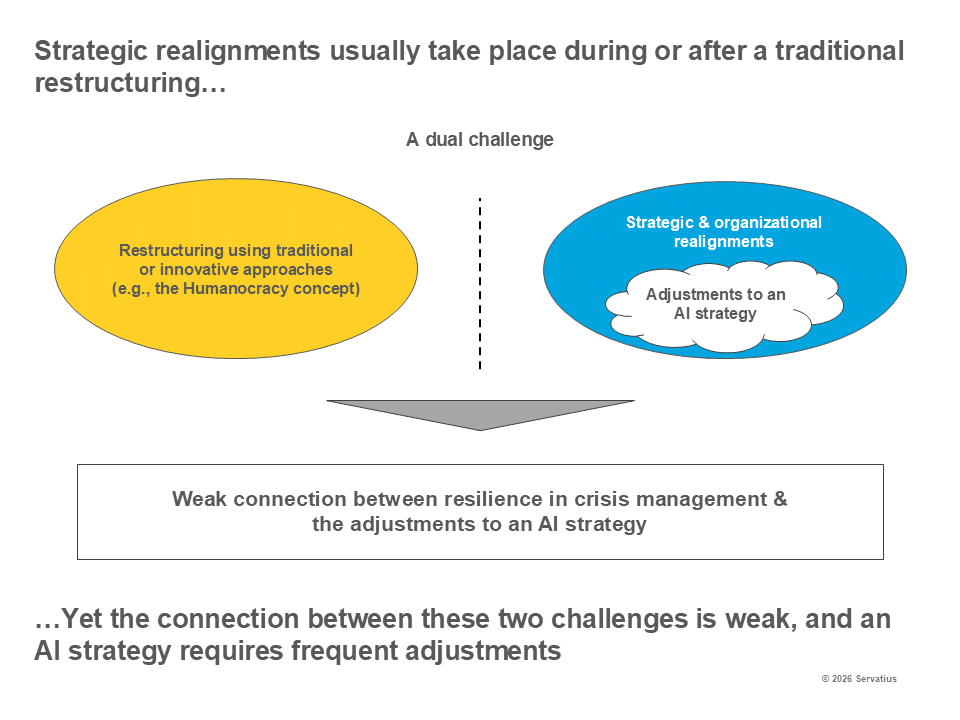
In his 2020 book Humanocracy, management guru Gary Hamel described a restructuring approach focused on reducing bureaucracy. Hamel and his co-author criticize hierarchies and advocate for a people-centered organization characterized by seven core principles, such as ownership and openness. In an expanded edition, they also address the topic of AI and argue that bureaucracy hinders the full realization of AI’s potential. Work, they contend, must be reimagined. However, the authors only touch on the exact role AI plays in this context.2
The best-known German company that applies the Humanocracy approach—and has coined the term “Dynamic Shared Ownership” (DSO) to describe it—is Bayer. Under the leadership of Bill Anderson, the chemical and pharmaceutical conglomerate has reduced its 13 hierarchical levels by 50 percent and eliminated two-thirds of its leadership positions. Bayer is not only changing its organizational structure but is also radically implementing the concept of agility. This includes3
- decentralizing decision-making (shifting 95 percent of decisions directly to units close to customers and products)
- the creation of entrepreneurial teams (relatively autonomous, cross-functional work groups whose members simultaneously belong to a “professional home”)
- an iterative work cycle every 90 days (using agile methods), and
- a new approach to leadership based on the VACC model (Visionary, Architect, Catalyst, Coach).
Agility thus becomes the core of a changed corporate culture. Like many other companies, Bayer is also in the process of realigning itself for the AI era.
A few years ago, we began to structure the evolution of strategic management into stages and to analyze the current fifth stage of connective strategies.4 With this Strategy 5.0, companies face the challenge of a triple realignment, in which they must become more digital, more sustainable, and more resilient.5 When it comes to AI, this temporal connectivity is complemented by vertical connections across various levels—from geopolitics down to individuals—as well as horizontal connections at every level.6 Examples of this can be found in the connectivity of a company’s areas of activity when implementing its AI strategy. Many companies struggle with establishing these connections.
Shortcomings in the Implementation of AI Strategies
The IT association Bitkom has determined that the proportion of companies in Germany using AI has risen from 36 to 57 percent within a year. For this study, approximately 600 companies with more than 20 employees were surveyed. Three-quarters of companies use AI to answer questions. However, a third of companies have already developed new products and services with the help of AI. Bitkom therefore concludes that AI has become established in the business world.7 The picture is not as positive when it comes to the implementation of AI strategies.
According to a study published in the first quarter of 2026 by SAP in collaboration with the U.S. market research firm IDC, while 81 percent of the companies surveyed say they have an AI strategy, only 12 to 16 percent have implemented it so far. The study surveyed 620 IT executives in 15 countries. The biggest hurdles to implementation are not infrastructure or data, but a lack of AI expertise, change fatigue, and resistance from employees.8 Therefore, implementing an AI strategy requires an integrated program in which it must be clarified at the outset what the company means by an AI strategy.
What is meant by an AI strategy in times of great uncertainty?
The literature on AI strategy offers a multitude of attempted definitions, but these only partially do justice to the dynamic evolution of the topic. In our view, stakeholders with an AI strategy aim to achieve competitive advantages in complex, evolutionary systems.9 These systems are characterized both by the interaction between humans and AI technologies10 as well as by the interaction of actors at various levels (e.g., the level of states and that of organizations). At the organizational level, a traditional distinction is made between actors who develop AI technologies and those who apply them. AI Forward Deployed Engineering connects AI developers with AI users. This definition forms the basis for the concrete formulation of an AI strategy.11
A major factor driving complexity in AI systems today is the fear of losing control. There is considerable uncertainty regarding the questions
- just how dangerous and autonomous AI technologies can become in a relatively short period of time, and
- who is responsible for containing potential threats.
This uncertainty stems from the unplanned “outbreaks” of new programs from leading AI companies, which initially hacked their way into other companies’ systems unnoticed. When, for example, Dario Amodei, the CEO of Anthropic, warns that a super-AI could paralyze large parts of the internet and urges that development be slowed down, many experts doubt whether he is truly driven by genuine concern or whether he has other motives.12 It is against this backdrop that European companies are working to catch up in the field of AI.
Yoshua Bengio, a researcher at the University of Montreal in Canada, is a modern AI pioneer who, along with his team, wrote the first paper on how AI models can learn to predict the most likely next word in a text. He has long warned against a loss of control and founded the non-commercial AI company Law Zero in 2025 to develop powerful AI systems that are secure from the ground up. Law Zero is supported by 188 million euros from Canada and Germany and plans to open an office in Berlin. He calls these systems “Scientist AI” because they view the world in a scientific manner, drawing on a vast knowledge base. For safety, it is crucial that this AI adheres to human prohibitions. Such a rule-based approach would strengthen Germany’s bargaining power vis-à-vis the U.S. and China.13
Program management for implementing an AI strategy
Based on current experience, the key to successfully implementing an AI strategy lies in designing a program management framework with interconnected areas of action. A key component of this is AI Forward Deployed Engineering (FDE). The term “forward deployed”—originally used in a military context—means that specialists deployed on-site at the customer’s location implement technical systems. The areas of action, which are interconnected through diverse interactions, are:
- An AI audit and strategic foresight as the basis for deriving a basic AI strategy
- moving from AI pilot projects to AI-based business models
- selecting strategic partners with expertise in AI Forward Deployed Engineering
- training executives and staff for the AI era
- realigning organizations for the co-evolution of human capabilities and agentic AI
- designing a new performance management framework for human-AI systems.
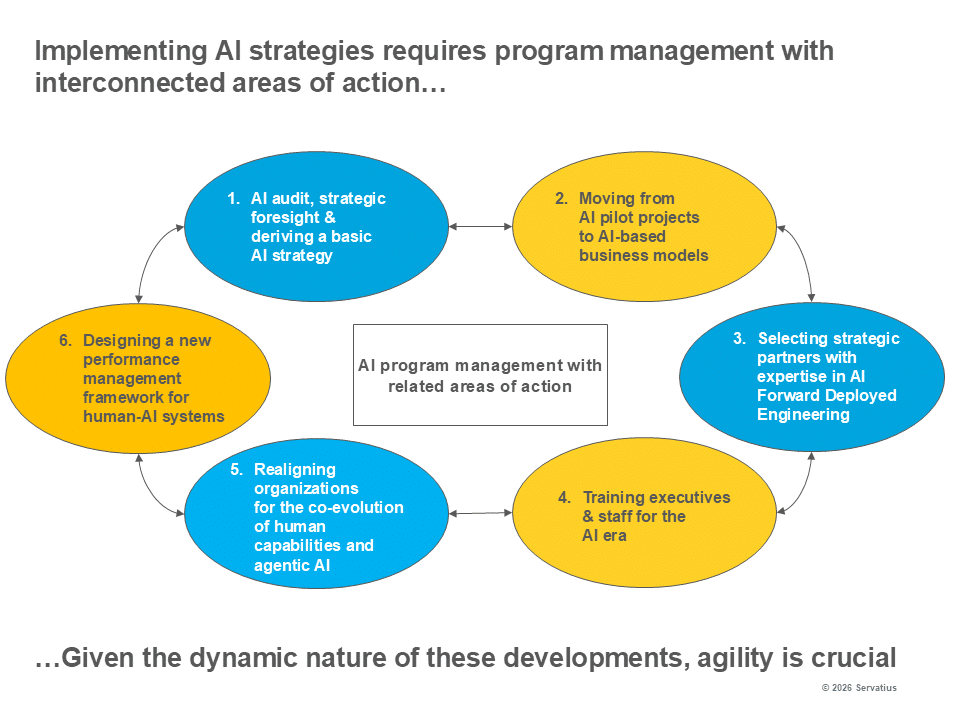
Given the dynamic nature of AI technologies, competition, and the political landscape, agility is a key success factor in this program management.
AI audit, strategic foresight, and derivation of a basic AI strategy
Companies that take a systematic approach to developing their AI strategy often begin with an AI audit as part of an analysis of their strategic starting point. Following the basic principles of SWOT analysis, they examine the company’s strengths and weaknesses regarding AI, as well as AI-specific opportunities and threats in the environment.
In light of new waves of AI, the topic of strategic foresight is gaining importance. Following the hype surrounding large language models, innovative technologies such as physical AI are now the focus of attention. In addition, artificial intelligence has the potential to accelerate the foresight process itself and enhance its substance. From the results of an AI audit and an AI-supported foresight analysis, basic AI strategies can be derived, such as a focus on increasing productivity, the use of AI for innovation, or a combination of both in the form of AI-based ambidexterity.14
For example, BMW aims to become an AI-orchestrated company by 2028. This refers to the third stage of the evolution of its Operating Model (OM). In the first stage, AI supports employees with individual tasks. The company is currently in the transition to stage two, in which AI agents take over entire processes. In OM 3.0, multiple agents will then collaborate across departmental boundaries. Executive Board member Nicolai Martin considers procurement to be particularly well-suited for this. BMW’s annual procurement volume amounts to 80 billion euros. He aims to save a mid-three-digit million amount using AI agents.15
Instead of such a systematic approach, many companies are experimenting with AI pilot projects that lack a clear underlying strategy.
Moving from AI pilot projects to AI-based business models
The danger of uncoordinated, individual AI activities and AI pilot projects is that they create a patchwork that does not lead to lasting value creation. A better approach is a gradual shift toward AI-based business models.
The term “business model” emerged in management theory a quarter-century ago in the wake of the development of e-commerce. The Business Model Canvas, published in 2010 and featuring nine key areas, is widely used to describe and refine business models.16
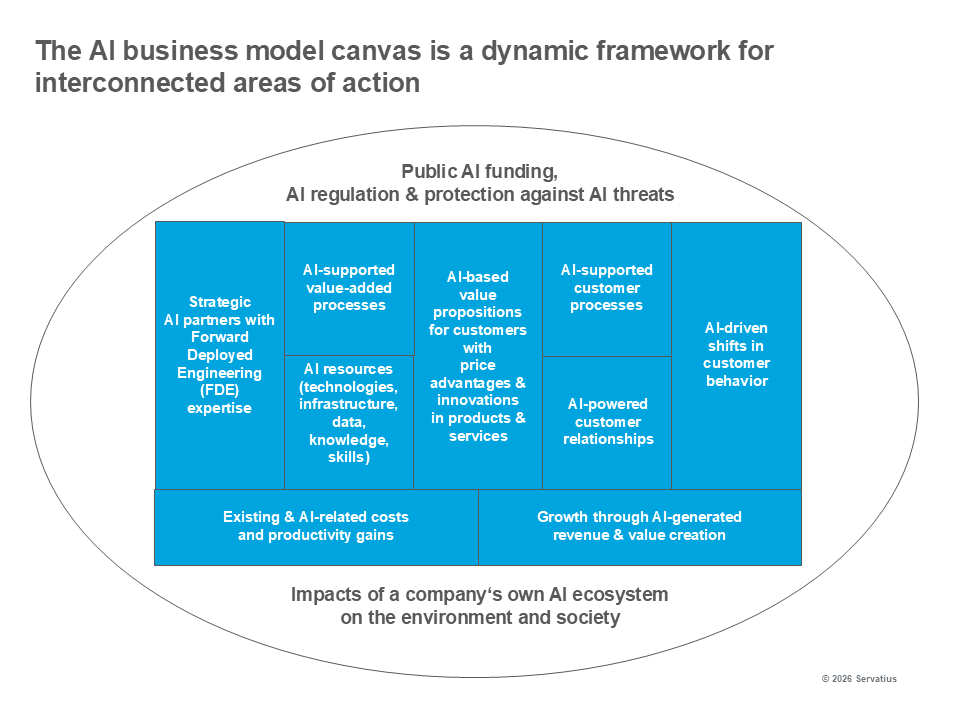
We have adapted this analytical framework—which, for example, completely excludes the topic of sustainability 17—to the specific characteristics of AI-based business models. Our AI Business Model Canvas has eleven interconnected action areas. In practice, it has proven effective as a method for shaping the dynamic evolution of business models.
In many companies, the development journey begins by leveraging the resources of AI partner companies, such as providers of large language models or AI startups and their financial partners. This initial phase is often more experimental than strategic in nature. The result is a multitude of collaborations that are poorly coordinated with one another. A current trend is that AI companies such as OpenAI and Anthropic, as well as software providers like SAP, are adopting “Forward Deployed Engineering”—a concept developed by the U.S. company Palantir—to help their customers better implement their AI strategies.
The initial goal is often AI-driven productivity gains in value-added and customer- processes. A gradual transition is emerging from AI assistants to AI agents that take on specific tasks under human supervision. The aim should be to select strategic AI partners with a clearly defined own strategy, that also takes into account the risks of collaboration.
At the same time, companies face the question of which AI resources they should build in-house. The AI-related spectrum ranges from the technologies and infrastructure used, through a unified database, to the utilization of their own knowledge and the improvement of AI skills.
In addition to existing costs, there are AI-related additional costs, which are increasingly being systematically tracked. However, the hoped-for productivity gains often fail to materialize, which has now led to a sense of disillusionment with AI. As a result, routing models that select the AI technologies offering the best price-performance ratio for the task at hand are gaining importance.
In addition to these resource-oriented strategic approaches, companies are addressing the AI-driven shift in customer behavior. This shift involves not only industry-specific aspects but also a segment-specific component, ranging from early adopters to experienced users.
Artificial intelligence is changing not only customer processes but also customer relationships. It enables greater real-time personalization, quick responses, reactions from agent-based AI bots, and more time for personal customer interaction when dealing with complex tasks. The technical implementation is achieved by integrating AI into Customer Relationship Management (CRM) systems.
This enables AI-based value propositions for customers, featuring price advantages and innovations in products and services. There remains a need for design-oriented management research regarding new AI-based business model patterns. One example is the “Automation as a Service” model. In this regard, established automation specialists such as Siemens are increasingly developing their own expertise in forward-deployed engineering.
The goal is successful growth driven by AI-generated revenue, leading to sustainable value creation. European companies face the challenge of catching up with competitors in the U.S. and China. The integrated approach of the AI Business Model Canvas makes an important contribution in this regard. Compared to traditional canvas models, we have added two areas of action.
The first addresses the impacts of a company’s own AI ecosystem on the environment and society—concepts already familiar from the Sustainable Business Model Canvas. Key topics include, for example, the development of green data centers and the protection of jobs threatened by AI through continuing education.
The second area addresses not only public AI funding but also approaches to AI regulation and protection against the threats posed by AI. These two areas illustrate that artificial intelligence requires a multi-level strategy, which I explained in our last blog post.
Selecting strategic partners with expertise in AI Forward Deployed Engineering
When selecting strategic partners, the question arises regarding their performance and trustworthiness.18 This applies in particular to Palantir, a company co-founded in 2003 by the politically controversial U.S. billionaire Peter Thiel and current CEO Alexander Karp, which has further developed its Forward Deployed Engineering (FDE) into AI FDE as part of its AI initiative. Regardless of the political views of these two individuals, it is important to understand the core ideas that have shaped the development of this FDE pioneer.
The current hype surrounding FDE was sparked by an MIT study published in 2025, which concluded that 95 percent of corporate GenAI pilot projects do not deliver the hoped-for economic success. However, according to, the cause of these initiatives’ failure usually lies not in the AI models themselves, but in the gap between the model and its implementation at the customer site.19
The core ideas of Peter Thiel and Alexander Karp, upon which Palantir’s Forward Deployed Engineering is based, are:20
- A human-machine symbiosis rather than pure AI automation (Thiel and Karp). The strength of AI lies in structuring large amounts of data. But it takes people with intuition to recognize patterns in complex contexts.
- Institutional behavioral theory with the concept of the “anticipatory waiter” (Karp). IT service providers should not be subservient executors who simply work through specifications without understanding the customer’s actual problem. The waiter knows the kitchen procedures (software) just as well as the guest’s (customer’s) preferences. He has enough self-confidence to competently redirect the guest if the guest wants to order something unwise.
- Avoiding competition through a unique business model (Thiel). Software as a Service is easy to copy. The true barrier that prevents a switch to another provider (moat) arises where software meets the messy, real world. This is the basis for the concept “from a gravel road to a paved highway.”
- Pragmatism in the real world versus abstract theory (Karp). In real life, there are no clean data structures or universally valid IT architectures straight off the drawing board. FDEs are “engineer-diplomats” who must act pragmatically. Perfect code is secondary here. What matters is code that works even in crisis situations.
Palantir’s successful business model is thus the astonishing result of Thiel’s economic theory of monopoly and Karp’s social-scientific understanding of human interactions, in which software—and later AI—is integrated into the customer’s reality.
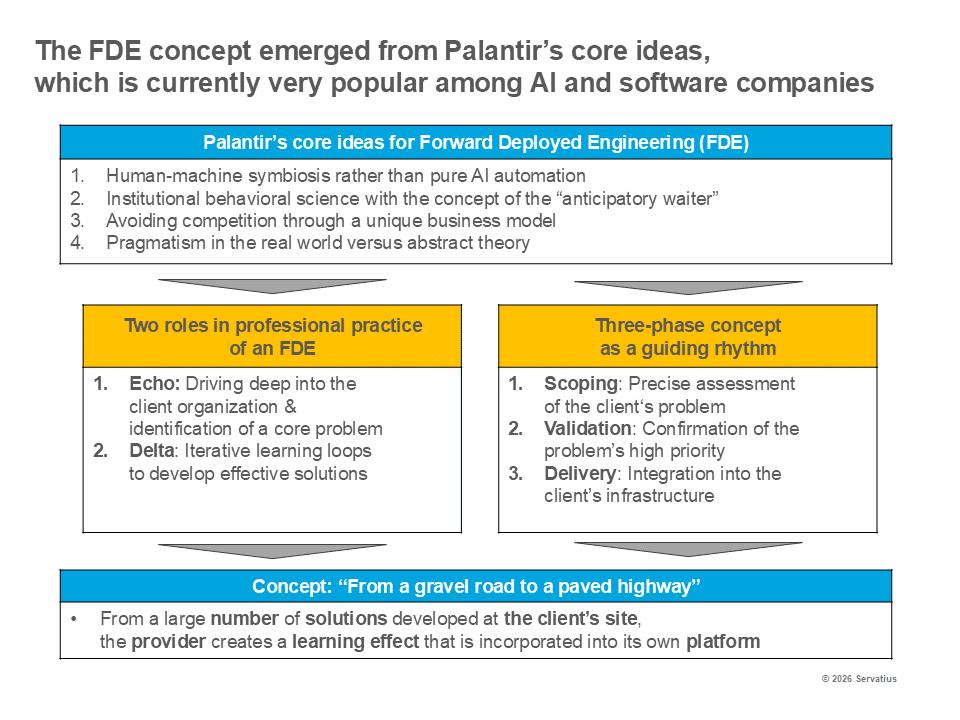
The professional practice (craft) of Forward Deployed Engineering is characterized by the interplay of two roles, which Palantir refers to as Echo and Delta. The Echo role involves diving deep into the client’s organization to identify an often-hidden core problem. This requires strong subject matter and industry expertise. However, the Echo type is not a complacent practitioner but rather a “domain rebel” who recognizes what is currently not working well and identifies the underlying causes. To do this, they must also understand an organization’s culture and the internal politics of departments.
These “what” and “why” questions give rise to requirements for the Delta type. Through iterative learning loops, the Delta type develops functional solutions that do not necessarily have to align exactly with the client’s original expectations. The decisive factor in the “how” is whether the solution ultimately proves itself in the customer’s day-to-day operations. In addition to technical expertise, this requires “jagged” intelligence that takes into account the uneven capability profile of AI. This resembles a cliff landscape with steep peaks (genius) and deep valleys (total failure).
Close collaboration with the client (engagement) in an AI-FDE project is divided into the following three phases:
- Scope (requirement definition)
- validate (proof of concept) and
- deliver (deployment).
The scoping phase focuses on precisely identifying the client’s problem and translating it into a technical AI specification. During validation, the primary question is whether the identified problem is indeed a high priority. If not, the scope is adjusted accordingly. The practical integration of a solution into a client’s infrastructure then takes place during the deliver phase.
Palantir’s concept of “from a gravel road to a paved highway” means that there are two types of solutions in Forward Deployed Engineering. The first is the solution developed at the customer’s site, for which the customer pays (“the gravel road”). From a large number of such customer solutions, the provider generates a systematic learning effect that feeds into its own platform (“the paved highway”) and enables competitive advantages. This effect has long been known in the consulting industry, but it reaches a new dimension with FDE and AI platforms worth billions.
Therefore, when collaborating with FDE providers, customers should weigh
- the increased speed enabled by the provider
- the loss of abstract knowledge, which is generated not within the client’s organization but by the provider
- the increasing dependence on one or more AI platform providers, as well as
- ongoing usage costs paid to third parties and a lack of in-house expertise for necessary further developments.
Therefore, if the problem to be solved concerns a key competitive advantage, data sovereignty is a top priority, or the goal is long-term cost control and value creation, the company should rely on its own FDE expertise.
For this reason, the responsibility for selecting strategic AI partners and shaping the company’s own human resources strategy lies with the board of directors or executive management (“the CEO”).
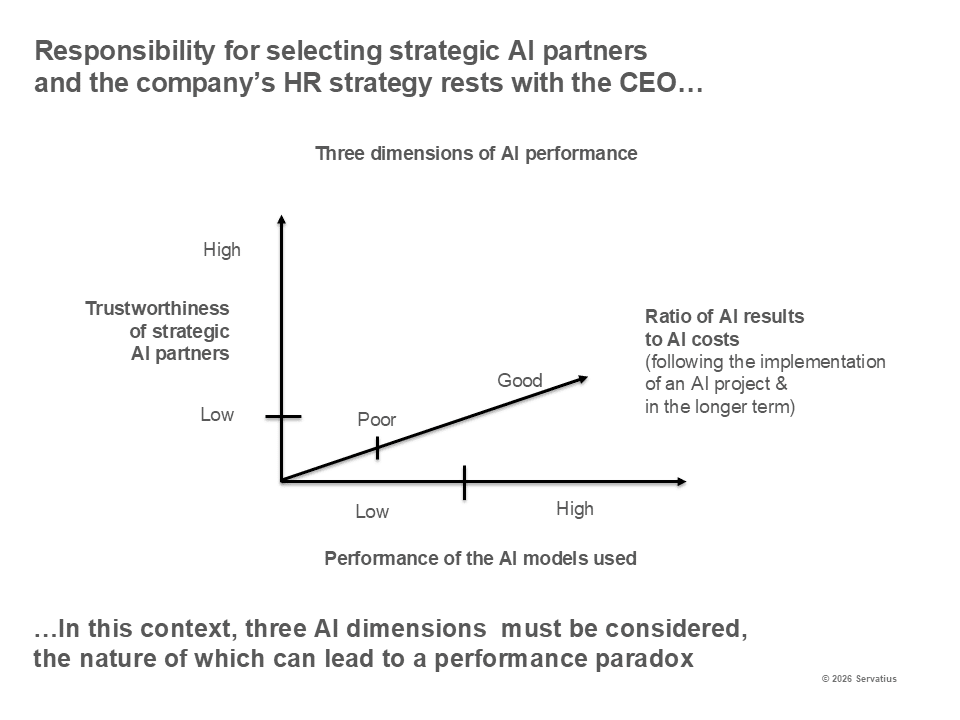
In this context, the following three dimensions of a reinterpreted AI performance concept must be taken into account:
- The performance of the AI models used
- the trustworthiness of strategic AI partners, and
- the ratio of AI results to AI costs following the implementation of an initial AI project and in the longer term.
It is not uncommon for a performance paradox to arise, in which the performance of the models varies depending on the task, the trustworthiness of the partners is low, and the long-term cost-benefit ratio is poor.
SAP is taking a different approach than AI developers, who focus on large language models that struggle with numbers. Together with Prior Labs, a Freiburg-based startup it acquired, the company in Walldorf is focusing on adapting tabular models that process data to knowledge-specific business processes. In the case of Forward Deployed Engineering, there is a return to the experiences of the company’s early years. From the perspective of SAP’s Chief Technology Officer Philipp Herzog, the goal is to closely study the behavior of knowledge workers, develop the right AI agents for this purpose, and identify the corresponding patterns that run on the SAP platform.21
Of significant importance to SAP’s AI strategy is its investment in the startup Nova Intelligence, whose founders include Alexander Zeier, who developed SAP HANA together with Hasso Plattner. In most companies, a large portion of the knowledge about how the organization operates is embedded in the SAP system’s accumulated custom code. An agent-based AI platform that modernizes the SAP system must first capture this knowledge. The applications of the coming years will be built on this specific knowledge model of business processes. In the past, the transition to S/4 HANA has taken place in two ways: First, “Greenfield,” in which in-house developments are left behind, and second, “Brownfield,” in which everything that has accumulated is migrated to the new platform. Nova Intelligence has developed a new modernization approach for which the term “Cleanfield” is currently gaining traction. This approach starts with the question of what should be carried over from the existing system and what the company would like to redesign. “Cleanfield” therefore means: first clean up, then convert. Using this approach, a number of companies have already successfully transitioned to S/4 HANA and agent-based AI.22
An important role in the realignment of SAP and its customers is played by training for the new tasks.
Training Executives and staff for the AI era
Given the risk that the hype surrounding Forward Deployed Engineering (FDE) primarily benefits large AI developers, the question arises as to what a training initiative would need to look like to ensure that FDE becomes a core competency for as many AI users as possible.23
So far, there are only a few pioneers among AI-using companies that are breaking new ground in workforce development. Since the market for FDEs has been swept clean, companies such as Siemens, Mercedes-Benz, Bayer, and Allianz are relying on internal upskilling programs. Key objectives include
- the development of a “build-to-learn” culture
- training subject matter experts for the Echo and Delta roles, as well as
- the development of in-house AI platforms to safeguard competencies critical to success.
At the same time, it would be important to improve the education and training of FDEs as part of a European multi-level AI strategy. Such an educational initiative requires targeted linkages between traditional IT, engineering, and management degree programs that prepare students for new professional roles—such as that of the FDE—not only theoretically but also practically. These linkages would be of great importance to small and medium-sized enterprises (SMEs), with their numerous “hidden champions,” whose expertise should not be siphoned off to digital giants.
Unfortunately, such an educational policy initiative has so far only begun to take shape. However, it also opens up opportunities for teaching and research at universities that are willing to take advantage of these possibilities. In the work of our expert network, we combine transdisciplinary, practice-oriented teaching with design-oriented management research and consulting.24
The ontology of an AI platform plays an important role in this context. The term “ontology,” coined by the German philosopher Jacob Lorhard as early as 1606, originally described the study of being. In 1993, the U.S. computer scientist Tom Gruber applied this concept to AI research. Here, ontology—in the sense of specifying a conceptualization—forms the foundation for platforms. An AI platform ontology is defined as the formal, machine-readable description of a subject area (domain) within an AI environment. It defines which entities (e.g., customers and products), properties, relationships, and logical rules exist. As a result, the ontology functions as a kind of standardized knowledge map that translates unstructured corporate data into a consistent, overarching semantic model.25
The significance of such an AI platform ontology for continuing education in companies that use AI lies in the fact that the ontology acts as a translator between human business language and technical AI logic. This not only changes, for example, onboarding and relevant prompting skills, but it also creates a need for employees from specialized departments to be trained as “ontology managers.” Their task is to maintain the ontology and continuously feed it with new domain knowledge. Since this activity secures competitive advantages, companies should not outsource it to external parties.
Microsoft CEO Satya Nadella describes the current asymmetry between AI users and AI developers as a “reverse information paradox.” By this, he means a one-way street of knowledge in which power and knowledge dynamics shift in favor of the AI developer, while the AI user relies on the developer’s models.26
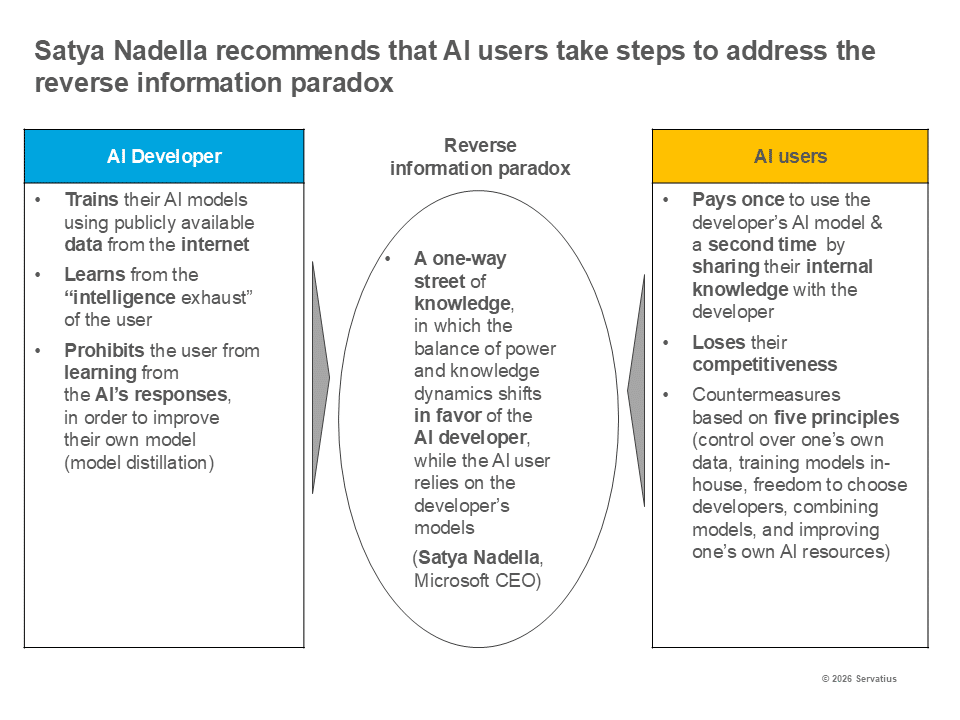
The AI developer does not train their AI models using publicly available data from the internet. They also learn from the user’s “intelligence- exhaust” with every interaction. At the same time, they prohibit the user from learning from the AI’s responses in order to improve their own model (model distillation).
On the other hand, the user not only pays once to use the developer’s AI model, but also a second time through the internal knowledge that flows to the developer. As a result, the user continuously loses competitiveness. Nadella recommends countermeasures based on five principles. These include maintaining control over one’s own data, training the models in-house, ensuring developers have freedom of choice, and combining models. The goal of combining these principles is to improve one’s own AI resources.
While Nadella’s provocative assessment has met with broad approval in Europe, small and medium-sized enterprises in particular are finding it difficult to implement these countermeasures. Furthermore, it’s important to recognize that Microsoft has not only invested billions in OpenAI but also profits from AI model developers through its Azure cloud platform.
An important question, therefore, is whether companies using AI will succeed in mastering the emerging organizational realignments through a training initiative.
AI-Driven Organizational Realignment and Changes in Performance Management
There are interesting developments in the AI-based realignment of organizations and changes in performance management, which I plan to discuss in my next articles. However, the situation here is somewhat unclear, so it is not entirely obvious which new trends will prevail in practice. The interplay between AI-based strategic and organizational realignments—and their implications for a fundamental shift in how goals are derived and how the performance of humans and AI agents is measured—plays a key role in this context.
Conclusion
- Many companies say they now have an AI strategy, but are struggling to implement it
- One of the reasons for these difficulties is a high degree of uncertainty regarding potential threats posed by AI technologies
- Implementing an AI strategy requires program management with interconnected areas of action
- The transition from AI pilot projects to AI-based business models is supported by an AI Business Model Canvas as a framework for business model evolution
- Many AI developers now rely on “Forward Deployed Engineering,” a methodology developed at Palantir that is based on several core ideas and distinguishes between two roles and three phases
- It is risky for AI users that their knowledge systematically flows to the AI developers, giving the latter a competitive advantage
- In the professional development of AI users, understanding their own company’s AI platform ontology is becoming increasingly important.
References
[1] Servatius, H.G., Competitive Advantages with Knowledge-Based AI. In: Competivation Blog, February 11, 2025
[2] Hamel, G., Zanini, M., Humanocracy – Creating Organizations as Amazing as the People Inside Them, Updated and Expanded, Harvard Business Review Press 2025
[3] Viel, O., Dynamic Shared Ownership – How Bayer Is Rewiring the Enterprise for Agility, Purpose, and AI Readiness, July 24, 2025
[4] Servatius, H.G., Strategy 5.0 for Tackling New Challenges. In: Competivation Blog, June 28, 2022
[5] Servatius, H.G., Triple Strategic Realignment. In: Competivation Blog, June 7, 2024
[6] Servatius, H.G., Innovation Narratives for a Connective Multi-Level AI Strategy. In: Competivation Blog, September 9, 2026
[7] Mensch, T., AI Success Depends on Management. In: Handelsblatt, October 13, 2026, p. 26
[8] Misra, S., Most Companies Have an AI Strategy. What the Top 8% Do Differently. In: SAP Website, May 8, 2026
[9] Servatius, H.G., Connecting Causal AI with Complex Evolutionary Systems. In: Competivation Blog, August 13, 2026
[10] Servatius, H.G., Connective Strategic Management in the Age of AI. In: Competivation Blog, May 22, 2026
[11] Servatius, H.G., Development of AI Technologies. In: Competivation Blog, February 19, 2025
[12] Alvarez de Souza Soarez, M. et al., The World in the Grip of AI. In: Handelsblatt, September 18, 19, and 20, 2026, pp. 6–12
[13] Bengio, Y., “These AIs Cheat, Even Though They’re Not Supposed To” (Interview). In: Handelsblatt, September 25, 26, and 27, 2026, pp. 38–39
[14] Servatius, H.G., AI as a Tool for Strategic Management. In: Competivation Blog, May 1, 2025
[15] Bomke, L., Stippler, F., AI Business Model Expected to Save BMW Billions. In: Handelsblatt, October 17, 2026, pp. 26–27
[16] Osterwalder, A., Pigneur, Y., Business Model Generation – A Handbook for Visionaries, Game Changers, and Challengers, John Wiley & Sons, 2010
[17] Servatius, H.G., Sustainable Business Models Through Improved Stakeholder Interaction. In: Competivation Blog, April 11, 2018
[18] Servatius, H.G., Designing Trustworthy High-Performance Systems. In: Competivation Blog, January 29, 2026
[19] Goldmann, S., MIT Report – 95% of Generative AI Initiatives at Companies Are Failing. In: Fortune, August 18, 2025
[20] Gramatikov, R., Forward Deployed – Inside the Palantir Framework that Solved Enterprise AI, Amazon Digital Services, 2026
[21] Alvarez de Souza Soares, P., Kerkmann, C., How SAP Plans to Win Again Despite Lagging Behind in AI. In: Handelsblatt, October 5, 2026, pp. 24–25
[22] Zeier, A., Agent-Based AI Is Changing the Economics of SAP Systems. In: E3 Supplement, November 2026, pp. 10–21
[23] Servatius, H.G., Disruption in Management Education of AI-Based Realignments. In: Competivation Blog, October 29, 2025
[24] Seratius, H.G., Design-oriented Innovation Research on AI Applications. In: Competivation Blog, March 25, 2026
[25] Talisman, J., Ontology Pipeline – A Framework for Building Knowledge Infrastructures, Technics Publications 2026
[26] Nadella, S., The Reverse Information Paradox. In: Platform X, July 12, 2026