

When it comes to Artificial Intelligence (AI), Europe faces the challenge of catching up with the U.S. and China. This requires a connective, multi-level strategy spanning from the macro level of geopolitics through the micro level of companies to the level of individuals. An important foundation of this strategy is the plurality of innovation narratives addressing various aspects of the catch-up process. This approach represents an extension of the fifth stage of connective strategic management that we have described thus far.
In this new blog post, I explore how innovation narratives can help Europe gain a competitive edge in Artificial Intelligence through a connective multi-level strategy.
Search for innovation narratives on Artificial Intelligence
AI experts argue that Germany’s future as a hub for AI depends on closer collaboration between academia and industry. A long-standing problem has been the translation of research findings into market-ready products and services.1 The political framework and people’s mindsets also play a decisive role. To overcome pessimism about the future and unite the efforts of all stakeholders, compelling innovation narratives are needed. A current topic in this context is Artificial Intelligence.
The term “narrative” describes a meaningful story that appeals to the emotions of a target audience and guides their actions. This classic definition requires a nuanced examination.
In his 1979 book The Postmodern Condition: A Report on Knowledge, the French philosopher Jean-François Lyotard critically examines the idea of a narrative as a grand story. These meta-narratives of modernity—such as the enlightenment or capitalism—served primarily to provide political and philosophical justification for domination, science, and social norms. Following the catastrophes of the 20th century, these meta-narratives are said to have lost their credibility and unifying power. In postmodernism, they are replaced by small narratives. These micro-narratives are characterized by a limited scope and a local context, based on knowledge-specific language games. A defining feature of postmodernism is a multitude of coexisting narratives that complement and contradict one another and shape life in a pluralistic world.2
Lyotard’s approach is visionary for our current understanding of innovation narratives, as he anticipated as early as 1979 the positive and negative effects of the AI era, with its mechanisms and ruptures. A core concept in his book is the performativity of a postmodern world in which grand truths are absent and systems are designed according to the principle of maximum optimization. However, this perspective tends to be rather critical of technology and underestimates the potential benefits arising from innovations.
The search for innovation narratives on artificial intelligence should therefore take threats seriously in order to generate positive effects. Put neutrally, an innovation narrative is a strategic story that explains the purpose of an innovation. These innovations may appear desirable, but they are often associated with threats as well. Therefore, skepticism toward one-sided grand narratives seems appropriate. One challenge lies in the plurality of micro-narratives, among which complex interactions are possible.
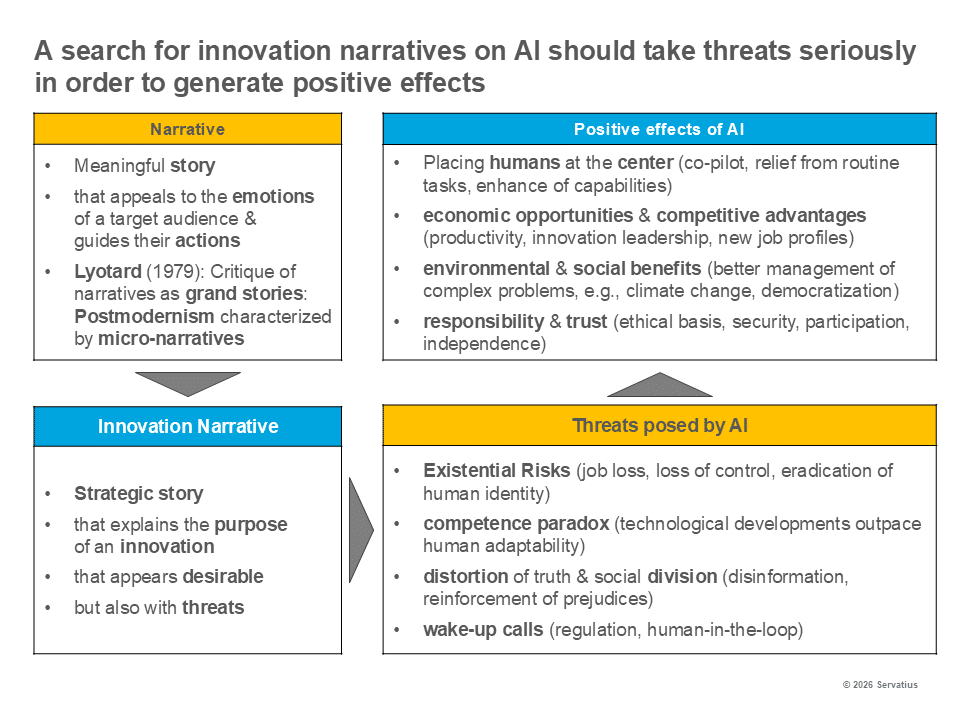
Threats posed by AI technologies are, first and foremost, existential risks such as job loss, loss of control, and the eradication of human identity. Added to this is a competence paradox, in which technological developments outpace human adaptability. Of increasing importance are the distortion of truth and social division, which manifest in targeted disinformation and the reinforcement of prejudices. This leads to wake-up calls demanding better regulation and viewing human-in-the-loop.
Narratives that emphasize the positive effects of artificial intelligence therefore continue to place humans at the center. AI is merely a co-pilot that relieves humans of routine tasks and enhances human capabilities. This creates economic opportunities and leads to competitive advantages through increased productivity and leadership in innovation, but it also requires new job profiles. In addition, environmental and societal benefits arise from better management of complex problems such as climate change and the democratization of autocracies. Key foundations for this are responsibility and trust, which form an ethical basis, create security, facilitate public participation, and ultimately ensure independence from enemies of our democratic order.
The search for innovation narratives from which Europe can learn in preparation for the next waves of AI leads, for example, to Canada.
Learning from Canada in preparation for the next waves of AI
Key impetus for the development of AI in Canada has come from Geoffrey Hinton, a Nobel laureate in physics. This includes
- decades of work on neural networks at the University of Toronto, which gave him the freedom and necessary financial support to pursue this topic—which was less popular in the 1980s and 1990s
- the establishment of a national research network in collaboration with other AI pioneers
- the integration of cutting-edge research with the Canadian business community, and
- the launch of the world’s first national AI strategy in 2017.
As a result, Canada has become a global magnet for talent. In 2023, Hinton ended his collaboration with Google and shifted his focus more toward AI safety. He used the prominence he gained from winning the Nobel Prize in 2024 to warn of the dangers of uncontrolled AI.3
Through its innovation program Next AI, the national nonprofit organization NEXT Canada aims to support promising founders from the idea stage through to market readiness in order to expand Canada’s leadership role in AI. The program is based on a multi-level strategy. This consists of
- a geographic level for the Toronto and Montreal regions
- a complementary business cycle level for innovation teams in these leading AI regions, and
- integration into the national AI strategy.
The key is a well-coordinated connection of these levels. Given the success of this approach, Europe should focus more intensively on the development and implementation of multi-level strategies. One example of the next wave is Physical AI.
The example of Physical AI
According to Robin Rombach, co-founder of the Freiburg-based AI startup Black Forest Lab (BFL), a new technological wave is currently emerging that opens up new opportunities for European companies. This involves AI systems that understand and interact with the physical world (Physical AI). Europe’s strengths include a relatively large number of AI researchers, a number of top universities and research institutions, and the diversity of industrial applications in which AI helps solve real-world problems and realign industries. European startups, which are now achieving valuations in the billions, are capitalizing on these opportunities with domain-specific AI models that build on their own research activities and are competitive on a global scale. However, a significant portion of the venture capital for these startups still comes from the U.S. In addition, major U.S. technology conglomerates are investing billions in data centers there. These benefit from fast approvals and low energy costs.4
AI-based robotics is emerging as a new growth market. Experts expect the global robotics market to grow to $2.5 trillion by 2035—25 times its current level. China has recognized this potential and is pursuing a clear strategy. The country is already by far the largest market and is driving the development of highly automated production structures that operate without human labor (“dark factories”). Unitree, a company based in Hangzhou in eastern China, is the first manufacturer of humanoid robots to be publicly traded on the mainland Chinese stock market. Since geopolitical tensions with the U.S. have escalated, the Chinese government has been encouraging companies to list on the domestic market rather than in New York.5
Artificial intelligence is increasingly being used in end devices, such as in cars, where it optimizes driving behavior, or in logistics robots. This decentralized edge AI is a subset of physical AI. While Nvidia chips dominate in data centers, edge AI relies on semiconductors from the Dutch company NXP, for example. These must be energy-efficient and have a long service life. European suppliers are global leaders in this field. The decentralization of AI also opens up new opportunities for end-device manufacturers.6
Model router for selecting the right AI
Alongside new technologies, a cost-benefit analysis of AI is becoming increasingly important. This is because the more AI-powered products companies use, the higher their consumption of computing units (tokens)—which AI providers use to bill customers. In light of rising AI costs, customers are increasingly asking what benefits AI provides and whether they need to use the particularly expensive “frontier” models from the U.S. for all applications. High token consumption (tokenmaxxing) does not automatically lead to greater efficiency. For less complex tasks, open-weight models—which are pre-trained and can be run by a company on its own servers—are often sufficient. The Berlin-based startup Langdock and other providers have developed routing platforms that analyze tasks and forward them to the most suitable AI. Customers’ nuanced cost-benefit analysis poses a challenge for AI providers such as Anthropic and OpenAI in light of their planned initial public offerings (IPOs).7
Model routers are giving rise to a new billion-dollar market driven by companies’ need to get AI costs under control. Chip giant Nvidia is also entering the router business; with Nemo Switchyard, it has introduced a system that automates model selection. The Düsseldorf-based startup Kauz AI is specifically targeting customers in Europe with its router business. In addition to cost, the Kauz Selection product focuses on data sovereignty. The advantage of specialized router providers is that they constantly adapt their products to the rapidly changing model landscape. Chinese providers are also trying to capitalize on this advantage. Overall, all providers aim to give customers more power again.8
Disruption driven by AI with a better price-performance ratio is also coming from the Beijing-based startup Moonshot. Its new open-weight model, Kimi K3, achieves very good results without relying on the scaling law or the illusion that more data and computing power always lead to better results. For founder Yang Zhilin, token efficiency is the top priority. To this end, Moonshot combines the following four approaches:
- A distinction between less important information and important information stored for longer periods, which requires less storage space and enables faster responses (Delta Attention)
- The targeted processing of information from previous layers (Attention Residuals), which results in less diluted outcomes
- a multitude of specialized networks (Mixture of Experts), which enables more precise access to information, as well as
- the decomposition of a query into small subtasks and parallel processing by individual agent systems (Agent Swarm).
This example shows that AI competition among economic regions has become even fiercer.9 This is where multilevel strategies come into play.
Multi-level strategies as the third dimension of connectivity
Over the past few decades, several approaches to multi-level strategies have emerged, though they employ different classifications and definitions of the levels. The basic principle of a multi-level strategy was already described in the mid-1990s by Richard Whittington of the Said Business School at the University of Oxford in his “Strategy-as-Practice” concept.10 Dutch transition research, building on the work of Frank Geels, has also been pursuing a multi-level approach since the early 2000s.11 The fourth generation of the St. Gallen Management Model (SGMM) distinguishes between different levels in terms of perspectives.12 Also of interest is the “Microfoundations of Strategy” approach, which advocates an aggregation from the individual level upward.13
In light of numerous new challenges, our framework distinguishes between the macro level (geopolitics and the environment), the meso level (nations and regions), the micro level (companies and public administrations), as well as society and individuals. We refer to the links between these levels as vertical connectivity.
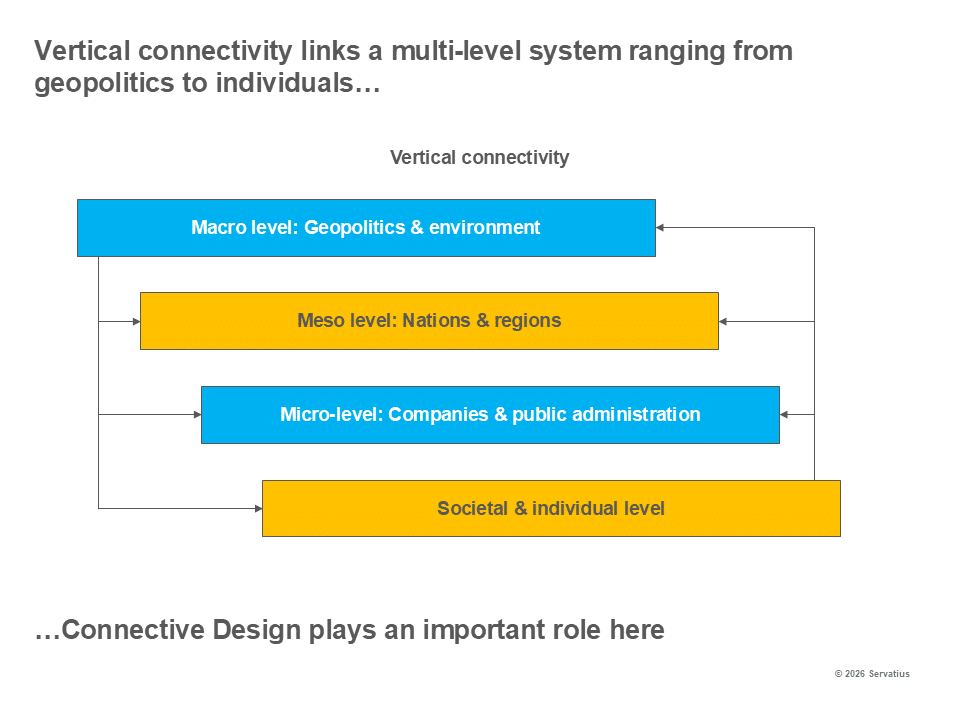
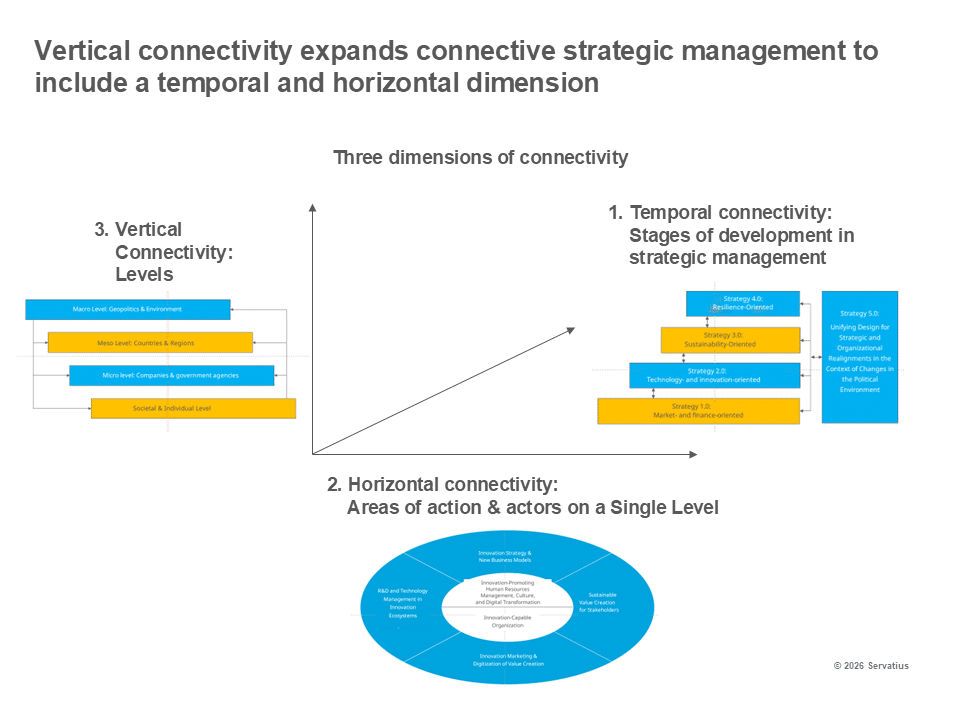
Connective design also plays an important role in multi-level strategies. We discussed this capability in a publication on the development and evolution of strategic management.14 The focus here is on the temporal connectivity linking the five stages of strategic management identified to date. Horizontal connectivity within a single level also always plays an important role. Examples include a country’s various policy areas or the fields of action and actors within a company’s innovation system.15 The following figure illustrates these three dimensions of connectivity.
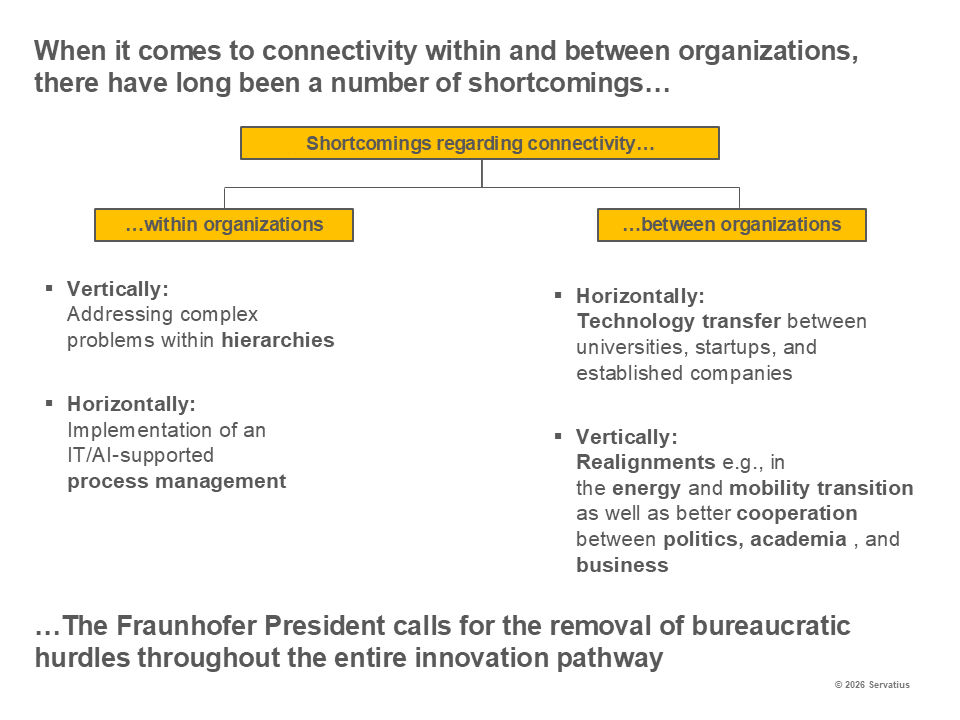
One cause of shortcomings in connectivity is increasing dynamism and complexity. In an environment that has become more dynamic, companies with traditional hierarchies and silo structures struggle to tackle complex problems. Parallel to this vertical connectivity, horizontal connectivity poses a challenge for many organizations when implementing IT- and AI-supported process management.16 Horizontal connectivity also poses difficulties between organizations. One example is the transfer of technology from universities to established companies via startups. In the context of strategic realignments—such as those related to the energy and mobility transitions—, vertical connectivity between organizations has proven to be a bottleneck. This highlights the need for improved forms of collaboration. This applies to politics, academia, and the business sector in general. Fraunhofer President Holger Hanselka calls for the removal of bureaucratic hurdles throughout the entire innovation pathway.17
The goal of multi-level strategies is to address threats and generate positive effects. I would like to illustrate this with examples, starting at the macro level with geopolitics and the environment.
From geopolitics to regions
Geopolitics forms the highest, framework-setting level that shapes global rules and strategic alliances. A primary role is ensuring technological sovereignty. The goal here is to reduce dependencies and protect one’s own infrastructure. A regulatory competition over global standards is underway between the U.S., China, and Europe. Geopolitical bloc formation and trade barriers—such as export controls—play a significant role in this context. National security and cyber defense are becoming increasingly important in the context of asymmetric warfare. Global bodies are vying for interpretive authority and standardization, for example, of technical protocols.18 Currently, the U.S. government and tech companies accuse China of training its AI models using U.S. technologies (knowledge distillation). The Chinese Ministry of Commerce denies this.19
The negative environmental impacts of AI are also of geopolitical significance. These include the high electricity consumption required for training and operating large AI models, CO₂ emissions when electricity comes from fossil fuels, the enormous water consumption needed to cool servers, electronic waste from rapidly obsolescent hardware, and resource consumption—for example, in the mining of rare earth elements. In the U.S., there are already protests against the construction of new, massive data centers. Individual states are enacting comprehensive new AI laws. Public sentiment is shifting. 71 percent of Americans oppose a data center in their neighborhood.20 Green data centers—operating in cooler regions with renewable energy and closed-loop water systems—could offer a solution.
At the meso-level of nations and regions, the question arises of how Germany, together with other countries, can catch up with the U.S. and China in the field of AI. This requires a series of coordinated strategic programs, such as
- a focus on AI applications that require specific capabilities
- intensive collaboration between established companies and AI startups, with their growth funded more heavily from Europe
- scaling up trustworthy AI infrastructure
- a realignment of AI education and training, as well as
- the use of innovation-friendly regulation as a competitive advantage.
It remains to be seen how many European providers of large language models there should be. In Japan, the startup Sakana AI is attempting to reduce this dependence. To this end, it is working with a system in which various models are embedded. It functions similarly to a conductor coordinating a swarm of agents. Such orchestration also presents an opportunity for Europe.21 The diversity of the regions can be an advantage in this regard.
Hidden champions play a key role in regional AI development by serving as practical partners for research institutes. Therefore, these lesser-known global market leaders act as
- data providers for specific AI
- investors in sustainability-focused impact startups
- drivers of regional AI ecosystems, and
- magnets for tech talent.
In this way, hidden champions not only improve their own competitiveness but also strengthen the financial strength of local communities. One example is the sensor specialist ifm electronic, headquartered in Essen with a production site at Tettnang on Lake Constance. The company has evolved from a sensor manufacturer into an AI platform for production. The importance of hidden champions for regional development has long been recognized, but their potential role as AI pioneers has yet to be fully explored. This is currently giving rise to exciting new narratives.22
From companies to individuals
At the micro level of companies and public administration, we must address the question of why established organizations find AI-based change so difficult. The challenge likely lies in integrating a range of areas of action. These include
- a strategy for realigning business models
- overcoming cultural and personnel barriers
- developing AI competencies from the executive level through middle management down to entry-level employees
- designing a high-performance AI infrastructure in collaboration with trusted partners, as well as
- integrating individual pilot projects into a coordinated process of changing organizations.
Despite the widespread use of the buzzword “digital transformation,” the number of organizations that have successfully achieved this level of change is limited.23
One success story is the Swabian family-owned company Trumpf, which ranks among the global market leaders in the use of lasers for sheet metal processing and chip manufacturing. The company is working on a new stage of development in AI-supported robotics for sheet metal processing. For example, in the SortMaster Vision, AI uses cameras to analyze the position of sheet metal parts to be processed and calculates a spatial image of the situation, which facilitates the sorting process. In doing so, the AI continuously learns from real-world data without the need for extensive reprogramming. Trumpf aims to take a leading role in AI applications in production. This example demonstrates how important it is to combine specific knowledge with AI expertise. Other organizations can learn from this.24
So far, public administration in Germany has fared even worse than the private sector in mastering the digital change. Yet we could have learned from the small Baltic state of Estonia. Around 2000, the “Government-as-a-Platform” concept emerged there. Under this concept, the government provides a platform on which all services are built. It defines standards and guarantees security and functionality. The X-Road data pipeline, which originated from an open-source project, is based on this concept. The basic idea was that data would remain decentralized within individual organizations but could still circulate. This has become a major export success, deployed by the company Cybernetica as a service provider in more than 20 countries. Germany is not among them because, here, there have long been plans to develop a next generation that is even better.25
The current German Minister for Digital Affairs is planning a unified framework consisting of standards, software, and infrastructure. This “Deutschland-Stack” is intended to streamline government agencies. However, the plan faces challenges from existing specialized procedures and software architectures. The “Deutschland-App” is set to be the first visible product for citizens.26 Critics describe it as nothing more than “window-dressing digitalization.” They argue that the challenge lies not in the app itself, but in the processes behind it. The outcome of a pilot project remains to be seen.27
More generally, the question arises as to what implications AI has for society in an industrialized country like Germany. In light of a multitude of crises, these implications primarily concern the transition of the world of work. Here, there is a risk of a societal divide between a few winners who capitalize on the opportunities created by AI and a multitude of losers whose jobs are eliminated or changed in ways that leave them unable to withstand this pressure. Populists are exploiting this development to capitalize on polarization. This makes it all the more important to intensify AI-oriented education and training as a counterbalance to strengthen societal resilience. The everyday experiences of people who recognize how AI helps them—for example, with legal and medical issues—can play a significant role in this regard. Overall, better cooperation across various policy areas appears necessary to prepare for this change process.28
In the world of work, major upheavals are on the horizon for individuals at all hierarchical levels. This applies above all to management. For those just entering the workforce, routine tasks—which AI is taking over—are becoming less important. It is becoming increasingly relevant to acquire knowledge on how to work with AI already during one’s training. In middle management and at the top level, the competencies required for personnel management are changing in particular. Personal experience with AI strategies and AI-driven productivity gains has now become a prerequisite for leadership positions. In this context, AI takes on the role of a sparring partner. The upheavals caused by AI are occurring at a time when companies are already streamlining hierarchical levels and cutting jobs. This contributes to a sense of uncertainty. An important task for the remaining executives is to tap into AI-based productivity potential and use the freed-up capacity to create something new. An innovation narrative should emphasize this positive aspect.29
Customers of OCBC Bank in Singapore have recently been able to discuss their portfolios with an avatar. Nevertheless, the bank has no plans to cut staff; rather, it aims to expand its workforce to continue growing. In this regard, the OCBC CEO is in line with the Singaporean government, which wants to be among the global pioneers in the use of AI but at the same time seeks to ensure that the AI-driven realignment of the financial sector does not result in massive job losses. To this end, there is a pact between the government, financial institutions, and the labor union. At its core is a continuing education and retraining program designed to equip employees for new roles. At Singapore’s leading bank, all 40,000 employees have now received basic AI training, and 11,000 have been qualified for new roles created by the use of AI. Singapore’s Institute of Banking and Finance (IBF) plays a leading role in continuing education.30
A connective effect despite threats?
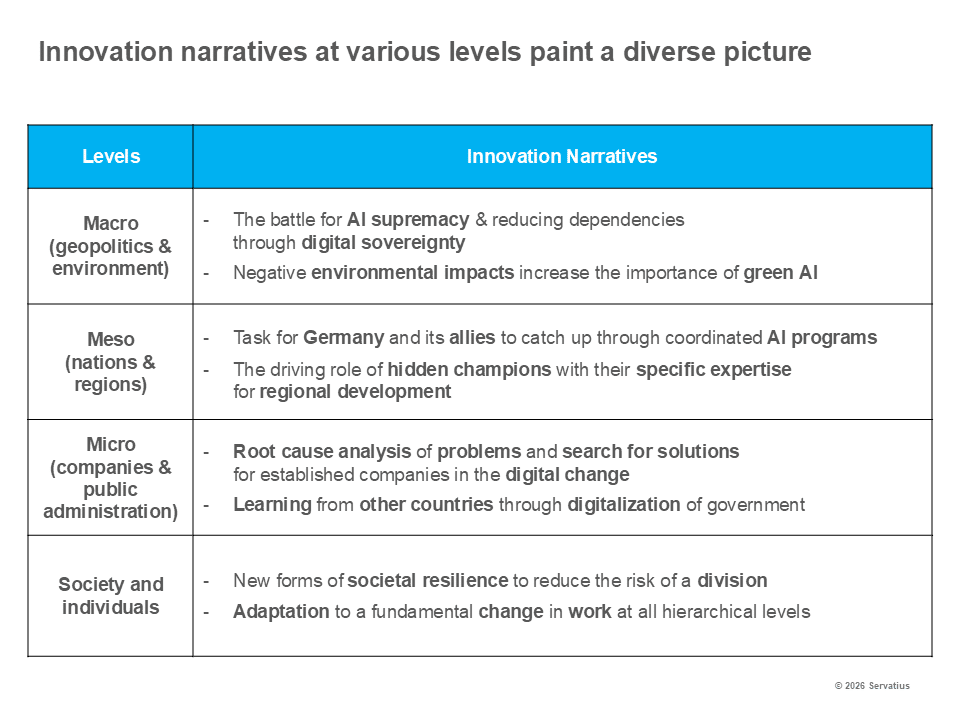
An examination of potential innovation narratives at various levels reveals a diverse picture overall. This raises the question of how these narratives can exert a connective effect within the framework of a multi-level AI strategy, even though AI poses significant threats.
We have seen that, at the macro level, geopolitics is primarily concerned with AI supremacy and reducing dependencies through digital sovereignty. AI can have negative environmental impacts, as is the case, for example, with large data centers. This underscores the importance of green AI.
At the meso level of the nations, Germany faces the challenge of catching up with the U.S. and China through a series of coordinated AI programs. In the different regions, the numerous hidden champions, with their specific application expertise, should take on a leading role.
At the micro level, established companies in particular must identify the root causes of their challenges in digital change and find appropriate solutions to address them. It remains to be seen whether the new approaches to digitizing public administration in Germany will be successful. In any case, we can learn from other countries.
The serious implications of AI for society require new forms of resilience to reduce the risk of social division. For each individual—especially those in management roles—work is undergoing fundamental changes at all hierarchical levels. These points are summarized in the following figure.
When addressing the question of the connecting effect despite potential threats, a key insight is that micro-narratives can have both positive and negative manifestations. The connectivity is amplified when positive manifestations interact. Negative manifestations weaken it. It is therefore crucial to leverage the amplifying effect of as many positive micro-narratives as possible.
A second insight is that there is no “self-sustaining” effect here, and one should be skeptical of oversimplified, grand narratives about AI. For example, the United States’ technological leadership is extremely fragile in the face of an autocratic government. A European AI narrative should be mindful of this fragility when leveraging the amplifying effect of a cohesive, multi-level strategy.
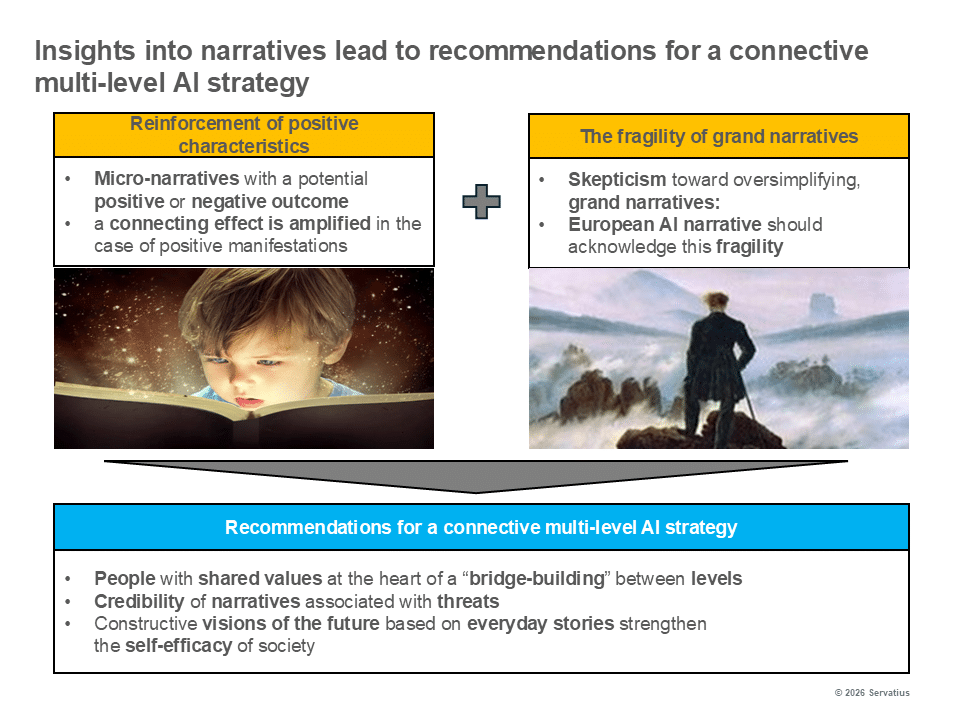
These insights lead to the following recommendations for designing a connective, multi-level AI strategy:
- People and their shared values should be at the heart of “bridge-building” between the levels
- narratives that deal honestly with threats are more credible than utopias or dystopias, and
- within the framework of constructive visions of the future, stories drawn from people’s everyday lives strengthen society’s sense of self-efficacy.
In this respect, addressing AI challenges is a shared task of shaping the future, in which narratives highlight the potential benefits for people.
Implications for research and teaching
A multitude of exciting questions arise for research and teaching. Important insights come from linking causal AI with management theory of complex, evolutionary systems.31 Accordingly, educational institutions such as universities and business schools are also realigning their strategies in the AI era.32
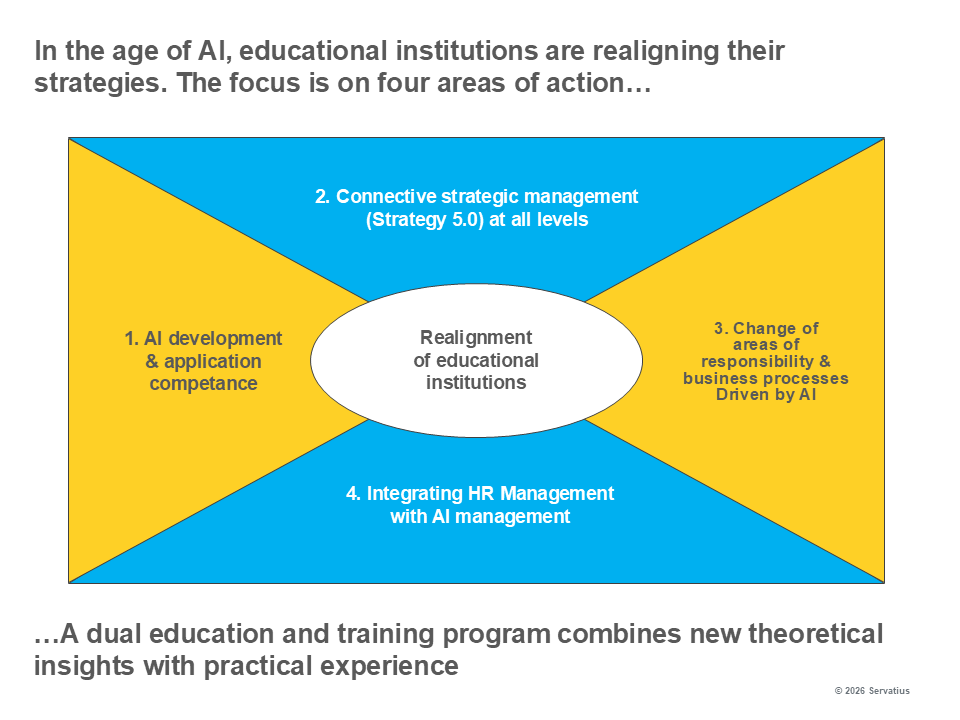
The focus is on the following areas of action:
- AI development and application competencies
- A connective strategic management (Strategy 5.0) at all levels
- A change of areas of responsibility and business processes through AI, as well as
- The integration of human resources management with AI management.
There is currently a high demand for dual education and training programs that combine new theoretical insights with practical experience. One topic is Vibe Coding, in which software developers no longer write the code line by line themselves but instead instruct an AI on what to create.
The Mannheim-based startup Osapiens, which is working on agent platforms that, for example, support the flow of sustainability data into key decisions, provides insights into relevant qualifications. In the past, the focus was on who could write the best code, says co-founder Stefan Wawrzinek. Today, it is important to understand the big picture in order to shape strategies in a comprehensive sense.33
Conclusion
- To gain a competitive edge in the field of artificial intelligence, Europe needs a multi-level strategy
- Innovation narratives in the form of micro-stories provide an important foundation for this
- New waves of technology are currently emerging—such as Physical AI—where Europe can leverage its strengths
- Our approach to multi-level strategies distinguishes between geopolitics and the environment (macro level), nations and regions (meso level), companies and public administration (micro level), and the level of society and the individual
- We refer to the connection between these levels as vertical connectivity. This third dimension—alongside temporal and horizontal connectivity—expands the scope of connective strategic management (Strategy 5.0)
- The diversity of micro-narratives illustrates the goal of multi-level strategies: to manage threats and generate positive impacts
- The connecting effect of innovation narratives stems from the amplifying effect of many positive, small-scale stories. Given the fragility of grand AI narratives, skepticism is warranted
- For the design of a multi-level AI strategy, it follows that credible everyday stories that clearly demonstrate the benefits for people have a connecting effect
- Examples include successful, personal developments in a work environment increasingly shaped by AI.
References
[1] Klüwer, T., The Future Made in Germany—Why We Must Promote Innovation Now to Save Our Prosperity, Rowohlt 2025
[2] Lyotard, J.F., The Postmodern Condition: A Report on Knowledge, University of Minnesota Press 1984
[3] Oppert, S., Geoffrey Hinton – The Untold Story of AI’s Hidden Risks and the Man Who Warned the World, Independently 2025
[4] Bomke, L., Europe’s Second Chance—A Billion-Dollar Bet on New AI Labs. In: Handelsblatt, June 22, 2026, pp. 26-27
[5] Benninghoff, M., China’s New Stock Market Frenzy. In: Handelsblatt, August 20, 2026, pp. 34-35
[6] Hoffer, J., AI in End Devices Is Coming ‘Faster Than Expected. In: Handelsblatt, August 25, 2026, p. 20
[7] Alvarez de Souza Soares, P., et al., The Rebellion of AI Customers. In: Handelsblatt, July 10, 11, and 12, 2026, pp. 34-40
[8] Bomke, L., Holtermann, F., Scheuer, S., The New Gatekeepers of the AI Economy. In: Handelsblatt, August 21, 22, and 23, 2026, pp. 26-27
[9] Scheuer, S., This Chinese Model Is Causing a Stir Worldwide. In: Handelsblatt, July 20, 2026, p. 24
[10] Whittington, R., Strategy as Practice. In: Long Range Planning, 1996, Issue 5, pp. 731-735
[11] Geels, F., Technological Transitions as Evolutionary Reconfiguration Processes – A Multi-level Perspective and a Case Study. In: Research Policy, 2002, Issues 8-9, pp. 1257-1274
[12] Rüegg-Sturm, J., Grand, S., The St. Gallen Management Model, 3rd ed., Haupt 2017
[13] Foss, N.J., Felin, T., Strategic Organization – A Field in Search of Micro Foundations. In: Strategic Organization, November 2005, Issue 3, pp. 441-455
[14] Servatius, H.G., Development and Change in Strategic Management. In: Competivation Blog, September 19, 2025
[15] Servatius, H.G., Designing and Empowering Innovation Systems. In: Competivation Blog, February 22, 2018
[16] Servatius, H.G., Process-Oriented AI for Productivity Gains. In: Competivation Blog, March 12, 2025
[17] Delhaes, D., Researchers and Industry Call for More Freedom for Innovation. In: Handelsblatt, August 31, 2026, p. 14
[18] Brands, H. (ed.), Geopolitics of AI – Power, Conflicts, and the Future of Global Order, Johns Hopkins University Press, 2026
[19] Gusbeth, S., Heide, D., The Battle for AI Supremacy. In: Handelsblatt, August 4, 2026, pp. 6-7
[20] Heide, D., Alvarez de Souza Soares, P., The Governors’ AI Rebellion. In: Handelsblatt, July 15, 2026, pp. 10-11
[21] Kölling, M., Knees, L., Why Japan Doesn’t Depend on Anthropic. In: Handelsblatt, July 3, 4, and 5, 2026, pp. 30-31
[22] Simon, H., Hidden Champions – The New Rules of the Game in the Chinese Century, Campus 2021
[23] Davenport, T.H., Mittal, N., All In on AI – How Smart Companies Win Big with Artificial Intelligence, Harvard Business Press 2023
[24] Buchenau, M., Trump on the Path to Becoming a Machine-Human. In: Handelsblatt, August 28, 29, and 30, 2026, pp. 42-43
[25] Lutz, J., Two Digital States That Companies Dream Of. In: Handelsblatt, May 15, 16, and 17, 2026, pp. 60-62
[26] Fokul, J., The Architect of Digital Germany. In: Handelsblatt, May 15, 16, and 17, 2026, pp. 64-65
[27] Fokuhl, J., Just a Chatbot in Front of the Old Bureaucratic Apparatus? In: Handelsblatt, August 17, 2026, pp. 12-13
[28] Baecker, D., Digitalization, Suhrkamp 2026
[29] Hougaard, R., Carter, J., More Human – How the Power of AI Can Transform the Way You Lead, Harvard Business Review Press 2025
[30] Peer, M., Banks Promise AI Transformation Without Mass Layoffs. In: Handelsblatt, September 1, 2026, p. 36
[31] Servatius, H.G., Connecting Causal AI with Complex Evolutionary Systems. In: Compativation Blog, August 13, 2026
[32] Fleig, S., Artificial Intelligence Challenges Career Prospects. In: Handelsblatt, September 4, 2026, pp. 36-37
[33] Schimroszik, N., We Roll Out New AI Agents Every Month (Interview with Stefan Wawrzinek). In: Handelsblatt, September 7, 2026, pp. 26-27