

strategic management | Competivation
Development and change in strategic management

Development and change in strategic management


The task of strategic management is to shape corporate development and overcome challenges. New opportunities and threats mean that board members and managing directors are constantly faced with the need to learn. Improved didactics in executive education and training should take this change in strategic management into account. In the current phase of upheaval, the focus is on AI-based strategic and organizational realignments. We refer to the combination of these fields of action, which are changing the labor market and requiring new leadership skills, as innostrategizing.


In this blog post, I explain the stages of development of strategic management and the paradigm shift that is shaping the evolution of the field.


AI is also changing the job market for young professionals

The increasing importance of artificial intelligence (AI) is leading to a decline in demand for clearly structured, repetitive fields of activity, even for young professionals.Many of these tasks are already being performed faster, more cost-effectively, and with sufficient quality by AI. At the same time, new tasks are emerging, e.g., in AI training and the use of AI tools. In addition to AI skills, other qualifications are becoming more important. These include, for example, the ability to work on interdisciplinary projects. As this change affects all areas of management, innovative education providers are realigning their bachelor’s programs. In addition, the requirements for managers are also changing.


New requirements for managers

In the past, completing an MBA program increased the likelihood of a successful management career. For example, 18 percent of the board members of German listed companies have a Master of Business Administration (MBA), 88 percent of whom obtained their degree abroad. An important motivation for pursuing an MBA program is the desire to develop further and improve one’s own strategic skills. For business economists and especially for graduates of technical degree programs, MBA programs at renowned universities act as career accelerators. For universities in Germany and abroad that offer MBA programs, it is important to note that the challenges facing companies and thus also the field of strategic management have been undergoing fundamental changes for some time. Innovative education providers are equipping their students to cope with the complexity associated with these changes. The negative effects of US ’s policies on the country’s education system are an opportunity for Europe that universities should take advantage of.

Of particular importance here is an understanding of the changes in strategic management over the course of its development.


Stages of development in strategic management

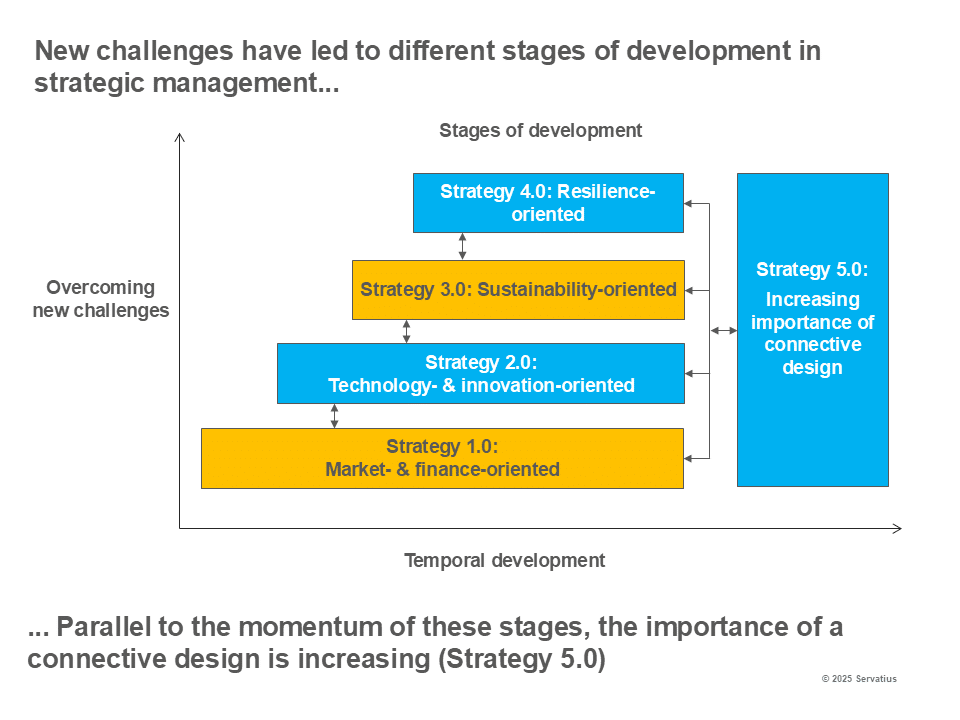
We have divided the development of strategic management since the 1960s into the following stages, which characterize the respective focus:3

  • Market- and finance-oriented (Strategy 1.0)
  • technology- and innovation-oriented (Strategy 2.0)4
  • sustainability-oriented (Strategy 3.0)5 and
  • resilience-oriented to overcome the current multi-crisis (Strategy 4.0)6 .

Parallel to the momentum of these stages, the importance of a connective design is increasing. By this we mean

  • to plan and implement
  • objects, systems, or problem solutions
  • carried out jointly by actors from different disciplines, levels, or organizations.

We consider such connective design to be the fifth stage of development in strategic management (Strategy 5.0). This stage connects and expands on the previous stages.7
Lernprozess Innovationsstrategie

An important foundation for connective design was laid by Nobel Prize winner Herbert Simon (1978) in his book The Sciences of the Artificial, which has shaped design theory.8 Even though this groundbreaking work is little known in Germany, hidden champions have been practicing this management approach for decades, which deals with questions such as how to connect new customer needs and technologies.

University teaching on strategic management still focuses primarily on the first stage of development, which is market- and finance-oriented. The second and third stages have given rise to the independent disciplines of technology, innovation and entrepreneurship, and sustainability. However, the integrative aspect of connecting the stages is usually neglected. In addition, there are the specialist areas of human resource management, organization, IT management, and change management, which are also often not linked to strategic management.


Connective design

Although the ability to create connections is rarely taught at universities, it has always been and continues to be relevant at all strategic levels. This is illustrated by the following tasks:

  • Designing business portfolios with the aim of permanently increasing company value (Strategy 1.0)
  • designing the innovation system of companies by connecting relevant fields of action and innovation ecosystems (Strategy 2.0)
  • designing the sustainability system of companies and GreenTech ecosystems, as well as jointly overcoming conflicts of interest between economics, ecology, and social issues (Strategy 3.0)
  • the design of resilient systems by connecting the levels of government, companies, and individuals, e.g., to overcome geopolitical crises (Strategy 4.0)
  • designing connections between the stages of development, e.g., in the areas of sustainability innovation and climate resilience (Strategy 5.0).

In addition to these stages of development and a unifying perspective, the change of strategic management is characterized by a paradigm shift.


Paradigm shift in strategic management

The term paradigm describes a fundamental pattern that serves as a guide in a particular field. In science, a paradigm forms a framework for theories, concepts, and practices. A paradigm shift is a transition from an older to a new fundamental pattern. The science historian Thomas Kuhn uses the term to describe scientific revolutions.9 One of the critics of this idea is the philosopher Stephen Toulmin. For him, a scientific paradigm is a loosely connected bundle of individual theories that must prove themselves in an evolutionary process.10 The paradigm shift in strategic management has a rather evolutionary character.

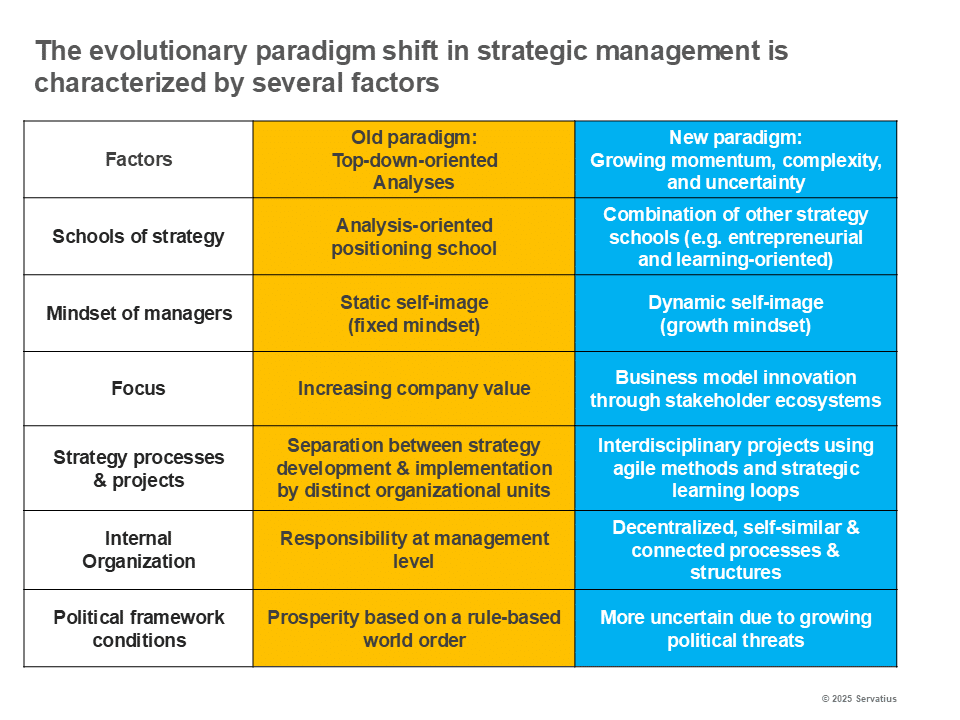
Since the 1990s, this paradigm shift has been taking place from top-down-oriented analyses to a growing dynamic, complexity, and uncertainty emanating from successful digital companies and a changed geopolitical landscape.11 Analysis in the old paradigm aims to break down problems. The following figure summarizes the factors that characterize the evolutionary paradigm shift.
Lernprozess Innovationsstrategie

The transition from the old to the new paradigm is changing the influence of various schools of strategy. The analysis-oriented positioning school has lost importance. A combination of other schools of strategy, such as the entrepreneurial school and the learning school, has become more relevant.12

Another important change concerns the mindset of managers. While a rather static self-image dominates in many established companies, the culture of successful digital companies is characterized by a dynamic self-image (growth mindset), which often begins to develop in childhood.13

The focus of the old strategy paradigm is on increasing company value. The new paradigm focuses more on business model innovation through stakeholder ecosystems. Artificial intelligence (AI) now plays an important role in managing the complexity associated with this.14

Strategy processes and projects have also changed. The old paradigm was dominated by a separation between strategy development and implementation by distinct organizational units. This separation encourages the emergence of silo cultures. The new paradigm is characterized by interdisciplinary projects using agile methods such as design thinking and Scrum. A common feature of these projects is the iterative approach in learning loops.15

The internal organization also differs accordingly. In the old paradigm, responsibility for strategic management lies at the management level. The new paradigm is characterized by more decentralized, self-similar (fractal) processes and structures. Strategy units with different tasks are connected to each other and to a central office.16

Currently, an important change is emanating from the political framework conditions. The old paradigm is based on the idea that prosperity arises from a rule-based world order. This idea is increasingly being called into question. Due to growing political threats, the framework conditions for strategies have become much more uncertain. A current example is the tariff crisis initiated by the US government. In this situation, the world seems to lack a reliable compass.17


AI-based strategic and organizational realignments

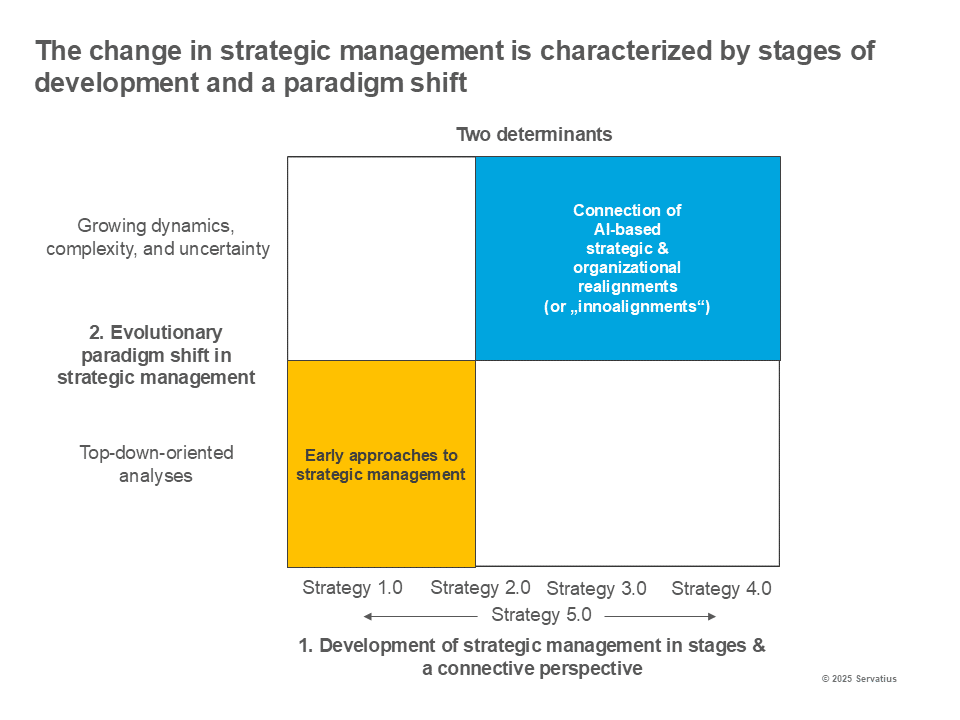
In summary, it can be said that the change in strategic management is characterized by the following two determinants:

  1. Development in stages with an increasingly important connective perspective, and
  2. an evolutionary paradigm shift.

Characteristic of the early approaches to strategic management according to the old paradigm are top-own-oriented analyses based on problem decomposition. These approaches determined the first stage of development and the beginning of the second stage. In contrast, the new paradigm focuses on growing dynamics, complexity, and uncertainty.
Lernprozess Innovationsstrategie

If one is looking for a term to describe current strategic management, the neologism „innoalignment“ comes to mind. By this we mean the connection of AI-based strategic and organizational realignments. The strategic realignments are aimed at making companies more resilient, digital, and sustainable.18 In organizational realignments, AI-supported performance management measures the success of leaner structures, networked processes and projects, and an innovative AI platform architecture.19 There are still few examples of such innoalignment. This makes it all the more important for application-oriented research and teaching to focus more on this topic. The further development of management didactics plays a central role in this.


Key players in management didactics

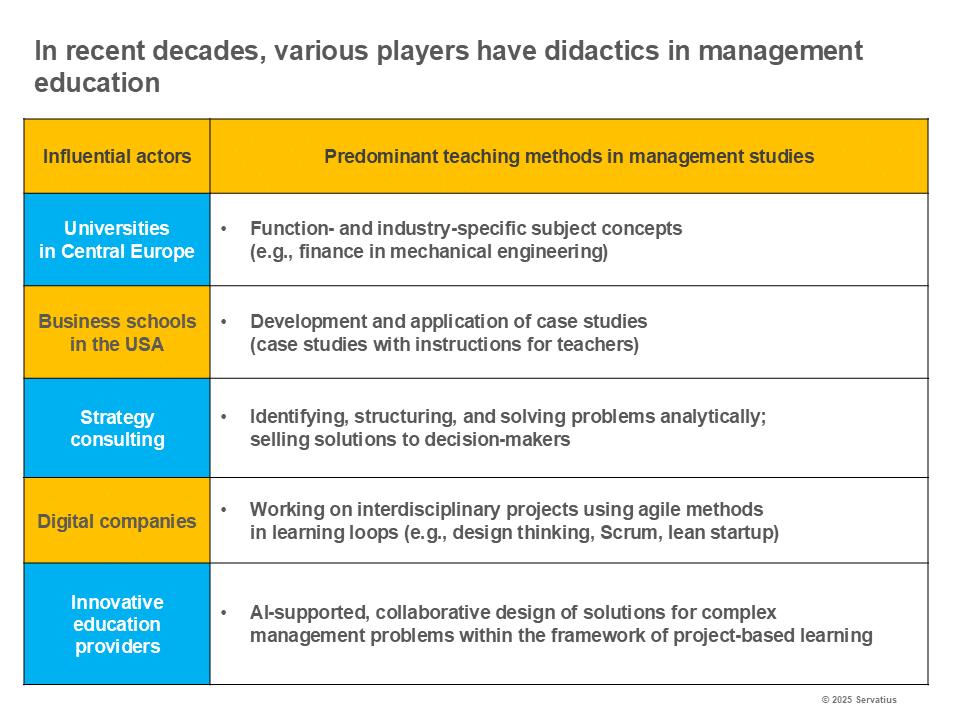
In recent decades, various players have shaped didactics in management education. Their approaches have specific advantages and disadvantages. In view of new challenges, innovative education providers are currently developing didactic concepts that focus on AI-supported solutions to complex management problems. 20
Lernprozess Innovationsstrategie

The prevailing management didactics at universities in Central Europe have long been function- and industry-specific subject concepts. The focus of business administration functional teaching (e.g., finance) and technical industry teaching (e.g., mechanical engineering) is on training specialists who work in hierarchies with clearly defined organizational units. This approach encourages the emergence of interface problems that are difficult for companies to overcome due to a rigid culture.

In the USA, Harvard Business School transferred the case study method from legal education to management education in 1920. The basic idea is that lecturers condense interesting practical examples into case studies, which form the focus of teaching. The promise of benefit here is to learn from actors who have attempted to solve a specific problem. This didactic approach differs fundamentally from subject-based learning. One disadvantage of the case study method is that the rapid transfer of a known solution often does not do justice to the complexity of new tasks.

The major strategy consultancies, which are influenced by the teaching methods used at business schools, have supplemented the case study approach with a specific form of further training for their consultants. This on-the-job training focuses on teaching the ability to identify problems, structure them, and solve them analytically. The final step is to sell the solutions by having experienced consultants convince decision-makers. A common criticism of this classic approach by consultants is that they leave their clients to implement the solutions on their own. This is where performance management, which emerged in the 1980s, comes in with the formulation of objectives and key results.

Successful digital companies and their venture capitalists rely less on external consultants and more often work on interdisciplinary projects themselves using agile methods such as design thinking or Scrum. In this iterative approach, the actors apply the concept of learning loops, which is well known in organizational development. The lean startup method is also based on this approach.

Since all of these approaches have specific strengths and weaknesses, innovative education providers build on what is already known and develop it further. The result is project-based learning that focuses on AI-supported, collaborative design of solutions for complex management problems.21 Such action-oriented learning can begin with simple problems and then move on to individual learning steps addressing current challenges for which there are no known solutions yet. The new education providers have recognized that this approach is best mastered by a heterogeneous teaching staff in which academics work together with practitioners who have different backgrounds and experience. An interesting question is how organizations can promote the further development of a dynamic self-image. The role model function of leadership plays an important role here.

This change in strategic management, combined with innovative didactics, opens up an opportunity for Europe that the „old continent“ should seize.


Change as an opportunity for Europe

Strategic management started as an import from the US, with its first stage of development spreading across Europe since the 1970s. Europe has been overtaken in many areas by the waves of digitalization, which have mainly originated from US companies. At the same time, changing geopolitical conditions are increasing Europe’s dependence on the US and China. It therefore seems high time for Europe to refocus on its strengths. Politicians have begun to rethink their approach, placing greater emphasis on competitiveness once again. One opportunity of global significance is the combination of digitalization and sustainability (digital green tech), where Europe should strive to take a leading role.22 The basis for this is an improvement in education systems.

The outlined change in strategic management creates a framework for joint programs between politics, science, business, and society in specific growth areas, such as the realignment of power grids with AI.23 This depends on the ability to design solutions for complex management problems. Overall, this change represents an opportunity for Europe if it succeeds in becoming more resilient in crisis management through a joint effort.

Advanced didactics in management play a central role in this. These methods must also address the question of what causes the basic patterns of error that Germany has made in the past, for example in digitization and the energy transition. An important insight is that such basic patterns of error are the fragmented interests of individual actors or groups. The theory and practice of connective design can help to overcome this basic pattern of error.


Conclusion

  • The development of strategic management has proceeded in stages, with the importance of a connective perspective increasing
  • Parallel to this, there has been an evolutionary paradigm shift with a change in a number of factors
  • These two determinants shape innostrategizing, which combines AI-based strategic and organizational realignments
  • To this end, innovative education providers are further developing management didactics
  • Europe should see this increasingly apparent change as an opportunity.


Literature

[1] Bomke, L., Müller, A., Telser, F., AI displaces career starters. In: Handelsblatt, August 12, 2025, pp. 16-17

[2] Westkämper, A., On the board thanks to an MBA – that’s what matters. In: Handelsblatt, July 18/19/20, 2025, pp. 54-55

[3] Servatius, H.G., Strategy 5.0 for overcoming new challenges. In: Competivation Blog, June 28, 2022

[4] Servatius, H.G., Evolution of strategic management. In: Competivation Blog, June 28, 2024

[5] Servatius, H.G., Sustainability-oriented strategic management. In: Competivation Blog, August 15, 2024

[6] Servatius, H.G., Resilience-oriented strategic management. In: Competivation Blog, March 15, 2024

[7] Servatius, H.G., Strategic leadership with contextual and relationship-oriented intelligence. In: Competivation Blog, March 14, 2023

[8] Simon, H.A., The sciences of the artificial, 3rd edition, MIT Press 1996

[9] Kuhn, T.S., The structure of scientific revolutions, Suhrkamp 1996

[10] Toulmin, S.E., Critique of collective reason, Suhrkamp 1983

[11] Servatius, H.G., Learning from successful digital companies. In: Competivation Blog, July 12, 2024

[12] Mintzberg, H., Ahlstrand, B., Lampel, J., Strategy safari: A journey through the wilderness of strategic management, Carl Ueberreuter 1999

[13] Dweck, C., Self-image – How our thinking causes success or failure, 7th edition, Piper 2017

[14] Servatius, H.G., AI as a tool for strategic management. In: Competivation Blog, May 1, 2025

[15] Servatius, H.G., GenAI-based strategic learning loops as a connecting process pattern. In: Competivation Blog, November 1, 2024

[16] Servatius, H.G., Fractal organization of strategy 5.0 labs. In: Competivation Blog, March 28, 2023

[17] Riecke, T., The struggle for a new world order. In: Handelsblatt, August 8/9/10, 2025, pp. 24-25

[18] Servatius, H.G., Triple strategic realignment. In: Competivation Blog, June 7, 2024

[19] Servatius, H.G., Process-oriented AI for increased productivity. In: Competivation Blog, March 12, 2025

[20] Servatius, H.G., AI and the future of management education. In: Competivation Blog, April 9, 2024

[21] Servatius, H.G., Learning to design solutions for complex management Problems. In: Competivation Blog, July 15, 2025

[22] Servatius, H.G., Achieving success in digital greentech with a Strategy 5.0. In: Fesidis, B., Röß, S.A. Rummel, S. (Eds.), (Towards a Climate-Neutral Company through Digitalization and Sustainability), SpringerGabler 2023, pp. 72-94

[23] Stratmann, K., Build less, digitize more. In: Handelsblatt, August 12, 2025, pp. 20-21

 

AI as a tool for strategic management

AI as a tool for strategic management

Artificial intelligence (AI) is currently developing into a powerful tool for strategic management that accelerates, strengthens and changes learning processes. This applies to the corporate level as well as to the level of functional areas and business processes. Pioneering companies are using knowledge-specific AI in the various phases of strategic processes and achieving competitive advantages with innovative, AI-based business models. Generative AI has the character of a wake-up call.


In our series of blog posts on artificial intelligence, this article deals with the role of AI in strategic management. In it, I explain the increasing importance of AI in strategy processes.


Generative AI as a wake-up call

The use of artificial intelligence in strategic management is not new. Since the turn of the millennium, US digital companies such as Amazon have been using AI-based personalization as part of their innovative business models.1 Surprisingly, many users of these business models are not aware of the contribution of AI.

In our book The Internet of Things and Artificial Intelligence as Game Changers, published in 2020, we described the strategy process for new IoT- and AI-based business models2 and discussed relevant business model patterns.3 At that time, however, interest in the topic was still limited in Germany.

The real wake-up call that shook the general public awake came in November 2022, when OpenAI released its ChatGPT dialog program. This action triggered a hype around generative AI and large language models, which was followed by a certain disillusionment.4

Many companies are now asking themselves what role artificial intelligence can play in their strategy processes.


AI-supported strategy processes at corporate level

A study by the Massachusetts Institute of Technology (MIT) concludes that artificial intelligence accelerates and strengthens learning processes.5 Such augmented learning builds on existing learning capabilities. An important field of application are the various phases of innovative strategy processes that help companies to gain a new form of competitive advantage.

Lernprozess Innovationsstrategie

It starts with an AI audit to analyze the company’s initial strategic situation and its use of AI. This is followed by AI-supported strategic foresight, which enables faster and more efficient early detection. Knowledge-based AI is also a means of realigning business models. Another phase is the design of an AI-oriented stakeholder ecosystem. When selecting partners, it is important to find the right balance between cooperation and competition.

Innovative AI platform architectures form the basis for relevant applications, and companies generally need partners to implement them. Strategies are implemented with the help of agile, AI-supported performance management. This involves close coordination between the corporate level and the level of connected business processes.

Strategic learning loops, which take the form of rapid iterations, play a decisive role in agile strategy processes. This turns the analysis of the initial strategic situation into a dynamic process.


AI audit to analyze the initial strategic situation

A study by the German Economic Institute (IW) concludes that AI could contribute 330 billion euros to gross value added nationwide. One in five companies already uses AI. However, most applications are rather selective, e.g. in the form of chatbots for customer inquiries. Surprisingly, 66% of companies say that AI is not relevant to their business model. 36 percent consider integration into existing systems to be difficult. 47% complain about the lack of employee expertise. NRW Minister President Hendrik Wüst nevertheless believes that AI could be the driving force behind an economic upturn.6

To achieve this goal, companies should carry out an AI audit and use a SWOT analysis, for example, to gain an overview of their initial strategic situation.7 Interestingly, results of such an analysis of strengths, weaknesses, opportunities and threats are similar. One strength of companies is that they have a lot of specific knowledge that has the potential to be enhanced by AI. This is often offset by weaknesses in the systematic anchoring of AI in strategies and processes. The potential of AI lies both in increasing productivity and in innovation benefits through new products, services and business models. On the other hand, there are many threats from competitors, foreign stakeholder ecosystems and misuse of the power inherent in artificial intelligence.8

Lernprozess Innovationsstrategie

On this basis, the next step is to prepare even better for future developments with the help of AI-supported strategic foresight.


AI-supported strategic foresight

The term strategic foresight, coined in the 1980s, has a long history, during which methods such as scenario analysis, which are still widely used today, were developed. The Gamechanger Radar developed by us makes it possible to prepare for far-reaching changes.9 With AI-supported strategic foresight, pioneering companies are now writing a new chapter in foresight. This chapter assumes a change in the way people search for information on the internet.

For example, Google has developed the new search function „Overview with AI“, which provides summarized texts on topics. An example is shown in the following illustration. The topic I entered is: „Applying Complexity Theory in Management“. The answer that Google provides is surprisingly good. It describes the paradigm shift in strategic management that has taken place in recent decades more comprehensively and better than many individual publications on this topic.

Lernprozess Innovationsstrategie

Foresight users will learn to improve their prompting capabilities relatively quickly. In addition, AI-supported foresight platforms are currently emerging that simplify and accelerate the early recognition of new trends, which usually take the form of weak signals.

Of course, this development also poses a threat to Google’s traditional search engine business, which is linked to advertising. The start-up Perplexity, for example, is trying to take users away from Google with its user-friendly „answer engine“. It remains to be seen what effect this will have on the market leader’s profit driver10

Reasoning AI enables advantages for complex tasks such as strategic foresight. It is now offered by some AI developers. In reasoning, the AI breaks down possible queries into sub-problems and processes them step by step. Such slower thinking costs more computing power and electricity. Developers call the „reasoning“ of AI a chain of thought (CoT). Reasoning models achieve this through an additional training step that uses reinforcement learning to train detailed reasoning. Similar to an experienced employee, reasoning models analyze complex information step by step. To do this, they need a single precise prompt and a lot of context. However, the application of reasoning AI in strategic foresight is still at the experimental stage.11


AI-based realignment of business models

Innovative business models for AI-based robotics are currently emerging. This represents an opportunity for Europe. Stanford professor and great „godmother of AI“ Fei-Fei Li has founded the start-up World Labs, which develops AI models for the spatial intelligence of robots that support machines. Google subsidiary DeepMind and digital giant Nvidia are also working on partner networks for AI-based human-like robots. Many of the partners come from Europe. In addition to well-known robotics companies, start-ups such as Anybotics (Switzerland) and Agile Robots, Neura Robotics and Quantum Systems from Germany are emerging here, although they do not have as much funding as their competitors from the USA (e.g. Figure AI and Covariant). For Europe, it is important to seize the opportunities arising from the combination of in-depth industry-specific knowledge and innovative AI models as quickly as possible.12

Two dimensions are relevant for an AI-based realignment of business models. These dimensions are productivity orientation and innovation orientation. Most companies start with an AI-based increase in productivity and use AI in routine processes to reduce personnel costs. In addition, many fields of application for AI-based innovations have now emerged. When both dimensions come together, we speak of AI-based ambidexterity. The term ambidexterity originally refers to the ability to use both hands in sport. Applied to management, ambidextrous leadership describes leadership that strikes a good balance between innovation and productivity.13

Lernprozess Innovationsstrategie

The specific applications of these two dimensions in industries and companies result in a wide variety of AI-based ambidexterity. The new business models are embedded in AI-oriented stakeholder ecosystems.


AI-oriented stakeholder ecosystems

German and European policymakers are planning to boost the performance of their AI ecosystem. In view of the changing geopolitical situation, the coalition agreement of the new German government provides for a strengthening of digital sovereignty. The digital policy of the European Union (EU) aims in the same direction. Five gigantic data centers are planned in order to catch up in the field of artificial intelligence. The Jülich and Stuttgart sites are candidates for such a gigafactory in Germany. When it comes to AI regulation, the EU wants to focus more on competitiveness and reduce bureaucracy. An EU action plan has been drafted to this end. It remains to be seen whether these measures will be enough to reduce dependence on the large cloud providers (hyperscalers) from the USA.14

There are also two dimensions to consider when designing a company’s AI-oriented stakeholder ecosystem.15 One dimension is the dependence on powerful AI providers. In order to reduce this dependency, the second dimension for companies is improving their own skills in the development and application of artificial intelligence. In the hype phase of basic AI models, dependence on US providers has increased. The opportunity for Europe now lies primarily in knowledge-specific AI models for various applications. Hybrid AI ecosystems are emerging by connecting these two dimensions. Such connectivity requires specific skills.

Lernprozess Innovationsstrategie

In view of the geopolitical uncertainties, companies are faced with the difficult task of finding the right partners when designing their AI ecosystem. The transitions between cooperation and competition are fluid. The term coopetition describes such a situation.16 However, the theoretical basis for a combination of cooperation and competition is still lacking in AI ecosystems. An important field of application is the selection and in-house development of innovative AI platform architectures.


Innovative AI platform architectures

The chip manufacturer AMD and the Finnish start-up Silo AI, which belongs to AMD, are working together with the companies of the Swedish Wallenberg Group. The Nvidia competitor AMD has announced a partnership with 38 companies. These include AstraZeneca, Scania, Saab, Ericsson and IKEA. The collaboration is coordinated by the Wallenberg innovation network Combient. The aim is to scale company-specific AI models. While OpenAI trains its AI models on Nvidia chips, Silo AI uses chips from AMD. The role of Silo AI is to accelerate the deployment of AI models at companies that use AMD platforms. The infrastructure on which the work has begun plays an important role here, as a move is time-consuming. Silo AI uses multimodal AI agents, i.e. models that process images and audio files as well as speech.17

Established digital companies have been practising an organizational form with an IT platform at its center for some time now.18 With the increasing importance of artificial intelligence, this concept is becoming more and more relevant for established companies. Innovative AI platform architectures combine both the strategic and operational levels as well as centralized and decentralized organizational units. This enables all business processes and projects to have access to a common database. Due to their connecting role, AI platforms not only become a strategic building block, but also an important organizational design element. One question that is not easy to answer is how large the share of partners and the company’s own share should be in such an AI platform.

Lernprozess Innovationsstrategie

Innovative platform architectures also provide the infrastructure for AI-supported performance management.


AI-supported performance management

To answer the question of how artificial intelligence can improve performance management, it helps to take a look at the history of performance measurement. The Management by Objectives (MbO) developed by Peter Drucker and the goal-setting theory developed by organizational psychologist Edwin Locke provide important conceptual foundations. Back in the 1980s, Intel developed the agile Objectives and Key Results (OKR) method, which the venture capitalist Kleiner Perkins used at Google, for example.19 In Germany, the Balanced Scorecard method, which emerged from a best practice study by Robert Kaplan and David Norton, is much better known.20 An AI-supported performance management system designed by Kleiner Perkins and the start-up Betterworks now aims to better connect strategy and motivation.

Lernprozess Innovationsstrategie

Although artificial intelligence is one of the top management issues for 2025, many companies neither formulate specific AI targets nor measure the results. A global BCG study, in which 1,800 managers were surveyed, found that only 24% of companies track their operational and financial AI targets. AI-supported performance management faces three challenges. These challenges are:21

  1. Do not stall early trials
  2. define appropriate key results for the success of an individual measure and, in addition
  3. capture the longer-term effects resulting from the interaction of various measures.

The agile OKR method provides a conceptual basis for this, but requires adaptation. OKR pioneer Kleiner Perkins is one of the investors in performance management software provider Betterworks. The vision of the Palo Alto-based company, which was founded in 2013, is to further develop traditional performance management. AI plays an important role here as a co-pilot. Managers can thus invest time saved on routine tasks in better harmonization of strategic and operational projects. Important use cases are:22

  • Alignment of ambitious corporate goals and personal goals
  • data-based, motivating feedback and
  • the support of communication and learning processes.

The intended benefit, which contributes to the overall success, is

  • a reduction in bias, more fairness and objectivity
  • increased productivity and
  • better personal relationships.

This brings performance management one step closer to the motivational concept already pursued by goal-setting theory.

With the increasing importance of artificial intelligence in strategic management, geopolitical expertise in working with stakeholders is becoming ever more important alongside practical skills in using AI as a tool. One basis for this is a strong future narrative.


A strong future narrative as a basis

In our 2020 book on the gamechanging potential of artificial intelligence, we took a critical look at European and German digital policy.23 The new German government now faces the task of developing a strong future narrative that connects various policy areas.24 One approach to such a much-needed grand narrative is the application of trustworthy AI both to increase productivity and to solve the innovation and environmental problems of organizations. At the heart of this is the new form of ambidexterity outlined earlier.

Lernprozess Innovationsstrategie

Traditional ambidexterity strives for a balance between tapping innovation potential (exploration) and utilization of productivity (exploitation). With the help of AI, which should be trustworthy, it is now possible to simultaneously

  • reduce labor costs by increasing productivity, counter the shortage of skilled workers25 and
  • to make greater use of qualified personnel for the digital and ecological realignment of organizations26

In view of the changed geopolitical situation, there is a window of opportunity for AI made in Europe, which the „old continent“ should use to strive for global market leadership in the necessary sustainability innovations.27 Due to the large number of crises to be overcome, this initially requires resilience-oriented strategic management.28


Conclusion

  • Strategy processes become more efficient through the use of artificial intelligence
  • Knowledge-specific AI supports strategic foresight, the realignment of business models, the design of stakeholder ecosystems, innovative platform architectures and performance management
  • Pioneering companies are working on AI-based ambidextry
  • In view of the geopolitical challenges, choosing the right partners is crucial.


Literature

[1] Servatius, H.G., Competitive advantages with knowledge-specific AI. In: Competivation Blog, 11.02.2025

[2] Kaufmann, T., Servatius, H.G., Das Internet der Dinge und Künstliche Intelligenz als Game Changer – Wege zu einem Management 4.0 und einer digitalen Architektur, SpringerVieweg 2020, p. 56ff.

[3] Kaufmann, Servatius, op. cit. p. 34ff.

[4] Servatius, H.G., Development of AI technologies. In: Competivation Blog, 19.02.2025

[5] Alavi, M., Westerman, G., How GenAI Will Transform Knowledge Work. In: Harvard Business Review, November 7, 2023

[6] Höning, A., Kowalewski, R., Every fifth company in NRW uses AI. In: Rheinische Post, November 13, 2025, p. 1

[7] Servatius, H.G., Auditing the innovation system of a company. In: Competivation Blog, 19.03.2015

[8] Suleyman, M., Bhaskar, M., The Coming Wave – Technology, Power and the Twenty-First Century’s Greatest Dilemma, Crown 2013

[9] Servatius, H.G., Strategic foresight with a game changer radar. In: Competivation Blog, 27.01.2021

[10] Alvares de Souza Soares, P., Geldmaschine Google – Wie lange noch? In: Handelsblatt, April 25/26/27, 2025, p. 26-27

[11] Knees, L., Why users pay more for slow AI. In: Handelsblatt, March 31, 2025, pp. 24-25

[12] Holtermann, F., Schimroszik, N., The robots are coming! In: Handelsblatt, January 3/4/5, 2025, pp. 44-48

[13] O’Reilley, C., Tushman, M., Lead and Disrupt – How to Solve the Innovator’s Dilemma, Stanford Business Books 2016

[14] Bomke, L., et al, Europe wants to build its own AI factories. In: Handelsblatt, April 9, 2025, p. 6-7

[15] Servatius, H.G., Designing innovative stakeholder ecosystems. In: Competivation Blog, 10.01.2023

[16] Brandenburger, A.M., Nalebuff, B.J., Co-Opetition – A Revolutionary Mindset That Combines Competition and Co-Operation, Bantam 1996

[17] Holzki, L., AMD enters into partnership with the industry. In: Handelsblatt, January 30, 2025, p. 24

[18] Servatius, H.G., The resource platform with agile teams as a new organizational form. In: Competivation Blog, 12.01.2021

[19] Doerr, J., Measure What Matters – How Google, Bono and the Gates Foundation Rock the World with OKRs, Portfolio/Penguin 2018

[20] Kaplan, R.S., Norton, D.P., Balanced Scorecard – Translating Strategy into Action, Harvard Business School Press 1996

[21] Bomke, L., Höppner, A., Only a few companies measure their AI initiatives. In: Handelsblatt, January 16, 2025, p. 21

[22] Gouldsberry, M., The Pivotal Role of AI in Performance Management, January 11, 2025

[23] Kaufmann, Servatius, op. cit. p. 203ff.

[24] Servatius, H.G., On the way to a new economic policy narrative. In: Competivation Blog, 16.05.2022

[25] Servatius, H.G., Process-oriented AI to increase productivity. In: Competivation Blog, 12.03.2025

[26] Servatius, H.G., AI and the future of management education. In: Competivation Blog, 09.04.2025

[27] Servatius, H.G., Sustainability-oriented strategic management. In: Competivation Blog, 15.08.2024

[28] Servatius, H.G., Resilience-oriented strategic management. In: Competivation Blog, 15.03.2024

Evolution of strategic management

Evolution of strategic management

Digital companies have combined the first development stage of market- and finance-oriented strategic management with a second stage characterized by technology and innovation. Even before the emergence of strategic management, such connectivity of fundamental orientations has been a success factor of European hidden champions. The ability to connect is also currently an opportunity for European industry, which must reorient itself towards digitalization, sustainability and resilience based on its traditional strengths.

In this blog post, I explain the basics and characteristics of the first two development stages of strategic management and discuss the role of generative artificial intelligence (AI) as a game changer.


Linking strategy 1.0 and 2.0

Almost every second German company fears that the deindustrialization of Germany as a business location can hardly be stopped and that it will continue to lose its attractiveness. This is the sobering result of a study by the Federation of German Industries (BDI). According to the respondents, the situation is worse than it has been for a long time.1

Of course, this is above all a wake-up call for politicians. However, it also raises the question of how companies can adapt their strategic management to a changed environment.

The task of strategic management as an interdisciplinary field is to shape corporate development and master new challenges. In recent decades, the framework conditions for the economy have changed fundamentally. We divide the resulting evolution of strategic management into five development stages.2 There are many interactions and feedback loops between these stages. The link between Strategy 1.0 and Strategy 2.0 is currently of particular importance, with digital companies playing a key role.3


Four basic orientations

Strategic management has developed from strategic planning since the 1960s.4 Long before that, one of the strengths of the little-known European world market leaders was their combination of technology, innovation, market and financial orientation. To this day, the four basic orientations of this type of company are focused on specific, knowledge-intensive business areas.5 This has contributed to the high reputation of German engineering in the world.

The triumphant advance of the first development stage of market- and finance-oriented strategic management, on the other hand, began in diversified large US companies. An important benefit for those responsible lay in the integrative view of operational functions and the support of portfolio decisions. This new management theory reached large German companies in the 1970s. At the same time, functional strategies gained in importance. However, strategy implementation often failed due to a complexity that was not mastered by personnel management.

Technology and innovation aspects played a subordinate role in this first stage. As a result, the spread of strategic management among European hidden champions and SMEs was rather low. This prompted me to start a doctorate in strategic technology management at the end of the 1970s. Interestingly, the US industry was in a deep crisis at that time.6 In my dissertation, I developed a resource-oriented methodology for the development of technology strategies and thus made a contribution to the second development stage of technology and innovation-oriented strategic management.7 An important finding was that successful corporate innovation systems consist of interconnected fields of action. Their design depends on the ability to combine the development and implementation of strategies with an entrepreneurial culture. 8

In Europe, tapping into the potential of digital cross-sectional technologies has been less successful. Ultimately, it was US start-ups that brought together the first and second development stages of strategic management as part of various waves of digitalization. This is how the most valuable companies in the world today were created. The diagram illustrates the four orientations that link the first two development stages of strategic management.

Lernprozess Innovationsstrategie

In the following, I would like to explain the basics and characteristics of these two stages of development in more detail.


Market and finance-oriented strategic management

The origins of the concept of strategy lie in the military sector. An early transfer to the business world took place at Harvard Business School, where a course on business policy was launched in 1911 to create a framework for business management theory. The focus of business policy is on vision and mission.9 Another foundation of the first stage is a look into possible futures, which is described by the term foresight.10 In this development phase, strategic management gradually replaced the long-term planning that had been widespread until then.  However, strategic management has never been a homogeneous concept. Various schools emerged relatively early on to describe the multitude of possible strategic processes. The analytical process is only one of the variants. 11

Lernprozess Innovationsstrategie

The focus of the first development stage of strategic management (Strategy 1.0) is on competitive advantages in sales markets.12 The overriding goal is to increase the value of the company for shareholders.13 Stakeholder theory was initially unable to assert itself against this dominant shareholder value view. The positioning school, which was shaped by academics and management consultancies and views strategy development as a primarily analytical process, had a strong influence on practical strategy work. One popular method is the portfolio analysis of strategic business fields, which seems relatively mechanistic from today’s perspective. 14

The main criticism of Strategy 1.0 is that the primarily analytical approach alone does not succeed in overcoming implementation problems. The top-down approach and the difficulty of harmonizing functional strategies contribute to the failure of strategy implementation. Despite criticism, this first stage of development has long been widespread, especially in established large companies. It is also still the focus of teaching at many universities, which differentiate between the subjects of strategic management and technology and innovation management.


Technology and innovation-oriented strategic management

The second, technology and innovation-oriented stage of strategic management is based more strongly on entrepreneurship. Entrepreneurship research therefore provides an important basis for Strategy 2.0.15 In the USA, the financing of start-ups through venture capital16 and corporate venture management gained importance much earlier than in Europe.17 Another important foundation is the holistic design theory coined by Nobel Prize winner Herbert Simon.18 Of the functional business management theories, research and development (R&D) management19 and production management20 deal primarily with technological topics.

Lernprozess Innovationsstrategie

Since the 1980s, the second stage of strategic management has developed very dynamically in various phases.21 The focus here is on technologies and innovation advantages. Technology and innovation management integrates classic management tasks in a system-oriented approach.22 The importance of personnel management, culture and organization should be emphasized. The task of innovation managers is to shape the connected fields of action of their company’s innovation system.23 This system-oriented view of fields of action forms a common framework for the actors involved. The evolution of such an open, complex system results from the interaction of the actors with their environment. In recent decades, the importance of new business models24 and a culture that promotes innovation25 has increased significantly. Initially, it was primarily start-ups with agile methods that exploited the potential of digital technologies.26

These start-ups have given rise to the US digital giants, whose market power is sometimes viewed critically. For established companies, digital change and the associated dependence on IT companies represent a major challenge.27 The following figure summarizes the development of technology and innovation-oriented strategic management over time.

Lernprozess Innovationsstrategie

A new wave of digitalization is coming from generative artificial intelligence (AI) with large language models, which enables productivity advantages and changed forms of knowledge work. In June 2024, AI supplier Nvidia briefly became the most valuable listed company in the world.28 In this current wave, the cards between companies and economic blocs could be reshuffled. The question arises as to how Europe can master the resulting risks.


Generative AI as a game changer for Europe

When we published our book The Internet of Things and Artificial Intelligence as a Game Changer in 2020, the current hype surrounding generative AI was not yet foreseeable. In the last chapter of the book, we take a critical look at European and German innovation policy.29 An exciting question is to what extent generative AI will contribute to a successful reorientation of the German economy or accelerate its further decline. Both seem possible. Our country is therefore at a turning point.

We can learn from the success story of the European hidden champions that it is crucial to connect the sectors of politics, science, business and society as well as the strategic fields of action of companies. Our recommendation is therefore to try to regain a culture of solidarity. It would be important for everyone involved to develop a corresponding mindset. The elites should set an example and hope that citizens will follow their example. Education and training on the topic of cultural connectedness can contribute to this.


Conclusion

  • The success of digital companies results from the combination of the first and second development stages of strategic management
  • One problem of the first market- and finance-oriented stage is coping with the complexity of strategy implementation
  • Digital champions are better than established companies at exploiting the potential of information technology and successfully shaping the associated fields of action of their innovation systems
  • A new chapter in the combination of Strategy 1.0 and 2.0 has begun with the topic of generative artificial intelligence (AI)


Literature

[1] Höpner, A., „Deindustrialization can hardly be stopped“. In: Handelsblatt, June 18, 2024, p.18

[2] Servatius, H.G., Strategy 5.0 for mastering the new challenges. In: Competivation Blog, 28.06.2022

[3] Servatius, H.G., Personnel management in the age of connective management. In: Competivation Blog, 19.01.2021

[4] Ansoff, I.H., Declerck, R.P., Hayes, R.L. (eds.), From Strategic Planning to Strategic Management, John Wiley 1976

[5] Simon, H., Hidden Champions des 21.Jahrhunderts – Die Erfolgsstrategien unbekannter Weltmarktführer, Campus 2007

[6] Hayes, R.H., Wheelwright, S.C., Restoring Our Competitive Edge – Competing Through Manufacturing, John Wiley 1984

[7] Servatius, H.G., Methodology of Strategic Technology Management – Basis for Successful Innovations, Erich Schmidt 1985

[8] Schein, E.H., Organizational Culture and Leadership – A Dynamic View, Jossey Bass 1986

[9] Bleicher, K., Das Konzept Integriertes Management, Campus 1991

[10] Müller, A.W., Müller-Stewens, G., Strategie Foresight – Trend- und Zukunftsforschung in Unternehmen – Instrumente, Prozesse, Fallstudien, Schäffer Poeschel 2009

[11] Mintzberg, H., Ahlstrand, B., Lampel, J., Strategy Safari – Eine Reise durch die Wildnis des strategischen Managements, Ueberreuter 1999

[12] Porter, M.E., Competitive Strategy – Techniques for Analyzing Industries and Competitors, The Free Press 1980

[13] Rappaport A., Creating Shareholder Value – The New Standard for Business Performance, The Free Press 1986

[14] Kirsch, W., Roventa, P. (eds.), Bausteine des Strategischen Managements – Dialoge zwischen Wissenschaft und Praxis, De Gruyter, 1983

[15] Ronstadt, R.C., Entrepreneurship – Text, Cases and Notes, Lord Publishing 1984

[16] Gladstone, D.J., Venture Capital Handbook – An Entrepreneur’s Guide to Obtaining Capital To Start a Business, Buy a Business, Or Expand An Existing Business, Reston Publishing 1983

[17] Servatius, H.G., New Venture Management – Successful Solution of Innovation Problems for Technology Companies, Gabler 1988

[18] Simon, H.A., The Sciences of the Artificial, 2nd ed., MIT Press 1981 (1st ed. 1969)

[19] Brockhoff, K., Research and Development – Planning and Control, Oldenbourg 1988

[20] Zäpfel, G., Strategic Production Management, De Gruyter Oldenbourg 2000

[21] Zahn, E. (ed.), Handbuch Technologie-Management, Schäffer-Poeschel 1995

[22] Servatius, H.G., Piller, F.T. (eds.), The innovation manager – value enhancement through holistic innovation management, Symposion 2014

[23] Servatius, H.G., Triple strategic realignment, Competivation Blog, 07.06.2024

[24] Osterwalder, A., Pigneur, Y., Business Model Generation – A Handbook for Visionaries, Game Changers, and Challengers, Wiley 2010

[25] Mc Afee, A., The Geek Way – The Radical Mindset That Drives Extraordinary Results, Macmillan Business 2023

[26] Ries, E., The Lean Startup – How Today’s Entrepreneurs Use Continuous Innovation to Create Radically Successful Businesses, Crown Currency 2011

[27] Rogers, D.L., The Digital Transformation Roadmap – Rebuild Your Organization for Continuous Change, Columbia Business School Publishing 2023

[28] Brüntjen, J.S., Narat, I., Maisch, M., Share price quake shakes Nvidia. In: Handelsblatt, June 26, 2024, p.30-31

[29] Kaufmann, T. Servatius, H.G., Das Internet der Dinge und Künstliche Intelligenz als Game Changer – Wege zu einem Management 4.0 und einer digitalen Architektur, Springer Vieweg 2020, p.203 ff.


Interessiert?

CONNECTIVE MANAGEMENT

Vereinbaren Sie einen unverbindlichen Gesprächstermin:


    +49 (0)211 454 3731