connective design | Competivation
Gestaltende Innovationsforschung zu KI-Anwendungen

Gestaltende Innovationsforschung zu KI-Anwendungen

Weltweit stehen viele Unternehmen vor der Herausforderung, bei der Künstlichen Intelligenz (KI) nicht den Anschluss zu verlieren und mit KI-Werkzeugen, die ihr spezifisches Wissen nutzen, Wettbewerbsvorteile zu erzielen. Diese Entwicklung führt zur Renaissance einer gestaltenden Management- und Innovationsforschung, die das Ziel hat, Theorie und Praxis zu verbinden. Dabei verlagert sich die Forschung von der empirischen Arbeit an Universitäten zu einem verbindenden Gestalten in Reallaboren des Wandels.


In diesem Blogpost skizziere ich die Entwicklung des gestaltenden Forschungsansatzes, zeige seine Vorteile auf und erläutere ein allgemeines Vorgehenskonzept.


Jahr der Entscheidung bei der Anwendung von KI

2026 könnte zum Jahr werden, in dem sich für viele Unternehmen entscheidet, ob bei der Anwendung von KI der Durchbruch gelingt oder ob es bei isolierten Pilotprojekten bleibt. Nach einer Analyse des Marktforschungsunternehmens Forrester berichten nur 15 Prozent der Entscheider, dass der Einsatz von KI bislang messbar zum operativen Ergebnis ihrer Unternehmen beigetragen hat. Dies könnte dazu führen, dass diese rund ein Viertel ihrer geplanten Ausgaben für KI auf 2027 verschieben. Die Gefahr bei einer zu zögerlichen KI-Anwendung ist jedoch, dass so ein Rückstand entsteht, der nur schwer aufzuholen ist.1

Andererseits gelingt es Vorreiter-Unternehmen, mit einer an ihre spezifische Situation angepassten KI deutliche Wettbewerbsvorteile zu erzielen. Diese Pioniere praktizieren eine gestaltende Management- und Innovationsforschung, um so die Grundlage für Erfolge zu schaffen. Ein Beispiel ist Siemens, das das weltweite größte und breiteste Angebot an industriellen KI-Anwendungen gestalten und seinen Unternehmenswert verdoppeln möchte.2

Das Institut der Deutschen Wirtschaftsforschung (IW) prognostiziert, dass das Potenzial zur Steigerung der Bruttowertschöpfung durch den Einsatz von KI bis 2034 in Deutschland bei 440 Milliarden Euro liegt. Davon entfallen 110 Milliarden Euro auf mögliche Innovationen und 330 Milliarden Euro auf einer Steigerung der Produktivität. Für den Industriestandort Deutschland bildet vor allem die Anwendung von KI eine Chance. Das hat auch Google, die Tochter des US-Technologiekonzerns Alphabet erkannt. Man wird in Deutschland 5,5 Milliarden Euro investieren und in Berlin ein Zentrum für KI-Anwendungen eröffnen, wo auch eigene Forscher angesiedelt sind.3

Aus dieser neuen Lage ergeben sich spannende Implikationen für die Gestaltung von KI-Ökosystemen.


Gestaltung von KI-Ökosystemen

Die Chance für etablierte Unternehmen liegt in einer wissensspezifischen KI, bei der KI-Werkzeuge das spezielle Know-how der Unternehmen nutzen und verstärken.4 Dies gelingt am besten in KI-Ökosystemen.

Unter dem Begriff KI-Ökosystem versteht man ein dynamisches Netzwerk mit guten Verbindungen zwischen verschiedenen Akteuren, die KI-Technologien nutzen, um Innovationen zu gestalten und zu verbreiten. KI-Ökosysteme können auf eine Region konzentriert sein und sich um einen Kern herum entwickelt haben, z.B. eine Universität oder ein Unternehmen. Das bekannteste und einflussreichste KI-Ökosystem der Welt ist im Silicon Valley in der San Francisco Bay Area entstanden. Den Kern des Silicon Valley hat in den 1930er Jahren die Stanford University nahe Palo Alto gebildet. 1939 gründeten Bill Hewlett und David Packard dort in einer Garage das Unternehmen HP. Später haben sich hier führende Halbleiter-Unternehmen, die dem Tal seinen Namen gegeben haben und einige der großen KI-Anbieter angesiedelt.

Die Stanford University ist das Vorbild für Helmut Schöneberger gewesen, den Chef des Münchner Gründerzentrums Unternehmertum. Entscheidend für den Erfolg waren dabei die Zusammenarbeit mit der Technischen Universität München und die Unterstützung durch die BMW-Gesellschafterin Susanne Klatten: Daneben sind in München weitere Gründerzentren entstanden, wie z.B. das Center for Digital Technology and Management (CDTM), das den transdisziplinären Master-Studiengang Technology Management anbietet, dabei eng mit Industriepartnern zusammenarbeitet und über 250 Unternehmensgründungen hervorgebracht hat.

2025 haben Startups in München 3,3 Milliarden Euro Risikokapital erhalten und damit bei diesem Kriterium Berlin auf Rang 2 verdrängt, wo Jungunternehmen 2,7 Milliarden Euro einsammeln konnten. Daneben sind aber auch in anderen deutschen Regionen KI-Ökosysteme mit erfolgreichen Startups entstanden.

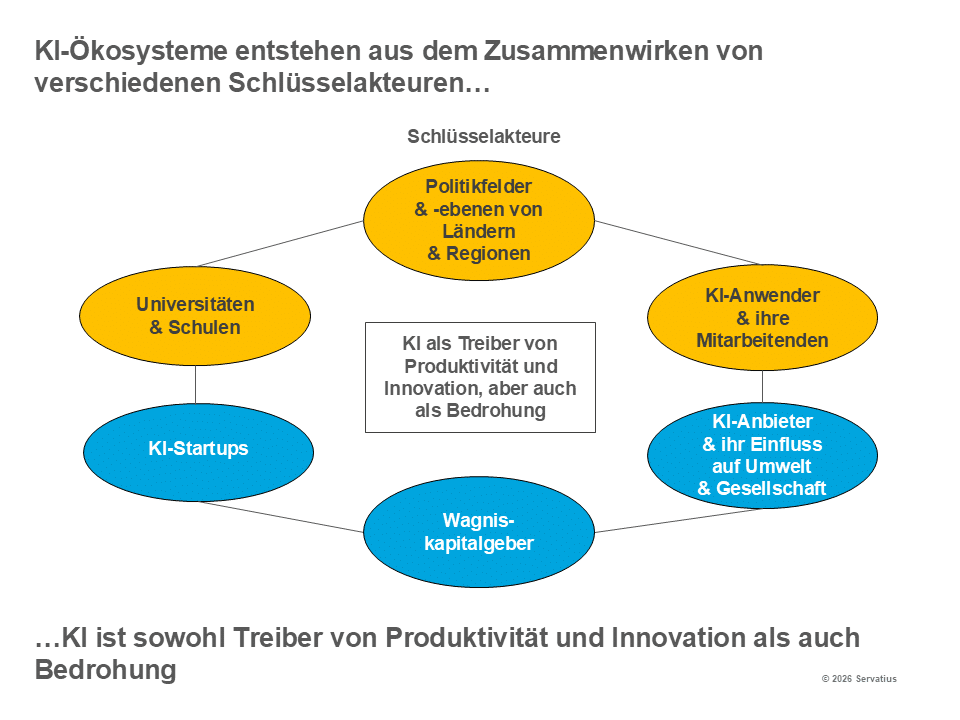
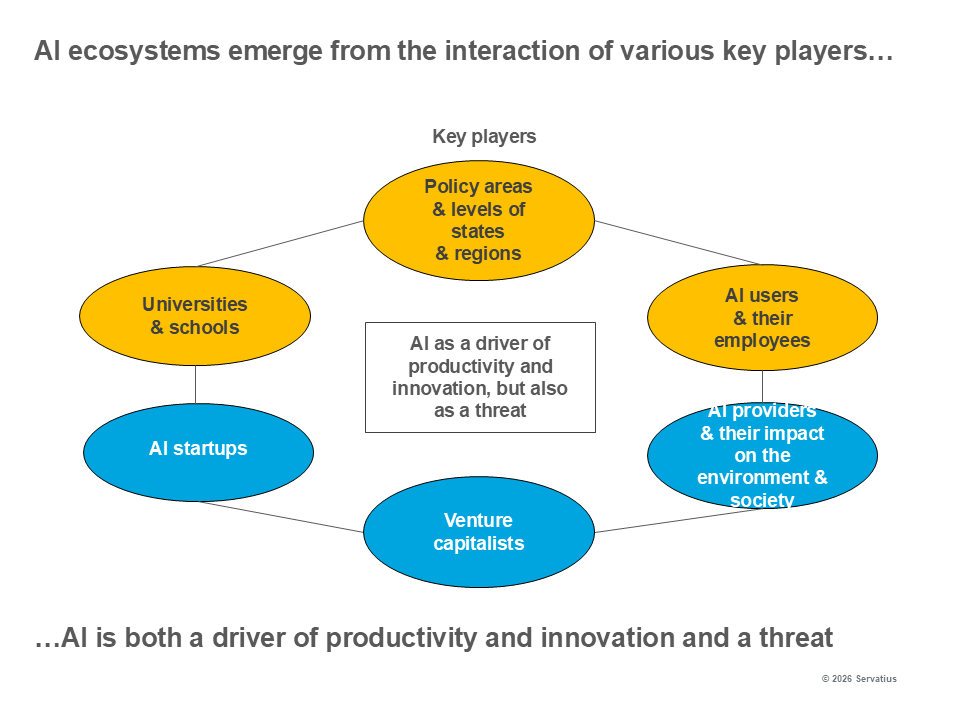
Schlüsselakteure in KI-Ökosystemen sind:

  • Verantwortliche in relevanten Politikfeldern und auf verschiedenen Ebenen von Ländern und Regionen
  • Universitäten und Schulen
  • KI-Startups, die als Ausgründungen entstanden sind oder sich in einer Region angesiedelt haben
  • Wagniskapitalgeber, die mit Venture Capital das Wachstum der KI-Startups finanzieren
  • große Anbieter von KI-Hardware und -Software, die mit ihrer Kapitalkraft die Finanzmärkte prägen und einen erheblichen Einfluss auf Umwelt und Gesellschaft haben sowie
  • etablierte Unternehmen und ihre Mitarbeitenden, die KI anwenden, mit Startups zusammenarbeiten und sich an ihnen beteiligen.

Ein interessantes Beispiel für neue Möglichkeiten der Zusammenarbeit zwischen etablierten Unternehmen und Startups liefert die Pharmaforschung.

Lernprozess Innovationsstrategie

In der Pharmabranche beschleunigen Techbio-Unternehmen, wie das französische Startup Owkin mithilfe von KI die frühe Wirkstoffforschung. Eine erste Welle von Medikamenten, die so entwickelt wurden, befindet sich in klinischen Studien. Eine mögliche Form der Zusammenarbeit ist, dass KI-Biotechs die frühe Wirkstoffsuche übernehmen und etablierte Pharma-Unternehmen die späteren Phasen und die Vermarktung. Eine andere Option ist, dass Pharma-Unternehmen die KI-Startups akquirieren und entsprechende eigene Kompetenzen aufbauen. In jedem Fall steht die forschungsintensive Branche vor einem grundlegenden Wandel, bei dem die Gestaltung von KI-Ökosystemen ein wichtiger Erfolgsfaktor ist.5 Das Beispiel verdeutlicht, dass sich mit dem Wandel von Branchen auch die Managementforschung verändert.

Künstliche Intelligenz ist aber nicht nur Treiber von Produktivität und Innovation, sondern stellt auch eine potenzielle Bedrohung dar. Angesichts der Veränderungen der Geopolitik kommt es für Europa darauf an, Gestaltungsmacht zurückzugewinnen. Ein wichtiges Mittel hierzu kann eine vertrauenswürdige KI sein. Die jüngste Auseinandersetzung zwischen der US-Regierung mit dem US-Startup Anthropic verdeutlicht, wie politisch die Gestaltung von KI-Ökosystemen inzwischen geworden ist.6 Auch dies führt zu gravierenden Veränderungen in der Managementforschung.

Ein wichtiger Aspekt, der bei KI-Ökosystemen häufig übersehen wird, sind die ökologischen und sozialen Wirkungen, die von KI-Technologien ausgehen. So erfordern große Sprachmodelle die Arbeit von Crawlern, die Daten zusammentragen und Annatoren, die Texte und Bilder kommentieren, bewerten und beschriften. Diese Arbeit läuft versteckt von der Öffentlichkeit häufig in Ländern des „globalen Südens“ ab. Die Transparenz dieser Lieferketten ist gering.7


Managementforschung in Reallaboren des Wandels

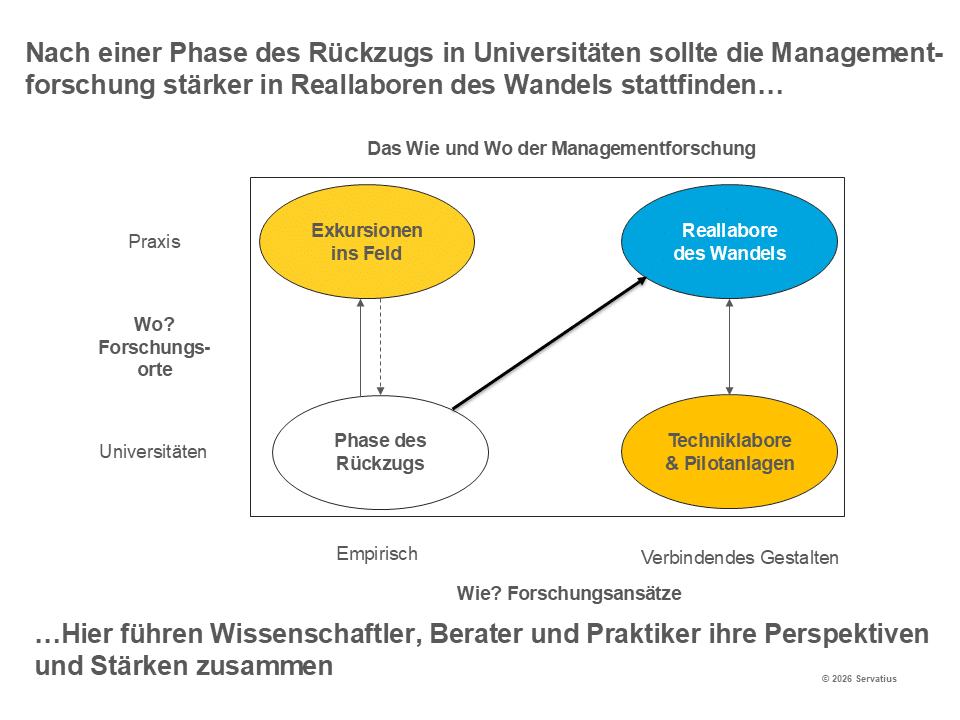
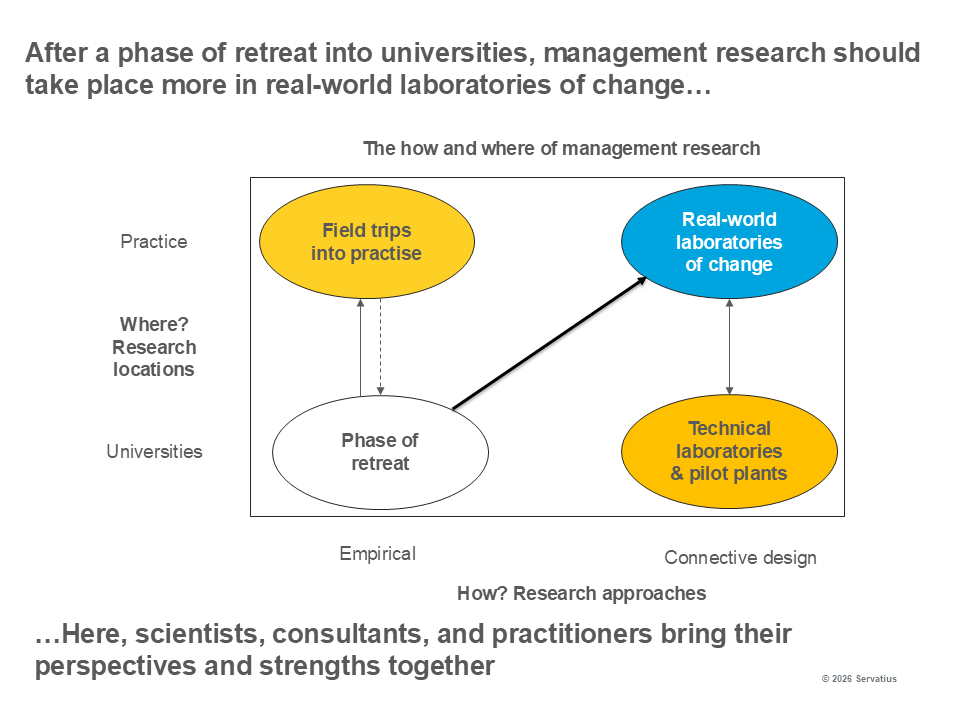
In der betriebswirtschaftlichen Forschung dominieren seit langem empirische Ansätze, die überwiegend von Universitäten ausgehen. Die Ergebnisse ihrer Arbeiten publizieren die Autoren in wissenschaftlichen Fachzeitschriften, die Praktiker aber nur selten lesen. Die Kritik an diesem Rückzug in einen „wissenschaftlichen Elfenbeinturm“ bemängelt, die praktische Relevanz der Forschung habe abgenommen. Diese Kritik ist nicht neu, aber stärker geworden.8

Die Universitäten verteidigen ihre Position mit dem Argument, die Praxisrelevanz der empirischen Forschung basiere auf „Exkursionen ins Feld“, in denen die Sichtweisen relevanter Akteure analysiert würden. Das Ziel der Arbeiten liegt jedoch in der Regel nicht darin, konkrete Objekte wie z.B. neue KI-basierte Geschäftsmodelle in ihrem spezifischen Kontext zu gestalten.9

Insofern unterscheidet sich die betriebswirtschaftliche Forschung von dem gestaltenden Ansatz der Technikwissenschaften, der überwiegend in Laboren und Pilotanlagen abläuft.

Aufgrund der wachsenden Bedeutung einer inter- oder transdisziplinären Forschung nimmt auch in der Managementwissenschaft inzwischen der Anteil eines verbindenden Gestaltens zu. Diese praxisnahe, Design-orientierte Forschung erfolgt zunehmend in Reallaboren des Wandels.10 Ein wichtiger Treiber dieser Entwicklung ist die Künstliche Intelligenz, die als Motor für die Gründung von Startups und eine Neuausrichtung etablierter Unternehmen wirkt. Wir vertreten die Auffassung, die Managementforschung sollte nach einer Phase des Rückzugs in Universitäten wieder stärker in der Praxis stattfinden und dabei gestaltende Ansätze nutzen.

Lernprozess Innovationsstrategie

Mit dieser Antwort auf die Fragen nach dem Wie und Wo der Forschungsansätze beginnt ein neues Kapitel in der Entwicklungsgeschichte der Managementforschung. Ein wichtiges Kennzeichen dieser Neuausrichtung auf ein Connective Design ist eine Forschung, in der Wissenschaftler, Berater und Praktiker ihre verschiedenen Perspektiven und Stärken zusammenführen. Der Nutzen liegt in einer besseren Lösung komplexer Probleme ausgehend von neuen wissenschaftlichen Erkentnissen.11

Ein Beispiel liefert die Entwicklung von humanoiden Robotern. In dem rasant wachsenden Markt haben die Unternehmen die besten Chancen, die Software- und Hardware-Kompetenz verbinden. Dabei sind Daten aus der realen Welt der größte Engpass. Der Metzinger Hersteller Neura Robotics hat sich daher entschieden, Trainingshallen für Roboter zu errichten. Eines der ersten dieser Gyms entsteht in Zusammenarbeit mit der Technischen Universität München im Munich Institute of Robotics and Machine Intelligence (MIRMI) am Flughafen München. Im internationalen Wettbewerb mit Unternehmen aus den USA und aus China kommt es bei dieser KI-Anwendung auf eine schnelle Skalierung an.12

Da die gestaltende Managementforschung weniger verbreitet ist, möchte ich kurz ihre Entwicklungsgeschichte skizzieren. Persönlich habe ich in den letzten Jahrzehnten immer wieder erlebt, wie unterschiedlich die Denk- und Sprachmuster der relevanten Akteure in Theorie und Praxis sind.


Grundlagen und Pioniere einer gestaltenden Managementforschung

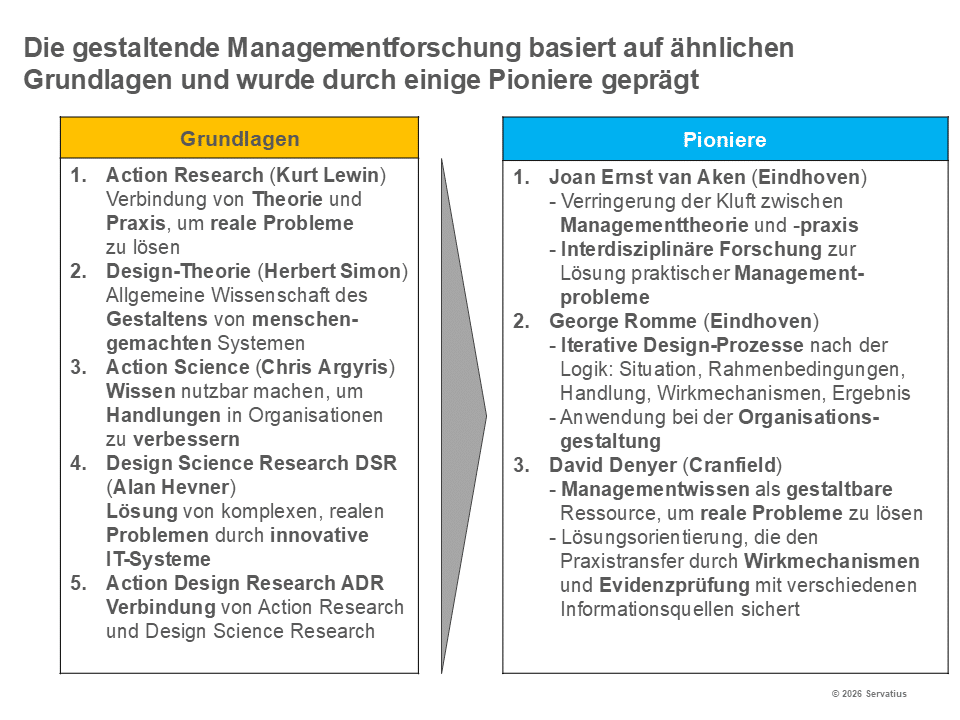
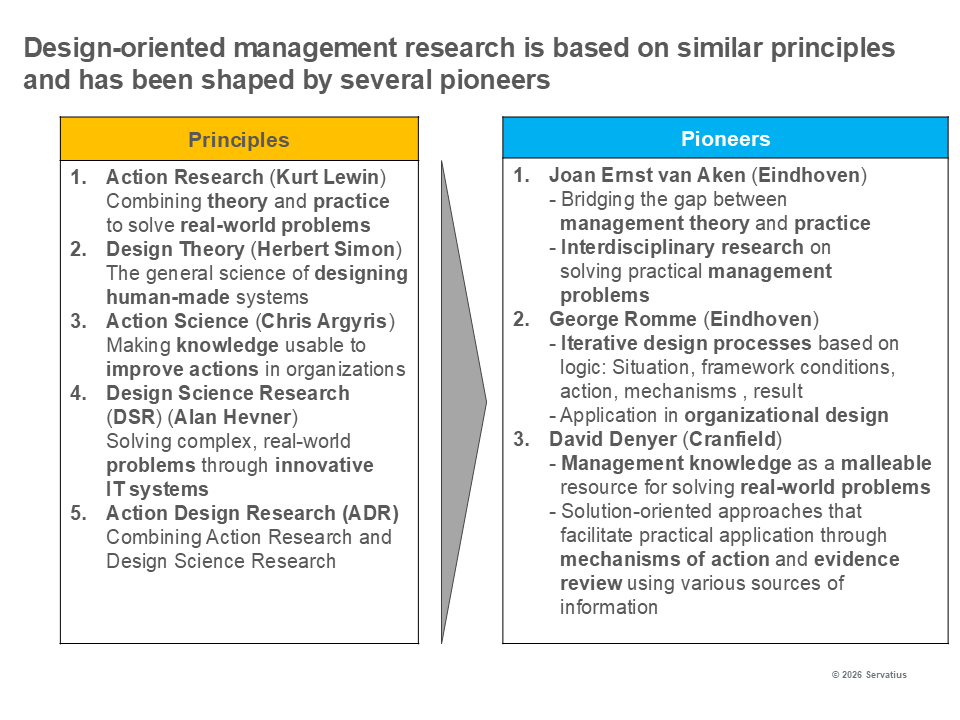
Die gestaltende Managementforschung basiert auf ähnlichen Grundlagen und wurde durch einige Pioniere geprägt.13 Diese Grundlagen sind:

  1. Das von dem Sozialpsychologen Kurt Lewin ausgegangene Action Research. Lewin setzte sich für eine Verbindung von Theorie und Praxis ein, um reale Probleme zu lösen.
  2. Die durch den Wirtschaftsnobelpreisträger Herbert Simon geprägte allgemeine Design-Theorie.14 Simon versteht hierunter eine Wissenschaft des Gestaltens von menschengemachten Artefakten und Systemen.
  3. Die von dem Harvard-Professor Chris Argyris konzipierte Action Science.15 Argyris Ziel ist es vor allem, Wissen nutzbar zu machen, um Handlungen in Organisationen zu verbessern.
  4. Dem von Alan Hevner an der Universität South Florida entwickelten Ansatz des Design Science Research (DSR).16 Bei diesem vor allem in der Wirtschaftsinformatik verbreiteten Konzept steht die Lösung von komplexen, realen Problemen durch innovative IT-Systeme im Mittelpunkt.
  5. Das von verschiedenen Wissenschaftlern beschriebene Action Design Research (ADR), das Action Research und Design Science Research verbindet.
Lernprozess Innovationsstrategie

Pioniere einer gestaltenden Managementforschung sind unter anderem die an der Universität Eindhoven lehrenden Joan Ernst van Aken und Georges Romme sowie David Denyer von der Cranfield University in Großbritannien. Van Aken verfolgt das Ziel, die Kluft zwischen Managementtheorie und -praxis zu verringern. Im Vordergrund steht dabei eine transdisziplinäre Forschung zur Lösung praktischer Managementprobleme. Ausgehend von der Design-Theorie erprobt Romme iterative Prozesse bei der Organisationsgestaltung.17 Denyer sieht Managementwissen als gestaltbare Ressource, um reale Probleme zu lösen. Sein Ansatz zur Lösungsorientierung versucht, den Praxistransfer durch Wirkmechanismen und eine Evidenzprüfung mit verschiedenen Informationsquellen zu sichern.

Besonders deutlich werden die Vorteile eines gestaltungsorientierten Ansatzes in der Innovations- und Nachhaltigkeitsforschung.


Vorteile in der Innovations- und Nachhaltigkeitsforschung

Bei der Anwendung von KI entfalten sich die Vorteile einer gestaltenden Innovations- und Nachhaltigkeitsforschung vor allem in Unternehmen, die diesen Ansatz in selbstähnlichen Strategie 5.0-Laboren praktizieren. Das Ziel eines solchen Reallabors ist eine Verbindung der verschiedenen Handlungsfelder für KI-Anwendungen.18 Dabei hilft es, wenn das Gegenstromprinzip aus top-down entstehender KI-Strategie und einer sich bottom-up entwickelnden harmonischen Vielfalt der KI-Anwendungen funktioniert.

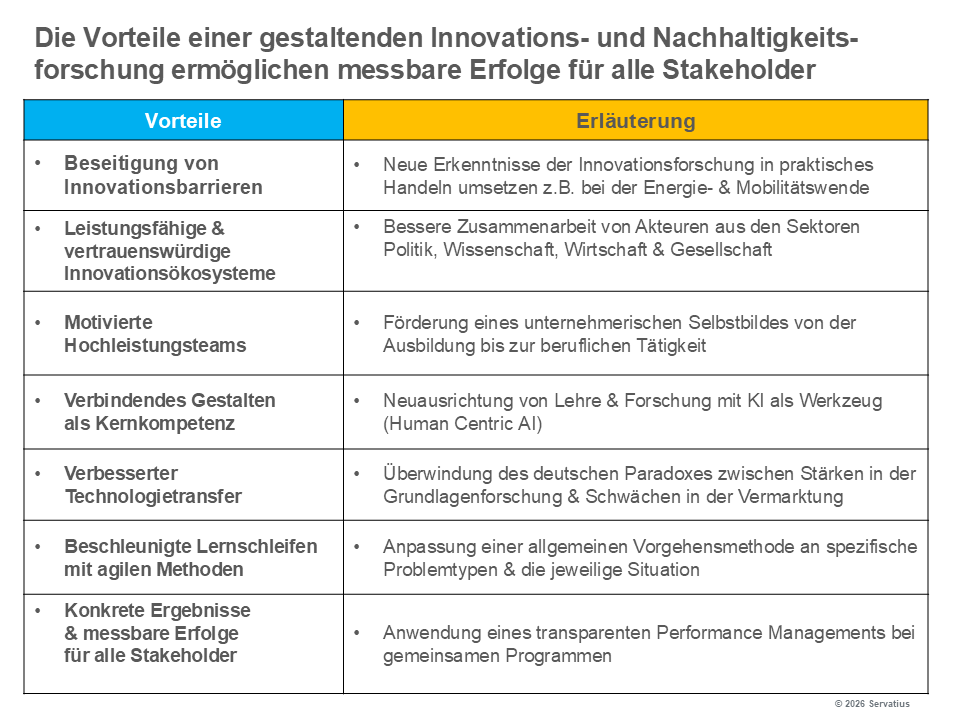
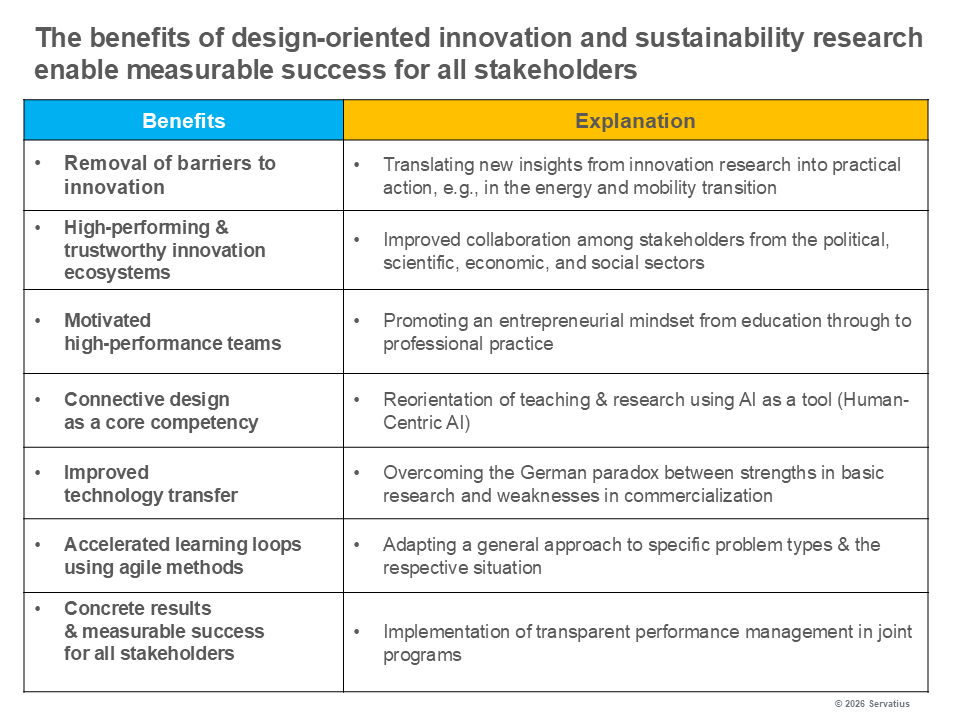
Nach unserer Erfahrung aus einer Reihe an Projekten haben die folgenden Vorteile eine besondere Bedeutung:

  • Die Beseitigung von Innovationsbarrieren
  • leistungsfähige und vertrauenswürdige Innovationsökosysteme
  • motivierte Hochleistungsteams
  • ein verbindendes Gestalten als Kernkompetenz
  • ein verbesserter Technologietransfer
  • beschleunigte Lernschleifen mit agilen Methoden sowie
  • konkrete Ergebnisse und messbare Erfolge für alle Stakeholder.

Diese Vorteile ermöglichen eine Neuausrichtung von Innovationssystemen.

Lernprozess Innovationsstrategie

Die Defizite bei der deutschen Energie- und Mobilitätswende sind ein Beispiel dafür, wie wichtig es ist, Innovationsbarrieren zu beseitigen.19 Hierbei geht es darum, neue Erkenntnisse der Innovationsforschung in praktisches Handeln umzusetzen.

Das Ziel ist die Gestaltung von leistungsfähigen und vertrauenswürdigen Innovationsökosystemen.20 Ein Kennzeichen dieser Systeme ist die bessere Zusammenarbeit der Akteure aus den Sektoren Politik, Wissenschaft, Wirtschaft und Gesellschaft.

Eine Schlüsselrolle bei der gestaltenden Innovationsforschung haben motivierte Hochleistungsteams.21 Führungskräften kommt die Aufgabe zu, ein unternehmerisches Selbstbild vorzuleben und zu fördern. Dies beginnt bei der Ausbildung und setzt sich in der beruflichen Tätigkeit fort.

Eine dabei zu entwickelnde Kernkompetenz ist das verbindende Gestalten.22 Dies erfordert eine Neuausrichtung von Lehre und Forschung mit KI als Werkzeug. Eine solche Human-Centric AI durchdringt alle Disziplinen.

Ein positiver Nebeneffekt ist der verbesserte Technologietransfer.23 Dabei geht es um eine Überwindung des deutschen Paradoxes zwischen Stärken in der Grundlagenforschung und Schwächen bei der Vermarktung.

Ein Mittel hierzu sind beschleunigte Lernschleifen in Organisationen.24 Dabei kommen agile Methoden zum Einsatz. Wichtig ist, ein allgemeines Vorgehenskonzept an spezifische Problemtypen und die jeweilige Situation anzupassen.

Dabei sollten sich alle Stakeholder an konkreten Ergebnissen und messbaren Erfolgen orientieren.25 Bei gemeinsamen Programmen erfolgt dies mit Hilfe eines transparenten Performance Managements.

Im Folgenden möchte ich ein geeignetes Vorgehenskonzept erläutern.


Schritte eines allgemeinen Vorgehenskonzepts

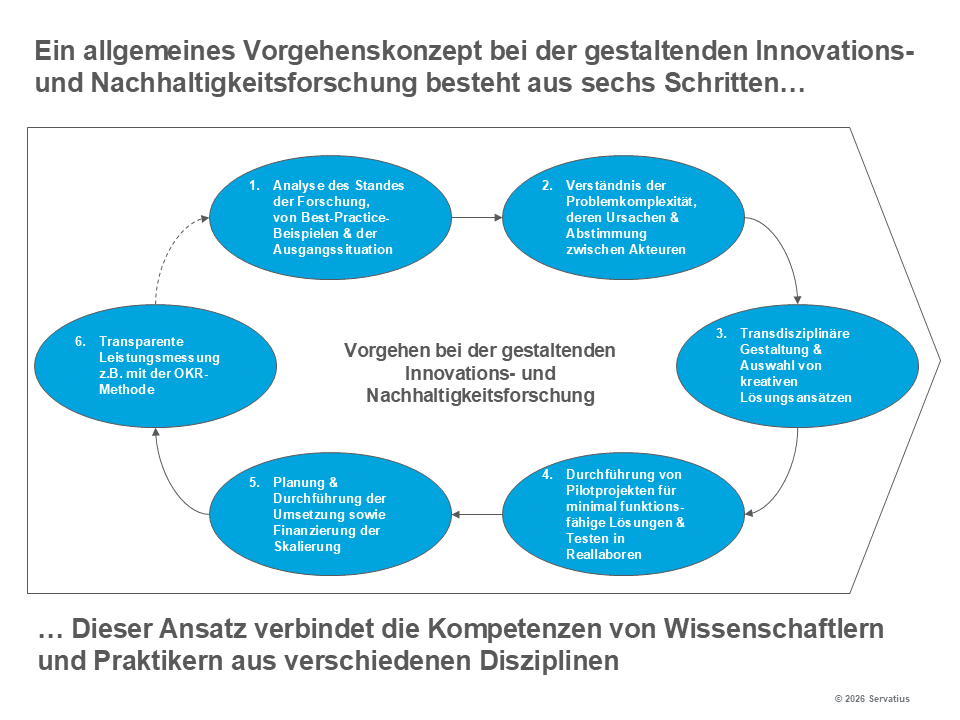
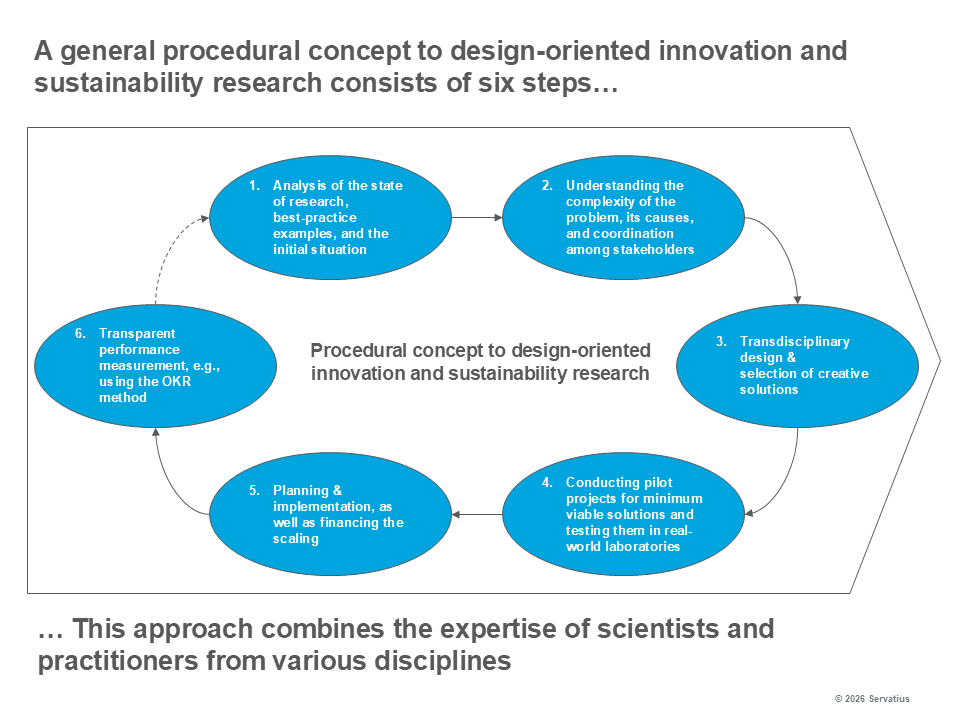
Ein Beispiel für gestaltende Innovations- und Nachhaltigkeitsforschung ist die KI-basierte strategische und organisatorische Neuausrichtung eines Unternehmens.26 Bei Themen wie diesem hat sich ein allgemeines Vorgehenskonzept bewährt, das aus den in der Abbildung dargestellten sechs Schritten besteht.

Lernprozess Innovationsstrategie

Der erste Schritt ist eine Analyse des Standes der Forschung sowie von Best-Practise-Beispielen und der spezifischen Ausgangssituation. Hierbei stellt sich die Aufgabe, eine interne und eine externe Perspektive in einem Audit zu verbinden.

Entscheidend ist dann, ein umfassendes Verständnis der Problemkomplexität zu entwickeln, deren Ursachen zu verstehen und sich dabei zwischen den relevanten Akteuren abzustimmen. Erfolgreicher als disziplinäre Forschungsansätze ist dabei eine Zusammenarbeit verschiedener Fachbereiche mit der Praxis.

Auch bei der anschließenden Gestaltung und Auswahl von kreativen Lösungsansätzen spielen transdisziplinäre Teams eine wichtige Rolle. Was für eine einzelne Organisation Neuland, ist kann dabei in der Summe durchaus zu einem wissenschaftlichen Erkenntnisfortschritt beitragen.

Ein prägendes Kennzeichen der Design-orientierten Innovationsforschung ist die Durchführung von Pilotprojekten für Minimum Viable Solutions (MVS). Diese „minimal funktionsfähigen Lösungen“ werden in Reallaboren des Wandels getestet. Für etablierte Unternehmen erfordert das Arbeiten in Lernschleifen häufig einen Wandel des Mindset. Bei dieser Aufgabe kann die Personalentwicklung unterstützen.

Der fünfte Schritt ist die Planung und Durchführung der Umsetzung. Dies ist eng verbunden mit einer Finanzierung der Skalierung. Deutsche Startups beklagen seit langem Nachteile z.B. gegenüber den USA. Daher ist gerade bei diesem Schritt eine Verbesserung der politischen Rahmenbedingungen anzustreben.

Parallel dazu erfolgt eine transparente Leistungsmessung z.B. mit der Objectives and Key Results (OKR-) Methode. Transparent bedeutet in diesem Zusammenhang, dass das Performance Management nicht in sektoralen Silos stattfindet. Für eine Politik, die zwar Ziele festlegt, aber die Erfolgsmessung vernachlässigt, ist dies mit einem Lernprozess verbunden, der auf eine gemeinsame Systemgestaltung durch Innovationsmanager gerichtet ist.


Innovationsmanager gestalten komplexe, evolutionäre Systeme

Bereits in unserer 2014 erschienenen Buchpublikation „Der Innovationsmanager“ sind wir zu dem Ergebnis gekommen, dass eine zentrale Aufgabe von Innovationsmanagern in der Gestaltung von Innovationssystemen und einer Verbindung verschiedener Handlungsfelder liegt.27 Danach haben wir uns intensiv mit der verhaltensökonomischen Perspektive eines solchen verbindenden Gestaltens beschäftigt.28

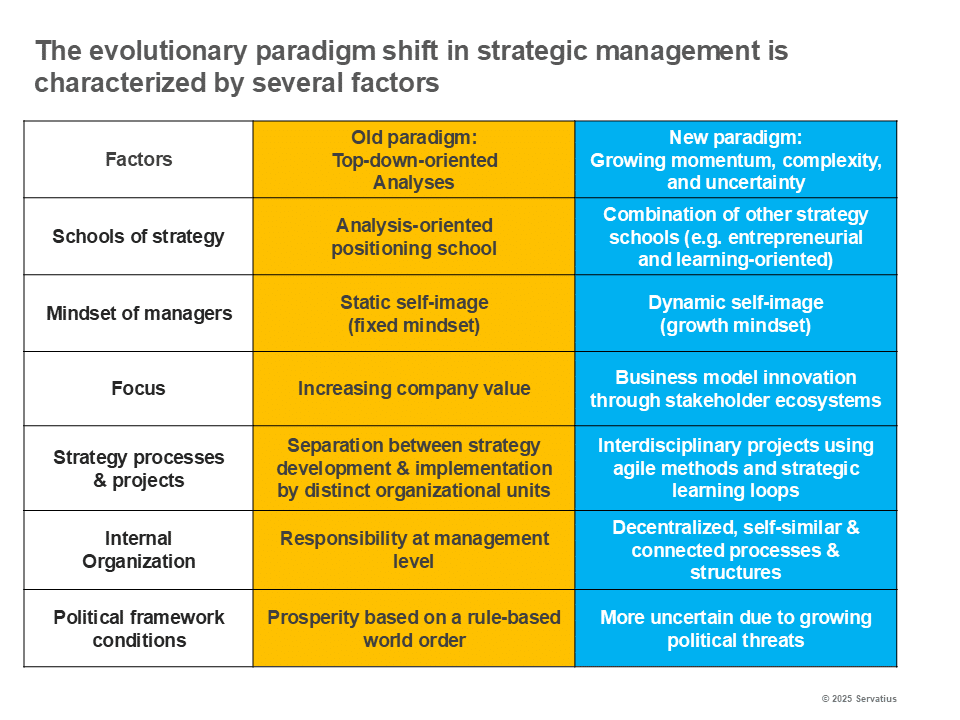
Die wissenschaftliche Grundlage für das Connective Design bildet die Theorie komplexer, evolutionärer Systeme. Die Übertragung dieses Ansatzes auf sozio-technische Systeme hat einen Paradigmenwechsel im strategischen Management ausgelöst.29 Das neue Management-Paradigma haben US-amerikanische Digital-Unternehmen besser gemeistert als die europäische Wirtschaft.30

Eine weitere Erkenntnis ist, dass es sich bei der Innovationsforschung um eine transdisziplinäre Gestaltungsaufgabe handelt.


Inter- oder transdisziplinär?

Wir verwenden bewusst den Begriff transdisziplinär, um deutlich zu machen, dass es nicht nur wie bei dem Begriff interdisziplinär um die Vermittlung zwischen wissenschaftlichen Fächern geht, sondern auch um die Einbeziehung von nichtwissenschaftlichen Akteuren und eine Verbindung zwischen der Theorie und einem praktischen Gestalten.31 Die besondere Komplexität einer transdisziplinären Innovationsforschung resultiert aus

  • der Heterogenität der Disziplinen, die von der naturwissenschaftlichen und technischen Forschung über verschiedene Politikfelder bis zur Managementwissenschaft und Organisationspsychologie reicht
  • den verschiedenen Interessen und Denkmustern z.B. von Wissenschaftlern und Praktikern
  • der Dynamik der Entwicklung und der Anzahl von Ebenen, von der Geopolitik bis zum einzelnen Menschen sowie
  • den unterschiedlichen Rollen der Akteure, z.B. als neutraler Beobachter oder persönlich Betroffener.

Leider mangelt es der transdisziplinären Innovationsforschung in Universitäten bislang an Anerkennung. Die Ursachen hierfür sind vielfältig. Ein wichtiger Grund ist wohl, dass das traditionelle Wissenschafts- und Publikationssystem eher disziplinäre Spitzenleistungen honoriert. Dies ist eine Chance für die anwendungsorientierte Forschung.


Transdisziplinäre Forschung zu Nachhaltigkeitsinnovationen

Unsere 1994 erschienene Buchpublikation zum „ökologischen Umsteuern“ von Automobilunternehmen ist aus Beratungsprojekten und einer begleitenden Forschung an der Universität Stuttgart entstanden.32 Diese Forschung war transdisziplinär, aber nur eingeschränkt gestaltend, weil deutsche Unternehmen und die Politik damals unsere Empfehlungen z.B. zu neuen Antriebssystemen nicht umgesetzt haben.

Dreißig Jahre später kämpft die für die deutsche Wirtschaft so wichtige Branche mit gravierenden Problemen. VW, der nach Fahrzeugabsatz zweitgrößte Automobilhersteller weltweit, befindet sich in einem Prozess der strategischen und organisatorischen Neuausrichtung.33 Gleichzeitig sind die geopolitischen Rahmenbedingungen von extremer Unsicherheit geprägt.

Das Beispiel verdeutlicht, dass beim Thema Nachhaltigkeitsinnovation eine transdisziplinäre und gestaltende Forschung für die Sicherung des Wohlstands unseres Landes von entscheidender Bedeutung ist. 34 In den letzten Jahren hat sich das Thema dynamisch weiterentwickelt. Dabei ist die Verbindung von Umwelttechnik und Künstlicher Intelligenz in den Mittelpunkt des Interesses gerückt. Aus der Zusammenarbeit von etablierten Unternehmen mit Digital Greentech Startups können neue Marktführer entstehen, wenn es der europäischen Politik gelingt, die Rahmenbedingungen zu verbessern. 35

Ein Beispiel ist das deutsch-luxemburgische Startup R3 Robotics, das eine KI-gestützte Robotik-Plattform für das Batterierecycling entwickelt hat. Auf diese Weise kann Europa seine Abhängigkeit von Importen verringern und die Nachhaltigkeit von Batterien erhöhen.36

Nach meiner persönlichen Erfahrung sind Studierende an solchen Themen nach wie vor sehr interessiert, weil sie die sich ergebenden Karrierechancen erkennen. Hiervon gehen für unser Expertenetzwerk wichtige Impulse aus.


Verbindung von Managementberatung und Personalentwicklung mit einer gestaltenden Innovations- und Nachhaltigkeitsforschung

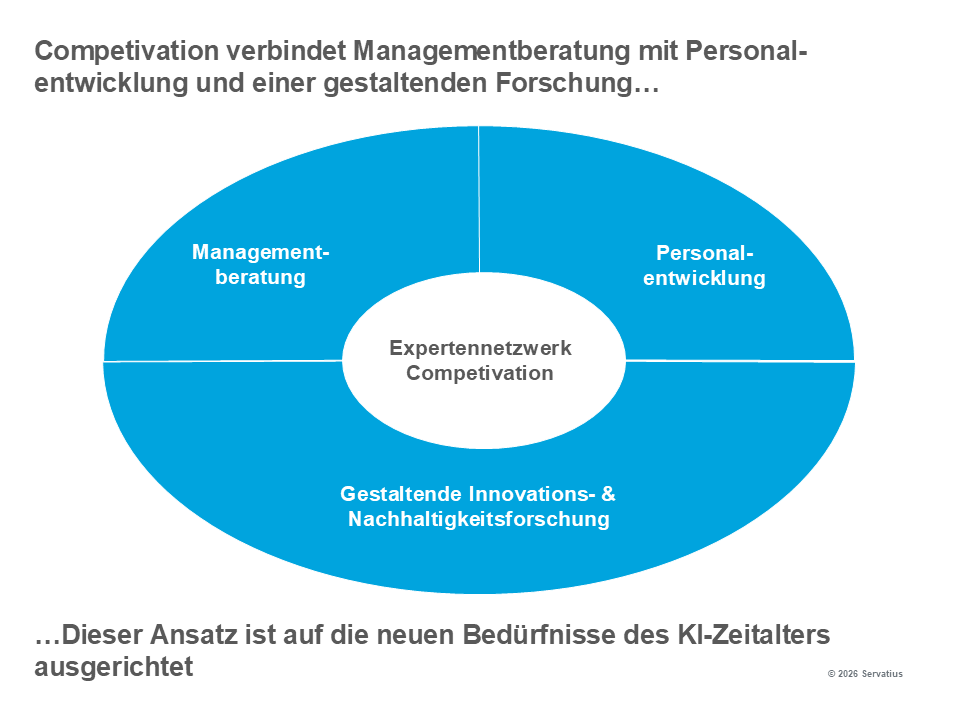
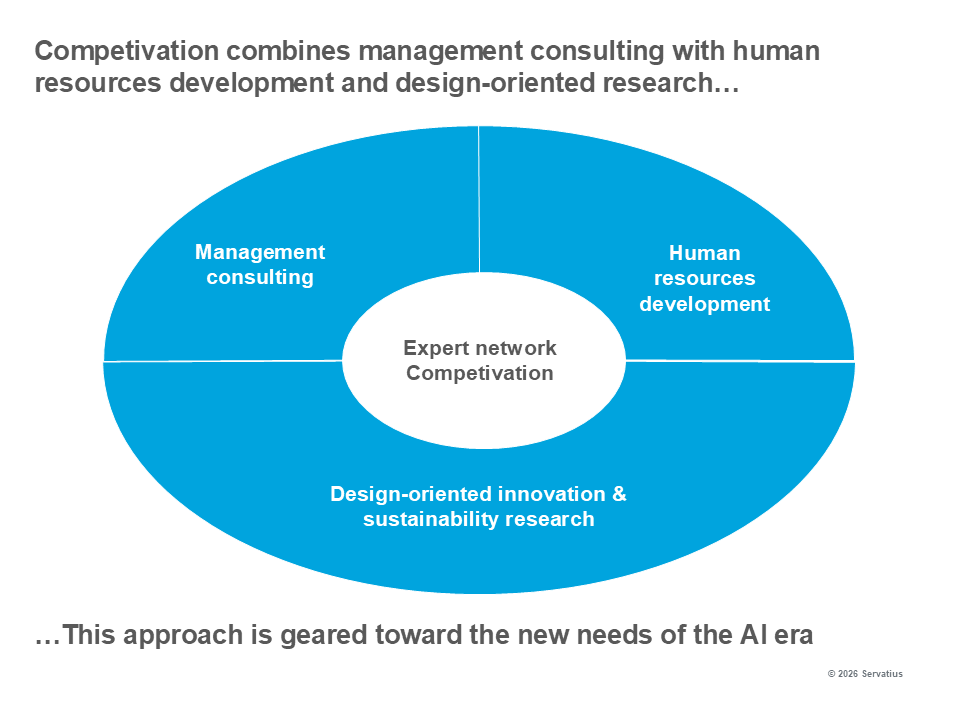
Unser Expertennetzwerk Competivation verbindet seit langem Managementberatung und Personalentwicklung. Der Vorteil für die Klienten ist ein besseres Preis-Leistungsverhältnis als bei traditionellen Consultants, da ein Schwerpunkt auf der Qualifikation der Mitarbeitenden liegt, die aktiv in die Projekte eingebunden sind.

Seit einigen Jahren ergänzen wir diese Dienstleistung durch eine gestaltende Innovations- und Nachhaltigkeitsforschung. Dabei betreuen wir die Abschlussarbeiten von dualen Studierenden und externen Doktoranden, die in der Klientenorganisation an entsprechenden Projekten arbeiten. Hierbei liegt der Vorteil darin, dass die Forschung auf die spezifische Situation des Unternehmens zugeschnitten ist. Die Forschenden und ihr Unternehmen profitieren von der langen Erfahrung unserer Experten.

Lernprozess Innovationsstrategie

Mit diesem Ansatz hat Competivation ein internationales Alleinstellungsmerkmal geschaffen, das auf die Bedürfnisse des KI-Zeitalters ausgerichtet ist.

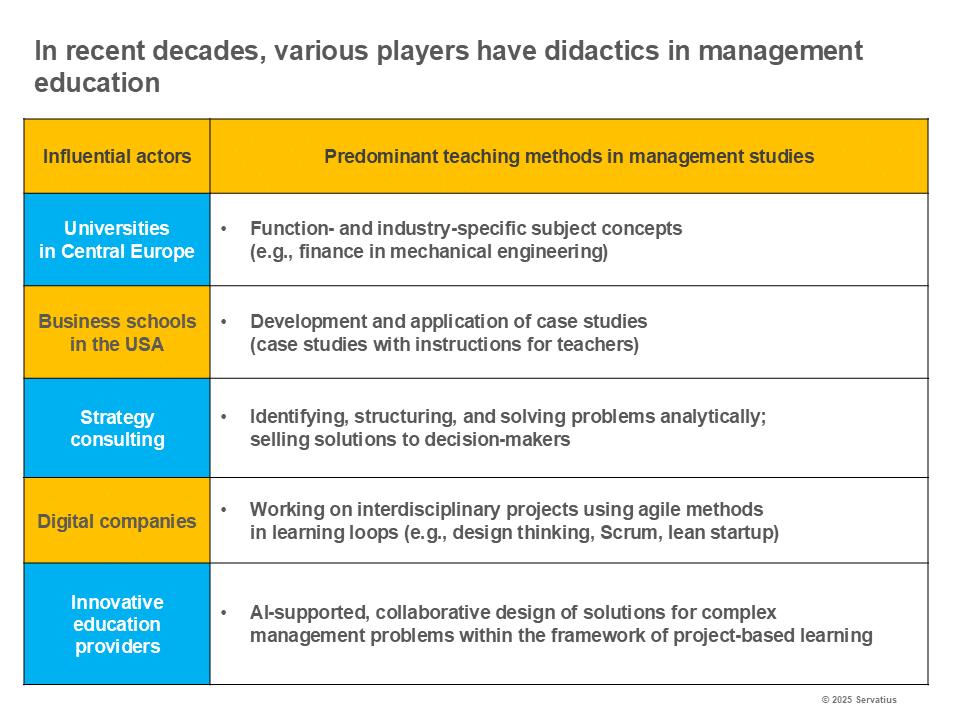
Eine gestaltende Forschung hat auch weit reichende Implikationen für die Hochschullehre. Dabei verstehen wir uns als innovativen Bildungsanbieter, der die Fähigkeit zu einem KI-unterstützten verbindenden Gestalten von Lösungen für komplexe Managementprobleme vermittelt.37


Fazit

  • Bei der Anwendung von KI stehen viele Unternehmen vor der Aufgabe, ihre Position zu verteidigen und mit einem spezifischen Ansatz Wettbewerbsvorteile zu erzielen
  • Dabei kommt es entscheidend auf die Gestaltung von KI-Ökosystemen an
  • Parallel zu dieser Entwicklung verlagern sich Forschungsansatz und -ort in Richtung auf eine gestaltende Innovationsforschung in Reallaboren des Wandels
  • Dabei erlebt die gestaltende Management- und Innovationsforschung eine Renaissance, die sich aus einer Reihe von Vorteilen ergibt
  • Bei diesem transdisziplinären Forschungsansatz hat sich ein Vorgehen in sechs Schritten bewährt, das an den jeweiligen Problemtyp und die Situation angepasst wird.


Literatur

[1] Bomke, L., Wie Unternehmen den KI-Stresstest bestehen. In: Handelsblatt, 18. Februar 2026, S. 24

[2] Busch, R., „Wir erschaffen das industrielle Gegenstück zu ChatGPT“ (Interview). In: Manager Magazin, März 2026, S. 86-90

[3] Scheer, O., Das 440-Milliarden-Euro-Potenzial. In: Handelsblatt, 25. Februar 2026, S. 12

[4] Servatius, H.G., Wettbewerbsvorteile mit wissensspezifischer KI. In: Competivation Blog, 11.02.2025

[5] Smolak, H., Mehr Wirkstoffe, weniger Jobs? In: Handelsblatt, 24. Februar 2026, S. 22

[6] Matthes, S., Die Verfassungskrise der Maschinen. In: Handelsblatt, 13./14./15. März 2026, S. 5

[7] Muldoon, J., Feeding the Machine – Hinter den Kulissen der KI-Imperien, Harper Collins 2025

[8] Servatius, H.G., KI und die Zukunft der Management Education. In: Competivation Blog, 09.04.2025

[9] Servatius, H.G., KI als Werkzeug für das strategische Management. In: Competivation Blog, 01.05.2025

[10] Servatius, H.G., Gestaltung von vertrauenswürdigen Hochleistungssystemen. In: Competivation Blog, 29.01.2026

[11] Servatius, H.G., Lernen, Lösungen für komplexe Managementprobleme zu gestalten. In: Competivation Blog, 15.07.2025

[12] Buchenau, M., et al., Die deutschen Konkurrenten der Tesla-Roboter. In: Handelsblatt, 25.03.2026, S. 22-23

[13] Obdenakker, R., Cuijpers, C., Design Science Methodology for the Management Science – From Foundations to Implementation, Springer 2025

[14] Simon, H.A., The Sciences of the Artificial, 3. Aufl., MIT Press1996

[15] Argyris, C., Putnam, R., McLain Smith, A., Action Science – Concepts, Methods and Skills for Research and Intervention, Jossey-Bass 1985

[16] Hevner, A.R., et al., Design Science in Information Systems Research. In: MIS Quarterly, März 2004, S. 75-105

[17] Romme, G., The Quest for Professionalism – The Case of Management and Entrepreneurship, Paperbackshop UK Import 2016

[18] Servatius, H.G., Fraktale Organisation von Strategie 5.0-Laboren. In: Competivation Blog, 28.03.2023

[19] Servatius, H.G., Auf dem Weg zu einem neuen wirtschaftspolitischen Narrativ. In: Competivation Blog, 16.05.2022

[20] Servatius, H.G., Design von smarten Innovationsökosystemen. In: Competivation Blog, 12.05.2017

[21] Servatius, H.G., Eine Organisation auf Leistung trimmen. In: Harvard Manager, 1988, Nr. 4, S. 128-134

[22] Servatius, H.G., Let‘s Connect! Personalentwicklung für Stakeholder-Ökosysteme. In: IM+io, 2023, Heft 1, S. 40-41

[23] Servatius, H.G., Innovationsstrategien gemeinsam mit Stakeholdern gestalten. In: Competivation Blog, 31.08.2018

[24] Servatius, H.G., GenAI-basierte strategische Lernschleifen als verbindendes Prozessmuster. In: Competivation Blog, 15.08.2024

[25] Servatius, H.G., Von der digitalen Fitness zu Key Performance Indicators. In: Competivation Blog, 05.07.2017

[26] Servatius, H.G., Dreifache strategische Neuausrichtung. In: Competivation Blog, 07.06.2024

[27] Servatius, H.G., Gestaltung des Innovationssystems von Unternehmen. In: Servatius, H.G., Piller, F.D., (Hrsg.), Der Innovationsmanager – Wertsteigerung durch ein ganzheitliches Innovationsmanagement, Symposion 2014, S. 21-64

[28] Servatius, H.G., Wie Manager das Innovationssystem verhaltensökonomisch gestalten. In: IM+io, September 2015, Heft 3, S. 20-27

[29] Servatius, H.G., Entwicklung und Wandel des strategischen Managements. In: Competivation Blog, 19.09.2025

[30] Servatius, H.G., Von erfolgreichen Digital-Unternehmen lernen. In: Competivation Blog, 12.07.2024

[31] Schmohl, T., Philipp, T. (Hrsg.), Handbuch transdisziplinäre Didaktik, Transcript 2021

[32] Berger, R., Servatius, H.G., Krätzer, A., Die Zukunft des Autos hat erst begonnen – Ökologisches Umsteuern als Chance, Piper 1994

[33] Backovic, L., Weniger Volkswagen wagen. In: Handelsblatt, 20./ 21./ 22. März 2026, S. 50-54

[34] Servatius, H.G., Konnektivität bei Nachhaltigkeitsinnovationen. In: Competivation Blog, 01.02.2022

[35] Servatius, H.G., Mit einer Strategie 5.0 zu Erfolgen bei Digital GreenTech. In: Fesidis, B., Röß, S.A., Rummel, S. (Hrsg.), Mit Digitalisierung und Nachhaltigkeit zum klimaneutralen Unternehmen, SpringerGabler 2023, S. 71-94

[36] Höpner, A., Mit KI Elektroautos recyceln. In: Handelsblatt, 23. März 2026, S. 29

[37] Servatius H.G., Disruption der Management Education für KI-basierte Neuausrichtungen. In: Competivation Blog, 10.10.2025

Gestaltende Innovationsforschung zu KI-Anwendungen

Design-oriented innovation research on AI applications

Around the world, many companies face the challenge of keeping pace with artificial intelligence (AI) and gaining a competitive edge through AI tools that leverage their specific expertise. This development is leading to a renaissance in design-oriented management and innovation research, which aims to bridge the gap between theory and practice. In the process, research is shifting from empirical work at universities to connective design in real-world laboratories of change.


In this blog post, I outline the development of the design-oriented research approach, highlight its advantages, and explain a general procedural concept.


A decisive year for AI adoption

2026 could be the year that determines for many companies whether they achieve a breakthrough in AI adoption or remain stuck with isolated pilot projects. According to an analysis by the market research firm Forrester, only 15 percent of decision-makers report that the use of AI has so far made a measurable contribution to their companies’ operating results. This could lead them to postpone about a quarter of their planned AI spending until 2027. However, the danger of being too hesitant in adopting AI is that it creates a gap that is difficult to close.1

On the other hand, pioneering companies are succeeding in achieving significant competitive advantages with AI tailored to their specific situations. These pioneers practice design-oriented management and innovation research to lay the groundwork for success. One example is Siemens, which aims to develop the world’s largest and broadest range of industrial AI applications and double its enterprise value.2

The German Economic Research Institute (IW) forecasts that the potential for increasing gross value added through the use of AI in Germany by 2034 stands at 440 billion euros. Of this, 110 billion euros is attributable to potential innovations and 330 billion euros to increased productivity. For Germany as an industrial hub, the application of AI in particular presents an opportunity. Google, a subsidiary of the U.S. technology conglomerate Alphabet, has also recognized this. It plans to invest 5.5 billion euros in Germany and open a center for AI applications in Berlin, where its own researchers will also be based.3

This new situation has exciting implications for the design of AI ecosystems.


Designing AI ecosystems

The opportunity for established companies lies in knowledge-specific AI, where AI tools leverage and amplify the companies’ specialized expertise.4 This is most effectively achieved within AI ecosystems.

The term “AI ecosystem” refers to a dynamic network with strong connections between various actors who use AI technologies to create and disseminate innovations. AI ecosystems can be concentrated in a single region and have developed around a central hub, such as a university or a company. The world’s best-known and most influential AI ecosystem emerged in Silicon Valley in the San Francisco Bay Area. Stanford University near Palo Alto formed the core of Silicon Valley in the 1930s. In 1939, Bill Hewlett and David Packard founded the company HP there in a garage. Later, leading semiconductor companies – which gave the valley its name – and some of the major AI providers established themselves here.

Stanford University served as a model for Helmut Schöneberger, the head of the Munich-based startup incubator UnternehmerTUM. Crucial to its success were the collaboration with the Technical University of Munich and the support of BMW shareholder Susanne Klatten. In addition, other startup incubators have emerged in Munich, such as the Center for Digital Technology and Management (CDTM), which offers the transdisciplinary master’s program in Technology Management, works closely with industry partners, and has spawned over 250 startups.

By 2025, startups in Munich had received 3.3 billion euros in venture capital, thereby pushing Berlin into second place in this category, where startups raised 2.7 billion euros. However, AI ecosystems with successful startups have also emerged in other German regions.

Key players in AI ecosystems include:

  • Decision-makers in relevant policy areas and at various levels of state and regional government
  • Universities and schools
  • AI startups that originated as spin-offs or have established themselves in a region
  • Venture capitalists who use venture capital to finance the growth of AI startups
  • Major providers of AI hardware and software that shape financial markets with their financial clout and have a significant impact on the environment and society, as well as
  • established companies and their employees, who use AI, collaborate with startups, and invest in them.

Pharmaceutical research provides an interesting example of new opportunities for collaboration between established companies and startups.

Lernprozess Innovationsstrategie

In the pharmaceutical industry, tech-bio companies, such as the French startup Owkin, are accelerating early-stage drug discovery with the help of AI. A first wave of drugs developed in this way is currently in clinical trials. One possible form of collaboration is for AI biotechs to take on early-stage drug discovery and for established pharmaceutical companies to handle the later phases and commercialization. Another option is for pharmaceutical companies to acquire AI startups and build up their own relevant capabilities. In any case, this research-intensive industry is facing a fundamental change, in which the design of AI ecosystems is a key success factor.5 This example illustrates that as industries evolve, management research changes as well.

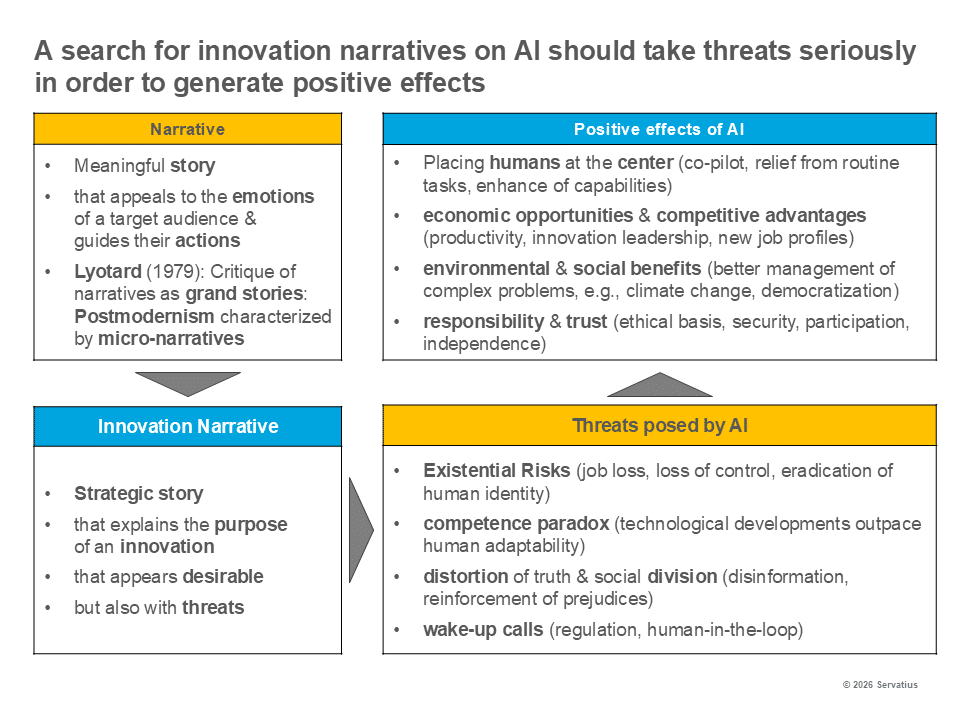
However, artificial intelligence is not only a driver of productivity and innovation but also poses a potential threat. In light of geopolitical shifts, it is crucial for Europe to regain its ability to shape the future. A trustworthy AI can be an important means to this end. The recent dispute between the U.S. government and the U.S. startup Anthropic illustrates just how political the design of AI ecosystems has become.6 This, too, is leading to significant changes in management research.

An important aspect that is often overlooked in AI ecosystems is the environmental and social impact of AI technologies. For instance, large language models require the work of crawlers that collect data and annotators who comment on, evaluate, and label texts and images. This work often takes place out of the public eye, frequently in countries of the “Global South.” Transparency in these supply chains is low.7


Management research in real-world laboratories of change

Empirical approaches, predominantly originating from universities, have long dominated business research. The authors publish the results of their work in academic journals, which practitioners rarely read. Critics of this retreat into an “academic ivory tower” argue that the practical relevance of research has diminished. This criticism is not new, but it has grown stronger.8

Universities defend their position by arguing that the practical relevance of empirical research is based on “field trips” in which the perspectives of relevant actors are analyzed. However, the goal of such work is generally not to design concrete objects – such as new AI-based business models –within their specific context.9

In this respect, business research differs from the design-oriented approach of engineering sciences, which takes place predominantly in laboratories and pilot plants.

Due to the growing importance of inter- or transdisciplinary research, the proportion of connective design is also increasing in management science. This practice- and design-oriented research is increasingly taking place in real-world laboratories of change.10 A key driver of this development is artificial intelligence, which acts as a catalyst for the founding of startups and the realignment of established companies. We believe that, following a phase of retreat into universities, management research should once again take place more strongly in practice and utilize design-oriented approaches.

Lernprozess Innovationsstrategie

This response to the questions of how and where research approaches should be conducted marks the beginning of a new chapter in the history of management research. A key feature of this reorientation toward connective design is research in which scientists, consultants, and practitioners bring their diverse perspectives and strengths together. The benefit lies in better solutions to complex problems based on new scientific insights.11

The development of humanoid robots provides an example. In this rapidly growing market, companies have the best chances when they combine software and hardware expertise. Data from the real world is the biggest bottleneck here. The Metzingen-based manufacturer Neura Robotics has therefore decided to build training facilities for robots. One of the first of these “gyms” is being developed in collaboration with the Technical University of Munich at the Munich Institute of Robotics and Machine Intelligence (MIRMI) at Munich Airport. In international competition with companies from the U.S. and China, rapid scaling is crucial for this AI application.12

Since design-oriented management research is less widespread, I would like to briefly outline its history. Personally, over the past few decades, I have repeatedly observed how different the thought and language patterns of the relevant actors are in theory and practice.


Principles and pioneers of creative management research

Design-oriented management research is based on similar principles and has been shaped by several pioneers.13 These principles are:

  1. Action research, pioneered by social psychologist Kurt Lewin. Lewin advocated for a connection between theory and practice to solve real-world problems.
  2. General design theory, as defined by Nobel Prize-winning economist Herbert Simon.14 Simon defines this as the science of designing human-made artifacts and systems.
  3. Action Science, conceived by Harvard professor Chris Argyris.15 Argyris’s primary goal is to make knowledge usable in order to improve actions within organizations.
  4. The Design Science Research (DSR) approach developed by Alan Hevner at the University of South Florida.16 This concept, which is particularly widespread in business informatics, focuses on solving complex, real-world problems through innovative IT systems.
  5. Action Design Research (ADR), described by various scholars, which combines Action Research and Design Science Research.
Lernprozess Innovationsstrategie

Pioneers of design-oriented management research include Joan Ernst van Aken and Georges Romme, who teach at Eindhoven University, as well as David Denyer from Cranfield University in the UK. Van Aken aims to bridge the gap between management theory and practice. The focus is on transdisciplinary research to solve practical management problems. Building on design theory, Romme tests iterative processes in organizational design.17  Denyer views management knowledge as a malleable resource for solving real-world problems. His solution-oriented approach seeks to ensure practical application through mechanisms of action and evidence-based verification using various information sources.

The advantages of a design-oriented approach are particularly evident in innovation and sustainability research.


Advantages in innovation and sustainability research

When applying AI, the advantages of a design-oriented approach to innovation and sustainability research unfold most notably in companies that practice this approach in self-similar Strategy 5.0 labs. The goal of such a real-world lab is to connect the various fields of action for AI applications.18 It is helpful if the countercurrent principle – combining a top-down AI strategy with a bottom-up, harmoniously diverse range of AI applications – is effectively implemented.

Based on our experience from a series of projects, the following benefits are of particular importance:

  • The removal of barriers to innovation
  • high-performing and trustworthy innovation ecosystems
  • motivated high-performance teams
  • connective design as a core competency
  • improved technology transfer
  • accelerated learning loops using agile methods, as well as
  • concrete results and measurable success for all stakeholders.

These advantages enable a realignment of innovation systems.

Lernprozess Innovationsstrategie

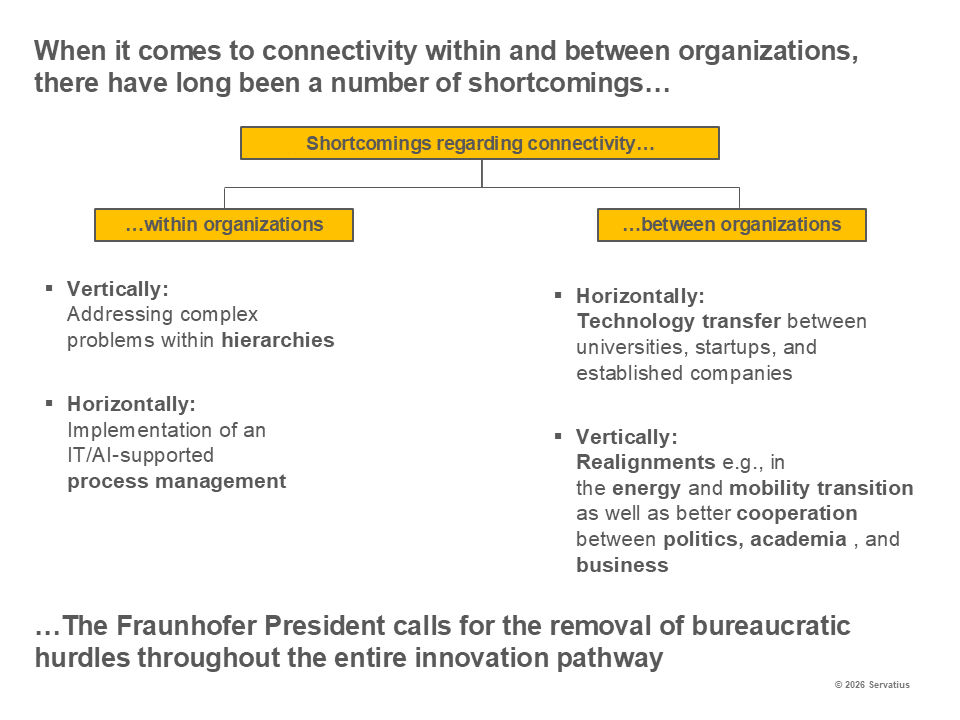
The shortcomings in Germany’s energy and mobility transition are an example of how important it is to remove barriers to innovation.19 The aim here is to translate new insights from innovation research into practical action.

The goal is to design high-performing and trustworthy innovation ecosystems.20 A hallmark of these systems is improved collaboration among stakeholders from the political, scientific, economic, and social sectors.

Motivated high-performance teams play a key role in shaping innovation research.21 Leaders have the task of exemplifying and fostering an entrepreneurial mindset. This begins with education and continues throughout one’s professional career.

A core competency to be developed in this context is connective design.22 This requires a reorientation of teaching and research using AI as a tool. Such human-centric AI permeates all disciplines.

A positive side effect is improved technology transfer.23 The goal here is to overcome the German paradox between strengths in basic research and weaknesses in commercialization.

One way to achieve this is through accelerated learning loops within organizations.24 Agile methods are used for this purpose. It is important to adapt a general approach to specific types of problems and the situation at hand.

In doing so, all stakeholders should focus on concrete results and measurable successes.25 In joint programs, this is achieved through transparent performance management.

In the following, I would like to explain a suitable approach.


Steps of a general procedural concept

An example of design-oriented innovation and sustainability research is the AI-based strategic and organizational realignment of a company.26 For topics such as this, a general procedural concept consisting of the six steps shown in the figure has proven effective.

Lernprozess Innovationsstrategie

The first step is an analysis of the state of research, best-practice examples, and the specific initial situation. The task here is to combine an internal and an external perspective in an audit.

It is then crucial to develop a comprehensive understanding of the problem’s complexity, to identify its causes, and to coordinate efforts among the relevant stakeholders. Collaboration between various disciplines and practitioners is more successful than disciplinary research approaches.

Transdisciplinary teams also play a key role in the subsequent design and selection of creative solutions. What may be uncharted territory for a single organization can, when taken as a whole, contribute significantly to scientific progress.

A defining characteristic of design-oriented innovation research is the implementation of pilot projects for Minimum Viable Solutions (MVS). These pilots are tested in real-world laboratories of change. For established companies, working in learning loops often requires a shift in mindset. Human resources development can support this effort.

The fifth step is planning and executing the implementation. This is closely linked to financing the scaling process. German startups have long complained of disadvantages, for example, compared to the U.S. Therefore, an improvement in the political framework conditions should be sought, particularly in this step.

In parallel, transparent performance measurement takes place, for example, using the Objectives and Key Results (OKR) method. In this context, “transparent” means that performance management does not occur in sectoral silos. For a policy that sets goals but neglects to measure success, this involves a learning process aimed at joint system design by innovation managers.


Innovation managers design complex, evolutionary systems

As early as in our 2014 book publication “The Innovation Manager,” we concluded that a central task of innovation managers lies in the design of innovation systems and the connection of various fields of action.27 Subsequently, we engaged intensively with the behavioral economic perspective of such connective design.28

The scientific foundation for connective design is the theory of complex, evolutionary systems. The application of this approach to socio-technical systems has triggered a paradigm shift in strategic management.29 U.S. digital companies have mastered this new management paradigm better than the European economy.30

Another insight is that innovation research is a transdisciplinary design task.


Interdisciplinary or transdisciplinary?

We deliberately use the term transdisciplinary to make it clear that, unlike the term interdisciplinary, it is not merely about mediating between scientific disciplines, but also about involving non-scientific actors and establishing a connection between theory and practical design.31 The particular complexity of transdisciplinary innovation research stems from

  • the heterogeneity of the disciplines, which ranges from natural science and technical research through various policy fields to management science and organizational psychology
  • the diverse interests and thought patterns, e.g., of scientists and practitioners
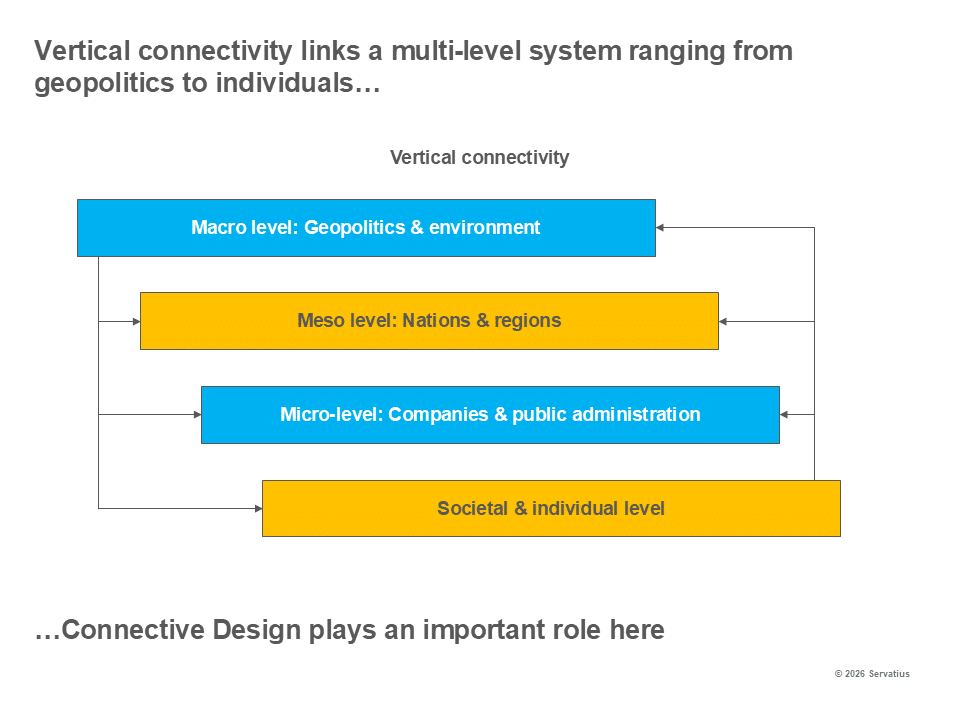
  • the dynamics of development and the number of levels, from geopolitics down to the individual, as well as
  • the different roles of the actors, e.g., as neutral observers or personally affected individuals.

Unfortunately, transdisciplinary innovation research has so far lacked recognition in universities. The reasons for this are manifold. One important reason is likely that the traditional academic and publication system tends to reward disciplinary excellence. This presents an opportunity for applied research.


Transdisciplinary research on sustainability innovations

Our book, published in 1994, on the “ecological reorientation” of automotive companies emerged from consulting projects and accompanying research at the University of Stuttgart.32 This research was transdisciplinary, but had only a limited impact because German companies and policymakers at the time did not implement our recommendations – for example, regarding new propulsion systems.

Thirty years later, this industry – so vital to the German economy – is grappling with serious problems. VW, the world’s second-largest automaker by vehicle sales, is undergoing a process of strategic and organizational realignment.33 At the same time, the geopolitical landscape is marked by extreme uncertainty.

This example illustrates that, when it comes to sustainability innovation, transdisciplinary and design-oriented research is of crucial importance for securing our country’s prosperity. 34 In recent years, the field has evolved dynamically. The intersection of environmental technology and artificial intelligence has moved to the center of attention. New market leaders can emerge from collaborations between established companies and digital greentech startups if European policymakers succeed in improving the framework conditions.35

One example is the German-Luxembourgish startup R3 Robotics, which has developed an AI-powered robotics platform for battery recycling. In this way, Europe can reduce its dependence on imports and increase the sustainability of batteries.36

In my personal experience, students remain very interested in such topics because they recognize the resulting career opportunities. This provides important impetus for our expert network.


Combining management consulting and human resources development with design-oriented innovation and sustainability research

Our expert network Competivation has long combined management consulting and human resources development. The advantage for clients is a better value for money than with traditional consultants, as the focus is on the qualifications of the employees who are actively involved in the projects.

For several years now, we have been supplementing this service with design-oriented innovation and sustainability research. In doing so, we supervise the theses of dual-track students and external doctoral candidates who are working on relevant projects within the client organization. The advantage here is that the research is tailored to the specific situation of the company. The researchers and their companies benefit from the extensive experience of our experts.

Lernprozess Innovationsstrategie

With this approach, Competivation has created a unique international selling point geared toward the needs of the AI era.

Design-oriented research also has far-reaching implications for university teaching. We see ourselves as an innovative educational provider that teaches the ability to a of AI-supported connective design of solutions for complex management problems.37


Conclusion

  • When applying AI, many companies face the challenge of defending their position and gaining competitive advantages through a specific approach
  • In this context, the design of AI ecosystems is crucial
  • Parallel to this development, research approaches and locations are shifting toward design-oriented innovation research in real-world laboratories of change
  • In this context, design-oriented management and innovation research is experiencing a renaissance stemming from a number of advantages
  • In this transdisciplinary research approach, a six-step procedure has proven effective, which is adapted to the respective problem type and situation.
Designing trustworthy high-performance systems

Designing trustworthy high-performance systems

In recent years, the importance of connective strategic management has continued to grow. In light of the dynamic development of artificial intelligence (AI) and new geopolitical challenges, the design of trustworthy high-performance systems has become a focal point of interest. In this context, the term „high performance“ is being reinterpreted in business and politics. An important field of action here is design-oriented management research.


In our first blog post of 2026, I address the question of what important areas of action for Europe in terms of trustworthy high-performance systems are.


High performance in business and politics reinterpreted

For Jeanette zu Fürstenberg, who is responsible for Europe at the US fund General Catalyst, there is an opportunity for the old continent in connecting startups with the world of established industrial companies. Her successful investments include Mistral in France and the defense company Helsing in Germany. These companies focus on artificial intelligence (AI) that uses highly specialized application knowledge. Her publication „Wie gut wir sind, zeigt sich in Krisenzeiten“ (How good we are is revealed in times of crisis) was named Management Book of the Year in 2025. For her, the basis for a European high-performance system that can achieve reindustrialization is resilience, which enables recovery as quickly as possible after external shocks.1 In 2025, the number of startups founded in Germany reached a record high.

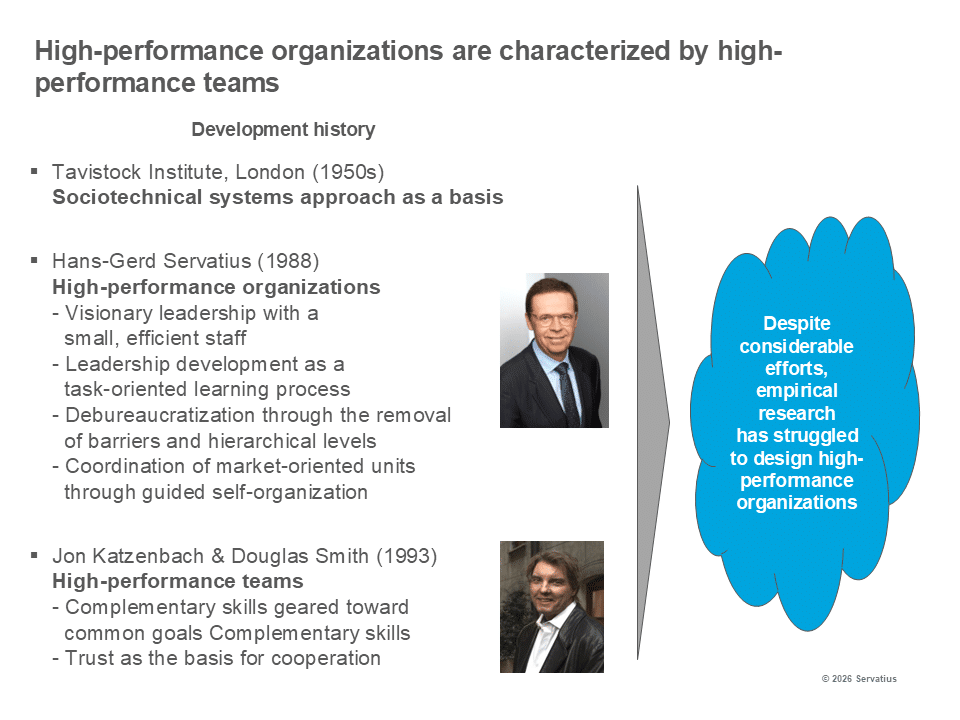
The topic of high-performance organizations is not new. High-performance organizations are characterized by high-performance teams. As early as the 1950s, the British Tavistock Institute developed an initial foundation with its socio-technical systems approach. I described the results of consulting projects on the characteristics of high-performance organizations in an article in Harvard Manager magazine in 1988. One important finding is that visionary leadership creates the framework for teams that work in a more self-organized manner.2

McKinsey consultants Jon Katzenbach and Douglas Smith examined the question of what characterizes high-performance teams.3 However, further developments have shown that, despite considerable efforts, empirical research is struggling with the design of high-performance organizations.4 AI is now giving performance management new impetus to improve the connection between strategy implementation and motivation.5

Lernprozess Innovationsstrategie

US tech companies with artificial intelligence (AI) now dominate the global economy. By the end of 2025, 61 of the world’s 100 most valuable companies will be from the US. The dominance of the US results from the unique strength of seven tech giants, which together have a market value of €18.3 trillion. An important driver of this development is the hype surrounding artificial intelligence (AI). Germany is represented in the top 100 ranking with the companies SAP (rank 40), Siemens (72), the European joint venture Airbus (91), and Allianz (100). In view of geopolitical changes, this concentration of power raises the question of how great the danger of dependence on the US is. 6 In the AI chip market, competitive pressure is increasing for market leader Nvidia.

AI chips are becoming increasingly powerful, but at the same time, AI increases the risk of disinformation. With a global market share of 85.2%, AI chip manufacturer Nvidia has a dominant position ahead of Broadcom (10.3%), Marvell (2.1%), and AMD (1.8%). Challengers AMD and Meta have announced a new AI system for data centers (Helios platform) that is expected to deliver a significant performance boost. Nvidia is countering with its new Rubin chip generation.7

However, there is a risk of a loss of trust in AI due to the risk of disinformation from fake accounts. AI bots falsify content, imitate people, and post automatically on social media. Such deepfakes can cause great economic damage and, for example, ruin a brand’s reputation.8

Large language models and free AI tools often lead to a loss of quality and trust because they are not trained for high performance, but rather for the production of average knowledge. When AI users are under time pressure and there are no quality standards in place, „AI slop“ can result. Although this produces faster results, the quality declines. Possible consequences include a loss of reputation and trust. When using AI, it is therefore important to supplement content with expert knowledge after quality control.9

AI and geopolitical challenges are reinterpreting the concept of high performance. Not all AI is trustworthy. We understand a trustworthy high-performance system to be a system (e.g., a company, a region, or a state) that performs very well compared to the competition and is trusted by the recipients of its services. In addition, these service recipients are willing and able to pay for the services. High-performance systems must therefore justify their higher prices (e.g., through „German quality,“ technical superiority, or a luxury brand).

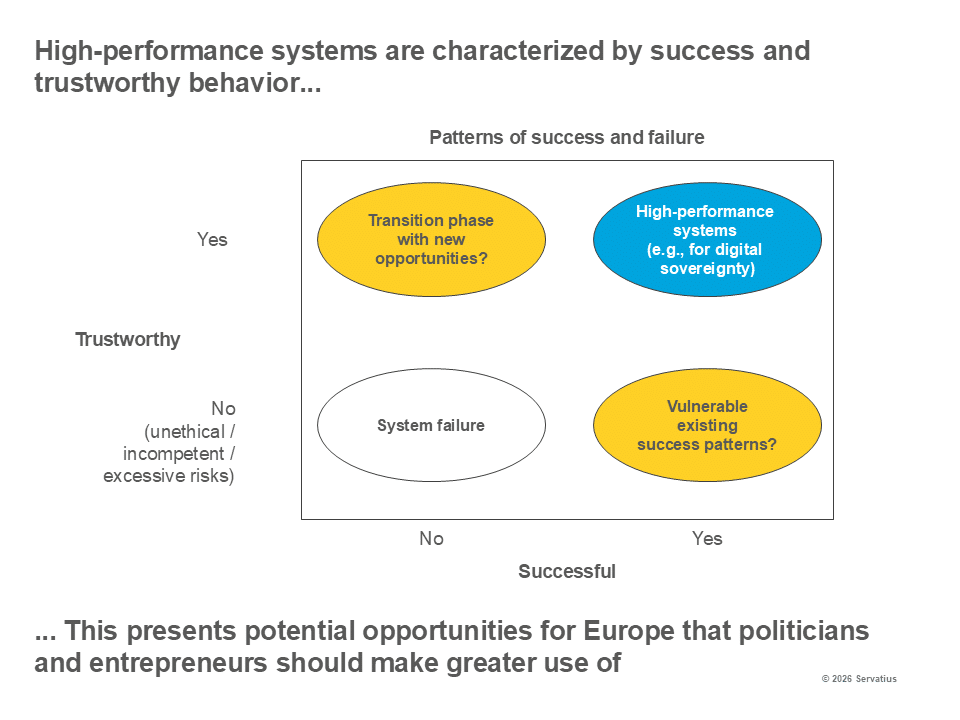
Reinterpreting high performance means that high-performance systems are characterized by both success and trustworthy behavior. If neither of these is the case, we speak of system failure. Most socio-technical systems fall somewhere in between. Cases where only one of the two criteria is met are interesting. An existing pattern of success is at risk when a previously successful system, such as that of the AI champions, loses trust. This could result in a transitional phase with new opportunities, for example, if Europe, which has been less successful in digitalization to date, scores points with trust.

Lernprozess Innovationsstrategie

Peter Frankopan, a British professor of global history teaching at Oxford, sees the world in a transitional phase similar to that of the 1920s, when the old order was not yet dead and a new one had not yet been born.10

The question is therefore how Europe can seize its opportunities and become a designer of trustworthy high-performance systems.


Strategic realignment in a phase of transition

In the first nine months of 2025, DAX companies spent €6 billion on restructuring. The highest restructuring costs in 2025 were incurred by Mercedes (€1.4 billion), Volkswagen (€900 million), Siemens and Commerzbank (€500 million each). The automotive, mechanical engineering, and chemical industries are particularly affected. At the end of September 2025, 120,300 fewer people were employed in German industry than a year earlier. Many companies are offering generous severance packages. Often, one round of restructuring is followed by another without solving the underlying problems. This would require a strategic realignment after restructuring.11

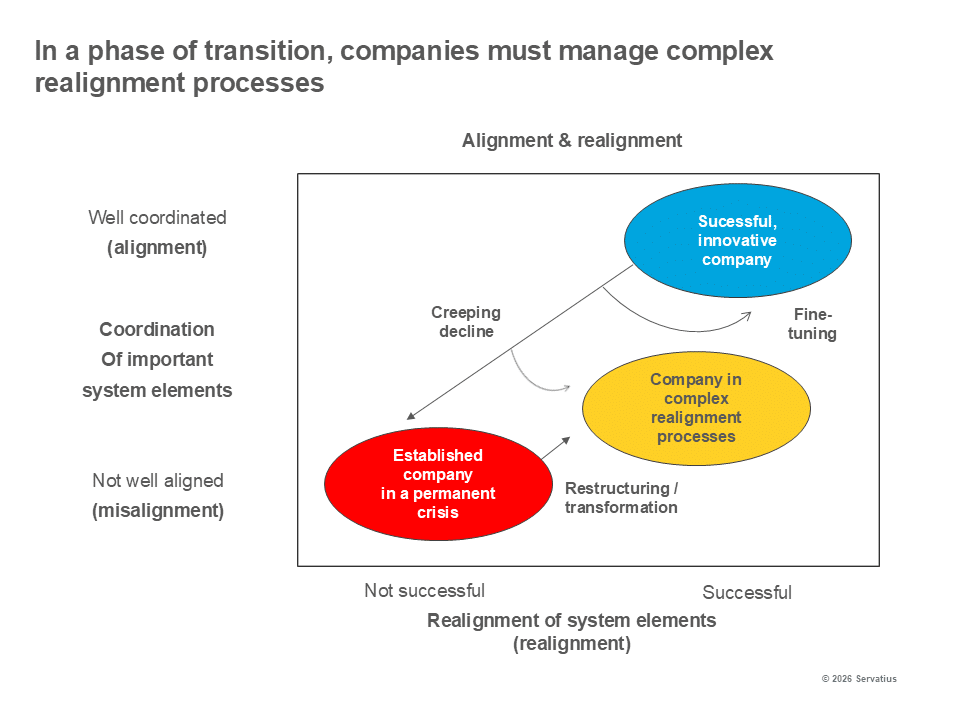
The term „strategic realignment“ describes an innovative approach to coordinating existing and new system elements (e.g., business model, strategy, technologies, customers, competencies, organization, culture, and environment). Realignments usually have a profound effect over a longer, undefined period of time in many parallel learning steps. Complex interactions play an important role in this process, resulting in specific patterns that are difficult to predict.

During a phase of transition, companies must manage complex realignment processes. In a successful, innovative company, important system elements are well coordinated. This alignment often takes place through fine-tuning, in which management continuously adapts the strategy to changes in the environment, for example. If this is not done, the company develops in the direction of misalignment. Management and supervisory boards often recognize this creeping decline too late. The result is an established company in a permanent crisis that requires restructuring.

The terms restructuring and transformation are now often used synonymously. Both terms describe a temporary, comprehensive change. Unfortunately, the inflationary use of the term transformation conveys the illusion that complex realignment processes are limited in time. The example of artificial intelligence clearly shows that such a static worldview is naive.

Lernprozess Innovationsstrategie

A longer-term goal of strategic realignments is the design of trustworthy high-performance systems.


Fields of action for trustworthy high-performance systems

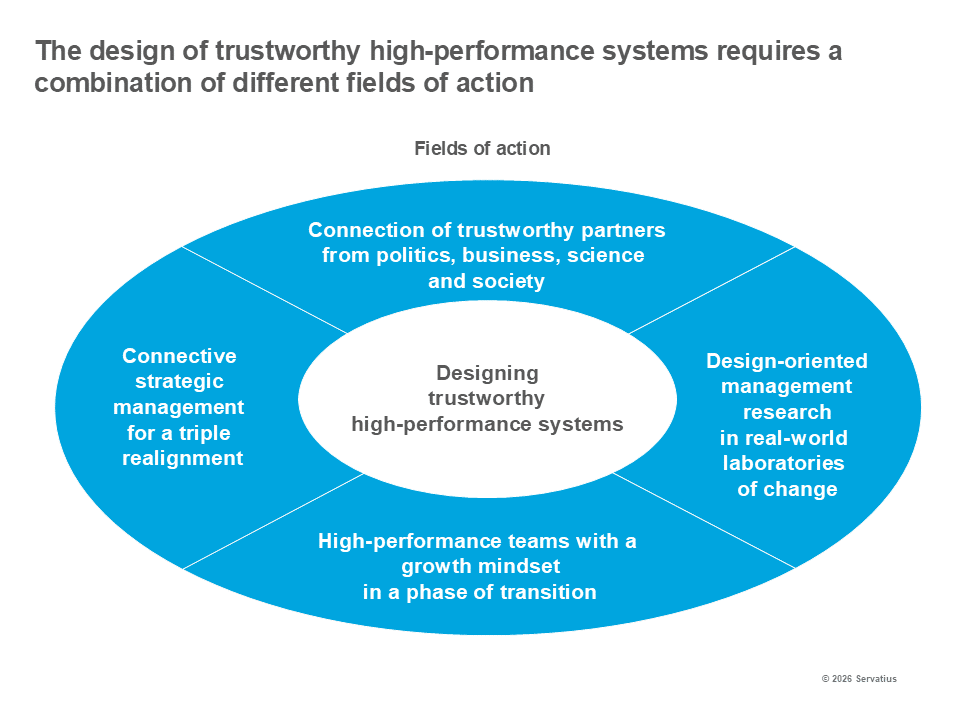
In times of increasing polarization, high-performance systems are characterized by their ability to bring people together. History teaches us that the risk of polarization increases during periods of technological and political upheaval. This also applies to the changes brought about by artificial intelligence (AI). It is crucial that people see themselves as active participants in shaping change rather than passive objects of it. The complementarity of humans and AI is a malleable system. The performance of such a system depends on the ability to improve connections between the actors and the system elements. In our application-oriented research and teaching, we start with the thesis that the following fields of action, shown in the figure, are important in the design of trustworthy high-performance systems:

  • A connective strategic management for a triple realignment
  • high-performance teams with a growth mindset in a phase of transition
  • the connection of trustworthy partners from politics, business, science, and society, and
  • design-oriented management research in real-world laboratories of change.

Interdisciplinary university teaching faces the task of imparting the relevant skills for these fields, e.g., in the area of entrepreneurship for AI applications.

Lernprozess Innovationsstrategie

In the following, I will discuss these fields of action and skills in more detail.


Connective strategic management for a triple realignment

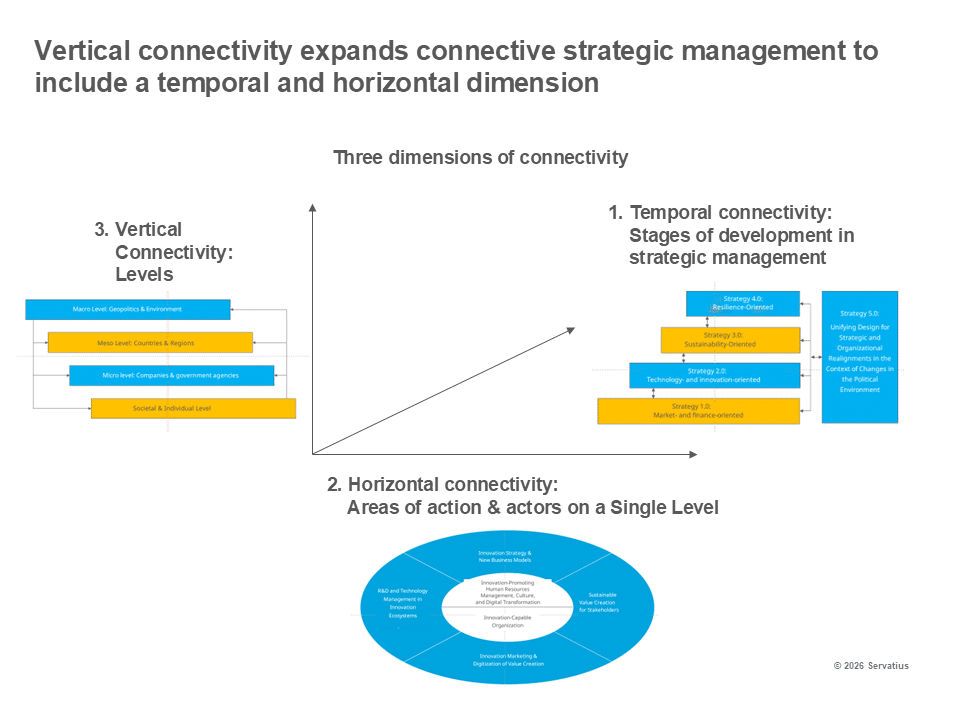
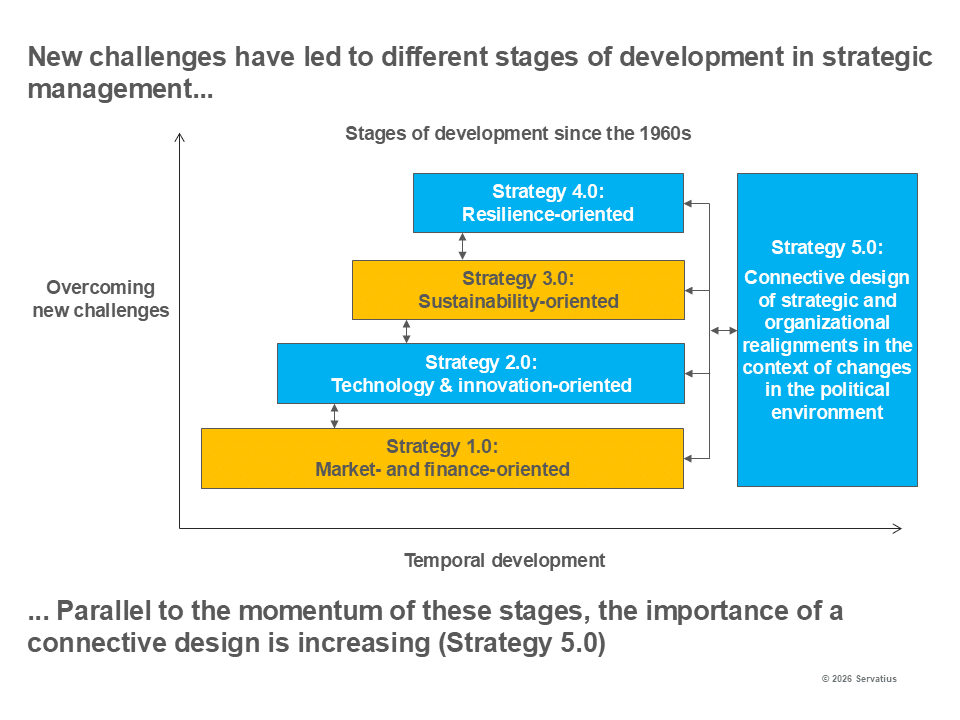
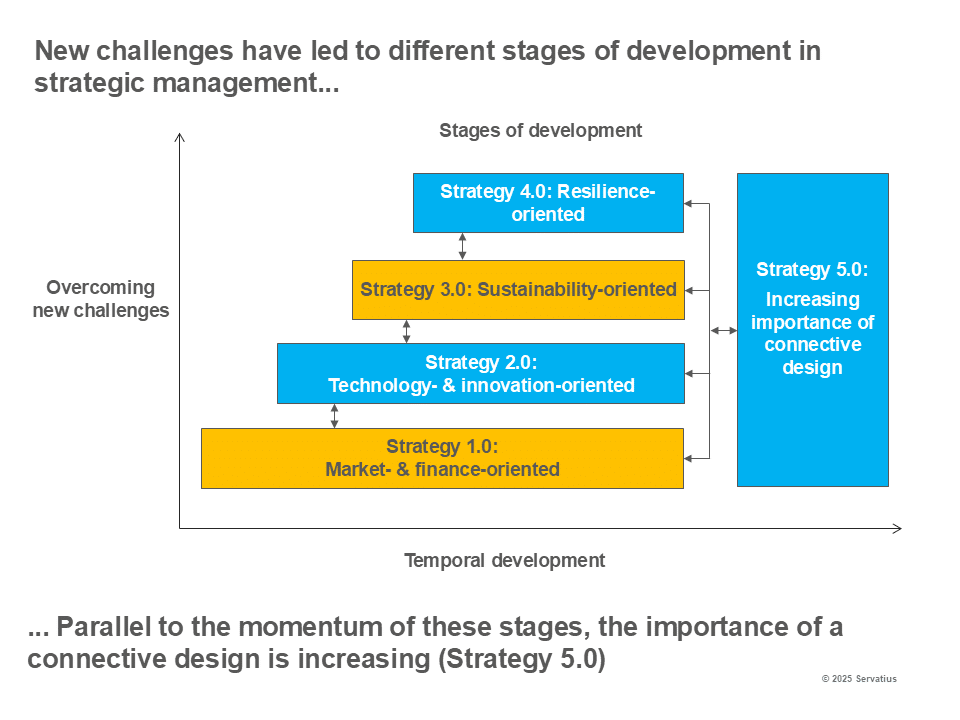
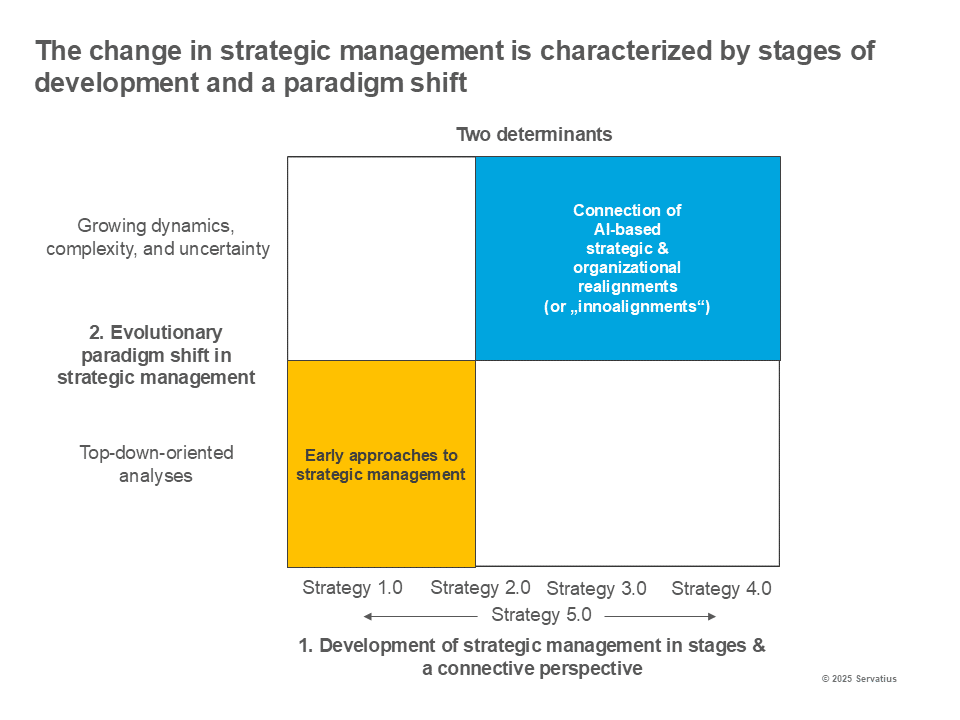
Since the 1960s, new challenges have led to various stages of development in strategic management.13 We distinguish between

  • a market- and finance-oriented stage (Strategy 1.0)
  • a technology- and innovation-oriented stage (Strategy 2.0)
  • a sustainability-oriented stage (Strategy 3.0) and
  • a resilience-oriented stage (Strategy 4.0).

In the current fifth stage of development (Strategy 5.0), the challenge lies in connecting the previous stages. Companies must become more resilient, more digital, and more sustainable at the same time.14 This requires the connective design of threefold strategic and organizational realignments. Such a triple realignment takes place in the context of serious changes in the political environment. The current situation is historically unprecedented. Therefore, the contextual intelligence of management plays an important role.15

Lernprozess Innovationsstrategie

German policymakers should create the framework for a cohesive strategic management approach through fundamental reforms. When the first signs of macroeconomic weakness appeared in 2018, they were harbingers of the most severe and longest industrial recession the Federal Republic has ever experienced. German industry has since lost much of its competitiveness. Experts are calling for new approaches to supply-oriented innovation policy and communication that conveys the need for a change of course. Politicians must implement the promised fundamental reforms. Such a new beginning can only succeed with solidarity instead of polarization.16

In this environment, resilience-oriented strategic management is becoming increasingly important.17  At this year’s World Economic Forum in Davos, the differing positions of the US president and European representatives clashed.18  Canadian Prime Minister Mark Carney suggests that in a world where major powers are becoming imperialists who blackmail other states, middle powers and smaller countries should form trustworthy partnerships.19

Such cooperation plays a decisive role not only at the geopolitical level, but also in high-performance teams.


High-performance teams with a growth mindset in a phase of transition

Black Forest Lab (BFL), currently Germany’s most valuable AI startup, is based in Freiburg, was founded in 2024, and develops AI models for image generation based on text. The founders are part of the core team behind the open-source AI model Stable Diffusion, the text-to-image model that generates digital images from text and, alongside ChatGPT, sparked the global AI hype in 2022. BFL’s Flux models are now one of Google’s biggest competitors. Important impetus for the work of the founding team came from Björn Ommer, a professor of computer science at LMU Munich. This example shows that high-performance teams can also emerge in Germany in the field of AI.20

New ideas and the creation of something new often originate from people who find a state of flow motivating. The term flow (in the sense of „being in the flow“) was coined by psychology professor Csikszentmihalyi back in 1975. It refers to being completely absorbed in an activity, which usually involves a high level of intrinsic motivation and a change in the perception of time. Interviews in which outstanding creative personalities from various fields look back on their working lives show that their motivation stems primarily from the creative process. For many people, the foundations for possible flow states are often laid in their youth, based on their growth mindset.21

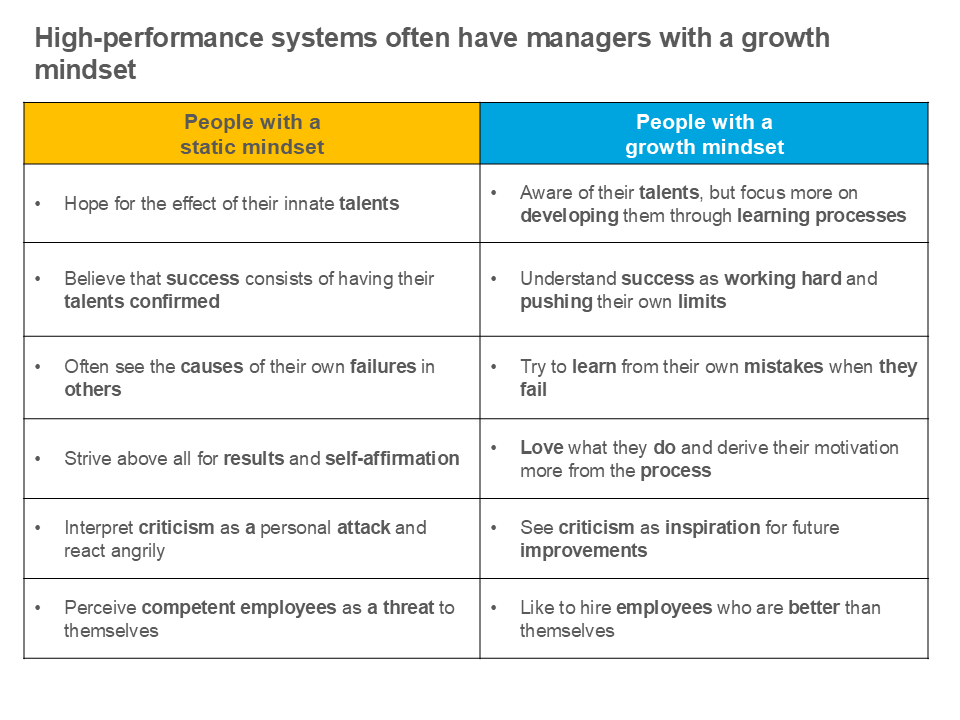
In her book Growth Mindset, Stanford professor Carol Dweck distinguishes between a static and a growth mindset.22 The following figure compares these two mindsets. High-performance systems often have leaders with a growth mindset. An important characteristic is that these people are aware of their talents, but place greater emphasis on their further development and learning processes. In contrast, people with a static worldview place greater hope in the effect of their innate talents.

Lernprozess Innovationsstrategie

Microsoft CEO Satya Nadella writes that the book had a strong influence on his personal development.23

A person’s self-image and their environment are closely linked. High performance therefore arises from an interplay between the two. Social psychologist Mary Murphy has extended the growth mindset concept to organizations, their culture, and the environment surrounding them:24

  • According to this, a growth culture promotes the potential of all employees. This culture emphasizes collaboration, continuous learning, and the development of skills.
  • A genius culture, on the other hand, believes in innate talent. This leads to internal competition, risk aversion, and a reluctance to admit mistakes.

Recommendations for action for managers are

  • create psychological safety and
  • giving constructive feedback.

However, simplistic application of this approach in practice underestimates the complexity of implementation. This can lead to demotivation among exceptional talents.

This raises the question of whether there are any current examples of a growth culture in Germany. A new bridge in South Westphalia has become a symbol of connective design. The Sauerland motorway is the most important transport link between the Ruhr area and Frankfurt. Due to the risk of collapse, the Rahmedetal bridge near Lüdenscheid, where I grew up, had to be suddenly closed in December 2021 and later blown up. This was a disaster for the economy with its many hidden champions and for the people in the region. Every day, 20,000 vehicles had to be diverted via bypasses and through residential areas. The German Economic Institute estimates the damage to businesses at around 1.5 billion euros. In Germany, new construction normally takes around eight to ten years. However, traffic is already rolling across one side of the A45 bridge via the after a record-breaking four years. This was made possible by smooth cooperation between the parties involved, a new planning procedure, and innovative construction methods. The German Chancellor sees this as a model for other renovations, and for the Minister President of North Rhine-Westphalia, the new benchmark for implementation speed in Germany is called „Rahmede“.25

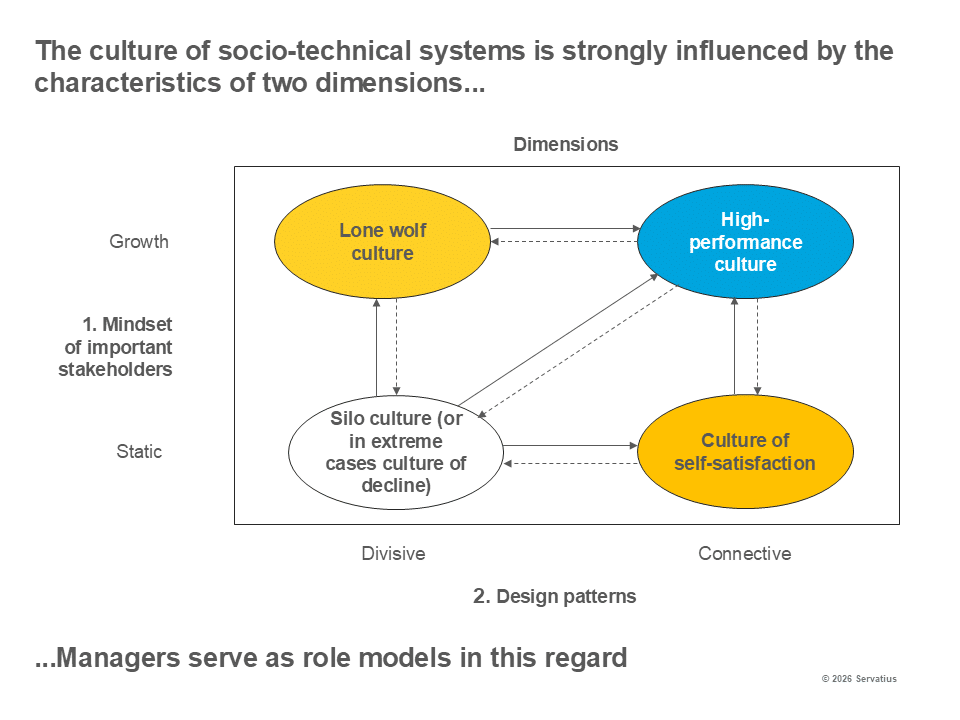
We can therefore summarize that the culture of socio-technical systems is strongly influenced by the mindset-image of important stakeholders and prevailing design patterns.

Lernprozess Innovationsstrategie

High-performance cultures are characterized by a growth mindset and a connective pattern. The opposite is a silo culture or, in extreme cases, a culture of self-satisfaction. Here, a static mindset and a divisive design dominate. Descriptions of outstanding leaders often heroize a lone wolf culture. These individuals are attributed with a growth mindset. At the same time, however, the impression is created that their successes were achieved single-handedly and in isolation from others, which is usually not the case. Until a few years ago, a culture of complacency was widespread in Germany. People rested on the successes of the past, but the mindset in politics and business was rather static and not very future-oriented.

Managers serve as role models in this regard. Their growth mindset is transferred to their employees. Conversely, managers with a static mindset and isolating behavior are responsible for the emergence of toxic cultures. Their position of power enables them to oust internal competitors and employees with a growth mindset that they perceive as a threat. Unfortunately, the role of consultants is often to secure and expand the position of power of the „static“ individuals. Attempts by external parties to change silo cultures are usually met with rejection and fail. It is therefore the task of supervisory bodies to review the dysfunctional mindsets of managers and take timely action. If this does not happen, there is a risk of system failure.

On its way to becoming a high-performance system, Europe currently finds itself in a difficult situation.


Connection of trustworthy partners from politics, business, science, and society

Europe first needs a resilience program against its enemies from outside and within. US political scientist Francis Fukuyama believes that Trumpism will continue even without Trump. For open democratic societies, this is an extremely dangerous development. He fears a relapse into the world order of the 19th century. It is therefore important that Western societies develop sufficient resilience. It should also be taken into account that tech billionaires primarily act in their own economic interests. The greatest danger for Europe is resignation.26

Marc Tüngler, head of the German Association for the Protection of Securities Holders, laments the lack of political support necessary for innovation and economic restructuring. Germany is no longer internationally competitive in terms of electricity prices, for example. Politicians are responsible for this. Important levers would therefore be an improved location policy and a more innovation-friendly climate. We are far from the necessary solidarity between business and politics. He expects 2026 to be a year of decisions for politicians.27

In his book „Wir Krisenakrobaten“ (We Crisis Acrobats), Stephan Grünewald, co-founder of the Cologne-based opinion research company Rheingold, describes the hope for self-efficacy that would enable our society to overcome the multitude of current crises. His recommendation consists of six points:

  1. Truthfulness (clear identification of problems)
  2. focus (successful national projects)
  3. participation (making one’s own contribution clear)
  4. fairness (unreasonable demands must be perceived as fair)
  5. culture of debate (dealing more productively with changes in perspective) and
  6. solidarity (which must be relearned).

Unfortunately, silo thinking („silodarity“) still prevails at present.28

Martin Keller has returned to Germany from the US to become the new president of the Helmholtz Association. The association comprises 18 independent research centers with almost 48,000 employees and a budget of more than six billion euros. Keller wants to use a plan of action to ensure that Germany remains or becomes a global leader in selected fields of innovation. This requires closer cooperation, e.g., in the context of public-private partnerships (PPP), in which politics, research, and business cooperate in order to become more competitive. He believes it is time to break down old structures.29

In his book „Visionen braucht das Land“ (The Country Needs Visions), Jochen Andritzky, co-initiator of Zukunft-Fabrik 2050, calls on politicians to develop visions of the future that can be discussed and provide guidance. This approach is more promising than short-term pseudo-solutions that merely combat the symptoms.30 This return to the power of vision provides important impetus for management research, which in the past has often been content with incremental improvements. Design-oriented management research aims to be more practice-oriented in this regard.


Design-oriented management research in real-world laboratories of change

A research project at Würth has given rise to an AI start-up that could revolutionize the crafts. The aim of the research project conducted by the wholesaler of mounting and fastening material Würth and the AI Lab at the Technical University of Munich was to process inquiries from trade customers in sales more quickly. This led to the spin-off Mercura AI in March 2024, which uses AI to try to solve several problems:

  • Overcoming the shortage of skilled workers
  • increasing productivity for highly complex tasks, and
  • faster processing of inquiries and quotes.

Mercura AI combines semantic models, the recognition of requirements,
company-specific rules, and learning from previous quotes. The software processes both text and speech. The founders have combined AI expertise with industry experience. This example shows the potential of design-oriented management research in companies. 31

Nobel Prize winner Herbert Simon provided important impetus for design-oriented management research. His book „The Sciences of the Artificial,“ published in 1969, is not only a fundamental work on AI, but has also had a strong influence on design theory. The basic idea is that, in addition to the natural sciences, there is a universal science of design. This gave rise to the design methods movement. Not only the technical sciences, but also management science deal with the design of the possible (contingent). In the technical sciences, the design of new things is a natural goal. In management, political science, and social science, the diversity of individual systems and subsystems originating from humans has a specific complexity that is difficult to research purely empirically. Simon’s groundbreaking work emphasizes the interdisciplinarity of design.32

Real-world laboratories of change open up new possibilities for management research. A real-world laboratory (living lab or sandbox) is a research and application space in practice where, for example, companies and their partners design innovative business models. In doing so, they combine research, learning, and action, promote interdisciplinary collaboration, and enable the testing of new legal frameworks (e.g., through the application of experimentation clauses). The concept became known in the 1990s primarily through the work of the Media Lab at the Massachusetts Institute of Technology (MIT).33 In Europe, real-world laboratories are primarily intended to create modern forms of regulation (e.g., in urban development). Real-world laboratories have been used relatively little in management research to date. Empirical approaches dominate in dissertations. The advantage of real-world laboratories lies in their ability to better connect theory and practice.

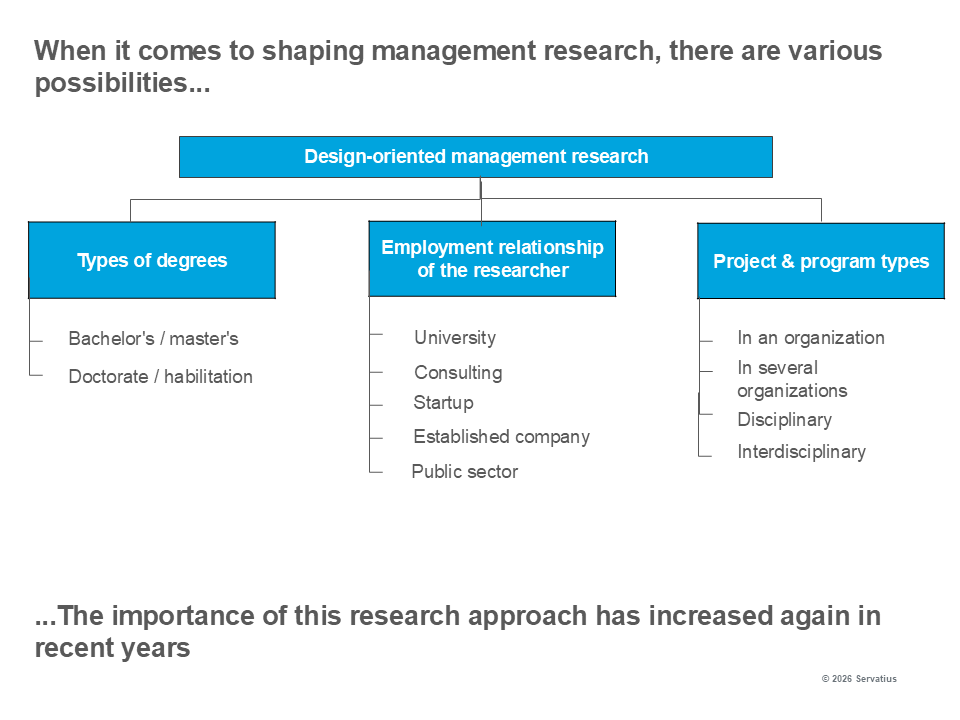
Design-oriented management research is not only taking place at universities, but also increasingly in practice. University lecturers are increasingly supervising creative research approaches by employees in their companies. This approach is mainly used in bachelor’s and master’s theses in dual study programs, in which the course of study is organized in parallel with practical work. In the past, this has also been done more frequently in external dissertations and postdoctoral theses, e.g., by management consultants. The focus here was more on practical relevance. Solving complex problems requires research by interdisciplinary teams, whose members then receive their degrees in their respective fields. Universities should work with partners in the field to combine such projects into programs that can also build on each other (e.g., to design a sovereign AI from Europe).34

The following figure summarizes various possible forms of design-oriented management research. Here, we distinguish between the type of degrees, the employment relationship of the researcher and the project and program types. In a part-time doctorate of a consulting employee, for example, it makes sense to compare the results of projects from several organizations and derive new insights from them. What seems important in this research approach is that design-oriented research projects based on theoretical foundations35 now focus more strongly on concrete application in practice.

Lernprozess Innovationsstrategie

In 2026, we will further develop this approach to management research in the context of designing high-performance systems in which trustworthiness has become an important competitive advantage. One model for this is the start-up ecosystem in Munich, from which other regions can learn.36


Conclusion

  • High-performance systems are characterized by their success and trustworthiness. In the current transition phase, Europe should seize this as an opportunity.
  • To do so, companies must master complex realignment processes and become more resilient, digital, and sustainable
  • Such connective strategic management (Strategy 5.0) is one of the fields of action of trustworthy high-performance systems
  • Another field of action is the promotion of high-performance teams with a growth mindset
  • This requires trustworthy partners and closer cooperation between business and politics
  • Real-world laboratories of change open up new opportunities for design-oriented management research.


Literature

[1] zu Fürstenberg, J., Kloepfer, I., How good we are is revealed in times of crisis – A wake-up call, Piper 2025

[2] Servatius, H.G., Trimming an organization for performance. In: Harvard Manager, 1988, No. 4, pp. 128-134

[3] Katzenbach, J.R., Smith, D.R., The wisdom of teams – Creating the high performance organization, Harvard Business School Press 1993

[4] de Waal, A., What makes a high performance organization, Warden Press 2019

[5] Servatius, H.G., AI as a tool for strategic management. In: Competivation Blog, May 1, 2025

[6] Sommer, U., US corporations are stronger than ever. In: Handelsblatt, December 29, 2025, pp. 1, 4-6

[7] Alvarez de Souza Soares, P., Holtermann, P., AMD wants to end Nvidia’s monopoly. In: Handelsblatt, January 7, 2026, pp. 18-19

[8] Knees, C., Disinformation as a business risk. In: Handelsblatt, January 7, 2026, pp. 20-21

[9] Merten, M., Companies sinking in AI junk. In: Handelsblatt, January 9, 2026, pp. 20-21

[10] Frankopan, P., „What does Europe have besides handbags and champagne?“ (Interview). In: Handelsblatt, December 19/20/21, 2025, pp. 12-13

[11] Fröndhoff, B., et al., Billions for restructuring. In: Handelsblatt, November 26, 2025, pp. 1, 4-5

[12] Servatius, H.G., Disruption of management education for AI-based realignments. In: Competivation Blog, October 10, 2025

[13] Servatius, H.G., Development and change in strategic management. In: Competivation Blog, September 19, 2025

[14] Servatius, H.G., Triple strategic realignment. In: Competivation Blog, June 7, 2024

[15] Servatius, H.G., Strategic leadership with contextual and relationship-oriented intelligence. In: Competivation Blog, March 14, 2023

[16] Huchzermeier, D. et al., Economy in reform gridlock. In: Handelsblatt, February 2/3/4, 2026, pp. 1, 6-7

[17] Servatius, H.G., Resilience-oriented strategic management. In: Competivation Blog, March 15, 2024

[18] Meiritz, A., „We will certainly remember a no.“ In: Handelsblatt, January 22, 2026, p. 1, 4-5

[19] Koch, M., Can an alliance of middle powers slow Trump down? In: Handelsblatt, January 22, 2026, p. 5

[20] Bomke, L., Germany’s AI hope. In: Handelsblatt, December 2, 2025, p. 1

[21] Czikszentmihalyi, M., Creativity – Flow and the psychology of discovery and invention, Harper Collins 1996

[22] Dweck, C., Mindset – The new psychology of success, Random House 2006

[23] Nadella, S., Hit Refresh – The quest to rediscover Microsoft’s soul and imagine a better future for everyone, Harper Collins 2017

[24] Murphy, M.C., Cultures of growth – How the new science of mindset can transform individuals, teams and organizations, Simon & Schuster 2024

[25] Herwig, M., Linnhoff, C., New A 45 bridge opened. In: Rheinische Post, December 23, 2025, p. A6

[26] Fukuyama, F., „Trumpism is a cry against modernity“ (interview). In: Handelsblatt, December 5/6/7, 2025, pp. 12-13

[27] Tüngler, M., „Friedrich Merz still has it in his hands“ (interview). In: Handelsblatt, December 11, 2025, pp. 22-23

[28] Grünewald, S., We crisis acrobats – Psychogram of an unsettled society, Kiepenheuer & Witsch 2025

[29] Delhaes, D., Architect of a German research breakthrough. In: Handelsblatt, December 30, 2025, p. 13

[30] Andritzky, J., The country needs visions – For long-term policies with the courage to face the future, Herder 2026

[31] Bomke, L., Revolutionizing the trade with AI. In: Handelsblatt, January 7, 2026, p. 26

[32] Simon, H.A., The sciences of the artificial, 3rd ed., MIT Press 1996

[33] Mitchell, W.J., City of bits – Space, place, and the infobahn, MIT Press 1995

[34] Servatius, H.G., AI and the future of management education. In: Competivation Blog, April 9, 2025

[35] Seckler, C., et al., Design sciences across industries – Building bridges for advancing impactful business research. In: Schmalenbach Journal of Business Research, December 9, 2025

[36] Banze, S., Freisinger, G.M., The Munich code. In: Manager Magazin, February 2026, pp. 30-36

Development and change in strategic management

Development and change in strategic management


The task of strategic management is to shape corporate development and overcome challenges. New opportunities and threats mean that board members and managing directors are constantly faced with the need to learn. Improved didactics in executive education and training should take this change in strategic management into account. In the current phase of upheaval, the focus is on AI-based strategic and organizational realignments. We refer to the combination of these fields of action, which are changing the labor market and requiring new leadership skills, as innostrategizing.


In this blog post, I explain the stages of development of strategic management and the paradigm shift that is shaping the evolution of the field.


AI is also changing the job market for young professionals

The increasing importance of artificial intelligence (AI) is leading to a decline in demand for clearly structured, repetitive fields of activity, even for young professionals.Many of these tasks are already being performed faster, more cost-effectively, and with sufficient quality by AI. At the same time, new tasks are emerging, e.g., in AI training and the use of AI tools. In addition to AI skills, other qualifications are becoming more important. These include, for example, the ability to work on interdisciplinary projects. As this change affects all areas of management, innovative education providers are realigning their bachelor’s programs. In addition, the requirements for managers are also changing.


New requirements for managers

In the past, completing an MBA program increased the likelihood of a successful management career. For example, 18 percent of the board members of German listed companies have a Master of Business Administration (MBA), 88 percent of whom obtained their degree abroad. An important motivation for pursuing an MBA program is the desire to develop further and improve one’s own strategic skills. For business economists and especially for graduates of technical degree programs, MBA programs at renowned universities act as career accelerators. For universities in Germany and abroad that offer MBA programs, it is important to note that the challenges facing companies and thus also the field of strategic management have been undergoing fundamental changes for some time. Innovative education providers are equipping their students to cope with the complexity associated with these changes. The negative effects of US ’s policies on the country’s education system are an opportunity for Europe that universities should take advantage of.

Of particular importance here is an understanding of the changes in strategic management over the course of its development.


Stages of development in strategic management

We have divided the development of strategic management since the 1960s into the following stages, which characterize the respective focus:3

  • Market- and finance-oriented (Strategy 1.0)
  • technology- and innovation-oriented (Strategy 2.0)4
  • sustainability-oriented (Strategy 3.0)5 and
  • resilience-oriented to overcome the current multi-crisis (Strategy 4.0)6 .

Parallel to the momentum of these stages, the importance of a connective design is increasing. By this we mean

  • to plan and implement
  • objects, systems, or problem solutions
  • carried out jointly by actors from different disciplines, levels, or organizations.

We consider such connective design to be the fifth stage of development in strategic management (Strategy 5.0). This stage connects and expands on the previous stages.7

Lernprozess Innovationsstrategie

An important foundation for connective design was laid by Nobel Prize winner Herbert Simon (1978) in his book The Sciences of the Artificial, which has shaped design theory.8 Even though this groundbreaking work is little known in Germany, hidden champions have been practicing this management approach for decades, which deals with questions such as how to connect new customer needs and technologies.

University teaching on strategic management still focuses primarily on the first stage of development, which is market- and finance-oriented. The second and third stages have given rise to the independent disciplines of technology, innovation and entrepreneurship, and sustainability. However, the integrative aspect of connecting the stages is usually neglected. In addition, there are the specialist areas of human resource management, organization, IT management, and change management, which are also often not linked to strategic management.


Connective design

Although the ability to create connections is rarely taught at universities, it has always been and continues to be relevant at all strategic levels. This is illustrated by the following tasks:

  • Designing business portfolios with the aim of permanently increasing company value (Strategy 1.0)
  • designing the innovation system of companies by connecting relevant fields of action and innovation ecosystems (Strategy 2.0)
  • designing the sustainability system of companies and GreenTech ecosystems, as well as jointly overcoming conflicts of interest between economics, ecology, and social issues (Strategy 3.0)
  • the design of resilient systems by connecting the levels of government, companies, and individuals, e.g., to overcome geopolitical crises (Strategy 4.0)
  • designing connections between the stages of development, e.g., in the areas of sustainability innovation and climate resilience (Strategy 5.0).

In addition to these stages of development and a unifying perspective, the change of strategic management is characterized by a paradigm shift.


Paradigm shift in strategic management

The term paradigm describes a fundamental pattern that serves as a guide in a particular field. In science, a paradigm forms a framework for theories, concepts, and practices. A paradigm shift is a transition from an older to a new fundamental pattern. The science historian Thomas Kuhn uses the term to describe scientific revolutions.9 One of the critics of this idea is the philosopher Stephen Toulmin. For him, a scientific paradigm is a loosely connected bundle of individual theories that must prove themselves in an evolutionary process.10 The paradigm shift in strategic management has a rather evolutionary character.

Since the 1990s, this paradigm shift has been taking place from top-down-oriented analyses to a growing dynamic, complexity, and uncertainty emanating from successful digital companies and a changed geopolitical landscape.11 Analysis in the old paradigm aims to break down problems. The following figure summarizes the factors that characterize the evolutionary paradigm shift.

Lernprozess Innovationsstrategie

The transition from the old to the new paradigm is changing the influence of various schools of strategy. The analysis-oriented positioning school has lost importance. A combination of other schools of strategy, such as the entrepreneurial school and the learning school, has become more relevant.12

Another important change concerns the mindset of managers. While a rather static self-image dominates in many established companies, the culture of successful digital companies is characterized by a dynamic self-image (growth mindset), which often begins to develop in childhood.13

The focus of the old strategy paradigm is on increasing company value. The new paradigm focuses more on business model innovation through stakeholder ecosystems. Artificial intelligence (AI) now plays an important role in managing the complexity associated with this.14

Strategy processes and projects have also changed. The old paradigm was dominated by a separation between strategy development and implementation by distinct organizational units. This separation encourages the emergence of silo cultures. The new paradigm is characterized by interdisciplinary projects using agile methods such as design thinking and Scrum. A common feature of these projects is the iterative approach in learning loops.15

The internal organization also differs accordingly. In the old paradigm, responsibility for strategic management lies at the management level. The new paradigm is characterized by more decentralized, self-similar (fractal) processes and structures. Strategy units with different tasks are connected to each other and to a central office.16

Currently, an important change is emanating from the political framework conditions. The old paradigm is based on the idea that prosperity arises from a rule-based world order. This idea is increasingly being called into question. Due to growing political threats, the framework conditions for strategies have become much more uncertain. A current example is the tariff crisis initiated by the US government. In this situation, the world seems to lack a reliable compass.17


AI-based strategic and organizational realignments

In summary, it can be said that the change in strategic management is characterized by the following two determinants:

  1. Development in stages with an increasingly important connective perspective, and
  2. an evolutionary paradigm shift.

Characteristic of the early approaches to strategic management according to the old paradigm are top-own-oriented analyses based on problem decomposition. These approaches determined the first stage of development and the beginning of the second stage. In contrast, the new paradigm focuses on growing dynamics, complexity, and uncertainty.

Lernprozess Innovationsstrategie

If one is looking for a term to describe current strategic management, the neologism „innoalignment“ comes to mind. By this we mean the connection of AI-based strategic and organizational realignments. The strategic realignments are aimed at making companies more resilient, digital, and sustainable.18 In organizational realignments, AI-supported performance management measures the success of leaner structures, networked processes and projects, and an innovative AI platform architecture.19 There are still few examples of such innoalignment. This makes it all the more important for application-oriented research and teaching to focus more on this topic. The further development of management didactics plays a central role in this.


Key players in management didactics

In recent decades, various players have shaped didactics in management education. Their approaches have specific advantages and disadvantages. In view of new challenges, innovative education providers are currently developing didactic concepts that focus on AI-supported solutions to complex management problems. 20

Lernprozess Innovationsstrategie

The prevailing management didactics at universities in Central Europe have long been function- and industry-specific subject concepts. The focus of business administration functional teaching (e.g., finance) and technical industry teaching (e.g., mechanical engineering) is on training specialists who work in hierarchies with clearly defined organizational units. This approach encourages the emergence of interface problems that are difficult for companies to overcome due to a rigid culture.

In the USA, Harvard Business School transferred the case study method from legal education to management education in 1920. The basic idea is that lecturers condense interesting practical examples into case studies, which form the focus of teaching. The promise of benefit here is to learn from actors who have attempted to solve a specific problem. This didactic approach differs fundamentally from subject-based learning. One disadvantage of the case study method is that the rapid transfer of a known solution often does not do justice to the complexity of new tasks.

The major strategy consultancies, which are influenced by the teaching methods used at business schools, have supplemented the case study approach with a specific form of further training for their consultants. This on-the-job training focuses on teaching the ability to identify problems, structure them, and solve them analytically. The final step is to sell the solutions by having experienced consultants convince decision-makers. A common criticism of this classic approach by consultants is that they leave their clients to implement the solutions on their own. This is where performance management, which emerged in the 1980s, comes in with the formulation of objectives and key results.

Successful digital companies and their venture capitalists rely less on external consultants and more often work on interdisciplinary projects themselves using agile methods such as design thinking or Scrum. In this iterative approach, the actors apply the concept of learning loops, which is well known in organizational development. The lean startup method is also based on this approach.

Since all of these approaches have specific strengths and weaknesses, innovative education providers build on what is already known and develop it further. The result is project-based learning that focuses on AI-supported, collaborative design of solutions for complex management problems.21 Such action-oriented learning can begin with simple problems and then move on to individual learning steps addressing current challenges for which there are no known solutions yet. The new education providers have recognized that this approach is best mastered by a heterogeneous teaching staff in which academics work together with practitioners who have different backgrounds and experience. An interesting question is how organizations can promote the further development of a dynamic self-image. The role model function of leadership plays an important role here.

This change in strategic management, combined with innovative didactics, opens up an opportunity for Europe that the „old continent“ should seize.


Change as an opportunity for Europe

Strategic management started as an import from the US, with its first stage of development spreading across Europe since the 1970s. Europe has been overtaken in many areas by the waves of digitalization, which have mainly originated from US companies. At the same time, changing geopolitical conditions are increasing Europe’s dependence on the US and China. It therefore seems high time for Europe to refocus on its strengths. Politicians have begun to rethink their approach, placing greater emphasis on competitiveness once again. One opportunity of global significance is the combination of digitalization and sustainability (digital green tech), where Europe should strive to take a leading role.22 The basis for this is an improvement in education systems.

The outlined change in strategic management creates a framework for joint programs between politics, science, business, and society in specific growth areas, such as the realignment of power grids with AI.23 This depends on the ability to design solutions for complex management problems. Overall, this change represents an opportunity for Europe if it succeeds in becoming more resilient in crisis management through a joint effort.

Advanced didactics in management play a central role in this. These methods must also address the question of what causes the basic patterns of error that Germany has made in the past, for example in digitization and the energy transition. An important insight is that such basic patterns of error are the fragmented interests of individual actors or groups. The theory and practice of connective design can help to overcome this basic pattern of error.


Conclusion

  • The development of strategic management has proceeded in stages, with the importance of a connective perspective increasing
  • Parallel to this, there has been an evolutionary paradigm shift with a change in a number of factors
  • These two determinants shape innostrategizing, which combines AI-based strategic and organizational realignments
  • To this end, innovative education providers are further developing management didactics
  • Europe should see this increasingly apparent change as an opportunity.


Literature

[1] Bomke, L., Müller, A., Telser, F., AI displaces career starters. In: Handelsblatt, August 12, 2025, pp. 16-17

[2] Westkämper, A., On the board thanks to an MBA – that’s what matters. In: Handelsblatt, July 18/19/20, 2025, pp. 54-55

[3] Servatius, H.G., Strategy 5.0 for overcoming new challenges. In: Competivation Blog, June 28, 2022

[4] Servatius, H.G., Evolution of strategic management. In: Competivation Blog, June 28, 2024

[5] Servatius, H.G., Sustainability-oriented strategic management. In: Competivation Blog, August 15, 2024

[6] Servatius, H.G., Resilience-oriented strategic management. In: Competivation Blog, March 15, 2024

[7] Servatius, H.G., Strategic leadership with contextual and relationship-oriented intelligence. In: Competivation Blog, March 14, 2023

[8] Simon, H.A., The sciences of the artificial, 3rd edition, MIT Press 1996

[9] Kuhn, T.S., The structure of scientific revolutions, Suhrkamp 1996

[10] Toulmin, S.E., Critique of collective reason, Suhrkamp 1983

[11] Servatius, H.G., Learning from successful digital companies. In: Competivation Blog, July 12, 2024

[12] Mintzberg, H., Ahlstrand, B., Lampel, J., Strategy safari: A journey through the wilderness of strategic management, Carl Ueberreuter 1999

[13] Dweck, C., Self-image – How our thinking causes success or failure, 7th edition, Piper 2017

[14] Servatius, H.G., AI as a tool for strategic management. In: Competivation Blog, May 1, 2025

[15] Servatius, H.G., GenAI-based strategic learning loops as a connecting process pattern. In: Competivation Blog, November 1, 2024

[16] Servatius, H.G., Fractal organization of strategy 5.0 labs. In: Competivation Blog, March 28, 2023

[17] Riecke, T., The struggle for a new world order. In: Handelsblatt, August 8/9/10, 2025, pp. 24-25

[18] Servatius, H.G., Triple strategic realignment. In: Competivation Blog, June 7, 2024

[19] Servatius, H.G., Process-oriented AI for increased productivity. In: Competivation Blog, March 12, 2025

[20] Servatius, H.G., AI and the future of management education. In: Competivation Blog, April 9, 2024

[21] Servatius, H.G., Learning to design solutions for complex management Problems. In: Competivation Blog, July 15, 2025

[22] Servatius, H.G., Achieving success in digital greentech with a Strategy 5.0. In: Fesidis, B., Röß, S.A. Rummel, S. (Eds.), (Towards a Climate-Neutral Company through Digitalization and Sustainability), SpringerGabler 2023, pp. 72-94

[23] Stratmann, K., Build less, digitize more. In: Handelsblatt, August 12, 2025, pp. 20-21


Learning to design solutions for complex management problems

Learning to design solutions for complex management problems

In light of major challenges such as the resilient, digital, and ecological realignment of companies, industries, and regions, the proportion of problem-oriented learning in education and training must increase. The ability to design solutions for complex management problems is crucial for success. Management theory for complex evolutionary systems provides an important foundation for this. The application of this approach, which has developed over the last few decades, has hardly been taught at business schools to date. One practical approach is the DSCMP method, which we have tested in many projects. DSCMP stands for Designing Solutions for Complex Management Problems.


In this new blog post, I explain the theoretical foundations of the DSCMP method and a general framework that can be adapted to specific problem situations.


What students and practitioners find difficult

An exam question that most students find difficult is: Using an example, explain a concept and approach for AI-based strategic realignment. It makes little difference whether the question asks for a digital or ecological realignment. However, designing solutions for complex management problems is not only difficult for students, but also for experienced practitioners in companies. Apparently, neither group is familiar with suitable theoretical foundations or a practical approach that they could apply. I would therefore like to begin by explaining the theory.


Management theory of complex evolutionary systems

Management theory of complex evolutionary systems has emerged from the combination of three lines of development, the application of which in management enables better strategic realignments.1 These paths, which I outline below, are:

  1. The path from ecosystems to system theories
  2. the application of evolutionary theories in economics, and
  3. a transfer of the theory of complex adaptive systems to the solution of management problems.

The term ecosystem was defined by biologist Arthur Tansley (oikos, the house, and systema, the connected) in 1935, among others. The field of cybernetics, which has been shaped by Norbert Wiener and others since the 1940s, deals with the control of systems. In 1959, Stafford Beer defined the term management cybernetics.2  Since the 1950s, a general systems theory has developed. According to this theory, open systems are in dynamic exchange with their environment. The sociological systems theory founded by Talcott Parsons regards actions as constitutive elements of social systems. In 1951, Parson developed the AGIL scheme (adaptation, goal attainment, integration and latency) for the structural and functional analysis of social systems.3 At the University of St. Gallen, Hans Ulrich has been developing the concept of system-oriented management theory since the 1960s.4 Since the 1990s, the terms economic, stakeholder, start-up, and AI ecosystems have gained importance.

Evolutionary theories (from evolvere, to develop) have a long history in various disciplines. Of particular importance for economics is the concept of spontaneous order developed in the 1960s by Friedrich August von Hayek, who later won the Nobel Prize in Economics (1974).5 This is the result of self-organizing processes that emerge over time and are based on rules that can change. An important basis for the concept of an evolutionary organizational theory of the Munich School around Werner Kirsch6 is the theory of communicative action developed by the philosopher Jürgen Habermas.7 An evolutionary process in management is characterized by a dynamic sequence of imbalances.

The interdisciplinary theory of complex adaptive systems was developed at the Santa Fe Institute in New Mexico (USA), which was co-founded in 1984 by Nobel Prize winner in physics Murray Gell-Mann (1969). Such a system absorbs information about its environment and its own interaction with this environment, recognizes patterns, and condenses them into competing models. The resulting actions feed back into these models. An important management recommendation is to create suitable conditions for more self-organized interaction between competent actors.8 Agile methods are based on this. The theory of complex responsive relationship processes emphasizes the importance of local, nonlinear interactions between actors, which give rise to patterns that are difficult to predict.9

Lernprozess Innovationsstrategie

The theory of complex evolutionary systems has initiated a paradigm shift in strategic management, which has been driven primarily by successful digital companies since the 1990s.10 The characteristics of this management theory, which is new to many established companies, are openness, dynamism, connectedness, non-linearity, emergence, path dependency, adaptivity, self-organization, and learning loops.

The question now is how this theoretical foundation can help teachers and learners in practice to design solutions for complex management problems.


Approach using the DSCMP method

The DSCMP method was developed as part of our consulting, teaching, and research activities. Consultants are usually called in when organizations are looking for support in solving complex management problems. However, consulting only leads to lasting success if managers and employees are successfully taught the relevant skills.

Designing solutions for complex management problems requires a conceptual framework that project teams can adapt to the situation at hand. The following figure shows the main phases of the iterative process used in the DSCMP method. The didactic challenge lies in teaching the ability to adapt this approach to new complex problems.

Lernprozess Innovationsstrategie

In the DSCMP method, the first phase involves forming interdisciplinary program and project teams that report to a management committee. The structure and composition of these teams may change as the work progresses.

In phase 2, the task is to bring together relevant information and different perspectives. The goal is to understand a complex problem and its causes and describe it as accurately as possible.

This is followed by the important step of designing creative solutions that bring everything together. Examples include the development of a hydrogen value chain and the conversion to climate-resilient cities. Communication with stakeholders from politics, science, and society is becoming increasingly important but is difficult to implement.11 Such cooperation requires dialogue-based action based on a position of strength, e.g., with the help of new methods such as connective design.

Depending on the type of problem, possible approaches can be tested in pilot solutions, prototypes, or minimum viable products.

A variety of methods have been developed for testing the „pilots.“ It is also important to identify implementation difficulties and adapt the solutions in rapid learning loops.

The implementation of a promising solution begins with planning the scaling and further financing. The Objectives and Key Results (OKR) method has proven useful for formulating goals and key results.

The final phase is then the implementation of scaling within the framework of programs and projects, a review of success, and regular reflection on interim results.

The success of such an approach depends crucially on the skills and mindset of the teams and managers involved.


Implications for management education

Important implications for management education can be summarized in three points:12

  1. Learning from complex current problems
  2. interdisciplinary work on these problems in projects
  3. the use of teachers with leadership experience.

The reality at most universities is far from this. However, this opens up a wide range of opportunities for innovative education providers. In our practical work, we use the DSCMP method in bachelor’s and master’s degree programs as well as directly in companies as part of customized management education. One focus of our research is on supporting problem-oriented project-based learning through artificial intelligence (AI). The benefit for all learners lies in improving their chances in a labor market that is currently undergoing dramatic change.


Artificial intelligence (AI) is changing the world of work

Dario Amodei, founder of the AI start-up Anthropic, predicts that AI will destroy half of all entry-level office jobs. Classic clerical work, which is characterized by repetitive, analytical, and administrative tasks, will be particularly affected. This makes it all the more important for job seekers to be able to demonstrate AI skills. Past experience with digitalization shows that jobs tend to change rather than disappear completely. It is therefore important to first learn how to use AI to perform time-consuming tasks more productively, thereby gaining more time to solve complex problems. In training and continuing education on the path to becoming a manager, the use of AI to manage complexity is crucial for success.13


Conclusion

  • Strategic realignments require a suitable theoretical foundation, innovative approaches, and problem-oriented learning
  • One such foundation is the management theory of complex evolutionary systems
  • A creative phase in the Designing Solutions for Complex Management Problems (DSCMP) approach is the connecting design
  • Innovative education providers play an important role in applying these foundations and approaches within the framework of problem-oriented learning.


Literature

[1] Servatius, H.G., Triple Strategic Realignment. In: Competivation Blog, June 7, 2024

[2] Beer, S., Cybernetics and Management, English Universities Press 1959

[3] Parsons, T., The Social System, The Free Press 1951

[4] Ulrich, H., The Enterprise as a Productive Social System, Haupt 1968

[5] von Hayek, F.A., The Constitution of Liberty, University of Chicago Press 1960

[6] Kirsch, W., Seidel, D., van Aaken, D., Evolutionary Organization Theory, Schäffer-Poeschel 2010

[7] Habermas, J., Theory of Communicative Action (2 volumes), Suhrkamp 1984

[8] Gell-Mann, M., The Quark and the Jaguar: From the Simple to the Complex, Piper 1994, p. 53

[9] Stacey, R.D., Complex Responsive Processes in Organizations – Learning and Knowledge Creation, Routledge 2001

[10] Servatius, H.G., Learning from Successful Digital Companies. In: Competivation Blog, July 12, 2024

[11] Servatius, H.G., Designing Innovative Stakeholder Ecosystems. In: Competivation Blog, January 10, 2023

[12] Servatius, H.G., AI and the Future of Management Education. In: Competivation Blog, April 9, 2025

[13] Knees, L., Maier-Brost, H., How secure is my job from AI? In: Handelsblatt, July 4/5/6, 2025, pp. 54-55

Interessiert?

CONNECTIVE MANAGEMENT

Vereinbaren Sie einen unverbindlichen Gesprächstermin:


    +49 (0)211 454 3731