AI era | Competivation
Connective strategic management in the age of AI

Connective strategic management in the age of AI

The fifth stage of connective strategic management (Strategy 5.0) continues to evolve. Currently, the focus is on the connectivity between human and artificial intelligence. To better understand this connective intelligence, it helps to examine the forms of connectivity in strategic management more closely. This yields important implications for teaching and research regarding the changing workplace in the AI era.

In this new blog post, I summarize various forms of connectivity in the fifth stage of strategic management and draw conclusions regarding connective intelligence.


Digital Industrial Engineering as an Opportunity

A central theme of this year’s Hannover Messe was artificial intelligence (AI). Both established companies and startups presented innovative solutions. For example, the Limburg-based software manufacturer German Edge Cloud (GEC) presented the AI agent Digital Industrial Engineer, which serves as a sparring partner for engineers and thus makes the interaction between humans and machines more efficient. Many human capabilities are based on experience. This tacit knowledge must be combined with AI. GEC sees this as an important opportunity for differentiation. The agent utilizes this undocumented knowledge for learning processes. It is the task of managers to show appreciation for the human knowledge carriers.1

An important concept in mechanical engineering is Physical AI. This refers to the integration of hardware and artificial intelligence. One aspect of this is the ability of machines not only to process data but also to perceive their environment. At the Hannover Messe, Siemens presented its AI agent “Eigen,” which is designed to make engineers’ work 50 percent more efficient. This is achieved through a combination of automated processes and human oversight. In doing so, Siemens draws on its comprehensive and deep domain knowledge, which providers of basic AI models generally do not possess.2


Connective Intelligence Instead of Robomobbing

Artificial intelligence (AI) can trigger a modern “Luddite movement” among employees who fear losing their jobs. The term “robomobbing” is currently gaining traction to describe acts of sabotage against robots. Analyses by the industry association Bitkom show that 23 percent of respondents perceive AI as a threat. Resistance to AI is understandable if companies fail to communicate and act credibly.3

A crucial factor here is equipping employees to work with AI. So far, only a rough outline of how human and artificial intelligence will interact in the future is visible. In this context of connective intelligence, not only is AI evolving at a rapid pace, but the human skills in demand are also changing. This raises the question of what lessons can be drawn for the future of work from various forms of connectivity.


Lessons from Forms of Connectivity in Strategic Management

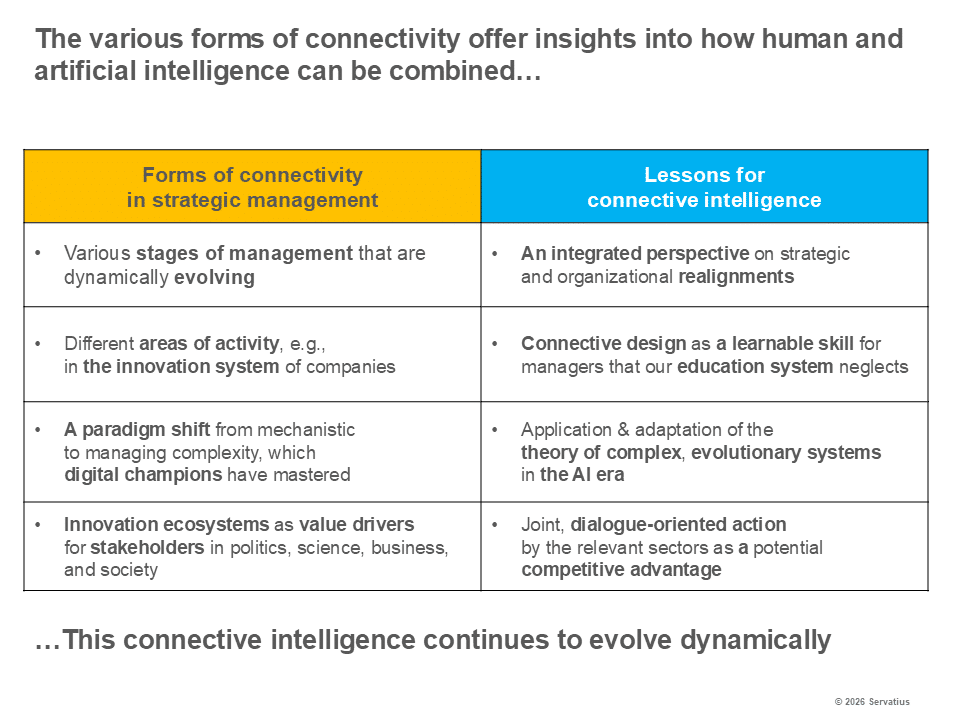
In response to new challenges facing companies, strategic management has gone through various stages over the past decades, which continue to evolve dynamically.4 These stages focus on the following areas:

  • Market and financial orientation (Strategy 1.0)
  • technology and innovation orientation (Strategy 2.0)
  • sustainability orientation (Strategy 3.0) and
  • resilience orientation, including necessary restructuring (Strategy 4.0).

In the current fifth stage of connective strategic management, the difficulty lies in the complexity of the challenges. Many companies must navigate strategic and organizational realignments while becoming more resilient, digital, and sustainable.5 The lesson for an emerging connective intelligence is that this requires an integrated perspective. Companies that possess such a perspective have significant advantages over others.

An effective corporate innovation system consists of various interconnected areas of activity. These areas—such as research, innovation marketing, and a culture that fosters innovation—require specific competencies. Successful innovation managers possess the ability to design connections.6 The lesson for connective intelligence is that this ability can be learned, yet it is neglected in our education system, which is oriented toward distinct disciplines. This leads to the recommendation that management theory and research be oriented more toward a transdisciplinary and design-oriented approach.7

In strategic management, there has been a paradigm shift from mechanistic to one that manages complexity.8 Digital champions recognized the potential of the theory of complex, evolutionary systems early on and applied it in management.9 Startups have thus become the most valuable companies in the world. The implication for connective intelligence is to learn from the positive experiences of these companies and to adapt the newer complexity theory to the AI era. This, too, requires design-oriented management research in real-world laboratories of change.

Perhaps the greatest challenge is improving cooperation among stakeholders from politics, academia, business, and society—for example, in the context of digital change. In recent decades, global competition among innovation ecosystems has intensified. These have become key value drivers for companies and regions.10 Germany has rested on the laurels of past successes for too long and must now catch up. The lesson for connective intelligence is that the relevant sectors must improve their ability to act jointly and in a dialogue-oriented manner in order to achieve competitive advantages.11 The following figure summarizes these forms of connectivity and lessons for connective intelligence.
Lernprozess Innovationsstrategie

For some time now, research has been exploring what approaches to connective intelligence might look like. The term, coined by Derrick de Kerckhove, initially focused on interaction with the Internet.12

In projects on connective strategic management, we have found that people with contextual and relationship-oriented intelligence are key. These skills can be developed.13 They also play an important role when working with AI. Both upskilling and deskilling are possible in this context.


Upskilling and Deskilling Through AI

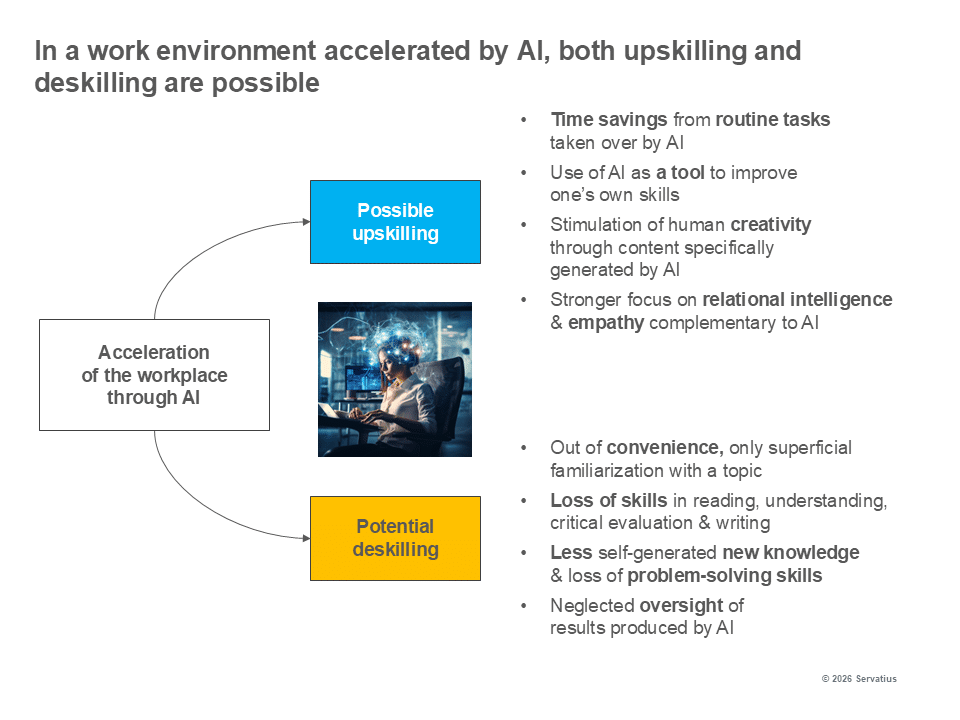
In a work environment accelerated by AI, there is an expansion of employees’ skills (upskilling) but also a reduction (deskilling). Therefore, it is crucial to promote upskilling and limit deskilling.
Lernprozess Innovationsstrategie

The aspects of upskilling mentioned in many case studies are:

  • Time savings from routine tasks taken over by AI
  • Using AI as a tool to improve one’s own skills
  • stimulation of human creativity through content specifically generated by AI, as well as
  • a stronger focus on relational intelligence and empathy, which are used in a complementary manner to AI.

Potential deskilling is not addressed as extensively. Causes for this may include:

  • A superficial understanding of a topic driven by convenience (offloading)
  • Loss of skills in tasks taken over by AI, e.g., reading, understanding, critical evaluation, and writing
  • a decline in self-generated new knowledge coupled with a loss of problem-solving skills, as well as
  • neglected oversight of the results produced by AI.

Research on connective intelligence—which seeks to answer the question of what the best connections between human and artificial intelligence are depending on the situation—is still in a relatively early phase.


Approaches to Connective Intelligence

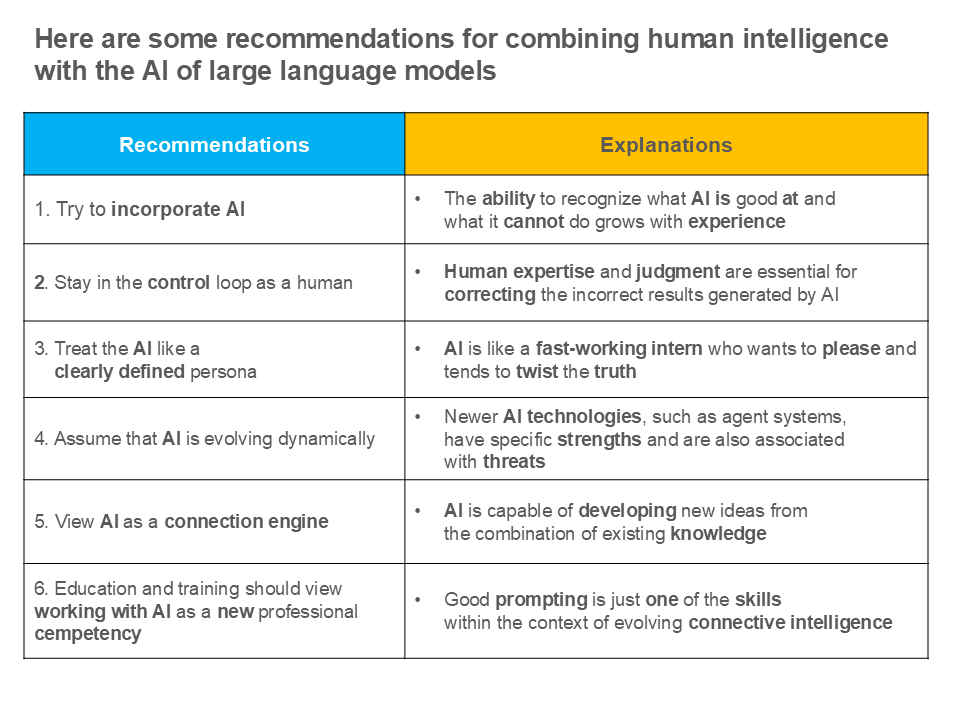
Ethan Mollick, an innovation researcher teaching at the Wharton School in Philadelphia, offers several recommendations for connecting human and artificial intelligence.
Lernprozess Innovationsstrategie
  1. Try to incorporate AI. In doing so, it is important to recognize what AI is good at and what it is not. This ability grows with experience
  2. Stay in the control loop as a human. Human expertise and judgment are essential for correcting the incorrect results generated by AI
  3. Treat the AI as a clearly defined persona representing a specific type. In this context, the AI is like a fast-working intern who wants to please and tends to twist the truth
  4. Assume that AI is evolving dynamically. Newer AI technologies, such as agent systems, have specific strengths but also pose threats
  5. View AI as a connection engine. In this way, AI is capable of developing new ideas from the combination of existing knowledge
  6. Education and training should view working with AI as a new professional competency. In this context, good prompting is just one of the skills within the framework of evolving connective intelligence.14

These approaches to enhanced intelligence give rise to specific performance patterns in the AI era.


Performance Patterns in the AI Era

In recent decades, a wealth of leadership theories has emerged, the practical relevance of which is highly dependent on time and context. Of particular importance for human-resource management within the framework of connective strategic management is the concept of connective leadership. Its recommendation for highly competitive and power-oriented managers is to expand their own leadership styles and behavioral preferences.15 However, the topic of artificial intelligence does not feature in this concept.

The development of AI technologies has proceeded in waves. There have been repeated phases of disillusionment, such as currently with generative AI using large language models.16 In most cases, the answer to the question of which next wave of AI (NextAI) will be successful is marked by great uncertainty.

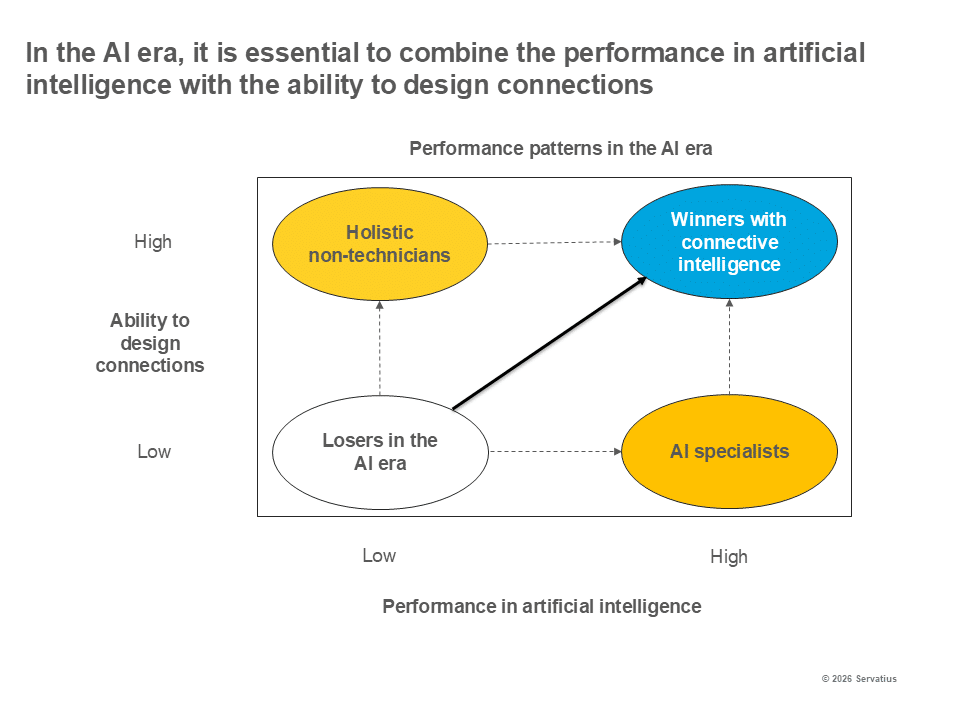
In the AI era, it is therefore crucial to link the dynamically evolving performance in artificial intelligence with the ability to design connections. A conceptual foundation for this is the design of trustworthy high-performance systems.17 Depending on the characteristics of the two dimensions mentioned, the following performance patterns emerge:

  • Losers in the AI era
  • holistic non-technicians
  • AI specialists and
  • winners with connective intelligence.

It can be assumed that both holistic non-technicians and AI specialists should further develop their mindset.
Lernprozess Innovationsstrategie

The disadvantage of holistic non-technicians is that, while they possess strong skills in integrative design, they are unable to leverage the new opportunities offered by AI or work with AI technologies that are not very powerful. AI specialists lack the integrated perspective required to understand the complex interrelationships of an AI application and its potential consequences. Therefore, in the AI era, leaders must train their connective intelligence. In our research and teaching accompanying projects, we examine the success factors of these winning types. The looming disruption of management education is serious.18


The Significance of Strategy 5.0 for Management Education

I asked AI what the significance of Strategy 5.0 is for management education. The answer summarizes some of my recent publications and highlights the following points:

  1. Expansion of the competency profile of executives and employees
  2. Integration of new technologies with AI as a partner
  3. Change of teaching methods and research approaches, as well as
  4. Focus on the intersection of digitalization, sustainability, and resilience.

I find this result surprisingly good because it not only identifies important aspects but also demonstrates a certain creativity.

You can continue the question-and-answer game for as long as you like, receiving a wealth of in-depth information and examples from the AI. Of course, you can also “activate” your own intelligence and explore the implications for existing management education.

In my view, many bachelor’s and master’s programs in business administration (BA) have the following weaknesses:

  1. Business administration is understood as an unconnected collection of functional business disciplines (e.g., marketing) and interdisciplinary fields (e.g., innovation)
  2. Entrepreneurship and venture capital are not required courses
  3. The curriculum neglects the fundamentals and applications of artificial intelligence in practical exercises
  4. Strategy courses—if offered at all—are typically introduced relatively late and address the initial stage of market- and finance-oriented strategic management (Strategy 1.0) in a more or less uncritical manner
  5. Universities do not, at least not in depth, teach the fundamentals of the theory of complex, evolutionary systems and their relevance, e.g., for agile project management
  6. When research approaches are taught, empiricism dominates, while design-oriented research is “uncharted territory” for many business administration professors.

One possible way to reorient the “Introduction to Business Administration” course would be to place connective strategic management at the beginning of a degree program and, using practical examples, provide an overall picture of the challenges. Since all students now work with AI in one form or another, they can contribute their own important experiences to practical exercises on the topic of connective intelligence. We have been pursuing this approach for several years in bachelor’s and master’s programs, in executive education, and in the supervision of theses.

Given the speed at which the world of work is changing due to AI, it is not surprising that the topics of Strategy 5.0 and connective intelligence are also evolving rapidly. This opens up new opportunities for the German education system. However, education providers who cling to outdated models run the risk of being left behind. The same fate threatens organizations that neglect continuing education.


Challenges in Continuing Education and Leadership Development

Figures from the McKinsey HR Monitor show that German companies have cut their budgets for employee continuing education by 30 percent over the past two years. This places Germany at the bottom of the list in a European comparison. In the AI era, attempts to cut costs in the short term undermine competitiveness in the medium term, as employees need to acquire new skills. Furthermore, many companies face the challenge of choosing the right approach given a complex continuing education system. As a result, learning processes—for example, on AI topics—often take place not in traditional seminars but informally within the context of projects. This underscores the importance of customized training tailored to the specific situation, which, for instance, sharpens critical judgment in the application of AI while using AI as a tool.19

The growing importance of artificial intelligence is also changing the demands placed on executives. Above all, companies are looking for individuals who have experience with concrete AI projects and can demonstrate that they have successfully navigated the changes associated with these new technologies. Since the AI-based realignment of a company is a complex yet highly specific task that is also constantly evolving, it is essential to continually adapt and develop the skills acquired to the specific situation at hand. This requires a growth mindset with a passion for lifelong learning. Such a mindset supports both the use of AI as a tool for strategic management20 and the improvement of process-oriented AI to increase productivity.21

In leading companies, new AI-based roles and job profiles have emerged that open up excellent career opportunities. These include the AI Realignment Officer, the AI Solutions Architect, and the Forward Deployment Engineer. An AI Realignment Officer designs the AI-based strategic, operational, organizational, and cultural realignment of organizations. Job postings still use the outdated term “Transformation Officer,” even though the focus is not on a one-time transformation but on numerous, rapid adaptations to or anticipations of new developments. The AI Solution Architect also plays a key role. As an AI architect, their task is to determine which AI applications and processes take priority based on an AI strategy, what the required IT architecture looks like, and how to successfully integrate the relevant data. This requires many Forward Deployment Engineers who understand the complex problems of internal and external customers and develop tailor-made solutions “from the ground up” through iterative processes. A shared core competency of these “bridge-building roles” is the ability to design solutions that connect.


Conclusion

  • AI agents learn from the experiential knowledge of engineers. This presents an opportunity for European industry if it succeeds in connecting human and artificial intelligence
  • Lessons in this regard emerge from the various forms of connectivity within the framework of the fifth stage of development of a connecting strategic management
  • Research that combines human and artificial intelligence is still in its infancy
  • This has important implications for gaining a competitive edge in the AI era, where the key lies in combining the capabilities of artificial intelligence with the ability to foster cooperation
  • This requires new approaches to executive education and development.


References

[1] Wittenbrink, J., “Sparring Partner for the Factory.” In: Handelsblatt, April 20, 2026, pp. 26–27

[2] Höpner, A., Siemens Introduces First AI Agent for Engineers. In: Handelsblatt, April 21, 2026, pp. 26–27

[3] Merten, M., Bomke, L., Man vs. Machine – How Bosses Help Their Employees Overcome Their Fear of AI. In: Handelsblatt, April 10, 11, and 12, 2026, pp. 54–55

[4] Servatius, H.G., Development and Transformation of Strategic Management. In: Competivation Blog, September 19, 2025

[5] Servatius, H.G., Triple Strategic Realignment. In: Competivation Blog, June 7, 2024

[6] Servatius, H.G., Designing and Empowering Innovation Systems. In: Competivation Blog, February 22, 2018

[7] Servatius, H.G., Creative Innovation Research on AI Applications. In: Competivation Blog, March 25, 2026

[8] Servatius, H.G., Learning from Successful Digital Companies. In: Competivation Blog, July 12, 2024

[9] Servatius, H.G., Learning to Design Solutions for Complex Management Problems. In: Competivation Blog, July 15, 2025

[10] Servatius, H.G., Designing Innovative Stakeholder Ecosystems. In: Competivation Blog, January 10, 2023

[11] Servatius, H.G., Management Education 5.0: Toward Dialogue-Based Action. In: Competivation Blog, January 13, 2024

[12] de Kerckhove, D., Connected Intelligence – The Arrival of the Web Society,
GB Gardners Books 1998

[13] Servatius, H.G., Strategic Leadership with Contextual and Relationship-Oriented Intelligence. In: Competivation Blog, March 14, 2023

[14] Mollick, E., Co-Intelligence – Living and Working with AI, Portfolio 2024

[15] Servatius, H.G., Human Resource Management in the Age of Connective Management. In: Competivation Blog, January 19, 2021

[16] Servatius, H.G., Development of AI Technologies. In: Competivation Blog, February 19, 2025

[17] Servatius, H.G., Designing Trustworthy High-Performance Systems. In: Competivation Blog, January 29, 2026

[18] Servatius, H.G., Disruption of Management Education for AI-Based Realignments. In: Competivation Blog, October 10, 2025

[19] Merten, M., Budgets for Continuing Education Cut by 30 Percent. In: Handelsblatt, May 13, 2026, p. 30

[20] Servatius, H.G., AI as a Tool for Strategic Management. In: Competivation Blog, May 1, 2025

[21] Servatius, H.G., Process-Oriented AI for Increased Productivity. In: Competivation Blog, March 12, 2025

[22] Obmann, C., Schimroszik, N., These new roles come with six-figure salaries. In: Handelsblatt, May 19, 2026, pp. 32–33

Design-oriented innovation research on AI applications

Design-oriented innovation research on AI applications

Around the world, many companies face the challenge of keeping pace with artificial intelligence (AI) and gaining a competitive edge through AI tools that leverage their specific expertise. This development is leading to a renaissance in design-oriented management and innovation research, which aims to bridge the gap between theory and practice. In the process, research is shifting from empirical work at universities to connective design in real-world laboratories of change.


In this blog post, I outline the development of the design-oriented research approach, highlight its advantages, and explain a general procedural concept.


A decisive year for AI adoption

2026 could be the year that determines for many companies whether they achieve a breakthrough in AI adoption or remain stuck with isolated pilot projects. According to an analysis by the market research firm Forrester, only 15 percent of decision-makers report that the use of AI has so far made a measurable contribution to their companies’ operating results. This could lead them to postpone about a quarter of their planned AI spending until 2027. However, the danger of being too hesitant in adopting AI is that it creates a gap that is difficult to close.1

On the other hand, pioneering companies are succeeding in achieving significant competitive advantages with AI tailored to their specific situations. These pioneers practice design-oriented management and innovation research to lay the groundwork for success. One example is Siemens, which aims to develop the world’s largest and broadest range of industrial AI applications and double its enterprise value.2

The German Economic Research Institute (IW) forecasts that the potential for increasing gross value added through the use of AI in Germany by 2034 stands at 440 billion euros. Of this, 110 billion euros is attributable to potential innovations and 330 billion euros to increased productivity. For Germany as an industrial hub, the application of AI in particular presents an opportunity. Google, a subsidiary of the U.S. technology conglomerate Alphabet, has also recognized this. It plans to invest 5.5 billion euros in Germany and open a center for AI applications in Berlin, where its own researchers will also be based.3

This new situation has exciting implications for the design of AI ecosystems.


Designing AI ecosystems

The opportunity for established companies lies in knowledge-specific AI, where AI tools leverage and amplify the companies’ specialized expertise.4 This is most effectively achieved within AI ecosystems.

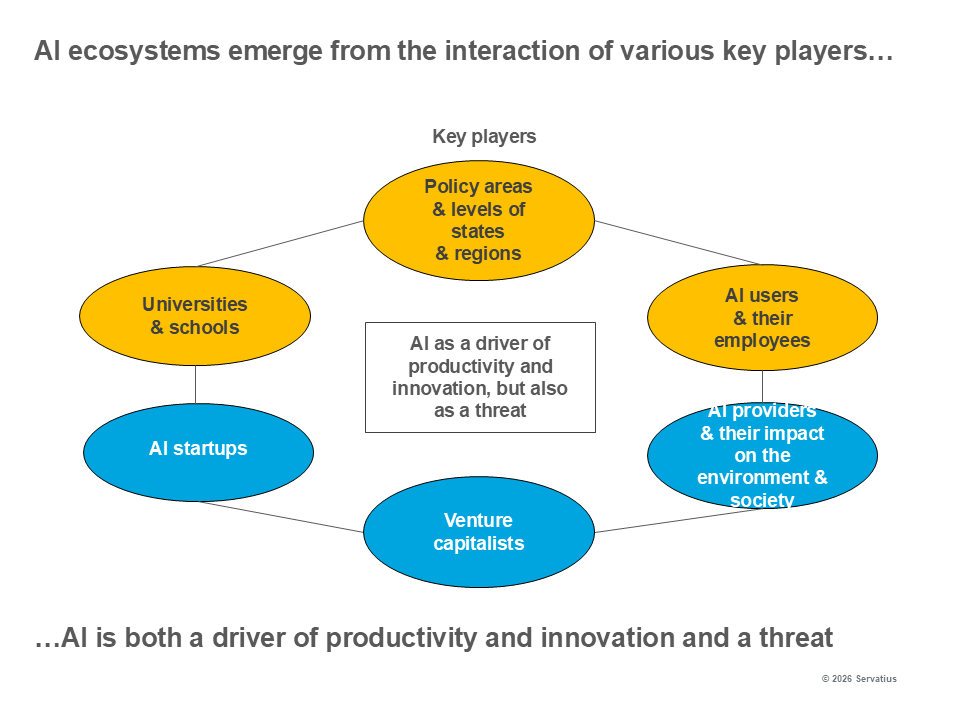
The term “AI ecosystem” refers to a dynamic network with strong connections between various actors who use AI technologies to create and disseminate innovations. AI ecosystems can be concentrated in a single region and have developed around a central hub, such as a university or a company. The world’s best-known and most influential AI ecosystem emerged in Silicon Valley in the San Francisco Bay Area. Stanford University near Palo Alto formed the core of Silicon Valley in the 1930s. In 1939, Bill Hewlett and David Packard founded the company HP there in a garage. Later, leading semiconductor companies – which gave the valley its name – and some of the major AI providers established themselves here.

Stanford University served as a model for Helmut Schöneberger, the head of the Munich-based startup incubator UnternehmerTUM. Crucial to its success were the collaboration with the Technical University of Munich and the support of BMW shareholder Susanne Klatten. In addition, other startup incubators have emerged in Munich, such as the Center for Digital Technology and Management (CDTM), which offers the transdisciplinary master’s program in Technology Management, works closely with industry partners, and has spawned over 250 startups.

By 2025, startups in Munich had received 3.3 billion euros in venture capital, thereby pushing Berlin into second place in this category, where startups raised 2.7 billion euros. However, AI ecosystems with successful startups have also emerged in other German regions.

Key players in AI ecosystems include:

  • Decision-makers in relevant policy areas and at various levels of state and regional government
  • Universities and schools
  • AI startups that originated as spin-offs or have established themselves in a region
  • Venture capitalists who use venture capital to finance the growth of AI startups
  • Major providers of AI hardware and software that shape financial markets with their financial clout and have a significant impact on the environment and society, as well as
  • established companies and their employees, who use AI, collaborate with startups, and invest in them.

Pharmaceutical research provides an interesting example of new opportunities for collaboration between established companies and startups.

Lernprozess Innovationsstrategie

In the pharmaceutical industry, tech-bio companies, such as the French startup Owkin, are accelerating early-stage drug discovery with the help of AI. A first wave of drugs developed in this way is currently in clinical trials. One possible form of collaboration is for AI biotechs to take on early-stage drug discovery and for established pharmaceutical companies to handle the later phases and commercialization. Another option is for pharmaceutical companies to acquire AI startups and build up their own relevant capabilities. In any case, this research-intensive industry is facing a fundamental change, in which the design of AI ecosystems is a key success factor.5 This example illustrates that as industries evolve, management research changes as well.

However, artificial intelligence is not only a driver of productivity and innovation but also poses a potential threat. In light of geopolitical shifts, it is crucial for Europe to regain its ability to shape the future. A trustworthy AI can be an important means to this end. The recent dispute between the U.S. government and the U.S. startup Anthropic illustrates just how political the design of AI ecosystems has become.6 This, too, is leading to significant changes in management research.

An important aspect that is often overlooked in AI ecosystems is the environmental and social impact of AI technologies. For instance, large language models require the work of crawlers that collect data and annotators who comment on, evaluate, and label texts and images. This work often takes place out of the public eye, frequently in countries of the “Global South.” Transparency in these supply chains is low.7


Management research in real-world laboratories of change

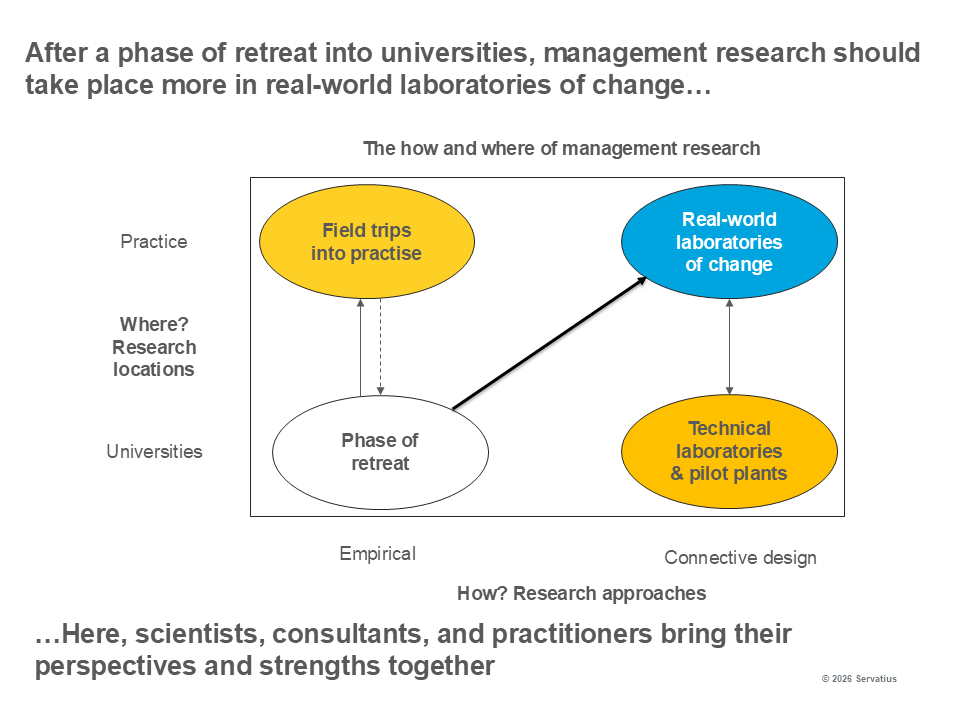
Empirical approaches, predominantly originating from universities, have long dominated business research. The authors publish the results of their work in academic journals, which practitioners rarely read. Critics of this retreat into an “academic ivory tower” argue that the practical relevance of research has diminished. This criticism is not new, but it has grown stronger.8

Universities defend their position by arguing that the practical relevance of empirical research is based on “field trips” in which the perspectives of relevant actors are analyzed. However, the goal of such work is generally not to design concrete objects – such as new AI-based business models –within their specific context.9

In this respect, business research differs from the design-oriented approach of engineering sciences, which takes place predominantly in laboratories and pilot plants.

Due to the growing importance of inter- or transdisciplinary research, the proportion of connective design is also increasing in management science. This practice- and design-oriented research is increasingly taking place in real-world laboratories of change.10 A key driver of this development is artificial intelligence, which acts as a catalyst for the founding of startups and the realignment of established companies. We believe that, following a phase of retreat into universities, management research should once again take place more strongly in practice and utilize design-oriented approaches.

Lernprozess Innovationsstrategie

This response to the questions of how and where research approaches should be conducted marks the beginning of a new chapter in the history of management research. A key feature of this reorientation toward connective design is research in which scientists, consultants, and practitioners bring their diverse perspectives and strengths together. The benefit lies in better solutions to complex problems based on new scientific insights.11

The development of humanoid robots provides an example. In this rapidly growing market, companies have the best chances when they combine software and hardware expertise. Data from the real world is the biggest bottleneck here. The Metzingen-based manufacturer Neura Robotics has therefore decided to build training facilities for robots. One of the first of these “gyms” is being developed in collaboration with the Technical University of Munich at the Munich Institute of Robotics and Machine Intelligence (MIRMI) at Munich Airport. In international competition with companies from the U.S. and China, rapid scaling is crucial for this AI application.12

Since design-oriented management research is less widespread, I would like to briefly outline its history. Personally, over the past few decades, I have repeatedly observed how different the thought and language patterns of the relevant actors are in theory and practice.


Principles and pioneers of creative management research

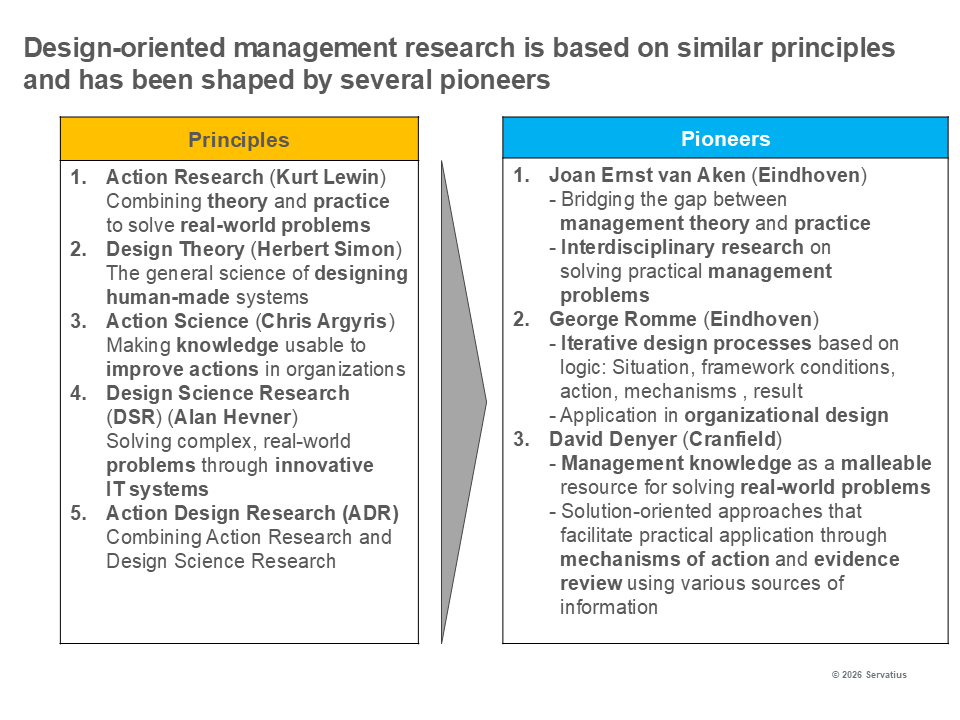
Design-oriented management research is based on similar principles and has been shaped by several pioneers.13 These principles are:

  1. Action research, pioneered by social psychologist Kurt Lewin. Lewin advocated for a connection between theory and practice to solve real-world problems.
  2. General design theory, as defined by Nobel Prize-winning economist Herbert Simon.14 Simon defines this as the science of designing human-made artifacts and systems.
  3. Action Science, conceived by Harvard professor Chris Argyris.15 Argyris’s primary goal is to make knowledge usable in order to improve actions within organizations.
  4. The Design Science Research (DSR) approach developed by Alan Hevner at the University of South Florida.16 This concept, which is particularly widespread in business informatics, focuses on solving complex, real-world problems through innovative IT systems.
  5. Action Design Research (ADR), described by various scholars, which combines Action Research and Design Science Research.
Lernprozess Innovationsstrategie

Pioneers of design-oriented management research include Joan Ernst van Aken and Georges Romme, who teach at Eindhoven University, as well as David Denyer from Cranfield University in the UK. Van Aken aims to bridge the gap between management theory and practice. The focus is on transdisciplinary research to solve practical management problems. Building on design theory, Romme tests iterative processes in organizational design.17  Denyer views management knowledge as a malleable resource for solving real-world problems. His solution-oriented approach seeks to ensure practical application through mechanisms of action and evidence-based verification using various information sources.

The advantages of a design-oriented approach are particularly evident in innovation and sustainability research.


Advantages in innovation and sustainability research

When applying AI, the advantages of a design-oriented approach to innovation and sustainability research unfold most notably in companies that practice this approach in self-similar Strategy 5.0 labs. The goal of such a real-world lab is to connect the various fields of action for AI applications.18 It is helpful if the countercurrent principle – combining a top-down AI strategy with a bottom-up, harmoniously diverse range of AI applications – is effectively implemented.

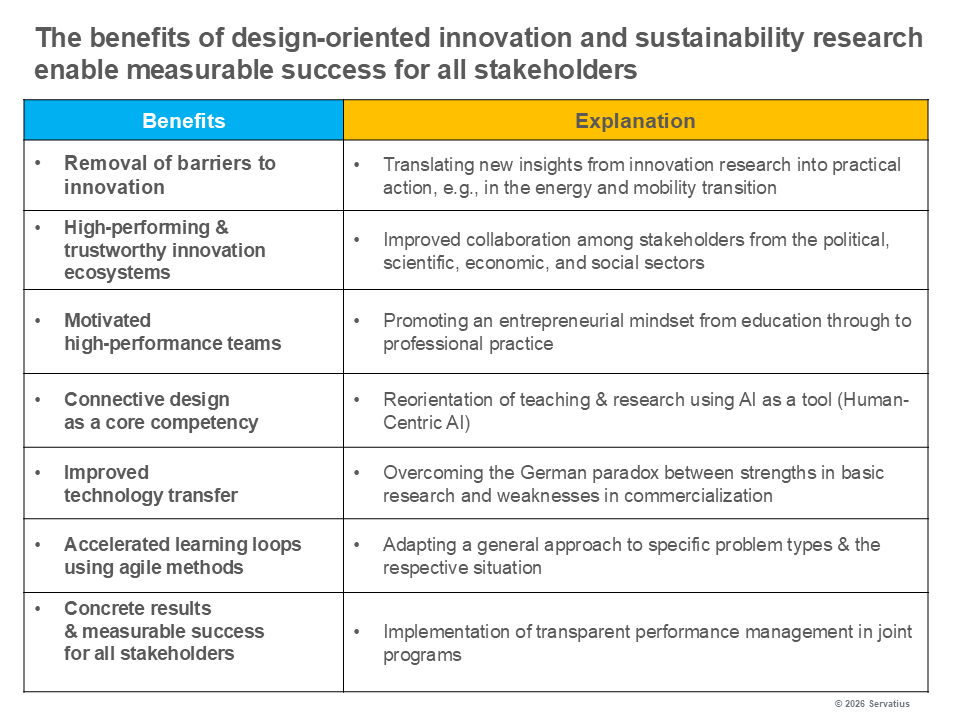
Based on our experience from a series of projects, the following benefits are of particular importance:

  • The removal of barriers to innovation
  • high-performing and trustworthy innovation ecosystems
  • motivated high-performance teams
  • connective design as a core competency
  • improved technology transfer
  • accelerated learning loops using agile methods, as well as
  • concrete results and measurable success for all stakeholders.

These advantages enable a realignment of innovation systems.

Lernprozess Innovationsstrategie

The shortcomings in Germany’s energy and mobility transition are an example of how important it is to remove barriers to innovation.19 The aim here is to translate new insights from innovation research into practical action.

The goal is to design high-performing and trustworthy innovation ecosystems.20 A hallmark of these systems is improved collaboration among stakeholders from the political, scientific, economic, and social sectors.

Motivated high-performance teams play a key role in shaping innovation research.21 Leaders have the task of exemplifying and fostering an entrepreneurial mindset. This begins with education and continues throughout one’s professional career.

A core competency to be developed in this context is connective design.22 This requires a reorientation of teaching and research using AI as a tool. Such human-centric AI permeates all disciplines.

A positive side effect is improved technology transfer.23 The goal here is to overcome the German paradox between strengths in basic research and weaknesses in commercialization.

One way to achieve this is through accelerated learning loops within organizations.24 Agile methods are used for this purpose. It is important to adapt a general approach to specific types of problems and the situation at hand.

In doing so, all stakeholders should focus on concrete results and measurable successes.25 In joint programs, this is achieved through transparent performance management.

In the following, I would like to explain a suitable approach.


Steps of a general procedural concept

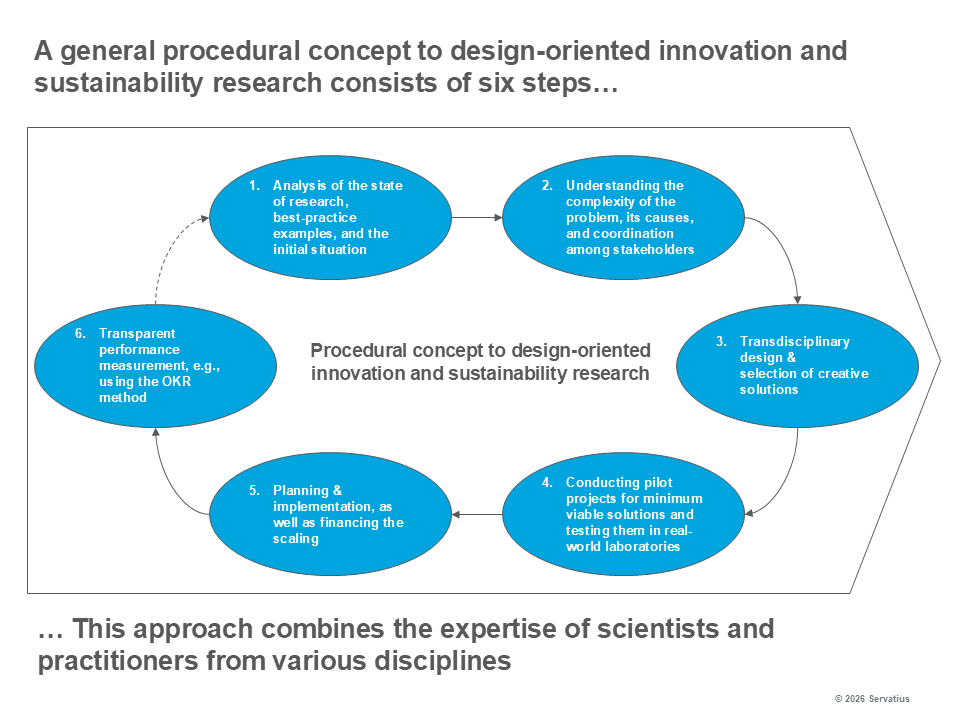
An example of design-oriented innovation and sustainability research is the AI-based strategic and organizational realignment of a company.26 For topics such as this, a general procedural concept consisting of the six steps shown in the figure has proven effective.

Lernprozess Innovationsstrategie

The first step is an analysis of the state of research, best-practice examples, and the specific initial situation. The task here is to combine an internal and an external perspective in an audit.

It is then crucial to develop a comprehensive understanding of the problem’s complexity, to identify its causes, and to coordinate efforts among the relevant stakeholders. Collaboration between various disciplines and practitioners is more successful than disciplinary research approaches.

Transdisciplinary teams also play a key role in the subsequent design and selection of creative solutions. What may be uncharted territory for a single organization can, when taken as a whole, contribute significantly to scientific progress.

A defining characteristic of design-oriented innovation research is the implementation of pilot projects for Minimum Viable Solutions (MVS). These pilots are tested in real-world laboratories of change. For established companies, working in learning loops often requires a shift in mindset. Human resources development can support this effort.

The fifth step is planning and executing the implementation. This is closely linked to financing the scaling process. German startups have long complained of disadvantages, for example, compared to the U.S. Therefore, an improvement in the political framework conditions should be sought, particularly in this step.

In parallel, transparent performance measurement takes place, for example, using the Objectives and Key Results (OKR) method. In this context, “transparent” means that performance management does not occur in sectoral silos. For a policy that sets goals but neglects to measure success, this involves a learning process aimed at joint system design by innovation managers.


Innovation managers design complex, evolutionary systems

As early as in our 2014 book publication “The Innovation Manager,” we concluded that a central task of innovation managers lies in the design of innovation systems and the connection of various fields of action.27 Subsequently, we engaged intensively with the behavioral economic perspective of such connective design.28

The scientific foundation for connective design is the theory of complex, evolutionary systems. The application of this approach to socio-technical systems has triggered a paradigm shift in strategic management.29 U.S. digital companies have mastered this new management paradigm better than the European economy.30

Another insight is that innovation research is a transdisciplinary design task.


Interdisciplinary or transdisciplinary?

We deliberately use the term transdisciplinary to make it clear that, unlike the term interdisciplinary, it is not merely about mediating between scientific disciplines, but also about involving non-scientific actors and establishing a connection between theory and practical design.31 The particular complexity of transdisciplinary innovation research stems from

  • the heterogeneity of the disciplines, which ranges from natural science and technical research through various policy fields to management science and organizational psychology
  • the diverse interests and thought patterns, e.g., of scientists and practitioners
  • the dynamics of development and the number of levels, from geopolitics down to the individual, as well as
  • the different roles of the actors, e.g., as neutral observers or personally affected individuals.

Unfortunately, transdisciplinary innovation research has so far lacked recognition in universities. The reasons for this are manifold. One important reason is likely that the traditional academic and publication system tends to reward disciplinary excellence. This presents an opportunity for applied research.


Transdisciplinary research on sustainability innovations

Our book, published in 1994, on the “ecological reorientation” of automotive companies emerged from consulting projects and accompanying research at the University of Stuttgart.32 This research was transdisciplinary, but had only a limited impact because German companies and policymakers at the time did not implement our recommendations – for example, regarding new propulsion systems.

Thirty years later, this industry – so vital to the German economy – is grappling with serious problems. VW, the world’s second-largest automaker by vehicle sales, is undergoing a process of strategic and organizational realignment.33 At the same time, the geopolitical landscape is marked by extreme uncertainty.

This example illustrates that, when it comes to sustainability innovation, transdisciplinary and design-oriented research is of crucial importance for securing our country’s prosperity. 34 In recent years, the field has evolved dynamically. The intersection of environmental technology and artificial intelligence has moved to the center of attention. New market leaders can emerge from collaborations between established companies and digital greentech startups if European policymakers succeed in improving the framework conditions.35

One example is the German-Luxembourgish startup R3 Robotics, which has developed an AI-powered robotics platform for battery recycling. In this way, Europe can reduce its dependence on imports and increase the sustainability of batteries.36

In my personal experience, students remain very interested in such topics because they recognize the resulting career opportunities. This provides important impetus for our expert network.


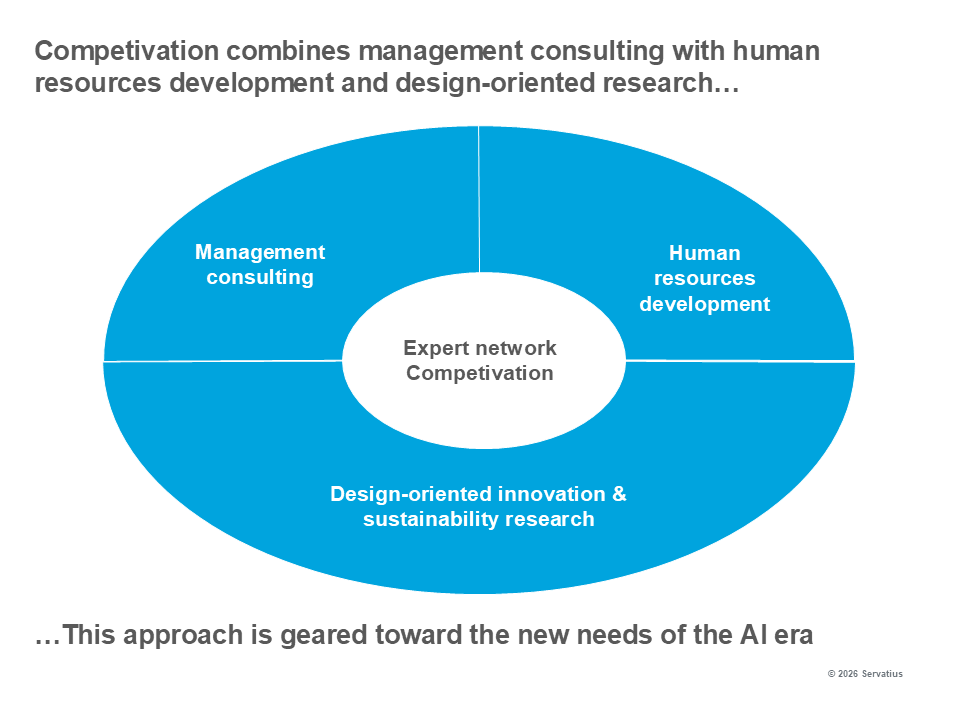
Combining management consulting and human resources development with design-oriented innovation and sustainability research

Our expert network Competivation has long combined management consulting and human resources development. The advantage for clients is a better value for money than with traditional consultants, as the focus is on the qualifications of the employees who are actively involved in the projects.

For several years now, we have been supplementing this service with design-oriented innovation and sustainability research. In doing so, we supervise the theses of dual-track students and external doctoral candidates who are working on relevant projects within the client organization. The advantage here is that the research is tailored to the specific situation of the company. The researchers and their companies benefit from the extensive experience of our experts.

Lernprozess Innovationsstrategie

With this approach, Competivation has created a unique international selling point geared toward the needs of the AI era.

Design-oriented research also has far-reaching implications for university teaching. We see ourselves as an innovative educational provider that teaches the ability to a of AI-supported connective design of solutions for complex management problems.37


Conclusion

  • When applying AI, many companies face the challenge of defending their position and gaining competitive advantages through a specific approach
  • In this context, the design of AI ecosystems is crucial
  • Parallel to this development, research approaches and locations are shifting toward design-oriented innovation research in real-world laboratories of change
  • In this context, design-oriented management and innovation research is experiencing a renaissance stemming from a number of advantages
  • In this transdisciplinary research approach, a six-step procedure has proven effective, which is adapted to the respective problem type and situation.

Interessiert?

CONNECTIVE MANAGEMENT

Vereinbaren Sie einen unverbindlichen Gesprächstermin:


    +49 (0)211 454 3731